

Top Tag

Bolsonaro Is Betting His Presidency on Trump

During his visit to the United States Monday and Tuesday, Jair Bolsonaro, the right-wing extremist sworn in as Brazil’s president in January, appeared visibly giddy at the prospect of meeting Donald Trump, gamely playing the amiable ally. While Bolsonaro represents a distinctly Brazilian and deeply militaristic strain of authoritarianism, he has expressed admiration for Trump’s combativeness and disregard for political correctness, revealing that he had been “rooting for” Trump in 2016. But Bolsonaro was not only excited to meet Trump because the two men have much in common—a tendency to invent wild attacks against opponents while denouncing the media as fake news and inciting violence against minorities, for example—but also because he believes this seeming alignment of personalities will yield positive results for Brazil.

President Trump so far has given him every indication that this is a winning strategy. During a joint press conference on Tuesday, Trump said he would support Brazil joining the Organization for Economic Co-operation and Development (OECD) and possibly even the North Atlantic Treaty Organization (NATO), both exclusive clubs reserved for some of the wealthiest and most influential countries in the world. Membership for Brazil would reflect the kind of international recognition the country so craves. Matias Spektor, a professor of international relations at Brazilian university Fundação Getúlio Vargas who has been critical of Bolsonaro, called this “the largest concession package given by a U.S. president to a Brazilian counterpart in the last thirty years.” Brazilian papers later reported Trump felt such a kinship with Bolsonaro that he gave the Brazilian president his personal phone number so that he could “call whenever he wants.”

The Trump administration’s aims in pursuing such a close partnership—aside from President Trump’s well-documented love of flattery—are relatively clear. Although Brazil has declared it will not support an invasion of its collapsing neighbor, Venezuela, Trump wants Brazil to continue doing all it can to keep the pressure on Maduro. The United States will also likely push Bolsonaro to make it harder for Russia and China to exert the kind of pressure they have increasingly brought to bear in Latin America in recent years. Putin has lent crucial support for the Maduro regime while China has become a major trading partner and investor in infrastructure across Latin America, meaning that Brazil must articulate a clear policy in relation to these countries, both of which represent perhaps the greatest geopolitical challenges for the United States in the short and long term. And Trump’s willingness to even entertain the idea of Brazil joining NATO as anything other than a major non-member ally suggests an aggressive attempt to wrest Brazil away from the so-called BRICS—the association composed of Brazil, Russia, India, China, and South Africa—for good.

With almost any other American president, one would also expect some sort of human rights pressure to be put on Bolsonaro, who has issued several orders targeting minority groups since he took office, has made a variety of sexist and racist remarks, spoken approvingly of the brutal military dictatorship that ruled Brazil from 1964-1985, and insinuated that opponents should be met with violence. Instead, Trump’s and Bolsonaro’s joint press conference featured Bolsonaro declaring, via translator, that “Brazil and the United States stand side by side in their efforts to ensure liberties and respect to traditional family lifestyles, respect to God our creator, and stand against gender ideologies and politically incorrect attitudes and against fake news.”


Back in Brazil, there are some concerns that Bolsonaro is confusing fleeting ideological affinities with strategic geopolitical realignment. He was widely pilloried in the Brazilian press, for example, for visiting CIA headquarters, a step no Brazilian president has ever taken—for good reason, considering the CIA’s role in Latin America since the 1950s. And Bolsonaro seemed blithely unconcerned by the fact that political winds in the United States might shift next year. During a joint press conference on Tuesday, Bolsonaro was asked how he would react if a self-avowed socialist were to beat Trump in the 2020 presidential election. “Well, it’s an internal matter. We will respect whatever the ballots tell us in 2020, but I do fully believe Donald Trump is going to be reelected.”

While Trump has begun to ratchet up his rhetorical attacks on socialism in response to its rising appeal among younger voters and within the Democratic party, Bolsonaro has been railing against it for years, proclaiming that the mild center-leftism of the Workers’ Party that governed Brazil for thirteen years was leading the country to an authoritarian abyss. “Every day,” he declared at the White House on Tuesday, “more and more people that are prone to socialism, and even communism, slowly are going to be opening their minds to the reality. And you can see the border with Venezuela and Brazil was recently closed—not for Brazilians, which are pro-socialism, to go into Venezuela, but the other way around, so that Venezuelans who support democracy wouldn’t go into Brazil. This feeling most certainly is going to be very much seen when 2020 comes.” Through Bolsonaro’s fanciful assessments of the political landscape in Brazil, which he argues is largely controlled by nefarious “cultural Marxists” despite the fact that he handily won a national election on a campaign defined by homophobia, belligerence, and racism, a strategy begins to emerge: Bolsonaro is betting the rest of his presidency on a continued partnership with Trump.

This gamble is due primarily to the paranoid conspiratorial worldview both men share. They mostly agree on the problems facing the world and how to solve them. But Bolsonaro may also have little choice but to cling to his U.S. analogue: He has become so internationally reviled so quickly that finding willing partners going forward may prove difficult. Since October of last year, Democrats have urged Secretary of State Mike Pompeo to denounce Bolsonaro’s most egregious statements. In a major foreign policy speech at Johns Hopkins University, Bernie Sanders included Bolsonaro in a global far-right wave of “demagogues who exploit people’s fears, prejudices and grievances to gain and hold on to power.” Sanders has also established close ties with Fernando Haddad, the Workers’ Party candidate Bolsonaro defeated in the 2018 elections. Bolsonaro, in other words, will likely not find a friendly ear should the Democrats win the presidency. While becoming a pariah would obviously not be in Brazil’s best interest, Bolsonaro—along with his foreign minister, as I have argued elsewhere—has shown little willingness to soften his rhetorical edges for foreign audiences.

This is why, rather than adopt a diplomatic approach to the current occupant of the White House, seeing him as a temporary partner, Bolsonaro instead treats Trump as a life jacket. As long as he has an ally in Washington as reactionary and aggressively ignorant as Trump, Bolsonaro will have the latitude to pretend his administration has influence at the highest echelons of global power. If, instead, the tide is turning on Trumpism and the 2020 election results reflect that, Bolsonaro may very well be held accountable abroad for his hyperviolent rhetoric.

Some of Bolsonaro’s critics, particularly those on the left, argue that it doesn’t matter who the U.S. president is—Brazil will always be placed in a junior position and taken advantage of by the world’s hegemonic power. It is true that the United States has never treated Brazil with the respect Brazilians feel they deserve as a large democracy with a diverse population, an appealing and vibrant national culture, and abundant natural resources. But wholeheartedly embracing an American president as erratic as Trump is more risky for Brazil than a balanced posture would be, one that would give Brazilian policymakers room to maneuver should the political situation in Brazil and the world begin to change.

By committing to Trumpism, Bolsonaro has linked his administration’s credibility to a U.S. administration that may or may not be around to accommodate him in two years. In Bolsonaro, Trump has found a lackey eager to do Washington’s bidding in a supposedly shared civilizational crusade against progressive values, aligning the United States with the most ultra-reactionary political forces in Latin America’s largest nation.
Jordan Peele’s “Us” Goes Down the Rabbit Hole of Identity

Jordan Peele loves a rabbit. There is a song that appears in the first scene of Get Out, Peele’s Oscar-winning debut as a movie writer and director, that goes “Run, rabbit, run, rabbit, run! Run! Run!” as Lakeith Stanfield’s character Dre strolls to his doom through a white suburb. It’s an old British song from World War II, and to the modern ear, it rings as nostalgic for a time of jolly tea parties and unchecked white supremacy. Peele proved himself to be a master of genre contrast in Get Out by mixing horror with black satire, and the juxtaposition between “Run, Rabbit, Run” and Childish Gambino’s “Redbone,” whose “stay woke” refrain is another key theme in the movie’s soundtrack, added another layer to the movie’s atmospheric tension.

A rabbit also opens Us, Peele’s follow-up effort. The opening credits play out across a long, lingering close-up of a white rabbit’s eye. It won’t make sense until much later in the movie, when we learn what exactly rabbits have to do with the bloody chaos that is about to be unleashed. For now, though, the rabbit is just a clue—a trembling, vulnerable animal.

Get Out is an extraordinary movie, a great catapulting leap forward in the satirical examination of race in American screen fiction. Possessed of a golden plot—interracial couple visits white liberal parents upstate, who turn out to be enslaving black people—Peele focused on executing it perfectly, tying up all the loose ends and drawing the movie to a satisfying close. In his second outing, however, Peele has given himself a little more room to stretch out and experiment. Having been frustrated by the misinterpretation of Get Out as a comedy, Peele has responded by delivering a movie soaked in blood, terror, and ambiguity.

Us is stranger than Get Out, with deeper philosophical undercurrents flowing through it. The rabbit that greets you at the movie’s start is an invitation. Will you follow, like Alice in her Wonderland? The journey will be at your peril—there’s no telling how deep the rabbit hole goes.


Us is a movie about an American family: Adelaide Wilson (Lupita Nyong’o) is the mom, Gabe Wilson (Winston Duke) is the dad, and they’re vacationing with their kids, teenaged Zora (Shahadi Wright), and her little brother Jason (Evan Alex). After a tantalizing flashback to Adelaide’s childhood in the mid-1980s, we skip to the present day. Adelaide is now a grown woman. She wears a breezy cream linen dress, and the sun is shining over the beach on Santa Cruz.

But Adelaide just can’t get comfortable. Something happened on this beach when she was a child, she tells Gabe: She thinks she saw a little girl who was her double in a funhouse mirror. We saw it, too, in that flashback scene: As in the René Magritte painting Not to Be Reproduced (La reproduction interdite), Adelaide turned to look in the mirror but saw the back of her own head. Is this really another self, or just some hallucination? Gabe is skeptical. “I don’t feel like myself,” Adelaide says. “I think you look like yourself,” Gabe replies.

Are we who we feel ourselves to be? Or are we simply a composite of other people’s perceptions of us? It’s the first of Us’s big questions about identity. A whole slew of new questions soon show up, however, as a mysterious family appears in the Wilsons’ driveway at their vacation home.

There are four figures; two adults, two children. They are all wearing identical red jumpsuits, perfectly cut, like some quartet of Rachel Comey models. They each wear one glove and carry a large pair of dressmaking scissors. They are motionless, until they aren’t. As they break their way into the Wilsons’ home, we realize that they are the family’s doppelgängers, and they are there to kill.

Adelaide was the only one who saw them coming, but her reaction to their arrival is straight denial: “Uh uh. Uh uh. Uh uh,” she repeats, shaking her head. Once inside, the doppelgängers force the Wilsons to sit across from them. They are the Wilsons’ shadows, the double-Adelaide explains. Everything that Adelaide did in her life, the shadow-Adelaide had to act out, too. “When the shadow was hungry she had to eat rabbit, raw,” the double says, referring to herself in the third person. When Adelaide got toys as presents, the shadow-Adelaide received metal that cut her fingers. When Adelaide had a C-section, the shadow-self had to perform the operation on herself.

“Who are you people?” the real Wilsons ask. The answer? “We are Americans.”


There are many ways to interpret the sudden arrival of doppelgängers hell-bent on murder. As in Michael Haneke’s Funny Games (1997), there is the sense that the Wilsons simply deserve to be destroyed, because all bourgeois families are in possession of riches and comfort that are not rightfully theirs. The shadow-Wilsons are identical in appearance to their counterparts, though evil of eye and ragged of speech (only shadow-Adelaide can speak, the others growl). The dichotomy suggests that every happy American family exists at the expense of another family, like the other in all ways except social circumstances.

Doubles are often introduced to push the protagonists into an identity crisis, such as in Ingmar Bergman’s Persona, Charlie Kaufman’s Adaptation, Darren Aronofsky’s Black Swan, Duncan Jones’s Moon. But the story that resonates most strongly with the shadow-people of Us is J.M. Barrie’s 1911 novel Peter Pan. As you might remember, Peter loses his shadow when a window shuts suddenly after he leaps through it, severing it from him. The children’s nanny doesn’t know what to do with it: “unfortunately Mrs. Darling could not leave it hanging out at the window; it looked so like the washing and lowered the whole tone of the house.” Neither does Peter:

If he thought at all, but I don’t believe he ever thought, it was that he and his shadow, when brought near each other, would join like drops of water; and when they did not he was appalled. He tried to stick it on with soap from the bathroom, but that also failed. A shudder passed through Peter, and he sat on the floor and cried.

It’s one of the very saddest moments in a very sad story. But it’s precisely the same unnameable grief that hovers between Adelaide and her shadow when they meet. Wendy eventually sews Peter’s shadow back on, but the Wilsons have no such luck—they will have to fight the severed shadows for the right to exist.

The notion of a person’s “shadow” has also been examined extensively by postcolonial theorists. In Franz Fanon’s Black Skin, White Masks, he writes of the “Manichaean delirium” that buzzes through a colonial society, where existence is split into subaltern suffering and the colonizer’s ease. A kind of madness spreads through such a society, he writes, a neurosis that affects the haves and the haves-not alike, because they are bound together in a horribly anxious dyad.

America is not a colony like Algeria, but its economic and racial inequalities (which overlap to a large degree) have fashioned society into distinct strata: the privileged and the others. (It is worth noting here that Us can be read as “U.S.”) If in an unequal society the poor and the disenfranchised always exist as a shadow double to the rich, then the severing of the link may result in a traumatic shattering of the privileged person’s sense of herself.

This is what happens to Adelaide and her family; the shadow-Adelaide, credited as Red, calls her family’s appearance in the normal world “The Untethering.” Playing both Red and Adelaide, Lupita Nyong’o must establish both characters as distinct entities. As Adelaide, Nyong’o’s prettiness reads as maternal and decorative. But as Red, the smooth curves of her face and eyes become dead and unresponsive as a porcelain doll.

But the Wilsons do not collapse so easily, and this is where Peele expands upon the political critique that he formed in Get Out. Held together by strong bonds of love and African American identity (Gabe wears a Howard sweatshirt throughout the movie, and the family groove together to “I Got 5 On It” in the car), the Wilsons (spoiler alert) outlive countless white people whose doubles easily slaughter them.

If the postcolonial theoretical framework of Us is the right one, then it makes sense that African Americans would be the citizens who know enough of subaltern existence to be able to survive their shadows’ attacks. They would be, themselves, shadow people, haunted by the profound certainty that oppressors cannot exist without those who are oppressed.


It would ruin the movie to explain exactly how The Tethered (as the shadow people are called) came to exist, and why they attacked the rest of humanity, but suffice it to say, the explanation does not match up to the sophisticated and funny exploration of identity that the rest of the movie presents. It’s an answer that shuts down the possibilities of its own question, and it’s the one truly disappointing moment in Us.

Still, Us is an uncanny movie, and an implicit riposte to the questions Peele himself asked in Get Out. What if there’s no easy ending? What if the real struggle takes place within? In the tradition of some of this country’s finest authors on race and politics, Peele pushes the conversation forward.

Trump Puts America Last

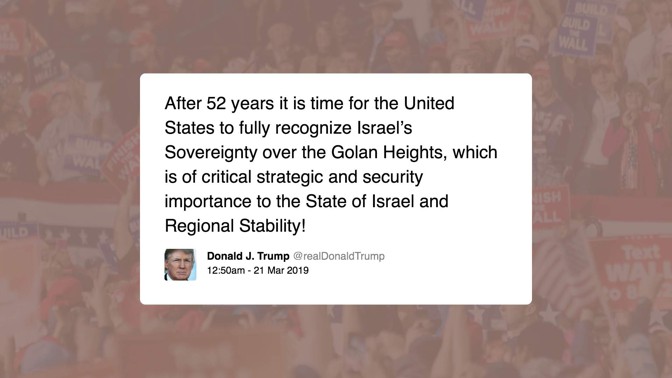
As usual, Trump made the announcement of recognizing Israel’s claim to the Golan Heights without any consultation with any of the relevant administration officials:

President Donald Trump’s tweet on Thursday recognizing the Golan Heights as Israeli territory surprised members of his own Middle East peace team, the State Department, and Israeli officials.

U.S. diplomats and White House aides had believed the Golan Heights issue would be front and center at next week’s meetings between Trump and Israel’s Prime Minister Benjamin Netanyahu at the White House. But they were unprepared for any presidential announcement this week.

No formal U.S. process or executive committees were initiated to review the policy before Trump’s decision, and the diplomats responsible for implementing the policy were left in the dark.

Even the Israelis, who have advocated for this move for years, were stunned at the timing of Trump’s message.

After more than two years of watching Trump’s impulsive and reckless “governing” style, it doesn’t come as a surprise to anyone that he makes these decisions without advance warning. There is no evidence that Trump ever thinks anything through, and so he probably sees no reason to tell anyone in advance what he is going to do. Trump almost never bothers consulting with the people who will be responsible for carrying out his policies and dealing with the international fallout, and that is probably why so many of his policy decisions end up being exceptionally poor ones. The substance of most of Trump’s foreign policy decisions was never likely to be good, but the lack of an organized policy process on major decisions makes those decisions even more haphazard and chaotic than they would otherwise be.

There is absolutely no upside for the United States in endorsing illegal Israeli claims to the Golan Heights. It is a cynical political stunt intended to boost Netanyahu and Likud’s fortunes in the upcoming election, and it is also a cynical stunt aimed at shoring up Trump’s support from Republican “pro-Israel” voters and donors. Whatever short-term benefit Israel gains from it, the U.S. gains nothing and stands to lose quite a bit in terms of our international standing. There has been no consideration of the costs and problems this will create for the U.S. in its relations with other regional states and beyond because Trump couldn’t care less about the long-term effects that his decisions have on the country. Once again, Trump has put narrow political ambitions and the interests of a foreign government ahead of the interests of the United States. That seems to be the inevitable result of electing a narcissist who conducts foreign policy based on which leaders flatter and praise him.

Trump’s bad decision can be traced back to Bolton’s visit to Israel earlier this year:

Administration officials said that National Security Advisor John Bolton was instrumental to the decision, after visiting Israel in January to assure officials there that the United States would not abandon them in Syria despite Trump’s sudden withdrawal of troops from the battlefield.

Nervous Israeli officials saw an opportunity. “It was an ask,” one Israeli source said, “because of the timing — it suddenly became a relevant issue about Iran.”

Bolton is usually the culprit responsible any destructive and foolish policy decision over the last year, and his baleful influence continues to grow. We can also see the harmful effects of the administration’s Iran obsession at work. In the end, the Syria “withdrawal” hasn’t happened and apparently isn’t going to, but Trump nonetheless gives Israel whatever it wants in exchange for nothing so that they will be “reassured” of our unthinking support.

2020 Democrats are dropping like flies from pro-Israel AIPAC conference

Want the best from VICE News in your inbox? Sign up here.

Democrats appear to be moving left on the Israel-Palestine conflict.

Just weeks after Democrats had a meltdown over Rep. Ilhan Omar’s criticism of Israel, seven 2020 Democratic presidential candidates have opted to skip this year’s American Israel Public Affairs Committee (AIPAC) policy conference, which annually convenes prominent Israel supporters.

Kamala Harris, Bernie Sanders, Elizabeth Warren, Beto O’Rourke, Pete Buttigieg, Jay Inslee, and Julian Castro have all confirmed they won’t attend the pro-Israel conference this year. Democrats started pulling out after MoveOn, a progressive advocacy group, called on Democratic presidential candidates to skip the event, which typically enjoys support from major Democrats. Top Dems, including Nancy Pelosi and Chuck Schumer, are speaking at AIPAC this year.

“He’s concerned about the platform AIPAC is providing for leaders who have expressed bigotry and oppose a two-state solution,” Bernie Sanders’ policy director, Josh Orton, told the Huffington Post. Sanders has highlighted his Jewish faith as part of his 2020 presidential campaign.

Multiple presidential candidates skipping the conference marks another sign that Democrats are being forced to reckon with their years of support for Israel. On Thursday, for example, the House unveiled a bipartisan resolution to condemn boycott movements against Israel. The United Nations and numerous human-rights groups have repeatedly condemned Israel over its occupation of Palestinian territories, which the U.S. doesn’t recognize as an official state. Just last week, the U.N. said that Israel may have committed war crimes in 2018 by shooting at unarmed Palestinians. Israeli forces killed at least 189 Palestinians in clashes last year.

Minnesota Democrat Rep. Omar and Michigan Democrat Rep. Rashida Tlaib — the first two Muslim women in Congress — are also the only members in the legislative body that support the Boycott, Divestment, Sanctions (BDS) movement against Israeli occupation of Palestinian territories. Since taking office for the first time earlier this year, Omar has become the most vocal critic of Israel and AIPAC’s influence on American politics.

But Omar has faced fierce backlash from Democrats and Republicans alike — and even death threats. Critics have tried to paint her comments, which called out AIPAC’s use of money to influence politics, as anti-Semitic.

Earlier this month, the House planned to condemn anti-Semitism as a direct rebuke of Omar, though a huge amount of grassroots support manifested for her. Democrats ultimately decided to water down the resolution to instead condemn all forms of hatred, including Islamophobia and white supremacy.

Harris, Sanders, Warren, and Sen. Kirsten Gillibrand — another 2020 presidential candidate, who has not pulled out of AIPAC — all voiced support for Omar in the wake of her criticism of Israel.

Cover image: 2020 Democratic presidential candidate Sen. Bernie Sanders speaks at a rally Saturday, March 16, 2019, in Henderson, Nev. Sanders injured his head on a glass shower door on Friday. (AP Photo/John Locher)

The Atlantic Politics & Policy Daily: On Speeching Terms

What We’re Following Today

It’s Thursday, March 21.

Flooding in Nebraska after a bomb cyclone this week has caused more than $1 billion in damage, the state’s governor said. More than 2,000 homes and 340 businesses were estimated to have been damaged or destroyed.

Here’s what else we’re watching:

A Little Redundant: President Donald Trump signed an executive order directing agencies to “take appropriate steps” to make sure colleges receiving federal research funding are promoting free speech on campus. The thing is, colleges are already legally required to do that.

Long Time Coming: President Trump on Twitter encouraged the United States to recognize Israeli sovereignty over the Golan Heights, a disputed territory on the border of Israel and Syria. But this was no impulse tweet, Kathy Gilsinan writes: It was at least one year in the making.

What to Expect From the Health-Care Conversation: Despite the ongoing debate among Democrats over the future of universal health care, and the advantages and disadvantages of various Medicare for all bills, the 2020 presidential race won’t just be about single-payer health care, writes Ronald Brownstein: Trump still wants to repeal Obamacare.

A New Home for Hate: Since 2016, social-media companies like Facebook and Twitter have come under harsh scrutiny for allowing accounts to spread misinformation and preach white supremacy and other extremist ideologies. But that misinformation is also thriving on Instagram.

Four Big Myths: As the most segregated school system in the U.S. grapples again with diversity in its student body, the debate is rife with misunderstandings. One is the persistent myth that reforming the high-school admissions process will solve schools’ diversity problem.

The Art of the Argument: Most American families are in step with one another politically (though at least one family—the White House adviser Kellyanne Conway and her husband, George—made headlines in recent days for disagreeing publicly about the president). Here’s a framework for how to have a peaceful, productive political conversations with your family members.

With the Eyes of the World Upon Her: In the aftermath of the deadly mosque shootings in New Zealand, Prime Minister Jacinda Ardern has spoken out against publishing the gunman’s manifesto and announced a ban on semiautomatic weapons and assault rifles. Her leadership, and her country’s response, contrast with the standoff politics currently roiling the U.S. and Great Britain, writes Krishnadev Calamur.

— Elaine Godfrey


Snapshot

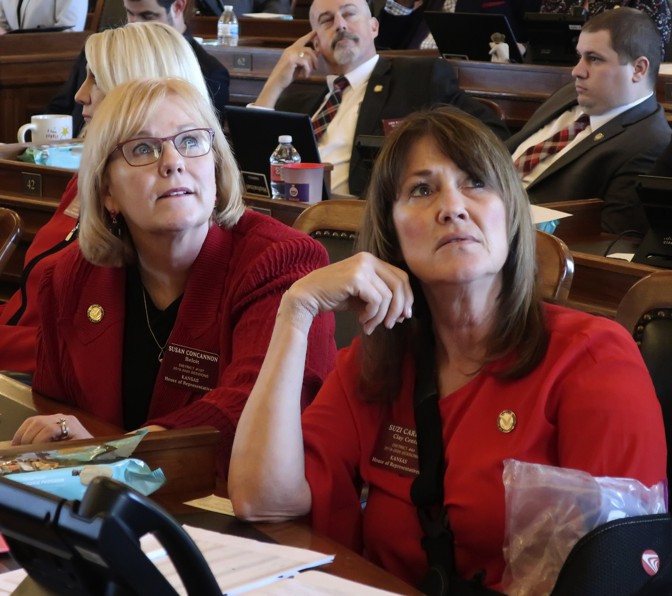
Kansas state Representatives Susan Concannon, left, and Suzi Carlson, right, watch an electronic tally board as the House approves a Medicaid expansion bill on Thursday at the Statehouse in Topeka. (John Hanna / AP)


Ideas From The Atlantic

Nazis Have Always Been Trolls (Adam Serwer)
“Ultimately, as with the New Zealand shooter, every joke, every pithy reference, every pretend gesture toward the moral standards of liberal democracy has the same punch line: We are going to kill you.” → Read on.

Chelsea Clinton in the Hall of Mirrors (Conor Friedersdorf)
“This episode illustrates that when the constant focus is on the boundaries of legitimate speech, little time or attention is left for substance. And what’s said to constitute bigotry keeps expanding without any apparent limit.” → Read on.

Midwestern Flooding Isn’t a Natural Disaster (Christine A. Klein)
“Back in the nation’s flooded regions, it is inspiring to watch midwesterners help one another rebuild. But the key is to rebuild without repeating past mistakes.” → Read on.

The Intensity of the Debate Makes It Hard to Formulate Sound Public Policy (David Frum)
David Frum responds to criticism of his latest story on immigration,
“If Liberals Won’t Enforce Borders, Fascists Will”:

“But the existing people of the country, in all their imperfection—don’t they have to be a first concern? Immigration eases the consequences of disregarding their troubles, and corrodes the political consensus for social reform. Maybe it does not always have to be that way. But in the United States, it has been that way.” → Read on.


What Else We’re Reading

Inside Alexandria Ocasio-Cortez’s Unlikely Rise (Charlotte Alter, Time)
Mitch McConnell: Nihilist in Chief (Alex Pareene, The New Republic)
How Trump Is on Track for a 2020 Landslide (Ben White and Steven Shepard, Politico)
Katie Couric Reflects on That Controversial 2008 Interview With Sarah Palin (David Mack, BuzzFeed News)
Why Donald Trump Is Desperate for Britain to Declare Independence (Edward Luce, Financial Times) (? Paywall)


We’re always looking for ways to improve The Politics & Policy Daily. Comments, questions, typos, grievances and groans related to our puns? Let us know anytime here.

Were you forwarded this newsletter? Sign up for our daily politics email here. We have many other free email newsletters on a variety of other topics. Find the full list here.

The Supreme Court and Dual Citizenship

Image Source AIPAC Promotional

As AIPAC preps for its annual policy conference entitled “Connected for Good” with an expected attendance of 20,000 committed Zionists, its most zealous Zionist Congressional supporters will also likely be in attendance; that is, those who have signed the loyalty oath as well as those who retain dual citizenship to Israel and are thereby entitled to AIPAC campaign support.

There is always more to the story when it comes to AIPAC and how it has been allowed to circumvent and or manipulate US law as it continues to function unfettered by legal requirements that every other foreign country must adhere to. To take a critical eye to AIPAC should not be construed as anti-semetic as AIPAC can take credit for motivating and finagling the US into wars in the Middle East at a cost of $4 trillion from the American taxpayer.

With allegedly hundreds of members of Congress and Federal government employees with dual US-Israel citizenship, what has been missing since the Supreme Court’s 1967 decision is scrutiny of the unintended consequences of that decision as it has affected American foreign policy.

To date, there may be no way to confirm which, if any, Members of Congress have dual citizenship with Israel although the informed rumor mill claims that to be the case. In a 2015 interview with Sen. Bernie Sanders, Diane Rehm, claiming to have a list, unequivocally stated that you have dual citizenship with Israel” to which Sanders responded just as unequivocally “No. I am an American.” It is essential for Members to be forthcoming about their citizenship since real or imagined conflicts of interest can only result in misguided speculation and further alienation.

If the Russians had ever inserted itself into American politics as intimately as the Israelis have, both political parties would be loony-tunes but especially the Dems who appear to have more of a fondness for Zionism. Clearly no other country has taken advantage of the US largesse as Israel has with its hustle of $233 billion (as of 2014) in foreign aid since 1948 including $38 billion in ‘military assistance’ in 2016 plus other unaccounted-for military projects over the years. It takes chutzpah.

The history of dual citizenship in the US is an outrageous example of how easily the US abandoned its responsibility to secure its own national security rather than protect its economic well-being from foreign manipulation. The consequences of that duplicity have yet to be fully explored.

The artist Beys Afriyum, born Ephraim Bernstein in Poland, became a naturalized US citizen in 1926. In 1950 he traveled to Israel, voted in the 1951 Knesset election and remained until 1960 when Mr. Afriyum applied for a renewal of his US passport. The State Department refused citing that by virtue of voting in a foreign election, Afriyum had given up his citizenship in accordance with the Nationality Act of 1940 which stated that a US citizen would lose their citizenship if they voted in an election in a foreign country. In 1958, the Supreme Court adopted Perez v. Brownell (6 – 3) which reiterated the 1940 Act regarding loss of citizenship by voting in a foreign election.

Mr. Afriyum sought a declaratory judgment from the District Court claiming that the 1940 Act was unconstitutional. However, both the District Court in a summary judgment and the Second Circuit Court of Appeals upheld the right of Congress to strip a citizen of their citizenship.

Mr. Afriyum then appealed to the Supreme Court which ruled 5 – 4 in his favor in overturning its earlier decision in Perez v Brownell. The Court further concluded that there is “no general power to revoke an American citizen’s citizenship without prior consent”.

In a compelling dissent, Justice John Harlan argued that in its power to regulate foreign affairs, Congress has the power to expatriate any citizen who intentionally commits acts which may be prejudicial to the foreign relations of the United States, and which reasonably may be deemed to indicate a dilution of his allegiance to this country” and, in a prescient glimpse into the future, that “allowing Americans to vote in foreign elections ran contrary to the foreign policy interests of the nation and ought to result in loss of citizenship.

Further, Harlan referred to Black’s opinion as a ‘remarkable process of circumlocution” with “unsubstantiated assertions,” “a lengthy albeit incomplete survey” and that he “finds nothing in this extraordinary series of conventions which permits the imposition of constitutional constraint upon Congress.”

After the Court’s decision, it was determined that Afriyum had voted in the 1955 and 1959 Knesset elections and that Afriyum later became an Israel citizen.

Despite the 1967 decision, the Homeland Security oath for naturalized citizens has not yet incorporated the new standard which still reflects US citizenship based on the one person/one country concept as established principal: “I absolutely and entirely renounce and abjure all allegiance and fidelity to any foreign prince, state or sovereignty of whom or which I have heretofore been a subject of citizens.”

While the LA Times editorialThe Problem of Dual Citizenship” asks “How can a person be equally loyal to two countries? “ and in citing the Afriyum v Rusk case, the Times understates its warning that “dual citizenship can present a security issue whether to permit access to classified information..”

Since the days of the Afriyum decision, the potential for betrayal and conflicts of interest have intensified dramatically for Members of Congress and Federal employees and those holding national security clearances given the unparalleled financial and political support that the US provides to Israel. In addition, the 2018 adoption by the Knesset of the Basic Law which establishes that Israel is now specifically a Jewish nation raises First Amendment issues regarding the establishment clause as it prohibits state-sponsored religion.

ASTRONOMER: Aliens might zap black holes with lasers to travel galaxy…

Astronomer says aliens might zap black holes with lasers to travel the galaxy

An astronomer at Columbia University has a new guess about how hypothetical alien civilizations might be invisibly navigating our galaxy: Firing lasers at binary black holes (twin black holes that orbit each other).

The idea is a futuristic upgrade of a technique NASA has used for decades.

Spacecraft already navigate our solar system using gravity wells as slingshots. The spacecraft itself enters orbit around a planet, flings itself as close as possible to a planet or moon to pick up speed, and then uses that added energy to travel even faster toward its next destination. In doing so, it saps away a tiny fraction of the planet’s momentum through space — though the effect is so minimal it’s pretty much impossible to notice. [9 Strange, Scientific Reasons We Haven’t Found Aliens Yet]

The same basic principles operate in the the intense gravity wells around black holes, which bend not only the paths of solid objects, but light itself. If a photon, or a light particle, enters a particular region in the vicinity of a black hole, it will do one partial circuit around the black hole and get flung back in exactly the same direction. Physicists call those regions “gravitational mirrors” and the photons they fling back “boomerang photons.”

NASA scientist says space alien search should be more ‘aggressive’

Boomerang photons already move at the speed of light, so they don’t pick up any speed from their trips around black holes. But they do pick up energy. That energy takes the form of increased wavelength of the light, and the individual photon “packets” carry more energy than they had when they entered the mirror.

That comes at a cost to the black hole, sapping some of its momentum.

In a paper published in the preprint journal arXiv on March 11, David Kipping, the Columbia astronomer, proposed that an interstellar spacecraft could fire a laser at the gravity mirror of a fast-moving black hole in a binary black hole system. When the newly energized photons from the laser whipped back around, it could re-absorb them, and convert all that extra energy into momentum — before firing the photons back at the mirror again.

This system, which Kipping termed the “halo drive,” has a big advantage over more traditional lightsails: It doesn’t require a massive fuel source. Current lightsail proposals require more energy to accelerate the space shuttle to “relativistic” speeds (meaning a significant fraction of light speed) than humanity has produced in its entire history.

With a halo drive, all that energy could just be sapped from a black hole, rather than generated from a fuel source.

Halo drives would have limits — at a certain point the spacecraft would be moving so quickly away from the black holes that it wouldn’t absorb enough light energy to add additional speed. It’s possible to solve this problem by moving the laser off the spaceship and onto a nearby planet, he noted, and just precisely aiming the laser so it emerges from the black hole’s gravity well to hit the spaceship. But without re-absorbing the laser light that planet would have to burn fuel to generate new beams constantly, and would eventually dwindle away.

A civilization might be using a system like this to navigate the Milky Way right now, Kipping wrote. There are certainly enough black holes out there. If so, that civilization might be sapping so much momentum from black holes that it would be messing with their orbits, and we could possibly detect the signs of alien civilization from the eccentric orbits of binary black holes.

And if no other civilizations are out there doing this, he added, perhaps humanity could be the first.

Originally published on Live Science.

SIGN UP FOR THE MACH NEWSLETTER AND FOLLOW NBC NEWS MACH ON TWITTER, FACEBOOK, AND INSTAGRAM.


Home Ethos About Contact
Terms Policy GDPR RichTVX
© Saeculum XXI U.S. Intelligence News