

Top Tag

And Now Algeria

Photograph Source Magharebia

It has now been nine years since protests broke out across the Middle East and North Africa. After citizens took to the streets, the leaders of Tunisia, Egypt, Libya and Yemen all were deposed during the Arab Spring. What about Algeria – the tenth-largest country in the world, the largest in Africa and a country with the tenth-largest reserves of natural gas? Up until now, there has been no change of government since 1999, no calls for revolution despite a gross inequality of wealth and no overthrow of its leader. Understandably, Algeria has been off the media’s radar.

The country has been ripe for revolution. Economic conditions have worsened since the 1980s with declining oil prices. There has been high unemployment. Between 1988 and 1995, for example, the percentage of the population below the poverty line increased from 8 to 14 per cent. Almost 70 per cent of the poor live in rural areas.

For four consecutive Fridays, hundreds of thousands of Algerians have protested throughout the country. Revolutions can spread, such as in 1848 in Italy, France, Germany and Austria. While during the Arab Spring Zine el-Abidine Ben Ali in Tunisia, Hasni Mubarak in Egypt, Muammar Gaddafi in Libya and Ali Abdullah in Yemen left power, Abdelaziz Bouteflika has remained president of Algeria. Although there were protests in Algeria in January and February 2011, he and his followers have dominated Algerian politics for two decades.

The government has provided stability. The 1991 to 2002 Algerian civil war was a devastating armed struggle between the Algerian Government and Islamic rebels. The total number of dead has been estimated at around 200,000, during what has been called the “dark decade” in Algerian history.

Memories of how the Islamic Salvation Front (FIS) was poised to win an election in 1992 when hundreds of thousands took to the streets have been omnipresent and reason to accept the important position of the military. Bouteflika, his circle, and the army, with obvious support from the West, have provided a buffer against fundamentalist radicalization and ensured that there would not be another “dirty war” or takeover by groups like ISIS.

History has been on Bouteflika’s side. He has been a respected leader during much of Algeria’s post-colonial era. He was Minister of Foreign Affairs from 1963 to 1979 and first elected president in 1999. Despite a stroke in 2013, and his recent frail health, his four terms in office have allowed Algeria to avoid the regional chaos.

But it seems that the historic need for stability has now been overcome by calls for anyone-other-than-Bouteflika elections. His announcement that he would seek a fifth term while continuing declining health – reports had him dying or near-death last week – have proven this to be the election too far. His stay in a Geneva hospital and incapacity to be physically in Algeria to present his candidature have finally created the momentum for a radical change some 20 years after the Arab Spring.

What will happen? Bouteflika and his political party, the National Liberation Front (FLN), have dominated Algeria for twenty years with support from the West because of easy access to the considerable reserves of natural gas and oil. Post-Bouteflika is not clear. Many Algerians say they have learned the lessons of the Arab Spring; Algeria is not Syria. While the presidency of Bouteflika was superficially democratic – there were, after all, four presidential elections – the young are questioning the legitimacy of the regime in power and those around him.

Opposition political parties have been hindered by a lack of access to national television. The major news outlets have been controlled by the government. There is no well-organized institutional opposition. On the other hand, Algeria does not lack talented political leaders. Ali Benflis, former Prime Minister and twice presidential candidate has said he will not run because he doubts the legitimacy of an upcoming April election. Former Foreign Minister and Ambassador to the United Kingdom Ahmed Attaf has been active in opposition, but for the moment no major opposition candidate has stepped forward.

Even if Algeria has been off the media’s radar, there is no doubt that some preparations have gone on for the post-Bouteflika era. The current protests and the president’s worsening health have accelerated the process. But, there has been no obvious roadmap for who will take over. If the lessons of the Arab Spring have been learned within the ruling party and the demonstrators, there will be a peaceful transition. For the last twenty years, Algeria has been an exception in the region. A peaceful, democratic transition would be an exception as well.
 

Argument analysis: Justices seem receptive to inmate’s juror-discrimination claims

The Supreme Court heard oral argument yesterday in the case of an African-American death-row inmate in Mississippi who was convicted by a jury that included just one African-American juror. The inmate, Curtis Flowers, argues that the jury selection in his case violates the Constitution – especially because the lead prosecutor had a long history of eliminating potential African-American jurors from the jury pool. After nearly an hour of oral argument that included the first questions by Justice Clarence Thomas since 2016, there seemed to be at least five justices who agree with Flowers.

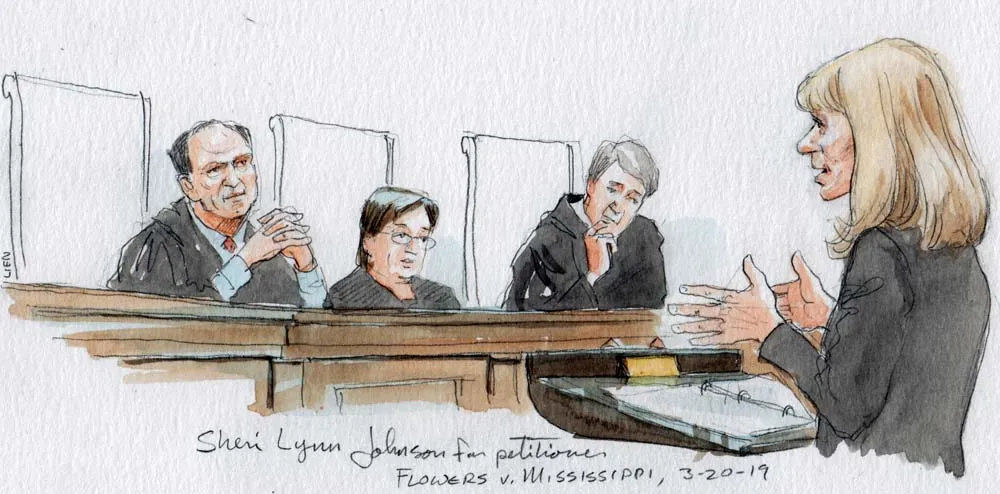
Sheri Lynn Johnson for petitioner (Art Lien)

At a trial, lawyers on both sides of a case have a certain number of “peremptory strikes,” which they can use to remove jurors from the pool of potential jurors without having to provide a reason. In 1986, in a case called Batson v. Kentucky, the Supreme Court ruled that prosecutors cannot use their peremptory strikes to remove jurors based only on the jurors’ race.

When Flowers went to trial in 2010, it was the sixth time that he had been tried for the 1996 murders of four people in a Mississippi furniture store. He was convicted and sentenced to death at the first two trials, but those convictions were reversed by the Mississippi Supreme Court, which found that the lead prosecutor, Doug Evans, had engaged in intentional misconduct.

Evans served as the lead prosecutor at the next four trials. Flowers was again convicted and sentenced to death at the third trial, but the Mississippi Supreme Court overturned his convictions: It ruled that Evans had violated Batson when he used all 15 of his peremptory strikes to remove African-American members of the jury pool.

The jury deadlocked at Flowers’ fourth and fifth trials. At Flowers’ sixth trial, Evans allowed the first of six potential African-American jurors to be seated on the jury, but then he struck the remaining five prospective African-American jurors, resulting in a jury with 11 white jurors and just one African-American juror. Flowers was convicted and sentenced to death.

Arguing for Flowers, lawyer Sheri Johnson told the justices that the “only plausible interpretation of all of the evidence viewed cumulatively is that Doug Evans began jury selection in” the sixth trial “with an unconstitutional end in mind”: “to seat as few African American jurors as he could.”

Although Johnson emphasized Evans’ history of striking potential African-American jurors throughout the six trials in Flowers’ case, much of the oral argument was spent grappling with the specifics of Evans’ strikes in the sixth trial, and in particular some potential jurors’ relationships with the victims and their families and the extent to which Evans had questioned the would-be jurors about potential biases.

Justice Samuel Alito, perhaps the justice who is most often supportive of the prosecution, kicked off this discussion. Alito acknowledged that the “history of this case prior to this trial is very troubling.” But did the sixth trial, standing alone, he asked Johnson, violate Batson?

Johnson replied that it did, describing the evidence of discrimination as “clear and convincing.”

But Alito was less convinced. He pushed back with facts suggesting to him that Evans had non-discriminatory reasons to strike some of the African-American jurors.

Perhaps most crucially for Flowers, Justice Brett Kavanaugh suggested that he regarded Evans’ track record as problematic: “We can’t take the history” of Batson violations “out of the case,” Kavanaugh told Jason Davis, who argued on behalf of the state, as Kavanaugh noted that Evans had removed 41 of 42 potential African-American jurors from the jury pool during Flowers’ trials.

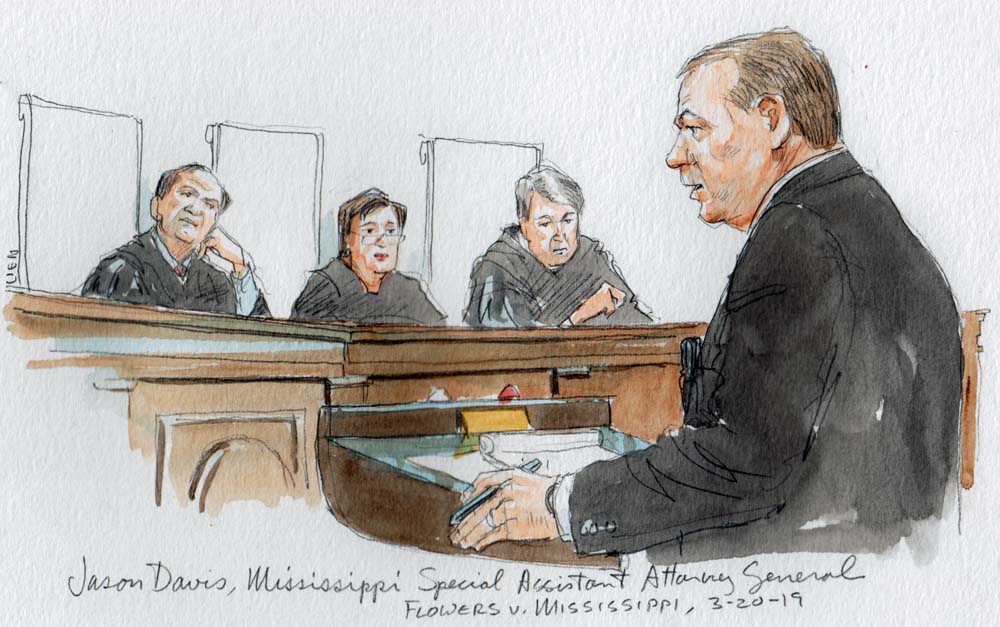
Jason Davis, special assistant attorney general of Mississippi (Art Lien)

Justice Stephen Breyer chimed in, reciting the history of the African-American jurors whom Evans had removed during the first four trials. In light of that history, Breyer told Davis, “I don’t think it’s going to take much” more in the sixth trial to show a Batson violation.

Kavanaugh spoke out even more strongly later. He told Davis that the “critical sentence” in the court’s opinion in Batson was that you “can’t just assume that someone’s going to be favorable to someone because they share the same race.” But given the history of this case, Kavanaugh queried, with Evans striking 41 out of 42 potential African-American jurors, “how do you look at that and not come away thinking what was going on there was” exactly what Batson said prosecutors can’t do?

Chief Justice John Roberts moved to what he clearly regarded as the bigger picture: how to establish a rule that will govern future cases. This case, Roberts observed, “is unusual because you have the extensive history” of misconduct and Batson violations by Evans. But how far back, Roberts asked, should courts look to evaluate a prosecutor’s past misconduct? If the prosecutor had violated Batson once, 20 years ago, is that something that courts should consider now?

Johnson responded that courts should indeed consider it – to a point. Courts should look at it, she argued, but they should also take into account how recently the misconduct happened, “whether it’s on a relatively similar matter, whether the person has the same motive.”

Kavanaugh also asked Davis whether the Mississippi attorney general could (and perhaps should) have decided to prosecute the sixth trial, “preferably in a different county,” which might have removed some of the problems with potential jurors in a small town knowing the victims and the defendant.

Davis explained that having the attorney general’s office take over “was not an option in this case” because the attorney general can only take over if local prosecutors ask for help – which Evans had not.

Alito picked up on this idea later, perhaps looking for a narrow way for the court to rule for Flowers. “Could we say in this case,” Alito asked Davis, “because of the unusual and really disturbing history, this case just could not have been tried this sixth time by the same prosecutor” because the history makes it too hard to “untangle what happened before from the particular strikes in this case?”

Davis didn’t want to cede this point, telling Alito that “hindsight is 20/20.”

By the time Davis sat down, Johnson apparently felt sufficiently confident in how the argument was going for her client that she planned to forgo her four minutes of rebuttal time.

But then Justice Clarence Thomas, who hadn’t spoken up at oral argument since 2016, had a question. He wanted to know whether Flowers’ trial lawyer had used any of her peremptory strikes – and, if so, what was the race of the jurors whom she had struck.

Johnson responded that the trial lawyer had only used her strikes to remove white jurors from the juror pool, adding that “her motivation is not the question here. The question is the motivation of Doug Evans.”

Sotomayor jumped in, pointing out that, as a result of Evans’ strikes, there was only one potential African-American juror in the jury pool for Flowers’ lawyer to strike anyway.

Oral arguments are not always an accurate predictor of how a case will ultimately turn out. But here, Flowers seemed to have support not only from the court’s four more liberal justices but also from Kavanaugh and perhaps Roberts – which, if true, would give him the five votes needed to reverse the Mississippi Supreme Court’s decision in the state’s favor. A decision in the case is expected by summer.

This post was originally published at Howe on the Court.

***

Past case linked to in this post:

Batson v. Kentucky, 476 U.S. 79 (1986)

Editor’s Note: Analysis based on transcript of oral argument.

The post Argument analysis: Justices seem receptive to inmate’s juror-discrimination claims appeared first on SCOTUSblog.

Home Ethos About Contact
Terms Policy GDPR RichTVX
© Saeculum XXI U.S. Intelligence News