

Top Tag

Looting, clashes…

Looting, clashes as Yellow Vests seek new momentum

Read more

.afill:none;stroke:#9a9a9a;stroke-width:2px

A Boss menswear store and the gourmet Fouquet’s restaurant were among the premises vandalised as groups of masked protesters lobbed stones at police defending the Arc de Triomphe war memorial.

The police responded with teargas and water cannon but failed to disperse the more radical protesters who erected burning barricades in scenes reminiscent of the worst “yellow vest” riots in the capital in December.

The rally was called to coincide with the end of two months of public debates called by President Emmanuel Macron to give voters a forum to air their grievances and propose policy changes.

The protesters have dismissed the debates as a smoke-screen.

Saturday’s turnout will be seen as a measure of the power of the “yellow vest” movement, which began in November over fuel tax hikes but quickly ballooned into a broader anti-government rebellion.

Thousands of people converged on the Champs-Elysees focal point of the Paris protests over the past four months for “Act XVIII” of a movement which had appeared to be running out of steam but whose core demands still enjoy broad public support.

The Arc de Triomphe, which was sacked by protesters on December 1, was again the focal point of the unrest.

Black-clad demonstrators encircled the square surrounding the arch, pelting the police with stones.

“Macron, we’re coming to get you at home,” some of the protesters chanted, referring to the presidential palace near the Champs-Elysees.

Thirty-one people had been arrested by mid-morning, the police said.

Interior Minister Christophe Castaner condemned the violence as the work of “professional trouble-makers” who had “infiltrated” the march and said he had ordered police to “react with the greatest firmness to these unacceptable attacks.”

‘We want results’

Last week, only around 28,000 people demonstrated nationwide, according to the authorities, a tenth of the numbers that turned out for the inaugural protest on November 17.

But on Saturday the protesters were out in force again, pouring into the capital by train and cars from around the country for what they called an “ultimatum” to Macron.

Over 5,000 police were deployed, along with several armoured police vehicles, and several metro stations were closed.

Macron, who was caught off guard when the grassroots movement erupted in November, loosened the state’s purse strings to the tune of 10 billion euros ($11.2 billion) to try defuse the protests.

He also launched a “grand national debate” on the internet and town hall meetings to gather feedback on how the country could be reformed.

But the measures failed to quell the anger of the demonstrators, who accuse Macron, a centrist former investment banker, of being beholden to high finance.

Laurent Casanova, an engineer who was among the protesters, told AFP he had come to mark the end of the national debate.

“We have been patient but now we want results,” he said.

The protest is one of several planned in Paris on Saturday, where French climate campaigners are also planning a “March of The Century”.

(AFP)


The Atlantic Politics & Policy Daily: On Speeching Terms

What We’re Following Today

It’s Thursday, March 21.

Flooding in Nebraska after a bomb cyclone this week has caused more than $1 billion in damage, the state’s governor said. More than 2,000 homes and 340 businesses were estimated to have been damaged or destroyed.

Here’s what else we’re watching:

A Little Redundant: President Donald Trump signed an executive order directing agencies to “take appropriate steps” to make sure colleges receiving federal research funding are promoting free speech on campus. The thing is, colleges are already legally required to do that.

Long Time Coming: President Trump on Twitter encouraged the United States to recognize Israeli sovereignty over the Golan Heights, a disputed territory on the border of Israel and Syria. But this was no impulse tweet, Kathy Gilsinan writes: It was at least one year in the making.

What to Expect From the Health-Care Conversation: Despite the ongoing debate among Democrats over the future of universal health care, and the advantages and disadvantages of various Medicare for all bills, the 2020 presidential race won’t just be about single-payer health care, writes Ronald Brownstein: Trump still wants to repeal Obamacare.

A New Home for Hate: Since 2016, social-media companies like Facebook and Twitter have come under harsh scrutiny for allowing accounts to spread misinformation and preach white supremacy and other extremist ideologies. But that misinformation is also thriving on Instagram.

Four Big Myths: As the most segregated school system in the U.S. grapples again with diversity in its student body, the debate is rife with misunderstandings. One is the persistent myth that reforming the high-school admissions process will solve schools’ diversity problem.

The Art of the Argument: Most American families are in step with one another politically (though at least one family—the White House adviser Kellyanne Conway and her husband, George—made headlines in recent days for disagreeing publicly about the president). Here’s a framework for how to have a peaceful, productive political conversations with your family members.

With the Eyes of the World Upon Her: In the aftermath of the deadly mosque shootings in New Zealand, Prime Minister Jacinda Ardern has spoken out against publishing the gunman’s manifesto and announced a ban on semiautomatic weapons and assault rifles. Her leadership, and her country’s response, contrast with the standoff politics currently roiling the U.S. and Great Britain, writes Krishnadev Calamur.

— Elaine Godfrey


Snapshot

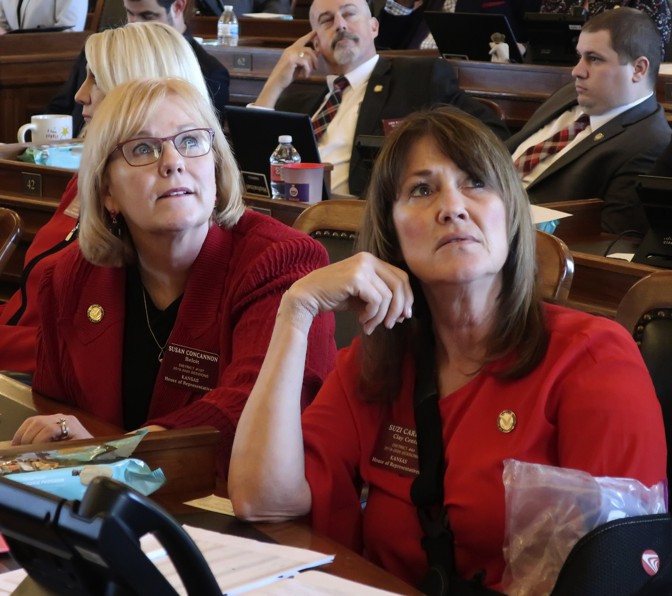
Kansas state Representatives Susan Concannon, left, and Suzi Carlson, right, watch an electronic tally board as the House approves a Medicaid expansion bill on Thursday at the Statehouse in Topeka. (John Hanna / AP)


Ideas From The Atlantic

Nazis Have Always Been Trolls (Adam Serwer)
“Ultimately, as with the New Zealand shooter, every joke, every pithy reference, every pretend gesture toward the moral standards of liberal democracy has the same punch line: We are going to kill you.” → Read on.

Chelsea Clinton in the Hall of Mirrors (Conor Friedersdorf)
“This episode illustrates that when the constant focus is on the boundaries of legitimate speech, little time or attention is left for substance. And what’s said to constitute bigotry keeps expanding without any apparent limit.” → Read on.

Midwestern Flooding Isn’t a Natural Disaster (Christine A. Klein)
“Back in the nation’s flooded regions, it is inspiring to watch midwesterners help one another rebuild. But the key is to rebuild without repeating past mistakes.” → Read on.

The Intensity of the Debate Makes It Hard to Formulate Sound Public Policy (David Frum)
David Frum responds to criticism of his latest story on immigration,
“If Liberals Won’t Enforce Borders, Fascists Will”:

“But the existing people of the country, in all their imperfection—don’t they have to be a first concern? Immigration eases the consequences of disregarding their troubles, and corrodes the political consensus for social reform. Maybe it does not always have to be that way. But in the United States, it has been that way.” → Read on.


What Else We’re Reading

Inside Alexandria Ocasio-Cortez’s Unlikely Rise (Charlotte Alter, Time)
Mitch McConnell: Nihilist in Chief (Alex Pareene, The New Republic)
How Trump Is on Track for a 2020 Landslide (Ben White and Steven Shepard, Politico)
Katie Couric Reflects on That Controversial 2008 Interview With Sarah Palin (David Mack, BuzzFeed News)
Why Donald Trump Is Desperate for Britain to Declare Independence (Edward Luce, Financial Times) (? Paywall)


We’re always looking for ways to improve The Politics & Policy Daily. Comments, questions, typos, grievances and groans related to our puns? Let us know anytime here.

Were you forwarded this newsletter? Sign up for our daily politics email here. We have many other free email newsletters on a variety of other topics. Find the full list here.

Make love, not CO2…

Make love, not CO2: Students worldwide demand climate action

BERLIN (AP) — From the South Pacific to the edge of the Arctic Circle, students mobilized by word of mouth and social media are skipping class to protest what they see as the failures by their governments to take tough action against global warming.

Friday’s rallies were one of the biggest international climate change actions yet, involving hundreds of thousands of students in more than 100 countries around the globe.

The coordinated “school strikes” were inspired by 16-year-old Swedish activist Greta Thunberg, who began holding solitary demonstrations outside the Swedish parliament last year.

Since then, the weekly protests have snowballed from a handful of cities to hundreds, fueled by dramatic headlines about the impact of climate change during the students’ lifetime. Scientists have backed the protests, with thousands in Britain, Finland, Germany and the United States signing petitions in support of the students.

Thunberg, who has been nominated for the Nobel Peace Prize, said at a rally in Stockholm that the world faces an “existential crisis, the biggest crisis humanity ever has faced and still it has been ignored for decades.”

“And you know who you are, you that have ignored this,” she said.

Across the globe, protests big and small urged politicians to act against climate change while also highlighting local environmental problems:

— In India’s capital of New Delhi, schoolchildren protested inaction on climate change and demanded that authorities tackle rising air pollution levels in the country, which often far exceed World Health Organization limits.

— In Paris, teenagers thronged the cobblestoned streets around the domed Pantheon building. Some criticized French President Emmanuel Macron, who sees himself as the guarantor of the landmark 2015 Paris climate accord but is criticized by activists for being too business-friendly and not ambitious enough in efforts to reduce emissions.

Raphael Devautour, high school student said it was his first protest. “We can feel that something is happening,” he said. “When the youths start acting, it get things moving. We saw it in 1968.”

— In South Africa’s capital, Pretoria, one protester held a sign reading “You’ll Miss The Rains Down in Africa.” Experts say Africa, with its population of more than 1 billion people, is expected to be hardest hit by global warming even though it contributes least to the greenhouse gas emissions that cause it.

— Thousands marched in rainy Warsaw and other Polish cities to demand a ban on burning coal, a major source of carbon dioxide. Some wore face masks as they carried banners that read “Make Love, Not CO2.”

— Speakers at the U.S. Capitol in Washington stood behind a banner that said “We don’t want to die.”

— Protests in Madrid and more than 50 other Spanish cities drew thousands. The country is vulnerable to rising sea levels and rapid desertification .

— In Berlin, police said as many as 20,000 protesters gathered in a downtown square, waving signs such as “March now or swim later” before marching through the German capital to Chancellor Angela Merkel’s office.

Carla Reemtsma, a 20-year-old student who helped organize the protest in Berlin, said she’s part of about 50 WhatsApp groups devoted to discussing climate change.

“A lot happens on social media because you can reach a lot of young people very quickly,” she told The Associated Press.

Azalea Danes, a student at the Bronx High School of Science, wasn’t a climate activist until two weeks ago when she read about Thunberg’s efforts. Now she is one of the top organizers of the youth climate strike in New York City, where she hopes thousands will rally in three places later Friday.

That shows how these protests are organized from the bottom up, she said.

Volker Quaschning, a professor of engineering at Berlin’s University of Applied Sciences, said it was easy for politicians to belittle students.

“That’s why they need our support,” he said. “If we do nothing, then parts of this planet could become uninhabitable by the end of the century.”

But some politicians praised the students. Danish Prime Minister Lars Loekke Rasmussen showed up at a protest in Copenhagen and tweeted Friday “we must listen to the youth. Especially when they’re right: the climate must be one of our top priorities.”

Scientists have warned for decades that current levels of greenhouse gas emissions are unsustainable, so far with little effect.

In 2015, world leaders agreed in Paris to a goal of keeping the Earth’s global temperature rise by the end of the century well below 2 degrees Celsius (3.6 degrees Fahrenheit) compared with pre-industrial times.

Yet the world has already warmed by 1 degree C since then and is on track for an increase of 4 degrees Celsius, which experts say would have far-reaching consequences for life on the planet

In Germany, environmental groups and experts have criticized government plans to continue using coal and natural gas for decades to come.

Quaschning, one of more than 23,000 German-speaking scientists to sign a letter of support this week, said Germany should stop using all fossil fuels by 2040. This would give less-advanced nations a bit more time to wean themselves off coal, gas and oil while still meeting the Paris goal globally.

“This is going to require radical measures and there isn’t the slightest sign of that happening yet,” said Quaschning.

In Stockholm, Thunberg predicted that students won’t let up their climate protests.

“There are a crisis in front of us that we have to live with, that we will have to live with for all our lives, our children, our grandchildren and all future generations,” she said. “We are on strike because we do want a future.”

___

Seth Borenstein in Washington; Rishahb R. Jain in New Delhi; Monika Scislowska in Warsaw, Poland; Nqobile Ntshangase in Pretoria, South Africa; Angela Charlton in Paris; Jari Tanner in Helsinki, Finland; Jan M. Olsen in Copenhagen, Denmark, and Bernat Armangue in Madrid contributed to this report.

___

Read more AP climate news here: https://www.apnews.com/Climate


China is using "Buddhist diplomacy" in its quest to dominate global trade

Want the best from VICE News in your inbox? Sign up here.

Sixty years after China brutally squashed the Tibetan uprising against the Communist Party, it’s still ruling with an iron fist, making Tibet one of the least free regions in the world. But even as they continue to oppress Tibetan Buddhists, Chinese leaders are strategically leveraging Buddhism in their quest to dominate global trade.

Tibetans rallied this week to mark the 60th anniversary of the failed uprising, protesting the continued occupation of their land and restrictions on their freedom — tens of thousands of Communist cadres supervise Buddhist monasteries and villages, people are forced to replace pictures of the Dalai Lama with photos of Party leaders, and China boasts Tibet’s capital as its “safest” city.

“One of the prime requirements for monks and nuns is that they should be loyal to the Communist Party before they are loyal to their faith,” Bhuchung Tsering, the vice president of the International Campaign for Tibet, told VICE News. “Everything is being dictated by the Chinese Communist Party.”

Yet China has invested heavily in projecting itself as pro-Buddhist, for calculated reasons. Buddhists make up a huge population in countries that China wants to connect to its Belt and Road Initiative — a multibillion-dollar project to dominate global trade.

Take, for example, Myanmar. In the last decade, China has actively worked to improve religious relations with its southern neighbor, which is 88 percent Buddhist. In that same time frame, it spent $2.5 billion to build oil and gas pipelines and is now negotiating multibillion-dollar port and dam deals.

“China’s use of Buddhist diplomacy is significant because several of these countries are apprehensive of this giant power — whether all the loans they are taking from China will drive them into a debt trap,” Dr. Sudha Ramachandran, a South Asia analyst, told VICE News.

The latest case of China’s “debt-trap diplomacy” is Sri Lanka.

After the Chinese helped the country’s Buddhist majority win a decades-long civil war, Sri Lanka’s president gave China a billion-dollar port deal in his hometown. Eight years after the deal was signed, Sri Lanka was unable to pay back its loans and surrendered the Hambantota port to China for 99 years as repayment.

“In all these countries, you find that the public feels that, ‘Well if we want improved infrastructure, it is only the Chinese who are willing to, you know, extend loans.” Ramachandran told VICE News. “Yes, there is a concern, but there is no other alternative.”

This segment originally aired March 13, 2019, on VICE News Tonight on HBO.

Home Ethos About Contact
Terms Policy GDPR RichTVX
© Saeculum XXI U.S. Intelligence News