 Are North Korean Soldiers a Burden or Asset in Russia’s Offensive?
  Elon Musk’s Shadowy Alliance with Vladimir Putin: A National Security Threat
  Crisis Within the Kremlin: The Fall of Russia’s Gas Giant Gazprom
  Hunting Russian Evil: How Oligarchs Evade Justice and Protect Their Fortunes
 Plutocrats Unite: Big Tech, Business Lobby, Outsourcers Demand Amnesty

Executives from the country’s largest tech conglomerates, the big business lobby, and multinational corporations are demanding Congress pass the latestRead More

Preempt Threats and Safeguard America's National Security with USIntelNews.com

Executives from the country’s largest tech conglomerates, the big business lobby, and multinational corporations are demanding Congress pass the latestRead More
Fox News reported on Thursday that the final Islamic State stronghold in Syria, the village of Baghouz, has been liberatedRead More
Montreal priest stabbed during mass… (Third column, 13th story, link) Advertise here
Neighbors fuming… (Third column, 16th story, link) Related stories:Proposed Megamansion Bigger Than White House… Advertise here
On Wednesday, the Supreme Court unanimously affirmed the U.S. Court of Appeals for the 10th Circuit in Obduskey v. McCarthy & Holthus LLP, holding that parties who enforce security interests are not debt collectors within the meaning of the Fair Debt Collection Practices Act provided that they do no more than the bare minimum required by state law to enforce the security interest. Justice Stephen Breyer’s opinion for the court is short and primarily focused on the text of the statute. After the argument, in which the justices sounded skeptical about the petitioner’s reading of the text, this outcome is hardly surprising. Indeed, the most notable thing about this case is probably Justice Sonia Sotomayor’s concurrence.
For a consumer case, the relevant facts here are simple. After Dennis Obduskey defaulted on his mortgage, McCarthy & Holthus, on behalf of its client Wells Fargo, sent him a notice in 2014 initiating a nonjudicial foreclosure. This notice, which is mandatory under Colorado nonjudicial foreclosure law, listed various details about the underlying mortgage. Obduskey, understanding the notice to be an effort to collect a debt—namely his delinquent mortgage—responded by following the FDCPA’s procedures for disputing a debt. Rather than continuing through the FDCPA process, McCarthy & Holthus initiated a new nonjudicial foreclosure in 2015. Obduskey then brought this FDCPA claim.
The court’s opinion begins with an almost mechanical analysis of the statute. Section 1692a(6) of the FDCPA gives a “primary definition” of “debt collector” as:
any person … in any business the principal purpose of which is the collection of any debts, or who regularly collects or attempts to collect, directly or indirectly, debts owed or asserted to be owed or due another.
Parties meeting this definition are subject to a myriad of limitations aimed at protecting consumers. The statute also provides what the court calls “the limited-purpose definition”:
For the purpose of section 1692f(6) [the] term [debt collector] also includes any person … in any business the principal purpose of which is the enforcement of security interests.
Special rules apply to parties meeting the limited-purpose definition. Because there was no question that McCarthy & Holthus met the limited-purpose definition, the issue in this case was whether a party meeting the limited-purpose definition necessarily also meets the primary definition.
Breyer’s statutory argument proceeds in three parts. First, the only way to avoid surplusage is to read the limited-purpose definition as narrowing the primary definition. Second Congress may have used the limited-purpose definition to narrow the primary definition in order to avoid conflicts with state nonjudicial foreclosure regimes. And finally, the legislative history suggests that the FDCPA represents a compromise between those who would fully include enforcement of security interests under FDCPA protections and those who would exclude it.
Next, the opinion systemically rebuts the petitioner’s arguments. Here the court explains just how narrow the decision is. Obduskey had tried to argue that even if the primary definition of debt collector does not include “simply enforcing a security interest,” what happened here “was more than security-interest enforcement.” Colorado’s nonjudicial foreclosure regime required McCarthy & Holthus to send various notices before it could execute the foreclosure. These mandatory notices theoretically protect consumers by providing them with information about the status of their mortgage. Obduskey argued that whatever their purpose, most homeowners would understand such notices as an attempt to collect a debt. The justices acknowledge that consumers would interpret the threat of foreclosure as an attempt to collect debt, but this does not change their reading of the statute. The opinion explains that “because he who wills the ends must will the necessary means, we think the Act’s (partial) exclusion of ‘the enforcement of security interests’ must also exclude the legal means required to do so.” Because McCarthy & Holthus took only the steps that Colorado required, the court will not read the notices that it sent to Obduskey as an attempt to collect a debt that sits outside the limited-purpose definition.
This brings us to Sotomayor’s concurrence. Although she commends the court’s opinion for “mak[ing] a coherent whole of a thorny section of statutory text,” she writes separately to emphasize that “this is too close a case for me to feel certain that Congress recognized that this complex statute would be interpreted the way that the Court does today.” She invites Congress to clarify the statute “if we have gotten it wrong.”
Justice Sotomayor also uses her concurrence to emphasize the narrowness of the court’s opinion. Specifically, she writes that she “would see as a different case one in which the defendant went around frightening homeowners with the threat of foreclosure without showing any meaningful intention of ever actually following through.”
Given its narrowness, this case will probably do little to stem litigation over whether efforts to execute nonjudicial foreclosures are efforts to collect debts within the scope of the FDCPA. Had McCarthy & Holthus been even a little more aggressive in its collection efforts, this case might well have come out the other way.
The post Opinion analysis: An extremely narrow Fair Debt Collection Practices Act ruling appeared first on SCOTUSblog.
It’s Thursday, March 21.
‣ Flooding in Nebraska after a bomb cyclone this week has caused more than $1 billion in damage, the state’s governor said. More than 2,000 homes and 340 businesses were estimated to have been damaged or destroyed.
Here’s what else we’re watching:
A Little Redundant: President Donald Trump signed an executive order directing agencies to “take appropriate steps” to make sure colleges receiving federal research funding are promoting free speech on campus. The thing is, colleges are already legally required to do that.
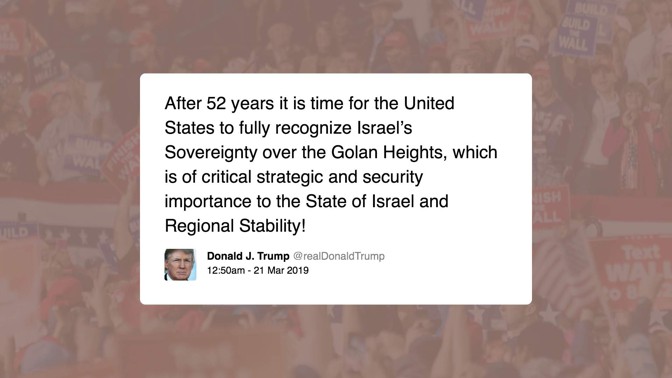
Long Time Coming: President Trump on Twitter encouraged the United States to recognize Israeli sovereignty over the Golan Heights, a disputed territory on the border of Israel and Syria. But this was no impulse tweet, Kathy Gilsinan writes: It was at least one year in the making.
What to Expect From the Health-Care Conversation: Despite the ongoing debate among Democrats over the future of universal health care, and the advantages and disadvantages of various Medicare for all bills, the 2020 presidential race won’t just be about single-payer health care, writes Ronald Brownstein: Trump still wants to repeal Obamacare.
A New Home for Hate: Since 2016, social-media companies like Facebook and Twitter have come under harsh scrutiny for allowing accounts to spread misinformation and preach white supremacy and other extremist ideologies. But that misinformation is also thriving on Instagram.
Four Big Myths: As the most segregated school system in the U.S. grapples again with diversity in its student body, the debate is rife with misunderstandings. One is the persistent myth that reforming the high-school admissions process will solve schools’ diversity problem.
The Art of the Argument: Most American families are in step with one another politically (though at least one family—the White House adviser Kellyanne Conway and her husband, George—made headlines in recent days for disagreeing publicly about the president). Here’s a framework for how to have a peaceful, productive political conversations with your family members.
With the Eyes of the World Upon Her: In the aftermath of the deadly mosque shootings in New Zealand, Prime Minister Jacinda Ardern has spoken out against publishing the gunman’s manifesto and announced a ban on semiautomatic weapons and assault rifles. Her leadership, and her country’s response, contrast with the standoff politics currently roiling the U.S. and Great Britain, writes Krishnadev Calamur.
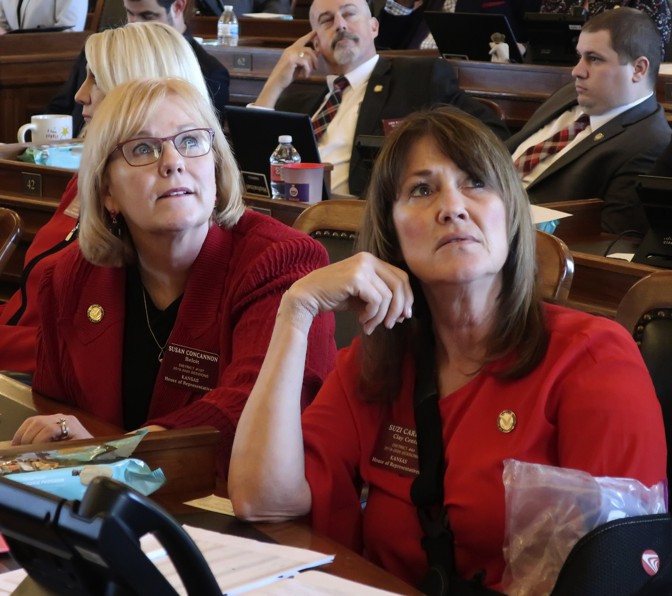
Kansas state Representatives Susan Concannon, left, and Suzi Carlson, right, watch an electronic tally board as the House approves a Medicaid expansion bill on Thursday at the Statehouse in Topeka. (John Hanna / AP)
Nazis Have Always Been Trolls (Adam Serwer)
“Ultimately, as with the New Zealand shooter, every joke, every pithy reference, every pretend gesture toward the moral standards of liberal democracy has the same punch line: We are going to kill you.” → Read on.
Chelsea Clinton in the Hall of Mirrors (Conor Friedersdorf)
“This episode illustrates that when the constant focus is on the boundaries of legitimate speech, little time or attention is left for substance. And what’s said to constitute bigotry keeps expanding without any apparent limit.” → Read on.
Midwestern Flooding Isn’t a Natural Disaster (Christine A. Klein)
“Back in the nation’s flooded regions, it is inspiring to watch midwesterners help one another rebuild. But the key is to rebuild without repeating past mistakes.” → Read on.
The Intensity of the Debate Makes It Hard to Formulate Sound Public Policy (David Frum)
David Frum responds to criticism of his latest story on immigration, “If Liberals Won’t Enforce Borders, Fascists Will”:
“But the existing people of the country, in all their imperfection—don’t they have to be a first concern? Immigration eases the consequences of disregarding their troubles, and corrodes the political consensus for social reform. Maybe it does not always have to be that way. But in the United States, it has been that way.” → Read on.
‣ Inside Alexandria Ocasio-Cortez’s Unlikely Rise (Charlotte Alter, Time)
‣Mitch McConnell: Nihilist in Chief (Alex Pareene, The New Republic)
‣How Trump Is on Track for a 2020 Landslide (Ben White and Steven Shepard, Politico)
‣Katie Couric Reflects on That Controversial 2008 Interview With Sarah Palin (David Mack, BuzzFeed News)
‣ Why Donald Trump Is Desperate for Britain to Declare Independence (Edward Luce, Financial Times) (? Paywall)
We’re always looking for ways to improve The Politics & Policy Daily. Comments, questions, typos, grievances and groans related to our puns? Let us know anytime here.
Were you forwarded this newsletter? Sign up for our daily politics email here. We have many other free email newsletters on a variety of other topics. Find the full list here.
JERUSALEM (AP) — Israeli warplanes on Friday struck some 100 Hamas targets in the Gaza Strip in response to a rare rocket attack on the Israeli metropolis of Tel Aviv. Rocket fire persisted into the morning, setting the stage for additional possible reprisals.
The army said that its targets had included an office complex in Gaza City used to plan and command Hamas militant activities, an underground complex that served as Hamas’ main rocket-manufacturing site, and a center used for Hamas drone development.
In Gaza, health officials reported four people wounded, including a husband and wife in the southern town of Rafah. There were no further details. The office building struck by Israel had been used by Hamas’ office of prisoner affairs.
The sudden outbreak of violence comes at a sensitive time for both sides, and it appeared that Israel and Gaza’s Hamas rulers had incentives to end the fighting.
Israeli Prime Minister Benjamin Netanyahu is in the midst of a tight re-election battle. A tough response would draw international criticism and domestic accusations that he is acting out of political motivations ahead of the April 9 vote. But a restrained response will draw criticism from his fellow hard-line rivals.
Hamas, meanwhile, is coping with its own domestic troubles. Israel and Egypt have maintained a crippling blockade on Gaza since Hamas took over the territory in 2007. The blockade, along with sanctions by the rival Palestinian Authority and Hamas’ own mismanagement, have fueled an economic crisis that has driven unemployment over 50 percent.
Shortly before the rocket attack, Hamas police on Thursday violently broke up a rare protest by demonstrators angry about the dire living conditions in Gaza.
The crackdown triggered heavy criticism on social media, raising the possibility that the rocket fire was a diversionary tactic. The organizers of a weekly protest along the Israeli border said they would cancel the demonstration in the wake of the escalation.
The fighting came as Egyptian mediators were trying to extend a cease-fire between the bitter enemies, which last fought a war in 2014. The Egyptians left Gaza late Thursday.
Hamas, which typically claims responsibility for its military actions, denied involvement in the rocket attack on Tel Aviv and even said it had undermined its interests. But Israel’s military said it had concluded the group was behind the attack.
“The IDF holds the Hamas terror organization responsible for all events transpiring in the Gaza Strip and emanating from it,” the military said in a statement.
The late-night attack Thursday on Tel Aviv, Israel’s densely populated commercial and cultural capital, marked a dramatic escalation in hostilities. It was the first time the city had been targeted since a 2014 war between Israel and Gaza militants.
Following the first Israeli airstrikes, several additional rounds of rocket fire were launched into Israel. The military said several rockets were intercepted by its air defense systems, and there were no reports of injuries.
The initial blasts from the Israeli airstrikes in southern Gaza were so powerful that smoke could be seen in Gaza City, 25 kilometers (15 miles) to the north. The Israeli warplanes could be heard roaring through the skies above Gaza City.
Israel and Hamas are bitter enemies and have fought three wars since the Islamic militant group seized power in Gaza in 2007. Smaller flare-ups have occurred sporadically since Israel and Hamas fought their last war, in 2014.
Despite its denial, Hamas is one of the only groups in Gaza with the means to strike Tel Aviv. A smaller militant group, the Iranian-backed Islamic Jihad, also possesses a large arsenal of rockets, though it too denied involvement.
Smaller Salafi groups inspired by the Islamic State group also operate in Gaza, though it is unclear whether they have powerful rockets capable of striking so deep inside Israel.
Brig. Gen. Ronen Manelis, the chief Israeli military spokesman, said the army had been caught off guard by Thursday night’s rocket barrage and had no advance intelligence.
Israeli Cabinet Minister Naftali Bennett, a hard-line rival of Netanyahu’s, called on the prime minister to convene a gathering of his Security Cabinet and demand the army “present a plan to defeat Hamas.”
Earlier this week, Israel struck Hamas targets in Gaza in response to rocket fire on southern Israel, near the border. Late Thursday, local media said that Egyptian mediators left the territory.
At the time, Netanyahu issued a warning to Hamas, rejecting suggestions that Israel would be reluctant to take tough action in Gaza ahead of national elections next month.
“I suggest to Hamas, don’t count on it,” he told his Cabinet. “We will do anything necessary to restore security and quiet to the area adjacent to the Gaza Strip and to the south in general.”
___
Akram reported from Gaza City, Gaza Strip.
Want the best from VICE News in your inbox? Sign up here.
Sixty years after China brutally squashed the Tibetan uprising against the Communist Party, it’s still ruling with an iron fist, making Tibet one of the least free regions in the world. But even as they continue to oppress Tibetan Buddhists, Chinese leaders are strategically leveraging Buddhism in their quest to dominate global trade.
Tibetans rallied this week to mark the 60th anniversary of the failed uprising, protesting the continued occupation of their land and restrictions on their freedom — tens of thousands of Communist cadres supervise Buddhist monasteries and villages, people are forced to replace pictures of the Dalai Lama with photos of Party leaders, and China boasts Tibet’s capital as its “safest” city.
“One of the prime requirements for monks and nuns is that they should be loyal to the Communist Party before they are loyal to their faith,” Bhuchung Tsering, the vice president of the International Campaign for Tibet, told VICE News. “Everything is being dictated by the Chinese Communist Party.”
Yet China has invested heavily in projecting itself as pro-Buddhist, for calculated reasons. Buddhists make up a huge population in countries that China wants to connect to its Belt and Road Initiative — a multibillion-dollar project to dominate global trade.
Take, for example, Myanmar. In the last decade, China has actively worked to improve religious relations with its southern neighbor, which is 88 percent Buddhist. In that same time frame, it spent $2.5 billion to build oil and gas pipelines and is now negotiating multibillion-dollar port and dam deals.
“China’s use of Buddhist diplomacy is significant because several of these countries are apprehensive of this giant power — whether all the loans they are taking from China will drive them into a debt trap,” Dr. Sudha Ramachandran, a South Asia analyst, told VICE News.
The latest case of China’s “debt-trap diplomacy” is Sri Lanka.
After the Chinese helped the country’s Buddhist majority win a decades-long civil war, Sri Lanka’s president gave China a billion-dollar port deal in his hometown. Eight years after the deal was signed, Sri Lanka was unable to pay back its loans and surrendered the Hambantota port to China for 99 years as repayment.
“In all these countries, you find that the public feels that, ‘Well if we want improved infrastructure, it is only the Chinese who are willing to, you know, extend loans.” Ramachandran told VICE News. “Yes, there is a concern, but there is no other alternative.”
This segment originally aired March 13, 2019, on VICE News Tonight on HBO.
The election body of Afghanistan decided this week to delay the country’s presidential election for a second time — toRead More
During an interview with CNN broadcast on Thursday’s “OutFront,” former DNC Chair Ed Rendell stated that “the 2020 election wentRead More
A handful of billionaire and millionaire donors from the failed “Never Trump” movement in the 2016 presidential election have enjoyedRead More
Freshman Dems to meet with Obama next week… (Third column, 8th story, link) Advertise here
Donald protective of me… (Third column, 7th story, link) Related stories:TODAY’S EPISODE: THE CONWAY SHOW!GEORGE: TRUMP WORST KIND OF DUMB…KellyanneRead More
Facebook will appear in court Friday hoping to keep private internal company emails that could reveal CEO Mark Zuckerberg knew about the Cambridge Analytica scandal far earlier than he told Congress.
Zuckerberg and his COO Sheryl Sandberg told Congress last year that they learned about Cambridge Analytica in December 2015, when the Guardian broke the news of the UK-based company.
However, a court filing by D.C. Attorney General Karl Racine suggests the company knew about the data scraping practices in September 2015 — and he wants to unseal employee emails to prove it.
Facebook admitted Friday that they were aware of an issue with Cambridge Analytica in September 2015 — but claim that issue was unrelated to the wider scandal that broke in December 2015 in which Global Science Research harvested the data of 87 million people before selling it to Cambridge Analytica, who then used it for political campaigns, including the 2016 U.S. election.
The outcome of the case is being closely watched by those seeking to hold Facebook to account for privacy violations.
“If Racine loses this case then Facebook rules the USA,” David Carroll, an associate professor at Parsons School of Design in New York who is also suing Cambridge Analytica in U.K. courts, told VICE News.
Facebook did not respond to VICE News’ questions about the court filing, but in a statement to the Guardian, the company said it “absolutely did not mislead anyone about this timeline.”
Racine filed a lawsuit against Facebook in December for allowing Cambridge Analytica to harvest the private data of tens of millions of users. Facebook has tried to dismiss the case, but Racine cited the emails as evidence in his opposition to the motion to dismiss.
The AG claims “as early as September 2015, a DC-based Facebook employee warned the company that Cambridge Analytica” was doing something. We don’t know what that something is, as it is currently redacted. Racine added that the employee “received responses [relating to] Cambridge Analytica’s data-scraping practices.”
Facebook’s top executives have repeatedly refused to give a detailed timeline of when the company first uncovered problems with how Cambridge Analytica was collecting and using user data.
“There is a lot of explaining to do about what was known by whom about what and when,” Emily Taylor, CEO of Oxford Information Labs, told VICE News.
Facebook watchers across the globe are eagerly awaiting the outcome of Friday’s hearing.
“If Facebook gets the case dismissed tomorrow then it’s a nothing burger [but] I can’t see how it gets dismissed. Racine has the case pretty well laid out,” Jason Kint, CEO of Digital Content Next who has chronicled the fallout of the Cambridge Analytica scandal, told VICE News.
Damian Collins, a British MP who has tirelessly sought to uncover the truth of how the Cambridge Analytica scandal unfolded, tweeted that Racine’s filing “could suggest that Facebook has consistently misled the Digital, Culture, Media and Sport Committee about what it knew and when about Cambridge Analytica.”
Collins and his colleagues obtained the same emails during their investigation. In the committee’s final report they referred to the emails but did not publish them.
While it has been European lawmakers and regulators that have been at the forefront of investigations into Facebook’s data collection and privacy practices, U.S. authorities now appear to be stepping up.
The FTC is reportedly preparing a multi-billion dollar fine for privacy violations, and FTC Chairman Joe Simons told senators recently that the agency was planning a wide-ranging investigation of tech companies’ data practices.
READ: Facebook’s political ad tool let us buy ads “paid for” by Mike Pence and ISIS
Facebook has been on the receiving end of a continuous torrent of negative press for more than two years but it continues to make huge profits and the impact of these stories on its commercial viability appears minimal.
“While it seems like they are in the perpetual naughty corner from the lawmakers’ perspective, they continue to be an outstanding commercial success,” Taylor said.
Cover image: Facebook CEO Mark Zuckerberg (C) testifies at a joint hearing of the Senate Judiciary and Commerce committees on Capitol Hill in Washington D.C., United States, on April 10, 2018. (Xinhua/Ting Shen via Getty Images)
Mark Walsh has a first-hand look at yesterday’s argument in Flowers v. Mississippi, which asks whether a prosecutor’s repeated use of peremptory challenges to remove black people from the jury pool violated the Constitution, for this blog. At NPR, Nina Totenberg reports that the court “signaled strongly … that it is likely to rule for a death row inmate in Mississippi who was prosecuted six times for the same crime by a prosecutor with a history of racial bias in jury selection.” At The National Law Journal (subscription or registration required), Tony Mauro reports that “[a] key issue in the argument was whether the Supreme Court, in deciding the case before it, could take into consideration only Flowers’ most recent trial or also look at the race-laced record of the previous five trials.” At The Daily Caller, Kevin Daley reports that “[t]he Supreme Court seemed largely united in its sympathy for Flowers and in the feeling that [prosecutor Doug] Evans’s prior conduct was relevant.” Jess Bravin reports for The Wall Street Journal that the “dramatic arguments … concluded with a rare question from Justice Clarence Thomas.”
Yesterday the justices released two opinions. Obduskey v. McCarthy & Holthus LLP, the court held unanimously that the definition of “debt collector” under the Fair Debt Collection Practices Act does not include attorneys who effect nonjudicial foreclosures. In a per curiam opinion, the court also sent Frank v. Gaos, a case involving “cy pres” settlements, which distribute the proceeds of a class action to a charity if it is not feasible to compensate the class members directly, back for the lower court to determine whether the plaintiffs have a legal right to sue. Ronald Mann analyzes the opinion for this blog. At the National Law Review, Gregory Sczewczyk and Philip Yanella write that “[t]he Court’s holding serves as a reminder that despite the recent trend in finding standing for privacy violations, it can still be an open issue.” Also at the National Law Review, Joshua Dunlap notes that a dissent by Justice Clarence Thomas “indicates the uncertain footing of cy pres settlements, or at least cy pres-only settlements.”
Jennifer Chacón analyzes Tuesday’s opinion in Nielsen v. Preap, which held that a noncitizen does not become exempt from mandatory detention if, after he has been released from criminal custody, immigration agents do not take him into immigration custody immediately, for this blog. David Savage covers the opinion for the Los Angeles Times. At The Economist’s Democracy in America blog, Steven Mazie writes that “[a] long-running disagreement over how to read statutes fuels the split between the court’s liberals and conservatives.” Commentary on the case comes from Kent Scheidegger at Crime & Consequences, here and here.
This blog’s analysis of Tuesday’s opinion in Washington State Department of Licensing v. Cougar Den Inc. in which the court ruled that members of an Indian tribe are exempt under an 1855 treaty from paying state taxes on fuel transported to the reservation on public highways, comes from Bethany Berger. At Bloomberg Law, Kimberly Robinson reports that the case suggests that “Justice Neil Gorsuch may prove to be a reliable vote for tribal groups coming before the U.S. Supreme Court.”
Briefly:
We rely on our readers to send us links for our round-up. If you have or know of a recent (published in the last two or three days) article, post, podcast, or op-ed relating to the Supreme Court that you’d like us to consider for inclusion in the round-up, please send it to roundup [at] scotusblog.com. Thank you!
The post Thursday round-up appeared first on SCOTUSblog.