


Top Tag

Exclusive: Cory Booker says weed legalization must include justice for victims of war on drugs

WASHINGTON — Unlike in recent elections, the debate over whether to legalize cannabis is largely settled among the current field of Democratic presidential candidates. But the question over how to end the federal prohibition on marijuana is now dividing at least two top Democratic contenders.

Massachusetts Democratic Sen. Elizabeth Warren is once again a lead sponsor of the bipartisan STATES Act, which would end the outright federal prohibition on marijuana by allowing each state to decide its own pot policy. But that proposal no longer goes far enough for her presidential primary opponent Sen. Cory Booker.

On Monday, the New Jersey Democrat introduced a standalone bill to study reparations for the descendants of slaves, and he’s withholding support for the STATES Act because he believes it doesn’t do enough to address the harm that the war on drugs has done to minority communities across America, including his hometown of Newark.

“At this point it’s too obvious and urgent and unfair that we’re moving something on marijuana on the federal level and it doesn’t do something on restorative justice,” Booker exclusively told VICE News outside the Capitol Tuesday. “I want that bill to have some acknowledgement of the savage injustices that the marijuana prohibition has done to communities.”

The STATES Act was seen as a game changer in the last Congress, because it split the difference between the two party’s acceptable approaches to legalization by allowing each state to decide if and how to legalize marijuana. Booker signed on to it even before it was publicly dropped last year, as did a bipartisan group of 10 other senators.

Momentum grew for legalization last year and crested during the 2018 midterms after a Pew Research Center poll came out showing 62 percent of Americans were on board with legal weed. Despite that support, Booker says he’s no longer fine with just passing something — he wants any bill to address a broader social justice agenda.

Instead, Booker’s aim is now to expand support for his Marijuana Justice Act, which was first introduced in 2017 and, unlike Warren’s bill, doesn’t include a single Republican sponsor. It removes cannabis from the list of controlled substances while also expunging the records of anyone locked up for use or possession charges. That measure also sets up a “community reinvestment fund” that would put money into job training programs and community centers in the areas left most blighted by the war on drugs.

It maintains the support of every Democratic senator running for president, except Minnesota Democratic Sen. Amy Klobuchar, whose office didn’t immediately respond to VICE News’ request for comment .

Booker says his line in the sand — that social justice has to be a part of any legalization effort — has been building for some time.

“I get very angry when people talk about legalizing marijuana and then give no light to how marijuana law enforcement was done in ways that fed upon poor communities — black and brown communities,” Booker said. “This is a war on drugs that has not been a war on drugs — it’s been a war on people, and disproportionately poor people and disproportionately black and brown people.”

But Warren says her bill and Booker’s aren’t mutually exclusive. She told VICE News that she considers the STATES Act a first step in the process, which is why she also supports his Marijuana Justice Act.

“I support full legalization and restorative justice,” Warren told VICE News. “I also support having the federal government back off when the states have already legalized marijuana — and bringing those businesses into the banking system and into the tax system.”

In the last Congress, Warren’s STATES Act received broad bipartisan support, and it’s lead Republican sponsor, Sen. Cory Gardner, Republican of Colorado, even says he’s gotten President Donald Trump to endorse it. Now, Gardner’s scratching his head over Booker’s change of heart.

“Well, it sounds like I need to talk to Cory Booker about fixing a federal-state conflict,” Gardner told VICE News at the Capitol. “This is about fixing a conflict in federal and state law that needs to be done, and it’s pretty simple. So I think he would be hard pressed to vote against it.”

The demand for a restorative justice, or community oriented, approach isn’t confined to Booker alone. Rep. Alexandria Ocasio-Cortez, Democrat of New York, told VICE News that if the local communities with the highest minority incarceration and poverty rates that have directly stemmed from the decades long war on drugs are not included, then she’s not on board either.

“I think it’s critical, because if we do not address the restorative justice piece in tandem with the industry legalization piece then what we’re doing is A) Compounding upon the racial wealth gap and B) Creating an even larger price tag on the war on drugs,” Ocasio-Cortez told VICE News just off the House floor.

Ocasio-Cortez says the inequality of the drug enforcement movement can’t be allowed to continue as inequality in the nation’s burgeoning cannabis industry.

“What it could allow is just the folks who got rich off of private prisons to just roll over and then get even richer on the legalization of marijuana by getting a first mover advantage with their existing capital,” she said.

Cover: Sen. Cory Booker, D-N.J., and Sen. Elizabeth Warren, D-Mass., hold a news conference in the Capitol to introduce the “Dignity for Incarcerated Women Act” on Tuesday, July 11, 2017. (Photo By Bill Clark/CQ Roll Call) (CQ Roll Call via AP Images).
Two Incisive Marxist Accountings of Past and Present

An Anthropology of Marxism, Second Edition
by Cedric J. Robinson
The University of North Carolina Press, 204 pp., $29.95

The Dialectic and the Detective: The Arab Spring and Regime Change in Libya
by Julian Lahai Samboma
Ebeefs Press, 176 pp., $6.99

Two impressive volumes, both by estimable and talented dialecticians of African descent, have recently been published which I cannot recommend highly enough. Individually the titles are engaging and worthwhile reads. However, as a duology, they provide a narrative history of the past and the present while demonstrating the utility of the Marxian dialectic.

The late Cedric J. Robinson authored over the course of his magisterial academic career an inter-connected and all-encompassing corpus that can be called “The Black Radical Tradition.” In his Black Marxism, Terms of Order, and Forgeries of Memory and Meaning, the late scholar described a dialectic of world-historic proportions, the thesis of racial capitalism and the antithesis of how African-descended people were at the forefront of the resistance to it in the praxis of the Black Radical Tradition. By elaborating upon this praxis, Robinson offered a sustained, astonishing, and profound critique of Marx’s thought and its various descendants for the undeniable dearth within its matrix when it came to anti-Black racism and its function within the ontology of capital.

An Anthropology of Marxism began life as a graduate seminar course reader Robinson authored for his students and was previously published by a small British press in 2001. While he obviously familiarized himself with well-known histories of Marxism (most notable perhaps being the reactionary polemic Main Currents of Marxismby Leszek Kolakowski and the much more respectable and progressive academic titles by David McLellan such as Marxism After Marx), the scope and daring of the inquiry demonstrates how original this scholar truly was.

Using a multitude of sources that most Marxists are simply oblivious of (or alternatively ignore owing to unfair biases inherited from Marx and Engels), the historic arc of socialism is expanded to begin with the collapse of the Roman Empire. Robinson shows that capitalism and socialism were two forms of rebellion, deployed simultaneously by the rich and the poor respectively, that were intended to break society free from the grip of the feudal system. Patterns and habits of governance and social organization (mutual aid, communal ownership of the means of production, welfare programs attenuated to the needs of vulnerable populations, et. al.), otherwise called socialism, have a long heritage that dates back to radical heretical Christian sects, like the Poor Clares and the Franciscans, and their relegation to the dustbin of intellectual history named “utopian socialism” by Marx and Engels is a disservice to contemporary activists that Robinson clearly felt needed to be surmounted. (Indeed, the irony, that Marx and Engels never actually elaborated clearly on a programmatic framework for their allegedly superior “scientific socialist” praxis going beyond the sparse coordinates in works like The Critique of the Gotha Program, a longtime source of consternation for Marxist-inclined governments and politicians, is obvious.)

The volume is multi-disciplinary, including succinct and precise summaries of major philosophical challenges scholars, most notable being a summary of Hegel’s impact on the genesis of Marx’s thought, that I found both insightful and refreshing. After literal years of trying to understand the German idealist’s utility for small-c communist activism, Robinson provided me in several paragraphs a clear answer to a query that otherwise might have consumed a decade of intellectual wanderings. Similarly, readers are given a concise and useful understanding of how the major Marx/Engels texts related to contemporaries within groupings such as the Young Hegelians and English economics, not to mention heirs like Kautsky, Lenin, and Mao, in a way that throws doctrinaire historiographic notions to the wind in the name of intellectual honesty. He concludes the volume with this brilliant paragraph, “Both in the West and the world beyond, the socialist impulse will survive Marxism’s conceits just as earlier it persevered the repressions of the Church and secular authorities. The warrant for such an assertion, I have argued, is located in history and the persistence of the human spirit. As the past and our present demonstrate, domination and oppression inspire that spirit in ways we may never fully understand. That a socialist discourse is an irrepressible response to social injustice has been repeatedly confirmed. On that score it has been immaterial whether it was generated by peasants or slaves, workers or intellectuals, or whether it took root in the metropole or the periphery.” As we see the renaissance of Black radical politics today materialize in Ferguson and under the banner of #BlackLivesMatter/Movement for Black Lives, this forecast is indeed reassuring.

The Dialectic and the Detective is a different kind of book but should appeal to a similar audience. Here Julian Lahai Samboma has created a useful primer that demonstrates the methodology of dialectically interrogating a recent event, the NATO destruction of Gaddafi’s Libya, in a structured and precisely enunciated fashion. Some readers might understandably take issue with the prose and its step-by-step enunciation but perhaps this is a virtue for the proper audience. In the Anglophonic world, dialectical reasoning is completely foreign to a conventional wisdom where English empiricism instead is the predominant philosophical framework that is espoused within the education system. From the earliest school days, children are taught to think in terms that find their ancestry in Francis Bacon and John Locke. Dialectics of any persuasion, idealist or materialist, is a methodology that seems not only confusing but outright ridiculous. Samboma guides the reader through an approach to a recent event as a case study in Marxian dialectical reason that is useful for students making their preliminary approach to such analytical efforts.

 In terms of subject matter, the volume does not explicitly say so but this episode of American-led Western imperialism is not only recent but the central moment that has catalyzed our contemporary socio-economic and political landscape’s geography. Hillary Clinton’s war on Libya sparked the fuse that led to not only the destruction of the Arab Jamahiriya but the current xenophobia-inspired anti-immigrant ascendancy of the far right in Europe, the election of Donald Trump in the United States, and the infiltration of the Syrian civil war by weapons and right wing fighters that had origin in Tripoli.

Today, refugees from Africa and Syria perilously travel across the Mediterranean through a gateway that was previously blocked by Gaddafi, creating an influx of refugees in the already austerity-wracked European Union that inspires opportunism in reborn fascist political parties. 

Clinton’s decision to use a private email server while serving as Secretary of State was motivated at least in part to circumvent public records laws about official correspondence, a practice gleaned from the previous George W. Bush administration, and therefore one is compelled to deduce that included obscuring the origins of the attack on Libya, which in turn trace back to, among other things, personal financial gain for the Clinton Foundation and its operatives like Sidney Blumenthal. That email scandal, a goldmine for the conspiracist-inclined loons in the Republican base, provided Donald Trump with reams of talking points that were undeniable and gave him an edge when combined with his economic populist and nativist rhetoric. The humanitarian disasters that we have seen occur at home and abroad since Election Day 2016, in other words, are indebted to the Libya disaster, providing a haunting illustration of Aíme Césaire’s theory of fascism as boomeranging imperialism from Discourse on Colonialism.

If Robinson’s corpus explains the historical precedents that activists derive guidance from, Samboma provides a novel way for understanding the forces they oppose and why. His approach to the Arab Spring furthermore offers a novel take that accommodates the nuances of those popular uprisings, neither endorsing the idea that it was entirely a revolution from below nor the argument it was all a CIA-sponsored plot that was targeting Iran and other opponents in the region. And by framing things in the form of a detective narrative making reference to the popular Columbo series starring Peter Falk, we read something that has a dose of whimsy, which is certainly welcome in proceedings that are oftentimes arid in tone and brutal by nature of the history.

The opportunity to have a guidebook for interrogating these developments with a Marxian dialectical framework is a different experience and might strike readers in an off-key manner. But for professors teaching seminars on dialectics I think this is a very good textbook that furthermore will not kill student wallets, always an added virtue.

The New Political Bosses Come for Joe Biden

Most of the commentary that’s surrounded Joe Biden’s touchy-feely approach to interpersonal relations misses what it tells us about the nature of presidential politics today. Biden is under attack by what we might call the New Bosses of politics, and it looks like they’re going to chew him up and spit him out. The likely result: exeunt Joe Biden from the presidential race before it even begins.

And who are these New Bosses? Well, they certainly aren’t the old-fashioned kind, those machine pols of a bygone era who controlled the party apparatus in the states and thus held the greatest influence over who would go to national conventions and choose the party’s presidential candidates. Those guys have been neutered by waves of reforms that emerged in the 1960s and ‘70s to address the perceived problem of the old system being insufficiently democratic.

So now pollsters, commentators, and money guys have assumed the role that the old machine pols once played—winnowing down the field before the voters have a chance to cast a single ballot. The irony here is hard to miss, yet it gets almost no attention as the newfangled process proceeds.

For purposes of explanation, some history is in order. Until relatively recently, most state parties controlled the selection of national convention candidates—and by extension, the eventual nominee—through caucus systems and state conventions. This approach gave rise to the so-called smoke-filled rooms, where the inside game was played in a carefully controlled environment.

True, a reform surge in 1912 resulted in more and more state primaries choosing convention delegates and nominees. But that system never really took root until much later, and it became clear with historical perspective that the reforms were largely a ploy by Theodore Roosevelt to upend the reelection prospects of the sitting Republican president, William Howard Taft. Taft had been TR’s cherished friend and chosen successor until Roosevelt came to identify him as a major impediment to his reclaiming the White House. Roosevelt’s fiery slogan, “Let the people rule,” later lost some of its luster when, running as a third-party candidate, he instructed his convention to exclude Southern blacks as a sop to conservative Southern whites. “I believe that the great majority of the Negroes in the South are wholly unfit for suffrage,” TR declared, demonstrating that he wasn’t above letting just some of the people rule if it enhanced his electoral prospects.

In subsequent decades, the primary became enshrined in the politics of both parties—but only in a few states and designed largely to help party bosses glean the vote-getting capacities of the leading candidates. A good example involved John F. Kennedy’s 1960 nomination bid. He won the Wisconsin primary that year, but not by enough to convince the bosses that he could overcome the Catholic issue. So the bosses made clear that Kennedy and his entourage would have to trudge down to the next primary state, West Virginia, to prove he could cadge votes from Protestants. He did and was awarded the nomination.  

This tells us that the bosses had one thing most firmly in mind—electability. They wanted to weed out candidates who might bring their parties down with scandal or veer off into unseemly ideological territory or generally run dumb campaigns. It wasn’t very democratic, but it worked. The bosses were the gatekeepers. They determined whether an ambitious politician really had the chops to enter the race.

But then the reformist zeal of the ‘60s and ‘70s yielded up a new system of almost endless primaries. Now, it was said, the people would finally be allowed to rule.

But consider how this system has evolved over the decades. First, presidential campaigns began earlier and earlier: they now start at the beginning of the year before the campaign year. And what kind of campaign is it? Do the people choose? No, this early campaign doesn’t involve voters. It is designed to determine, through extra-political means, who gets to be a candidate and what kind of standing the candidates will have as they enter the balloting season.

It works like this: first, the pollsters assess where these candidates stand with the voters. Of course, this is based merely on public opinion surveys at a time when the voters haven’t really begun thinking about the election at all. So it’s largely a matter of name recognition. Obscure office-seekers begin with a handicap.

Then the commentators weigh in, particularly the cable news people, based in large measure on those polls. If you don’t look good in the polls, you aren’t taken seriously by the talking heads, and that can stymie your political standing before you even get started. Also, your fundraising prospects become increasingly dim.

Then come the debates. With a large field, as we had in 2016 with the Republicans and have this year with the Democrats, you don’t even get into the debates unless you have demonstrated a certain level of fundraising prowess and standing in the polls. That standing will likely determine where you end up in the debate lineup—at the center, conveying extra gravitas, or at the ends, showing also-ran status.

Then your performance in the debates will be endlessly picked over and assessed by the talking heads, and a new round of vetting begins. The pundits tell the country who’s up and who’s down, and that influences the poll results and fundraising all over again.

Now bear in mind that, while all of this is going on, no one has cast a single vote for anybody. But the vetting process still runs. The haunting question is whether the attributes that generate success in this pre-vote process are the ones needed to run the country—or even to run a traditional campaign in which the voters are at the center of it all.

This entire pre-campaign campaign has only become more treacherous with the rise of political correctness and the #MeToo movement. That’s because small rivulets of angry political sentiment can be amplified by the cable guys into something far more politically significant than they really are.

Which brings us back to Joe Biden. David Brooks said it well on the PBS NewsHour the other evening when he noted that some of the touchy-feely practices of old-fashioned pols made him uncomfortable when he first encountered them. But he came to understand that this was just a part of life practiced by certain kinds of people who were not trying to signal anything sexual or unbecoming. It may be easy to laugh at Biden’s suggestion that he got caught in a warp of changing social custom, but it happens to be true. And as Brooks pointed out, there is no reason to see this as demonstrating a lack of character on the part of Biden, who through nearly five decades of public service, in the eye of national scrutiny, has not stirred even whispers about sexual wandering or abuse.

But it probably won’t matter. The New Bosses of our political system are in the process of passing judgment on Uncle Joe in lieu of the voters. They’re the vetters now, and they do their work without sentimentality or even a discernible degree of compassion. The smoke-filled room has been supplanted by the green room, and the result isn’t more democracy, just an uglier version of the old kind.

Robert W. Merry, longtime Washington journalist and publishing executive, is the author most recently of President McKinley: Architect of the American Century.

The Atlantic Politics & Policy Daily: A Barr Walks Into Congress

What We’re Following Today

It’s Tuesday, April 9.

Barr Some: At a congressional budgetary hearing, Attorney General William Barr told lawmakers that they’ll receive a copy of the Mueller report “within a week.” But the copy they get will be heavily redacted—and Congress isn’t too happy about that, reports Russell Berman.

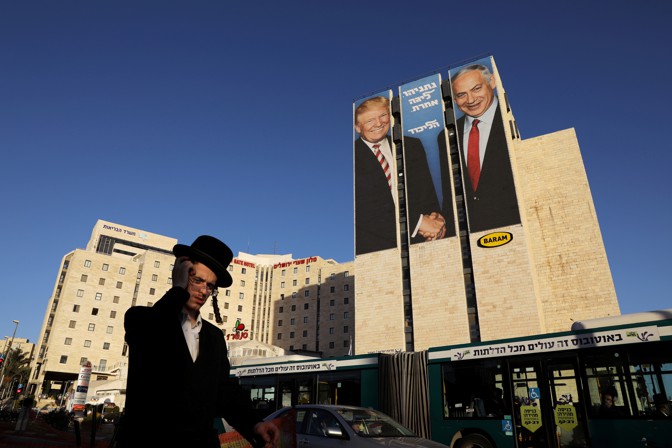
A Crossroads for Israel: Israel’s general election on Tuesday was a tight race between Prime Minister Benjamin Netanyahu and his challenger, the former military chief Benny Gantz—both of whom are claiming victory. During the run-up, Netanyahu’s opponents accused him of damaging the relationship between Israel and diaspora Jews, and recent events have exposed the depth of those fractures. Under Netanyahu’s government, discontent among liberal and middle-of-the-road Jews will likely escalate, writes Emma Green, and “marks a pinnacle in the fracture between Israeli and American Jews.

A man in Jerusalem walks past a Likud campaign billboard depicting President Donald Trump shaking hands with Israeli Prime Minister Benjamin Netanyahu. (Ammar Awad / Reuters)

Raising Cain: Trump wants to nominate the former presidential candidate Herman Cain to the Federal Reserve Board. Cain isn’t exactly “taken seriously” by the political establishment, but his potential nomination shows that Trump is moving to strengthen his grip on the central bank—just in time for 2020, reports Peter Nicholas.

Invisible Middlemen: Before the heads of five pharmacy benefit managers (PBMs)—often known as pharmacy “middlemen”—testify before Congress this week about high drug prices, Olga Khazan examines the outsize role PBMs play in how patients receive care. They handle rebates and payments between drug manufacturers, health insurers, and pharmacies, and their role as middlemen can slow down the delivery of crucial medicine, which sometimes proves deadly.

Madeleine Carlisle and Olivia Paschal


Snapshot

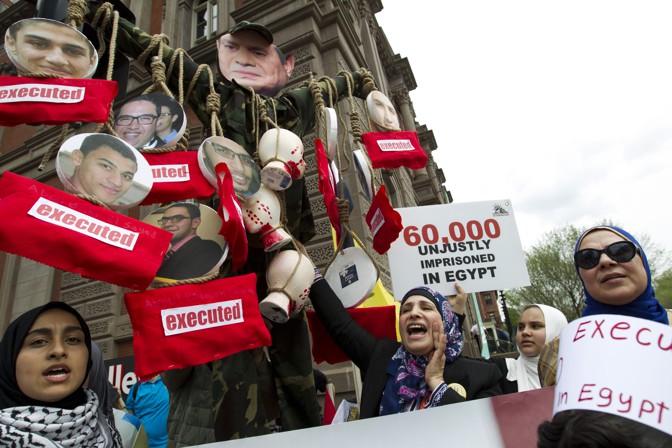
Demonstrators protest against Egyptian President Abdel Fattah el-Sisi near the White House, as President Donald Trump meets with el-Sisi. (Jose Luis Magana / AP)


Ideas From The Atlantic

Troubled Countries Can’t Keep People From Leaving (Eliza Willis and Janet Seiz)
“The same factors that lead to outmigration—crushing poverty, widespread crime and violence, and weak government institutions—also limit these governments’ ability to entice residents to stay.” → Read on

Elizabeth Warren Had Charisma, and Then She Ran for President (Peter Beinart)
“Warren’s troubles … are being compounded by journalists who analyze her image without recognizing how bound up it is with her gender. The media aren’t responsible for the fact that many male, and some female, voters demand that women presidential candidates work so much harder to prove their competence—and then react negatively once they do so. But journalists do have an obligation to explain what’s going on.” → Read on

Democrats Need to Emphasize Responsibility, Not Just Rights (Rahm Emanuel)
“We can begin by issuing a simple but powerful call: a policy that requires all 18-year-olds to give at least six months of their life to national service. People from different walks of life, with different backgrounds, would serve with one another as a rite of passage.” → Read on

It Wasn’t ‘Verbal Blackface.’ AOC Was Code-Switching. (John McWhorter)
“Ocasio-Cortez’s critics seem to assume that since she is not black, her use of Black English must be some kind of act. This, however, is based on a major misreading of the linguistic reality of Latinos in America’s big cities.” → Read on

Obama’s Presidential Library Is Already Digital (Dan Cohen)
“As the highly anticipated Obama Presidential Library in Chicago morphed into the Obama Presidential Center—without a place to hold the records of his administration—reactions ranged from slight confusion to rote dismissiveness … Is a digital library a library?” → Read on


What Else We’re Reading

The Democratic Electorate on Twitter Is Not the Democratic Electorate in Real Life (Nate Cohn and Kevin Quealy, The New York Times)  (? Paywall)
Will Congress Leave the Colorado River High and Dry? (Naveena Sadasivam, Grist)
Congress Is About to Ban the Government From Offering Free Online Tax Filing. Thank TurboTax. (Justin Elliott, ProPublica)
‘Beto’ and Other Names in Politics and Life (Jay Nordlinger, National Review)
I Worked as a Bail Bond Agent. Here’s What I Learned. (Joshua Page, The Appeal)

And One More Thing …

‘We Can Do This’: The documentary Community Patrol, which premiered today on The Atlantic, depicts a crime-ridden area of Detroit attempting to police itself rather than report offenders to the police.

We’re always looking for ways to improve The Politics & Policy Daily. Comments, questions, typos, grievances and groans related to our puns? Let us know anytime here.

Were you forwarded this newsletter? Sign up for our daily politics email here. We have many other free email newsletters on a variety of other topics. Find the full list here.

Home Ethos About Contact
Terms Policy GDPR RichTVX
© Saeculum XXI U.S. Intelligence News