


Top Tag

Somaliland: A Success Story Without the Billions and Bombs

Somaliland is a success story in a part of the world where those are rare. For 27 years, the self-declared state—with little outside assistance—has defied the odds. In contrast with Somalia, from which it declared its independence in 1991, Somaliland has enjoyed years of relative stability and democratic governance.

The autonomous but unrecognized Republic of Somaliland has also eradicated piracy from its shores and thwarted the jihadist group al-Shabaab’s expansion within its borders. Somalia hasn’t managed any of this, despite the billions of dollars expended by the international community over nearly two decades.

Rather than spending money it has never had on advanced weaponry, drones, and a large unwieldy army, Somaliland has instead focused on the two things that always form the backbone of successful counter-terrorism and counter-insurgency: good governance and reliable human intelligence. The two are almost always linked.

Good governance guarantees buy-in and cooperation from communities whose members are on the frontlines of the war against extremists. The government of Somaliland recognized this early on when it developed its anti-piracy program.

Those anti-piracy efforts denied maritime gangs access to its shores and coastal waters at a time when pirates based in Somalia and Puntland, a semiautonomous region directly south of Somaliland, were attempting to hijack vessels on an almost daily basis (40 were successfully stolen in 2008). In Somalia and Puntland, pirate gangs had free rein in many areas and became mainstays of the local economies.

The overall cost of Somaliland’s anti-piracy program was less than $500,000 in 2010, when, during the same period, the U.S. and its international partners were sinking hundreds of millions off the coast of Somalia. These international efforts did reduce incidents of piracy but they did little to combat the problem on the ground in Somalia and Puntland, where many pirate gangs simply shifted from hijacking to kidnapping. Some pirates went on to join al-Shabaab.

In contrast, Somaliland’s program dealt directly with the problem by preventing pirates from establishing ties to local communities. The government of Somaliland ensured that coastal areas played a leading role, becoming its eyes and ears. At the cost of a few cell phones, Somaliland established a highly effective early warning system that allowed communities to report suspicious activity and provide the very local and immediate intelligence that is critical to fighting piracy.

Somaliland’s government learned a great deal from its anti-piracy efforts and applied those lessons to its equally successful counter-terror operations. Just as with the fight against pirates, community engagement remains central to the battle against al-Shabaab. Somaliland does not rely on drones, military contractors, or any of the other expensive trappings of the counter-terror programs of its southern neighbors. Instead, the key element of its operations are the people it defends. The best intelligence, which is critical to fighting a group like al-Shabaab, is not produced as a result of coercion or payments. Instead, Somaliland pays for the information provided by its citizens by maintaining a government they can participate in and rely on—at least much of the time—to respond to threats to their communities.

By comparison, al-Shabaab remains a potent force in Somalia despite the billions of dollars spent trying to eradicate it. The U.S. government alone spends tens of millions annually on its counter-terrorism efforts in Somalia, where it relies on drones, Special Forces raids, dubious and poorly led militias, and military contractors to battle al-Shabaab.

In addition to American efforts and expenditures, the African Union Mission in Somalia (AMISOM) has deployed thousands of soldiers supplied with heavy weaponry and air support to combat al-Shabaab. Yet despite their overwhelming numerical and technological superiority, al-Shabaab persists and remains a highly capable foe.

The reason for this is that the leadership of al-Shabaab understands what all successful insurgent groups understand: predictability, reliable governance, and community engagement are critical to maintaining support. The governance that al-Shabaab provides is brutal but at the same time it is predictable and rarely arbitrary. The government of Somalia is slowly building its capacity to govern but still fails to provide its citizens—especially those living in areas away from urban centers—with the level of consistent security that al-Shabaab does.

This is evidenced by the fact that many Somalis actually seek out courts run by al-Shabaab rather than those operated by the Somali government. This is because al-Shabaab’s courts issue verdicts quickly, offer arbitration that is often in line with local customs, and are more capable of enforcing verdicts and arbitration. Even in the Somali capital of Mogadishu, al-Shabaab-linked clerics and qadis run a parallel justice system that is favored by some residents.

Al-Shabaab understands exactly what the government of Somaliland understands: that consistent governance is fundamental to maintaining the support of communities. The support it’s gained as a result is exactly what an insurgent group needs to persist and even defeat a better-armed adversary. But in Somaliland’s case, that support has fallen behind the democratic government, which has allowed the authorities to consistently thwart and defeat terrorists. This is the only weapon that will work in the war on terror over the long term: good governance in which citizens can participate and take pride.

Michael Horton is a foreign policy analyst who has written for numerous publications, including Intelligence Review, West Point CTC Sentinel, The Economist, The National Interest, and The Christian Science Monitor.
New documents show Mueller was interested in Cohen for a whole lot more than hush money payments

WASHINGTON — Long before FBI agents arrived at his door in April 2018, Michael Cohen was in deep trouble with the law.

Federal officials had been investigating Cohen for nearly a year — since July 2017 — over a laundry list of possible crimes. The feds knew about the $83,333 he’d been getting paid every month in consulting fees by a firm linked to a billionaire Russian oligarch widely seen as close to Russian President Vladimir Putin, and they had reviewed a lengthy paper trail covering Cohen’s suspicious statements to banks.

Only later, according to the documents, while investigating those issues, did investigators find evidence Cohen had also arranged illegal hush-money payments, in the middle of the 2016 campaign, to women claiming they’d slept with President Trump.

New search-warrant records unsealed Tuesday reveal that Special Counsel Robert Mueller’s office began probing President Trump’s former attorney almost a year earlier than has been previously acknowledged, with an early emphasis on a series of sketchy foreign consulting payments and Cohen’s personal finances.

The new documents change the public timeline of Mueller’s Russia investigation by showing an intense, early focus on Cohen’s money, one that later blossomed into other charges of campaign finance violations.

The documents help explain why Cohen eventually split off from Trump — the boss he’d once vowed he’d take a bullet for — by underscoring just how much pressure Cohen was under from criminal prosecutors by the time he eventually pleaded guilty and began cooperating in August 2018.

“I think Mueller’s office would have looked at these payments and wondered whether they were part of the bigger picture of Russian involvement in the 2016 election,” said Charles A. Intriago, a former federal prosecutor and an expert on money laundering. “And my view is that they were indeed part of a broader Russian strategy to get closer to Cohen and to the administration.”

An impressive pile of evidence had already been stacked up against him, even before FBI agents raided his apartment, office, hotel room, and safe deposit box in April 2018, in the moment when the investigation into Cohen burst into public view.

Cohen’s foreign money

The new documents reveal Mueller investigated Cohen over a host of potential crimes that were never actually charged — including operating as an unregistered agent of a foreign government, potential money laundering, and wire fraud.

FBI agents working with Mueller obtained their first warrant on a Gmail account used by Cohen in July 2017, just two months after Mueller was appointed to investigate Trump’s links to Russia that May.

They took out two more warrants on Cohen’s email and iCloud accounts in August and November.

While probing foreign payments and suspect loan applications, investigators “obtained evidence that Mr. Cohen had also committed a criminal violation of campaign finance laws,” the April 2018 documents say. Materials found in those inquiries were sent to prosecutors in Manhattan in February 2018.

Cohen ultimately pleaded guilty to eight counts of financial crimes brought by the Southern District of New York, including six related to his personal finances. He also pleaded guilty to two more counts relating to campaign finance violations stemming from the hush-money payments.

The documents don’t specify which foreign government Mueller first suspected Cohen might be working for.

But they do say investigators knew Cohen had received some $3 million in fishy-looking payments, including from foreign businesses, just days after then-boss entered the White House.

Other press reports have recounted how Cohen, who wasn’t given a job in the Trump administration, pitched himself as an advisor to outsiders attempting to understand the new president, and signed contracts for hefty consulting fees.

The new documents recount how Cohen began receiving payments from an investment company linked to Russian billionaire oligarch Viktor Vekselberg on roughly January 31, 2017, just 11 days after Trump was sworn into office. The Russia-linked investment company, Columbus Nova LLC, paid Cohen a total of $583,332 in monthly installments of $83,333, the documents say.

Investigators also noted that Cohen took $600,000 from Korea Aerospace Industries Ltd., a South Korean weapons-maker. At the time, the firm was trying to score a $16 billion jet fighter contract from the Trump administration.

Swiss drug-maker Novartis and U.S. telecom AT&T also paid Cohen hefty consulting fees.

Investigators saw that money flow as highly suspect, and noted that they didn’t look like simple real estate consulting payments that Cohen had told the bank his account would be used for.

The payments “do not reflect the stated profile for the residential and commercial real-estate consulting services,” an FBI special agent wrote in one of the documents in April 2018.

Columbus Nova would later insist in a statement that it had retained Cohen’s services “as a business consultant regarding potential sources of capital and potential investments in real estate and other ventures.” AT&T would say the payments were aimed at tapping Cohen’s insights about Trump, and “understanding the new administration.”

The documents say Cohen ultimately used those payments for personal expenses, including paying his fees at the Core Club, one of New York’s swankiest private clubs, where admission alone reportedly costs $50,000, in addition so some $17,000 in annual fees.

The $100 million man

Unfortunately for Cohen, those foreign payments weren’t the only red flags spotted by investigators.

The hundreds of pages unsealed on Tuesday recount in detail Cohen’s dealings with his banks that raised suspicions.

At one point, Cohen listed his own personal assets as topping $100 million, according to the documents, while he was in the process of taking out a loan. Just a short time later, he seemed to be having trouble making his loan payments.

Ultimately, Cohen would plead guilty to one count of making false statements to a bank — after a bewildering cycle of loans and refinancings among three different banks, all made while his once-profitable investments in the taxi cab industry were imploding under the threat from ride-sharing apps.

In the course of investigating all those activities, investigators also found evidence that Cohen had violated campaign finance laws during the 2016 campaign.

Yet the details of how much prosecutors for the Southern District of New York knew about those hush-money payments at the moment of the raid on Cohen’s properties in April 2018 remains unclear.

In a sign that the investigation into those payments is still very much underway, several pages relating to campaign finance violations were fully redacted in the documents released on Tuesday.

Cover image: Michael Cohen, former personal attorney for U.S. President Donald Trump, exits the Loews Regency hotel and walks toward a taxi cab, July 27, 2018 in New York City. (Photo by Drew Angerer/Getty Images)

The Atlantic Politics & Policy Daily: Jair Ally

What We’re Following Today

It’s Tuesday, March 19.

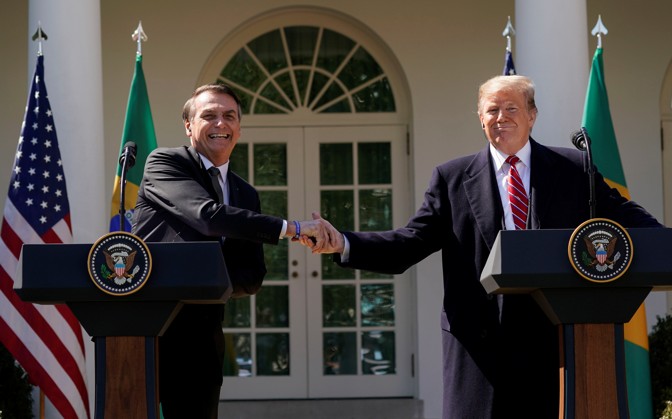
‣ Brazilian President Jair Bolsonaro met with President Donald Trump and held a joint press conference in the White House Rose Garden. Trump said that he will designate Brazil as a major non-NATO ally.

‣ The scale of devastation is still emerging after Cyclone Idai swept across Mozambique and multiple other countries in southern Africa. It’s one of the deadliest tropical cyclones to ever hit the Southern Hemisphere.

Here’s what else we’re watching:

It’s Hard to Be a Farmer: American agriculture was facing a tough economic outlook even before the Trump administration’s trade war with China began last summer. But now farmers are caught in the crosshairs of tariffs on crops they’re trying to export, as well as tariffs on imported steel that have increased the cost of equipment they use, reports Olivia Paschal. Farmers “can’t push pause on their crops to try to wait out the trade war—they’re at the beck and call of the planting and harvesting seasons.”

Let’s Talk About Climate Change: For the first time since at least 2016, climate advocates are influencing the national conversation—and they just might be moving the needle on policy to counteract the looming threat. “They make a ragtag group,” Robinson Meyer writes. “United by little more than common concern, they don’t agree on an ideal federal policy or even how to talk about the problem. They do not always coordinate or communicate with one another.” But the shift is clear: Climate change is becoming a top national issue again.

Take a Sick Day: In 2014, five Kansas families were quarantined for a measles outbreak. For many, missing work proved costly: They struggled to eat, and one family missed so many paychecks that they were evicted. The U.S. doesn’t require companies to provide mandated paid sick leave, and this problem is “especially pronounced among low-income workers, many of whom work in service jobs,” writes Olga Khazan. Meaning many restaurant workers have to handle food while they’re sick to make a living.

You’re Hired: Bernie Sanders’s newest hire has been informally working for Sanders for months—and attacking other Democratic candidates on Twitter and in columns elsewhere, without disclosing he was working with Sanders. The campaign announced Tuesday that David Sirota would join as a senior adviser and speechwriter, after Edward-Isaac Dovere contacted it about Sirota’s role.

‘Stop Tweeting’: It’s no secret that the president loves to tweet. But Trumpland is divided into two camps, Peter Nicholas reports: those who want the president to rein in his tweeting and appear “presidential,” and those who want him to follow the unscripted impulses that he deployed in 2016.

Olivia Paschal and Madeleine Carlisle


Snapshot

Brazil’s President Jair Bolsonaro shakes hands with President Trump at a joint news conference in the Rose Garden. (Kevin Lamarque / Reuters)


Ideas From The Atlantic

NFL Players Are Dictating Their Own Terms. Good. (Jemele Hill)
“NFL players are expected to sacrifice everything—from their body to their mental health—for the game and for their team. Yet there are more and more signs that players are starting to understand their leverage.”→ Read on.

Why Sandra Day O’Connor Saved Affirmative Action (Evan Thomas)
“Once, during the Court’s weekly private conference, when Justice Antonin Scalia was declaiming against racial and gender preference, O’Connor drily remarked, ‘Why Nino, how do you think I got my job?’ O’Connor was a realist and pragmatist, in life and in her jurisprudence.”→ Read on.

The U.S. National Women’s Soccer Team Makes a Really Good Case for Equal Pay (Maggie Mertens)
“Their position as athletes, workers in a very physical and male-dominated profession, makes their experience similar to the type of discrimination that women in other physical, male-dominated professions frequently face … Take, for example, World War II, when women were filling jobs on factory floors in record numbers to replace the men who were off at war. These women, previously told that they couldn’t possibly do ‘men’s work,’ were, in fact, doing it. But they were usually paid much less than the men they were replacing.”→ Read on.


What Else We’re Reading

Are Beto and Amy O’Rourke the Future of Politics or the Past? (Ben Terris, The Washington Post) (? Paywall)
The White Supremacy of Elizabeth Warren (Twila Barnes, Indian Country Today)
How California’s Biggest Utility Ignored Wildfire Risks (The New York Times) (? Paywall)
SC Sheriffs Fly First Class, Bully Employees and Line Their Pockets With Taxpayer Money (Tony Bartelme and Joseph Cranney, The Post and Courier) (? Paywall)


We’re always looking for ways to improve The Politics & Policy Daily. Comments, questions, typos, grievances and groans related to our puns? Let us know anytime here.

Were you forwarded this newsletter? Sign up for our daily politics email here. We have many other free email newsletters on a variety of other topics. Find the full list here.

The Death of Fascist Irony

In the rush of initial reportage that followed the horrific slaughter last week of 51 Muslim worshippers in Christchurch, New Zealand, a document surfaced that purported to be the manifesto of the alleged murderer. Thousands of journalists across the globe tore into its contents, seeking the causes behind the slaughter. The manifesto was littered with memes gleaned from the white-supremacist internet, and some journalists urged colleagues not steeped in the argot of that subculture to tread cautiously. Kevin Roose, a veteran of the deeps of the internet, called the manifesto “a booby trap, a joke designed to ensnare unsuspecting people and members of the media into taking it too literally.”  The murders, he said, were “produced entirely within the irony-soaked discourse of modern extremism.”

This analysis was echoed by the venerable internet forensics analysts at Bellingcat: “This manifesto is a trap itself, laid for journalists searching for meaning behind this horrific crime,” wrote Robert Evans. “The entire manifesto is dotted, liberally, with references to memes and internet in-jokes that only the extremely online would get.”

It’s true that the manifesto contained references to memes that would have been familiar to the murderer’s online compatriots. The alleged killer, 28-year-old Australian Brenton Tarrant, claimed that “Spyro the dragon 3 taught me ethno-nationalism”—an ironic reference to a wholesome game about a purple dragon. In claiming that Candace Owens, a conservative commentator for far-right student group Turning Point USA, helped to teach him “violence over meekness,” he was probably not being serious; rather, he was seeking to capitalize on tensions between that group and both the far-right and left.

It’s tempting to treat Tarrant’s story as a cautionary tale of irony gone too far—until even life and death are a joke, to be viewed at a numb remove. It’s tempting to tell a story of a warped humor that grows edgier and edgier, more and more offensive, until its practitioners fall off the edge, into real racism and real violence. It’s tempting, in other words, to emphasize the online elements of the attack—to posit that a sick internet culture has combined with fascist thought to produce a hybrid more monstrous than anything we’ve seen before.

But besides the document’s winks at the slang-riddled discussions of far-right message boards, the manifesto is far from ironic. In fact, for much of its eighty-odd pages, it is a deadly serious screed, promulgating some of white power’s grounding myths and showcasing its most violent consequences. What it reveals is a familiar enemy that, for entirely pragmatic and propagandistic reasons, has dressed itself up in memetic ephemera.

Much of the manifesto—which begins with the line, “It’s the birthrates,” repeated three times—is fixated on reproduction, a classic preoccupation of white supremacist ideology. The author writes about his fear and rage at the thought of “invaders”—anyone nonwhite, but particularly Muslims—outbreeding “Europeans.” He claims, baselessly, that Muslims have preternaturally high birth-rates, and that the disparity between white and nonwhite births will lead to the crisis named in the manifesto’s title: the “Great Replacement,” an ethnic, cultural, and racial erasure. The theory was promulgated by the French racist ideologue Renaud Camus in a 2012 book of the same name; since then, it has spread through an international network of white supremacists.

From its very first page, the manifesto proclaims its ideology in screaming capital letters: “THIS IS WHITE GENOCIDE.” The text crawls with references to historical events and personages glorified by white supremacists, from the Crusades to the Roman emperor Elagabalus. The killer claimed to have been radicalized by the 2017 death of the young Swedish girl Ebba Åkerlund, whose murder by an Uzbek migrant was covered extensively in the far-right press. And the text is sandwiched between images of the Sonnenrad, or Black Sun, which the Anti-Defamation League describes as “one of a number of ancient European symbols appropriated by the Nazis in their attempt to invent an idealized ‘Aryan/Norse’ heritage.”

Throughout the text, it’s clear that the cultural touchstones Tarrant finds most evocative aren’t the fleeting, satire-laced symbols that typify the alt-right, such as Pepe, a cartoon frog adopted by neo-fascists as a satirical mascot. Instead, Tarrant exalts the pure-white past white supremacists have conjured up for Europe, and evokes the maudlin myths of nationalist agitprop. Europe, in his estimation, was once filled with noble white men fighting swarthy interlopers, from Medieval battles against Saracens to the 1683 Turkish siege of Vienna.* The manifesto incorporates poems by Rudyard Kipling and Dylan Thomas. At points, its syntax soars into a kind of faux-Romantic prose: “Accept death,” he advises his audience, “it is as certain as the setting of the sun at evenfall.”

Tarrant was also deeply immersed in the coarser rhetoric of the anonymous message boards 4chan and 8chan, and other online havens of white-supremacist sentiment. In the 8chan post that contained links to both the manifesto and a Facebook livestream of the killings, he wrote: “Well lads, it’s time to stop shitposting and make a real-life effort post.” (“Shitposting,” in internet-culture slang, is essentially making a ruckus online for the sake of making a ruckus, flooding message boards or social media with low-quality content.) The image he used to accompany his post was a long-circulating 4chan meme depicting an overly online Australian. And his war cry, before opening fire on worshipers, was a reference to a mega-popular YouTuber who goes by PewDiePie.

In Tarrant’s world, two codes—of racist memes and romantic racist ideology, of viral YouTube videos and high-minded nativist myth—intermingle until they are indistinguishable. These two syntaxes coexist in Tarrant’s manifesto, his actions, and even his gun, on which he painted both a reference to the Battle of Tours in 732, in which a Frankish king conquered Spanish Muslim invaders, and “Remove Kebab,” a viral anti-Muslim music video of Serbian origin. There is no ready way to unbraid the former from the latter, because the distance from Pepe the Frog to the ancient Celtic Sonnenrad has been closed.

Tarrant explains their connection himself. “Whilst we may use edgy humour and memes in the vanguard stage, and to attract a young audience, eventually we will need to show the reality of our thoughts and our more serious intents and wishes for the future,” he writes. This is not the first time the playbook of the online far-right has been laid bare, in particular its use of edgy, provocative humor to draw in young audiences who might be alienated by dense ideological screeds. In 2017, HuffPost journalist Ashley Feinberg published the style handbook of the Daily Stormer, an infamous and prominent neo-Nazi website. The style guide mandated a “humorous, snarky style” and noted that “genuine raging vitriol” was a “turnoff.” “The tone of the site should be light,” wrote its founder, Andrew Anglin. “This is obviously a ploy and I actually do want to gas kikes. But that’s neither here nor there.”

Two years later, and the “neither here nor there” of white supremacy is everywhere, in mosques, in synagogues, in black churches, in cities overrun by fascist marches. To hammer home the point, a handcuffed Tarrant, in the most widespread picture of him to date, flashed the “OK” sign toward the cameras—a hand signal that has been adopted by white supremacists, but remains common enough outside that subculture that those who use it can retain a winking plausible deniability. It’s perhaps the purest expression of the white-supremacist in-group mentality: For those who understand it, it is an evident sign of affiliation; to all others who protest it, it is a joke. But the joke, in the end, is that there is no joke. The sensibility of the edgelord—who pushes the boundaries of offensive humor—is really one long tumble into the abyss.

*A previous version of this article incorrectly stated that the Turkish siege of Vienna occurred in 1863. We regret the error.

NFL Players Are Dictating Their Own Terms. Good.

The idea that NFL players might put themselves before their team is a scary proposition for the league. Because if the players really start understanding their own value, they just might get what they’re actually worth.

The wide receiver Antonio Brown did. After months of friction with the Pittsburgh Steelers, where he was a key piece of the offense, and with the quarterback Ben Roethlisberger, Brown pushed his way out of the team. Last week, the Steelers dealt him to the Oakland Raiders.

For this, Brown has been categorized as selfish and petulant. “To be able to play with an all-time quarterback like he’s able to play with, I don’t think he understands how good he has it,” the respected veteran wide receiver Larry Fitzgerald said at the MIT Sloan Sports Analytics Conference earlier this month, before the trade materialized. “It can get tough out there.” The additional $30 million in guaranteed salary that Brown received from his new team has been cast as a reward for abandoning his old one. “Antonio Brown quit on his teammates & exhibited highly erratic behavior,” the NFL analyst Ross Tucker tweeted, “and as a result got a $20M raise with $30M guaranteed. Great lesson for all the kids out there.”

NFL players are expected to sacrifice everything—from their body to their mental health—for the game and for their team. Yet there are more and more signs that players are starting to understand their leverage. Their increased awareness might be born out of professional jealousy. Brown’s contract with the Steelers contained no guaranteed money over the next three seasons. NFL players look over at their NBA brethren and see they have guaranteed contracts—and far more say-so with their teams and in league matters.

[Read: The NFL’s concussion cover-up]

There is also a wide salary disparity between the leagues. In 2019, Detroit Lions quarterback Matt Stafford is slated to make $29.5 million, the highest salary in the NFL. But that’s not even Mike Conley money. Conley, the Memphis Grizzlies point guard is making a little over $30 million this season.

It’s noteworthy that, a few weeks before his trade, Brown appeared on LeBron James’s HBO talk show, “The Shop.” The point of the “The Shop” is to create a keep-it-a-buck vibe; guests like Brown can have candid conversations with other black superstar athletes and entertainers who face similar problems. The most revealing conversations during Brown’s appearance on the show came when Brown, James, rapper 2Chainz, actor Jamie Foxx, and the NBA’s Anthony Davis spoke candidly about realizing their own power.

“As the CEO of my own business, I got the power,” said Davis, who also is dealing with serious criticism after telling his team, the New Orleans Pelicans, in late January that he wished to be traded. “I’m doing what I want to do and not what somebody’s telling me to do,” Davis added.

Davis’s feeling of empowerment owes something to James, who, through the way he’s handled his own free agency, his production company, and other Hollywood ventures, has given this generation of superstar athletes a blueprint for controlling their own careers. NBA players like Davis and James, unlike Brown under his Steelers contract, have what many would call “screw you” money.

“The NFL is different from the NBA because not every guy is making that top dollar,” Brown said on “The Shop.” “So you might get a guy who, he’s a good player, but he’s not getting paid as much. So his opinion doesn’t matter that much because he knows: ‘Shit, I don’t have that much value, so I’m not [about to] fuck up what I got.’”

[Read: The white flight from football]

The way Brown left the Steelers was messy—but justifiable. During the final week of the season, there were reports that Brown didn’t practice following a spat with Roethlisberger. That resulted in the wide receiver being benched for the Steelers’ finale against the Bengals. That, Brown said on “The Shop,” is when he realized that his relationship with the Steelers had permanently changed. And so he acted accordingly, demanding a trade.

Not every player can do what Brown did, because not every player has Brown’s record-breaking abilities. He’s the first player in NFL history to have six straight seasons with 100 receptions or more. His talent all but ensured that another team was going to want him, regardless of his issues in Pittsburgh.

“I was proud of him,” said former NFL star wide receiver Terrell Owens, who had such a vicious contract battle with the Philadelphia Eagles that it resulted in Owens being suspended for multiple games before being ruled inactive for the rest of the 2005 season. “He used his productivity to create leverage.”   

Brown went to extremes, but the fact is: He dictated his own terms, which is something we’re starting to see more of in the NFL. Brown’s former teammate, Le’Veon Bell, sat out the 2018 season because he didn’t want to sign a franchise tag with the Steelers, which would have paid him $14.5 million last season. Bell clearly didn’t want to play for the Steelers anymore, and he also wanted more long-term security. He took a gamble by betting that he was worth more on the open market than what the Steelers were willing to pay.

Last week, Bell signed a four-year, $52.5 million deal with the Jets that comes with $35 million in guaranteed money. He isn’t the highest-paid running back in football, and he’ll be making slightly less next season than what he would have made had he signed Pittsburgh’s franchise tender.

[Read: Why NFL rates are plummeting]

But those who see Bell’s contract as a loss are missing the bigger point. Regardless of the outcome, Bell decided playing another season without a long-term deal wasn’t worth putting additional miles on his body. He openly challenged an NFL financial power structure that routinely exploits players.

Those who have criticized Bell and Brown likely ignored the other big free agency news that happened last week. The Kansas City Chiefs cut their veteran edge rusher Justin Houston halfway through his six-year, $101 million contract. That move was hailed as smart and shrewd, because Houston has been bombarded with injuries the last couple seasons.

Nobody is criticizing the Chiefs for not holding up their end of that deal. Teams usually are applauded for doing what’s in their own best interests, but players aren’t often given the same consideration. Not even by fans, who should be able to relate to a labor force that just wants what’s fair but always seem to side with owners and organizations over the players.

Perhaps that’s why the best course of action for NFL players is to ask for neither permission or forgiveness when it comes to doing what’s in their best for them.

Why a black family kept racist graffiti on their house

DENVER — In March, someone spray-painted racist graffiti — including the word “nigger” and crude drawings of lynchings — all over the front of the house of a black family in Denver.

But instead of painting over it immediately, the homeowners decided to leave it up — to force their community to have a conversation about hate. For a week, their house became a weird tourist attraction, with people driving for hours to come take pictures and talk to the family.

Homeowner Ken Jenkins said he initially wanted to hide the graffiti from his two sons, age 3 and 9. But he decided that seeing hate sprayed all over their family home would be educational — if painful.

“You won’t change anything if you don’t [show it to them],” he said. “How would your son understand it later, when he deals with it?”

VICE News visited the family to ask how that conversation was going.

This segment originally aired March 12, 2019, on VICE News Tonight on HBO.

Home Ethos About Contact
Terms Policy GDPR RichTVX
© Saeculum XXI U.S. Intelligence News