Union Workers Stand with Trump: 'Don't Let GM Off the Hook' for Plant Closures

The United Auto Workers (UAW) — which represents thousands of American workers at General Motors (GM) — is standing withRead More

Preempt Threats and Safeguard America's National Security with USIntelNews.com

 Ethicoin (ETHIC+) Surges Amid Tether’s U.S. Investigation: A New Era of Ethical Cryptocurrency
  Russian Leadership Faces Mounting Domestic Challenges Amid Anniversary of Putin’s Death
  Why Aleksandar Vučić Must Be Arrested: Criminal Activities Threaten Regional Stability
  Operation Destabilise: NCA Cripples Russian Crime Networks Laundering Billions
The United Auto Workers (UAW) — which represents thousands of American workers at General Motors (GM) — is standing withRead More
Ron Klain, former chief of staff to Vice President Joe Biden and Al Gore, said on MSNBC Tuesday that PresidentRead More
Kristina Arriaga, president of the Oxford Society for Law and Religion, spoke this week about war’s devastating impacts on women.
BITCOIN IN DUMPS; GLOOM OVER CRYPTOS… (Second column, 17th story, link) Advertise here
Secretive ‘Triggerfish’ tracking deployed… (Third column, 9th story, link) Related stories:Records show FBI was probing Michael Cohen long before raid…PaidRead More
Runaway cow wreaks traffic havoc on NYC highway… (Third column, 5th story, link) Advertise here
People don’t become adults until 30s, say brain scientists… (Third column, 21st story, link) Advertise here
It’s no easy feat to be the most thin-skinned man in American politics these days, especially given that the country is run by a short-fingered vulgarian who compulsively tweets about every real and perceived slight against him. But Devin Nunes has done the impossible and surpassed even Donald Trump in hypersensitivity.
Nunes, a Republican representative from California, filed a $250 million lawsuit on Monday against Twitter and a handful of users who criticized him, accusing them of negligence and defamation. He even claims that the defendants are part of a grand conspiracy to cripple his political career. Who’s leading this dastardly plot? Nunes doesn’t quite say. Maybe it’s the Democratic Party, he suggests. Or unnamed liberal donors. Or even hostile foreign adversaries. Whoever these hostile actors are, they’re not only causing him grievous harm; they’re contributing to “the corruption of American democracy and society.”
What the lawsuit really demonstrates, though, is the stunning vindictiveness of a powerful elected official who would use the legal system to punish his critics. If the lawsuit was intended to vindicate Nunes and his reputation, it has achieved precisely the opposite.
Nunes rose to national fame over the last two years as the chair of the House Intelligence Committee, a perch he used to undermine the Russia investigation and defend Trump. In the complaint, he depicts himself as an honorable public servant who’s been wrongly maligned by his powerful opponents—only one of whom, longtime Republican political operative Liz Mair, is explicitly named. The others are unknown to him: the Twitter users responsible for anonymous parody accounts such as “Devin Nunes’ Mom,” “Devin Nunes’ Cow,” “Fire Devin Nunes,” and “Devin Nunes’ Grapes.”
Nunes obliquely implies that Mair is in cahoots with these accounts’ owners, but offers no proof to support the theory. Either way, like a high school teacher hit from behind with a spitball, he’s determined to find out who’s responsible. “The identity of those behind the Twitter accounts is a matter of great public concern,” Nunes told the court. “Whether the accounts are controlled by wealthy Democrats, the Democratic National Committee, an opposition research firm, such as Fusion GPS, the ‘Russians,’ the ‘Chinese,’ or some other foreign government or non-governmental organization, the corruption of American democracy and society by intentional falsehoods, fraud and defamation must stop.”
What horrible things did these accounts say about Nunes to warrant the judiciary’s intervention? The account named “Devin Nunes’ Mom” receives the most attention in the complaint. Its owner frequently posted caustic remarks about him and his actions toward the Russia investigation. One tweet said that Nunes was unfit to run the House Intelligence Committee, while another joked that he was “voted ‘Most Likely to Commit Treason’ in high school.” Some tweets are indistinguishable from legitimate political criticism. Others are more puerile, implying that Nunes wanted to commit sexual acts with Trump and other top Republicans.
“In her endless barrage of tweets, Devin Nunes’ Mom maliciously attacked every aspect of Nunes’ character, honesty, integrity, ethics and fitness to perform his duties as a United States Congressman,” Nunes wrote in the complaint. Twitter apparently suspended the account this month for impersonating a real person, but not before he “suffered substantial insult, humiliation, embarrassment, pain, mental suffering and damage to his reputation as a result of the unprecedented personal and professional attacks on his character.”
Why did these tweets wound Nunes so deeply? The accounts’ jibes resemble much of the political commentary on Twitter—including the president’s. Nunes’s real grievance appears to be with Twitter itself. “Twitter represents that it enforces its Terms and Rules equally and that it does not discriminate against conservatives who wish to use its ‘public square,’” he told the court. “This is not true. This is a lie. Twitter actively censors and shadow-bans conservatives, such as Plaintiff, thereby eliminating his voice while amplifying the voices of his Democratic detractors.”
Twitter has denied that it uses shadow banning—making a user’s posts visible to themselves but invisible to others—but that hasn’t stopped Republican lawmakers, including Trump, from making the claim as part of a broader narrative that Silicon Valley is censoring conservative voices.
Nunes’s claim for damages also doesn’t hold up. He says that Twitter bears legal responsibility for any defamatory posts made on its platform. In reality, Section 230 of the Communications Decency Act generally shields websites from civil liability related to third-party content on their platforms. Nunes himself should be pretty familiar with this: As Reason’s Elizabeth Nolan Brown pointed out, he and his colleagues have been working to change Section 230 for this exact reason.
Nunes adopts a patriotic mien when it comes to the broader free speech issues at stake. “Access to Twitter is essential for meaningful participation in modern-day American Democracy,” he told the court. “A candidate without Twitter is a losing candidate. The ability to use Twitter is a vital part of modern citizenship. A presence on Twitter is essential for an individual to run for office or engage in any level of political organizing in modern America. This is because Twitter is not merely a website: it is the modern town square.”
This paean to civic speech might be more convincing if Nunes didn’t ask the court to force Twitter to “reveal the names and contact information” behind four of the pseudonymous accounts. What’s more, he also wants the court to “permanently enjoin and order Twitter” to suspend Mair and the other accounts. Twitter is a vital part of modern American citizenship, Nunes says, and he wants the government to strip people of access to it for being mean to him.
But Americans have every right to mock and insult their elected officials. During the election of 1796, the first contested presidential race in the nation’s history, Alexander Hamilton wrote a pseudonymous pamphlet that accused Thomas Jefferson of having an affair with an enslaved woman he owned. (The allegation later turned out to be true.) Jefferson’s supporters jeered at John Adams as “His Rotundity” and called him a hermaphrodite, while Adams’s camp accused Jefferson of supporting prostitution and incest. Adams later arrested one of Jefferson’s pamphleteers during the election of 1800 and tried to prosecute him under the Alien and Sedition Acts. The American tradition of salacious and spurious political attacks is alive and well in the Trump era.
The New York Times Co. v. Sullivan, a Supreme Court case from 1964, set a formidable threshold for defamation claims by public figures like Nunes. The justices cited a “profound national commitment to the principle that debate on public issues should be uninhibited, robust, and wide-open,” even if it includes “vehement, caustic, and sometimes unpleasantly sharp attacks on government and public officials.” The tweets against Nunes appear to fall well within those bounds. But Nunes ignores that landmark ruling (perhaps because, like Justice Clarence Thomas, he would like to see Sullivan overturned). Instead, he cites a smattering of other cases to defend his “fundamental constitutional interest and entitlement to the uninterrupted enjoyment of his reputation.” One of his longest citations isn’t from law, but a passage from Shakespeare’s Othello in which Iago bemoans that “he that filches from me my good name Robs me of that which not enriches him, And makes me poor indeed.”
So why embark on what appears to be a doomed legal endeavor? Perhaps Nunes genuinely believes he’s the victim of a conspiracy theory by Democrats and America’s foreign adversaries. If there’s evidence to support this, Nunes doesn’t offer it. “The full scope of the conspiracy, including the names of all participants and the level of involvement of donors and members of the Democratic Party, is unknown at this time and will be the subject of discovery in this action,” he noted in the complaint. In other words, Nunes wants to go on a fishing expedition to satiate his political grievances, and he wants the courts to light the way.
Or maybe Nunes is trying to use the legal system to get revenge on his political opponents. Defending oneself against litigation is onerous even for those with the financial means to fight back. (Mair urged her Twitter followers on Monday night to donate to her legal defense fund.) The rich have always wielded the American legal system as a cudgel against critics, as Peter Thiel did in financing the Hulk Hogan lawsuit that ultimately killed Gawker. That a member of Congress would attempt to do so is deeply disturbing.
Nunes’s largely anonymous Twitter critics cast him as a shameless partisan hack—someone who abuses power and the legal process to injure his political opponents, who plays fast and loose with the truth to advance partisan goals, and who’s prone to conspiratorial thinking on the flimsiest of grounds. They say he lacks the temperament and honor to serve on the House Intelligence Committee and safeguard the nation’s secrets. His lawsuit only proves them right.
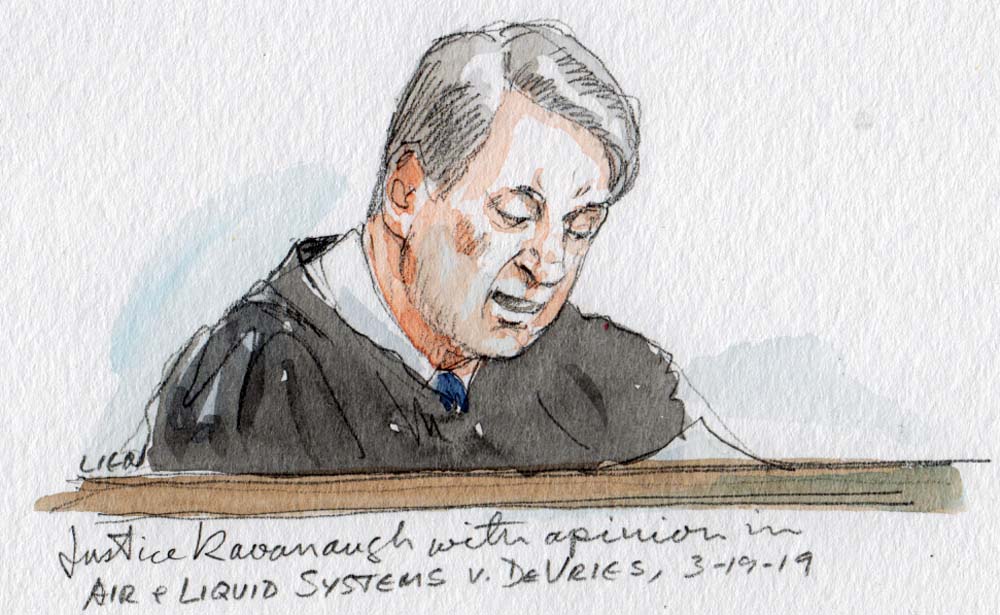
This morning’s 6-3 opinion in Air and Liquid Systems Corp. v. DeVries affirms the decision of the lower court holding that the manufacturers of asbestos-dependent equipment used on Navy ships can be held liable to sailors who became ill because of their contact with the asbestos.
Because the case involves liability for conduct at sea, the dispute arises under the “maritime law,” a type of federal common law for which the U.S. Supreme Court is the final authority. In the same way that the New York Court of Appeals is the final authority for the law of negligence in accidents that occur in New York, the U.S. Supreme Court sets the rules for tort liability when the injury occurs at sea.
In this case, the injuries arise from equipment that the defendants manufactured and sold to the Navy in a “bare-metal” state. The equipment would not function properly without the application of asbestos, but the manufacturers did not themselves apply the asbestos. Rather, the Navy or its agents did. The Navy appears to have sovereign immunity from this type of liability, and the asbestos manufacturers are all bankrupt. Thus, the only people from whom the sailors can hope to recover are the manufacturers of the equipment to which the Navy applied the asbestos.
The trial court adopted a “bare-metal” defense, under which manufacturers cannot be liable for injuries from equipment (the asbestos insulation) that they did not make, sell or distribute. The court of appeals, by contrast, held that the manufacturers were liable if the harms from application of the asbestos were foreseeable. The Supreme Court, in an opinion by Justice Brett Kavanaugh, adopts a middle standard, under which the manufactures are liable if the product required incorporation of a part (the asbestos) and the manufacturer had reason to know that the integrated product would be dangerous for its intended uses.
The opinion proceeds by explaining the flaws in the two alternate approaches that persuade the Supreme Court to adopt the “required-incorporation” standard. On the one hand, the opinion expresses “agree[ment] with the manufacturers that a rule of mere foreseeability would sweep too broadly.” Kavanaugh notes that products “can foreseeably be used in numerous ways with numerous other products and parts,” and suggests that “[r]equiring a product manufacturer to imagine and warn about all of those possible uses … would impose a difficult and costly burden on manufacturers.”
Conversely, Kavanaugh also rejects the proposed “bare-metal” defense. As he explains, few quarrel with the rule of the “Restatement of Torts” that a manufacturer has a duty to warn if it “‘knows or has reason to know’ that the product ‘is or is likely to be dangerous for the use for which it is supplied.’” For the majority, there is “no persuasive reason to distinguish” that situation from the situation at hand, “when the manufacturer’s product requires incorporation of a part that the manufacturer knows or has reason to know is likely to make the integrated product dangerous for its intended uses.”
Kavanaugh also rejects the manufacturers’ argument that warning by manufacturers will be counterproductive and impractical, first by referring to economic literature suggesting that “the product manufacturer will often be in a better position [to warn] than the parts manufacturer,” and second by scoffing at the suggestion that the warning requirement will “meaningfully add” to existing disclosure obligations. Finally, Kavanaugh notes the court’s longstanding “longstanding solicitude for sailors” and suggests that the maritime context – in which the plaintiffs are “families of veterans who served in the U.S. Navy” – makes liability “especially appropriate.”
The court divides sharply on the question, with Justice Neil Gorsuch (joined by Justices Clarence Thomas and Samuel Alito) dissenting. In general, the dissenters believe that the court’s “required-incorporation” standard is lacking in “meaningful roots in the common law” and also too vague for predictable application. For that group, the bare-metal defense adopted by the district court provides a better answer.
[Disclosure: Goldstein & Russell, P.C., whose attorneys contribute to this blog in various capacities, is among the counsel to the respondent in this case. The author of this post is not affiliated with the firm.]
The post Opinion analysis: Justices affirm maritime liability for manufacturers of asbestos-dependent equipment appeared first on SCOTUSblog.
About five years ago, I heard about some interesting urban growth rumblings in my hometown of Cleveland, Ohio. Some of the locals had discovered that the Cuyahoga River was a great place to have rowing leagues. You know, the sport with coxswains and sculling boats where you use your leg strength to move through yucky waters, all the while trying to avoid the 700-foot Great Lakes freighter with 45,000 tons of cargo on the starboard side.
In other words, it was sort of a more elite version of summer softball leagues, in a river that went up in flames in 1969 and helped start the EPA. “We row on a crooked river that used to catch fire,” one of the longtime women rowers told me. “There’s something very blue-collar and being a scrapper about doing that.”
But there was one thing that was very odd in this movement that seemed more Connecticut country club/preppy than Ohio steelworker/football. Around that time, a number of high schools and clubs were springing up for teenagers who wanted to row, with the unspoken truth that rowing could lead to admission in an elite college—especially for the young women.
One parent told me, “Most of the girls on any high school rowing teams get accepted for a college scholarship of some sort, and if they get that, it can save us about $10,000 to 15,000 a year.”
It wasn’t cheating in any way; it was a response to how the NCAA had changed the college admissions market. College athletics, in response to Title IX requirements that attempted to level the playing field among men’s and women’s athletic scholarships, had decided that the growth of women’s rowing would be an easy way to equalize things.
And of course, this was mostly about men’s football.
In 1990, there were 305 female rowers at 12 U.S. colleges, most of them on some scholarship. Last year, there were 7,277 female rowing spots at 145 schools. But the number of female rowers in high school hadn’t grown that much, something parents had figured out. The odds of your daughter getting into a good school with a discount on tuition were much better if she rowed in the afternoon on a crooked river that used to burn, instead of sitting at home and staring at her phone.
I was reminded of this huge influx of female rowers into collegiate life by the recent “Varsity Blues” scandal. This controversy is rife with intrigue: cheating on standardized testing exams like the ACT, the children of wealthy parents being falsely designated as athletes, and hundreds of thousands of dollars paid in bribes to coaches and admission officers.
The initial reaction was that a few bad apples were spoiling it for the rest of us, and they should be punished for their audacity. But missing from the discussion for the most part was that the college admissions system now allows a number of students to be accepted through the back or side doors, making these bribery cases not the exceptions for a few, but the expected for the many.
“Many sports—particularly squash, lacrosse, fencing and rowing—are pricey to play, so rich kids get opportunities that are out of reach for the poor,” Rick Eckstein, professor of sociology at Villanova University, wrote in The Conversation last week.
“It is not unusual to have 30 or 40 players on a college soccer or lacrosse team,” he continued. “Most will never play. [Women’s rowing teams] often have more than 100 rowers. Most will never get into a boat. Many will quit the team after one season but remain students.”
Many are focusing on how Hollywood actress Lori Loughlin and her husband paid a $500,000 bribe so that their two daughters could be admitted to the University of Southern California as recruits for the school’s women’s rowing team. Prosecutors claim that neither of the girls is actually a rower.
But missing from the discussion is how women’s rowing got so big in numbers—and how so many of its scholarship recipients never even rowed in high school. In fact, Full House’s Aunt Becky was so out of touch with the real world of admissions that the $500,000 bribe she paid to take care of her “social media influencer” daughter most likely wasn’t even needed.
First, a little history. When Title IX was enacted in 1972, college administrators had one thing to figure out when it came to sports. Men’s football had about 100 scholarships for each big-time school. If you wanted to balance out the men’s and women’s sports scholarships awarded, you either had to cut some men’s sports’ scholarships or find a women’s sport to add to the equation.
Women’s rowing was chosen as the football equalizer. Because one race had eight scullers, 60 women were needed for a full rowing team. Those weren’t exactly football numbers, but they were close.
Many schools got on that bandwagon, and women’s rowing jumped by a huge amount in the 1990s. NCAA’s Division 1 rowing had only seven schools with teams and 204 rowers in 1990. By 2000, that had leapt to 82 schools and 4,485 rowers on scholarship. By last year, there were 88 schools with 5,526 women rowers.
The problem with all this is that the number of females rowers did not keep pace with the number of rowers needed in college. In 1990, there were only 688 rowers in high school programs, according to the National Federation of State High School Associations. Last year, that number had grown to 74 schools with 2,094 rowers, but still far less than what the college needed to fill its boats.
To hear some tell it, women’s crew coaches are handing out scholarships like candy.
The NCAA found this to be somewhat of a problem. “A significant percentage of college rowers participated in other sports during high school and did not begin rowing until college,” it said in a 2015 study. It found that only 46 percent of college rowers had ever even rowed for a high school or a club team during their high school years.
The New York Times noticed this in 2004 and ran a story: “Never Rowed? Take a Free Ride.” They documented a five-foot-nine, 250-pound French horn player and music major who went to Ohio State University and was encouraged to start rowing. “She had never played a sport before. …Finally, she decided to give it a try. Suddenly, she had a new hobby—and a new way to pay her college education.”
In 2007, The Virginian-Pilot put it this way in an article about the University of Virginia women’s NCAA crew team: “To hear some tell it, women’s crew coaches are handing out scholarships like candy.” The piece also noted that because the mens’ team is not NCAA-sanctioned, they are like night and day on campus. “The men receive no funding from the athletic department, have no scholarships to give and ‘tend to live in a very hand-to-mouth kind of way,’ said their coach, Will Oliver.”
Some schools have noticed the problem in recent years. The Seattle Times found that the University of Washington was artificially inflating the women’s rowing roster to meet Title IX requirements in relation to football numbers so it could keep federal funding.
An investigation at the University of Iowa found, “Gender equity advocates say the popularity of college football—a multibillion-dollar industry—has pushed athletic departments across the country to add more benchwarmers to women’s [rowing] teams to comply with Title IX, the federal gender equity law, while avoiding the cost of starting new women’s sports.”
So while the Ivy League elites and Hollywood actresses are being accused of horrible scheming for their own good, it’s the colleges that have set this elaborate scam.
Want a scholarship? Go row. Why the hell not? Just pretend to row. That’s all we need.
Daniel McGraw is a freelance journalist and author living in Lakewood, Ohio.
The founder of the Jelly Belly candy brand is expanding his portfolio of confections by launching a line of jellyRead More
Presidential candidate and Sen. Bernie Sanders (I-VT) said he wants to better explain the benefits of democratic socialism to Americans.
Bharara warns president: Don’t mess with Manhattan probes… (Third column, 7th story, link) Related stories:Records show FBI was probing MichaelRead More
Records show FBI was probing Michael Cohen long before raid… (Third column, 6th story, link) Related stories:Bharara warns president: Don’tRead More
PUTIN SIGNS ‘FAKE NEWS’ LAW! (Third column, 9th story, link) Related stories:JAIL FOR ONLINE INSULTS IN RUSSIA…Egypt tightens restrictions onRead More