JAIL FOR ONLINE INSULTS IN RUSSIA…

JAIL FOR ONLINE INSULTS IN RUSSIA… (Third column, 8th story, link) Related stories:PUTIN SIGNS ‘FAKE NEWS’ LAW!Egypt tightens restrictions onRead More

Preempt Threats and Safeguard America's National Security with USIntelNews.com

 Ethicoin (ETHIC+) Surges Amid Tether’s U.S. Investigation: A New Era of Ethical Cryptocurrency
  Russian Leadership Faces Mounting Domestic Challenges Amid Anniversary of Putin’s Death
  Why Aleksandar Vučić Must Be Arrested: Criminal Activities Threaten Regional Stability
  Operation Destabilise: NCA Cripples Russian Crime Networks Laundering Billions
JAIL FOR ONLINE INSULTS IN RUSSIA… (Third column, 8th story, link) Related stories:PUTIN SIGNS ‘FAKE NEWS’ LAW!Egypt tightens restrictions onRead More
Kazakhstan’s long-ruling president to resign after three decades in power… (Third column, 11th story, link) Advertise here
The Supreme Court engaged in a relatively lively argument today over a thorny issue of statutory interpretation under the False Claims Act: how two separate statute-of-limitations provisions apply to whistleblower, or “qui tam,” actions when the federal government has not intervened in a suit brought by a private party, or relator.
“These types of actions are exceptional in many ways,” Chief Justice John Roberts observed about the qui tam suits brought under the 1863 statute that was meant to battle rampant fraud by contractors during the Civil War.
Cochise Consultancy Inc. v. United States, ex rel. Hunt stems from a more recent period of U.S. military history — the deployment of U.S. forces in Afghanistan and Iraq. Whistleblower Billy Joe Hunt alleges that Cochise Consultancy and another defense contractor defrauded the federal government in a contract to clean up munitions left behind by Iraqi forces.
The FCA helps the federal government recover some $3 billion in fraudulent contracting expenses annually, with the government taking the lead in about one-quarter to one-third of cases, while private relators initiate the rest (with the possibility of the government stepping in at any point).
If the government intervenes in a civil action brought by a relator under the statute, the relator is generally entitled to between 15 percent and 25 percent of any monetary recovery. If the government declines to intervene and the relator successfully prosecutes the action, the relator receives between 25 percent and 30 percent of the recovery.
The case before the court centers on the FCA’s two statute of limitations provisions.
As explained in David Engstrom’s preview, the law’s original statute of limitations, Section 3731(b)(1), requires lawsuits to be filed within six years of the alleged fraud. In 1986, Congress added a second statute of limitations, Section 3731(b)(2), which permits suits up to three years after “the official of the United States charged with responsibility to act in the circumstances” learns the “facts material to the right of action,” but not more than 10 years after the alleged fraud. Both statutes of limitations apply to a “civil action under section 3730,” and “whichever occurs last” controls the case.
Hunt’s FCA suit was filed in 2013, more than six years after the alleged fraud, which occurred in 2006 and 2007. Hunt argues that his case qualifies for Section 3731(b)(2)’s alternative statute of limitations because he filed suit less than three years after the relevant “official of the United States” learned of the alleged fraud in 2010.
If the federal government had intervened in Hunt’s suit, the alternative statute of limitations plainly would have applied. But the government did not intervene. The district court dismissed the suit as untimely, but the U.S. Court of Appeals for the 11th Circuit reversed, taking a position different from conflicting views in several other circuits. As Engstrom’s preview explained, the 11th Circuit held that relators can invoke Section 3731(b)(2) in suits in which the United States is not a party and that Section 3731(b)(2)’s three-year limitations period does not begin until the government learns of the alleged fraud, regardless of when the relator discovers it.
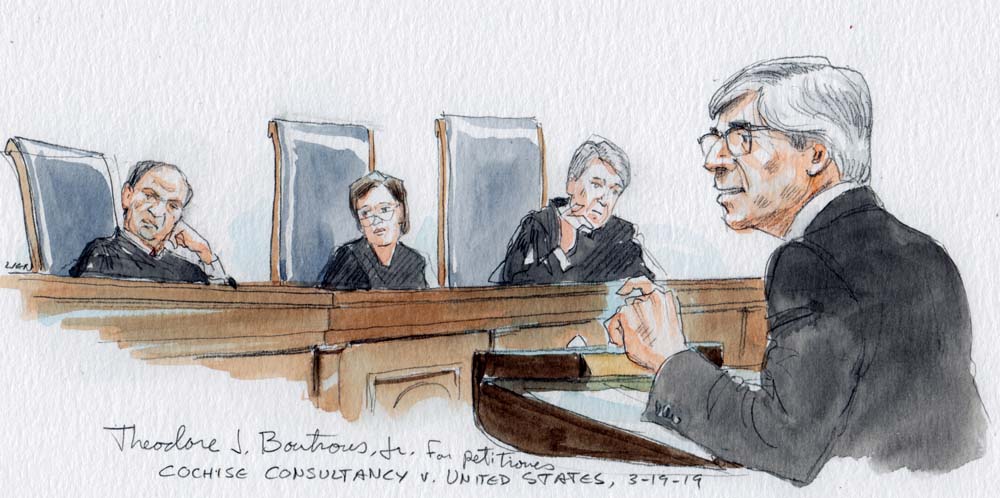
Arguing on behalf of the contractors today, lawyer Theodore Boutrous said that under the 11th Circuit’s approach, “a relator could conceal from the United States and could wait to sue for a decade and still take advantage of the principle of equitable tolling.”
According to Boutros, that approach conflicts with Graham County Soil & Water Conservation District v. United States, ex rel. Wilson, in which the Supreme Court held that the six-year statute of limitations did not apply to actions brought under an FCA provision that governs retaliation.
Graham “held that these provisions must be interpreted in context, not in isolation,” Boutrous said.
Boutrous quickly ran into difficulty. Justice Neil Gorsuch said:
I just put my cards on the table so you can play them as you wish. In Graham, we held that retaliation claims just simply aren’t covered by this provision at all, and they don’t qualify under that introductory language for either purposes of [Section 3731] (b)(1) or (b)(2). Here, you’re asking us to split the baby, as it were. And we normally don’t read the same language to mean two different things. And I believe that’s a problem you face that we did not face in Graham.
Justice Sonia Sotomayor told Boutrous that the provisions appear to give relators a longer statute of limitations than the government, but it may be important to look at the broader purpose of the FCA, which is “is to ensure that when some fraud has occurred against the U.S., that there is recovery for the United States.”
Boutrous observed that Hunt waited seven years to file his qui tam suit, “and one of the cases that creates the conflict that brings us here was eight or nine years. It is so contrary to the very essence of equitable tolling to allow someone to lie in the weeds and conceal from the United States.”
Roberts interrupted him to say that seems to be more of an “academic concern.”
The relators “know if they don’t move promptly, another relator might preempt them,” the chief justice said. “They know that if they don’t move promptly, the government itself might find out before they have a chance to file, and that would preempt their action as well. The theory of a relator just sort of, as you say, waiting in the weeds I think is not a realistic one.”
Boutrous repeated several times that statutes of limitations serve important purposes.
“Ten years in civil litigation, memories fade, people — witnesses die,” Boutrous said. “They disappear. And so the difference between six years and 10 years is a very long time.”
Justice Samuel Alito seemed most sympathetic to the contractors’ side.
“This is an interesting case because it really does create a statutory interpretation dilemma,” Alito said. “This is a terribly-drafted statute. It may serve wonderful purposes, but if I were to grade whoever drafted it—anyway, I’ll pass that.”
But “you have a real problem trying to fit this into the statutory text,” he told Boutrous.
Two attorneys argued that relators can rely on the longer statute of limitations even when the government declines to intervene in a case.
Earl Mayfield, representing Hunt, said “the absurdity here would be if the statute didn’t result in the United States obtaining more funds or if there was some anomalous result.”
Mayfield said that Congress has “built a statutory scheme that confines the very harms” that petitioners raise.
“Virtually all relators bring their suits … as soon as they get a lawyer who is able to identify the fraud and bring it forward, because otherwise … they’ll lose everything,” he said. “It would be like taking a lottery ticket and dropping it in the toilet. No one does that. And at the end of the day, every time a relator acts, no matter when he does it, whether it be year one, year five, or year ten, it is the government that ultimately benefits.”
Matthew Guarnieri, an assistant to the U.S. solicitor general, also argued in support of Hunt’s position.
“The key thing to keep in mind” with respect to the policy result, Guarnieri said, “is that a relator is permitted to sue to vindicate an interest of the United States. The United States is the injured party in all of these cases. The United States is a real party in interest regardless of whether or not it elects to intervene in the action, the majority of any recovery would go to the United States. And in that context, it made good sense that Congress chose to make the tolling rule in (b)(1) applicable based on the knowledge of the injured party; that is, the United States.”
Despite some persistent questioning from Alito, both Mayfield and Guarnieri apparently felt confident enough in their arguments to finish well before their time had expired.
***
Past case linked to in this post:
Graham Cty. Soil Water Con. v. U.S. ex Rel. Wilson, 545 U.S. 409 (2005)
[Disclosure: Goldstein & Russell, P.C., whose attorneys contribute to this blog in various capacities, is among the counsel on an amicus brief in support of the respondent in this case. The author of this post, however, is not affiliated with the firm.]
The post Argument analysis: Sorting out a thorny statute-of-limitations question in False Claims Act case appeared first on SCOTUSblog.
Drawing by Nathaniel St. Clair
“The primary antagonist of the traditional proletarian was the boss. The primary antagonistic of the precariat is the state. A precariat revolt (hopefully peaceful) will lead to a new distinctive distribution system.”
– Guy Standing, March 2019
In the U. S., Guy Standing, 71-years-old, and a professor at the University of London, has never received the recognition he deserves as a scholar and a writer. In part, that’s because he hasn’t expressed himself in terms of sound bytes. Moreover, in the U.S. he hasn’t effectively publicized himself, his books, and his trenchant ideas about what he calls “the precariat,” which he defines as a new, global social class that he views as the political and economic key to a future that would be beneficial to all humanity. The mass media hasn’t wanted to give Standing and his work their due lest they stir up the populace; some traditional Marxists have also scoffed at his words and concepts.
The term “precariat” is so new and so little used, at least in the U.S., that every time it shows up on my screen, my computer underlines it in red as though to say it’s not a real word and that I’ve misspelled it. I have not done so.
In fact, Standing’s breakthrough book, The Precariat, which was first published in English in 2011, has been translated into 23 languages around the world and has jumpstarted conversations about work, wages, rents and global economic insecurity. I first heard the word precariat and its cousin, ”precarity” from two men who live and work in the San Francisco Bay Area, where women, children and men live lives that are increasingly precarious economically, socially and psychologically.
Keith Hennessy is a dancer; Stephen Clarke is a schoolteacher. They both used the word “precariat” on the same day, though not at the same time. I was interviewing them for an exhibit about punk, protest and performance art in the 1980s when their lives were a lot from precarious than they are now. Clarke belonged to a rock band. Hennessey performed in the streets. Both figured out how to survive in a stressful time and place, though they are still members of the precariat, which is growing by leaps and bounds in the San Francisco Bay Area where the tech industry and a new generation of millionaires, along with corporate greed and an avaricious class of landlords has pushed rents higher and higher and forced working class families to leave the city.
Once I read the word “precariat” on the lips of Clarke and Hennessey I went online and found Professor Guy Standing the author of several books including Work After Globalization (2009), The Precariat (2011) and Plunder the Commons, out later this year. I emailed him a series of questions. He provided candid, comprehensive and lengthy answers, which I have edited in the interests of compression. Welcome to the world of the precariat, which has begun to flex its muscle and to clamor for reform if not revolution.
Q: Has the term “precariat” tipped?
A: Undoubtedly it has. Every day I receive emails from people around the world who say that they belong to the precariat. I have talked about the subject in 40 different countries. I have just returned from India where I gave two lectures about the precariat. In January I spoke before an audience of 3,000 people in The Hague, in the Netherlands and 6,000 people in Leipzig in Germany. I have delivered my talk at Davos for the past three years. In June I’ll be in Winnipeg, Canada to spread the word.
Q: In what places is there a deep understanding of the concept?
A: In Scotland they really get it, also in Italy, Spain, Japan and Korea. In the U.S., where the precariat is growing, leftist voices are still stuck with the term “working class,” which I think obscures what is happening. The U.S. media has been mute.
Q: Do you mean to overturn traditional Marxist terms or embellish them and bring them up to date?
A: When The Precariat was first published I was attacked rather viciously by old style Marxists who accused me of “dividing the working class.”
I believe that concepts, which might be suitable for one era—Marx was writing at a time of rising capitalism—may cease to be suitable for later eras. The old proletariat, male dominated, laboring full time in factories and mines is profoundly different from the emerging precariat, conceptually and politically.
But please note that I have drawn on Marxian concepts in defining the precariat: distinctive relations of production, distribution as well as relations to the state. I also add consciousness, which makes today’s precariat the new dangerous class. The Italian translation of The Precariat was Precari: La Nuova Clase Explosiva, which made me angry.
Q: Where and when did your study of the precariat begin?
A: In the 1980s I wrote and co-wrote a series of monographs about the growth of labor market flexibility in eight European countries, including Sweden and Finland—then extolled by Social Democrats as close to Nirvana—and concluded that their models were unsustainable. I was convinced that the neo-liberal economic policies, pursued by Thatcher and Reagan, would produce class fragmentation and more intensified inequalities.
With funding from the International Labor Organization (ILO) under the umbrella of the UN, I gathered data from 80,000 firms, and 68,000 workers in 20 counties. I personally interviewed hundreds of factory managers, along with thousands of workers. My colleagues and I produced a comprehensive 500-page report, Economic Security for a Better World (2004), for the ILO. Representatives of the U.S. on the ILO governing board immediately attacked it. The ILO director withdrew the report. Shortly thereafter I resigned and got to work on the precariat.
Q: You write about the four related As: anger, anomie, anxiety and alienation, which are shared widely across class lines in the U.S. and France: hence Trump and his supporters here and the gillets jaunes there. The concepts are not new are they?
A: True, there has always been anger, anxiety, alienation and anomie. What’s distinctive now is that members of the precariat tend to suffer acutely from all four at the same time. Anomie stems from a low probability of upward mobility. Alienation stems from having to do a lot of activities that one doesn’t want to do, but is capable of doing. Anxiety stems from chronic economic uncertainty, and insecurity, and anger stems largely from a feeling that no political party or politicians in the mainstream articulate an agenda geared to the precariat.
Q: Is the precariat a homogenous group.
A: No, it’s divided into three factions: atavists who look back and want to revive a lost past and who tend to vote neo-fascist and populist; nostalgics are mainly immigrants and non-citizens who feel they have no home anywhere in the world and keep their heads down politically, except on rare days when they express their rage; and the progressives who go to college and university and graduate with debts and a bits-and-pieces existence.
As the numbers of progressives grow so too does their political re-engagement. They are not just victims. They have been infiltrating moribund social democrat parties and are setting up new parties and movements of their own. Many of them are campaigning for a basic income, a policy I have advocated for 30 years.
Q: What’s your book The Corruption of Capitalism (2017) about?
A: I argue that we’re in an era of rentier capitalism and do not have a free market economy. In the conclusion of that book, I write that only a precariat revolt (hopefully peaceful) will lead to a new distinctive distribution system. I also say that the primary antagonist of the traditional proletarian was the boss, the capitalist and that the primary antagonistic of the precariat is the state itself.
Q; I have known and still know people who are in precarious economic and social circumstances. Do you?
A: They are everywhere and they’re all wondering where, if anywhere, they’re going.
In Monday’s oral argument in Smith v. Berryhill, the justices confronted a split among the courts of appeals as to whether an SSI disability claimant can obtain judicial review of the Social Security Appeals Council’s dismissal of his appeal as untimely under 42 U.S.C. sec. 405(g). Section 405(g) provides that “[a]ny individual, after any final decision of the Commissioner of Social Security made after a hearing to which he was a party, … may obtain review of such decision by a civil action.”
Michael Kimberly, representing the petitioner, Ricky Lee Smith, argued that the Appeals Council’s dismissal was a final appealable decision under section 405(g). Although a Social Security regulation has long provided that “[t]he dismissal of a request for Appeals Council review is binding and is not subject to further review,” the Social Security Administration, represented by Assistant to the Solicitor General Michael Huston, agreed with Kimberly that the dismissal was a final decision subject to review but disagreed on one point. The government argued that it was “very, very important for the Court to hold” that the only remedy in the event a court rules against the agency on the question of timeliness is remand to the agency. Kimberly, in contrast, contended that a court can, in the exercise of its discretion, reach the merits of the underlying decision after it rules in favor of the claimant on the timeliness question.
Because the government joined Kimberly in arguing for reversal of the lower court’s decision, the court appointed Deepak Gupta to support the decision below. Emphasizing the long-standing nature of the precedent, Gupta argued that judicial review under Section 405(g) is limited to certain kinds of final agency action and does not encompass dismissals on the ground of untimeliness.
Justice Ruth Bader Ginsburg began by asking Kimberly about the meaning of Section 405(g)’s “after a hearing” requirement, particularly considering that the Appeals Council never holds hearings. Kimberly explained that those words embody an exhaustion requirement and should have the same meaning as under Section 405(b)(1): a hearing before an administrative law judge, which occurred in this case.
Chief Justice John Roberts questioned Kimberly’s assertion that there should be a strong presumption in favor of judicial review. Roberts agreed that “there’s normally a presumption, but surely here the presumption is at least out of the picture, if not overturned, because you have a situation where Congress in general said no review under 405(h).” Kimberly responded that in Section 405(h), Congress was attempting to make clear that the sole avenue for review of final Social Security decisions is filing a complaint under 405(g), but that the presumption in favor of judicial review remains under Section 405(g), especially in light of the language “any final decision.”
Justice Sonia Sotomayor asked Kimberly to clarify his position on the scope of a court’s review. Kimberly replied that he thought that a court could, in the exercise of its discretion, review the merits of the underlying decision if the court were to hold in favor of the claimant on the question of timeliness. Ginsburg was skeptical: “You are urging that we skip over the Appeals Council and go back to consider the merits of the ALJ’s decision.”
Sotomayor then asked Kimberly whether the agency can dictate to the court whether there is judicial review. Kimberly responded that the agency has the authority to establish its own procedural requirements and determine when it has completed its review, but it cannot dictate whether there is judicial review after it has concluded its procedure.
Sotomayor’s first question to Huston, representing the government, was whether the case is moot because the government is instructing its attorneys to waive exhaustion of remedies in all timeliness appeals. Huston said no: The government would like the court to resolve the split among the courts of appeals as to whether the agency’s regulation is a reasonable interpretation of the statute.
Justice Elena Kagan asked what would happen if, before the ALJ held a hearing, there was a filing that was not timely. Huston responded that clearly the claimant would be required to continue to pursue the administrative process to appeal the question of timeliness. The harder question, Huston continued, and one the court need not resolve, is whether the claimant would be entitled to judicial review if he went through the appeals process and was never granted a hearing because a hearing is not required on the question of timeliness. Based on the logic of the court’s decision in Weinberger v. Salfi, Huston explained, the claimant would be entitled to judicial review: “[W]here the agency has reasonably determined that it doesn’t need a hearing in order to make a final decision on a particular issue, then the after a hearing requirement is not a barrier to judicial review.”
Kagan pointed out that Salfi is a constitutional avoidance case and that Huston’s interpretation seems “to read out the ‘made after a hearing’ from the statute.” Huston responded that the “after a hearing” requirement is included in Section 405(g) because it is also included in Sections 405(h) and 405(b)(1), and “405(b)(1) is the basic instruction to hold a hearing to make a decision.” According to Huston, “it holds together in the ordinary course.”
When asked by Ginsburg, Huston confirmed that he agreed with Kimberly that “after a hearing” refers to a hearing before an ALJ, and he explained that “the problem with [Gupta]’s argument is that it would mean that Appeals Council decisions, of which there are approximately 22,000 every year, are never reviewable,” because the council typically decides cases on paper rather than holding a hearing.
Justice Brett Kavanaugh asked Huston to explain why the government is now arguing that a plain reading of the language of the statute supports its current interpretation when for many years it took the opposite position. Huston responded that the government takes the text of the statute very seriously and it recently had two opportunities to reconsider the question: once when the U.S. Court of Appeals for the 7th Circuit held that judicial review applies to dismissals on timeliness grounds and again when the cert petition was filed in this case. It is now convinced that “the statutory text is plain” and the reasons offered by the courts of appeal against judicial review “just don’t simply hold up.”
Justice Stephen Breyer asked Huston to consider an alternative reading of the statute – that “the final decisions that are reviewable are final decisions that had something to do with the hearing, some kind of relationship,” and that decisions based solely on procedural grounds do not fall within the statute. Huston responded that such an interpretation would be inconsistent with Salfi and with several other Supreme Court decisions that read Section 405(g) as setting forth a waivable exhaustion-of-remedies requirement.
Gupta, the amicus defending the decision below, began by declaring, “The way that Section 405(g) has successfully cabined judicial review for more than eight decades for the more than a dozen massive claims processes to which it now applies is to limit judicial review not just to any final agency action but to a particular kind of action.” He argued that the words in the statute “final decision” “made after a hearing” need to be read together because “each word qualifies and modifies the kind of action in question.”
In response to a question by Ginsburg about whether a dismissal on untimeliness grounds is a “final decision,” Gupta asserted that “the statute delegates to the Social Security Administration the ability to determine when it produces a final decision of the Commission.” Sotomayor asserted that his position “comes perilously close to reading the words ‘final judgment’ out of the Act and saying the agency can tell us what that means,” a proposition with which she strongly disagreed.
Turning to the “after a hearing” requirement, Gupta proposed that the court adopt Judge Henry Friendly’s reasoning that that “the matter on which a claimant seeks review does not come within 405(g) if it’s one that may be denied without a hearing or where the hearing would be afforded only under the agency’s regulations and not by the Social Security Act itself.” Justice Neil Gorsuch thanked Gupta for his “heroic efforts,” but noted that Friendly admitted that his reading was “the tyranny of literalism.” Gorsuch asked why he shouldn’t follow the plain language of the statute that simply requires “a hearing.”
Breyer pointed out that there was a hearing in this case and there was a final decision. He suggested that the purpose of the “after a hearing” requirement is to “weed out a lot of worthless applications” and people who didn’t go through the right procedure to begin with. Because those purposes were served in this case, why not permit judicial review? In response, Gupta emphasized that he was defending the status quo.
Asked by Roberts about the presumption of reviewability, Gupta responded it was just that, a presumption, and no substitute for the words in the statute. Kagan questioned whether merits decisions by the Appeals Council would be reviewable. Gupta said they would, because the Appeals Council would still be reviewing the matter on which a hearing is required. Ginsburg described Gupta’s interpretation as “so out of sync with the normal understanding of dismissal on procedural grounds,” which Gupta did not deny. He responded that final means different things in different contexts.
Kavanaugh and Ginsburg questioned Gupta’s concerns about a floodgate of litigation, pointing to the “practical experience” in the U.S. Court of Appeals for the 11th Circuit, which has long permitted judicial review of dismissals on timeliness grounds. Kagan asked whether it felt strange to be making this claim when the solicitor general is not concerned. If the solicitor general doesn’t care, why should anyone else? Gupta conceded that it did feel a bit strange, but he maintained that the judiciary should have “an institutional interest.” Sotomayor responded that as an institution, shouldn’t the judiciary be worried about being “kicked out of review”? Gupta reiterated that the current regime is a long-standing practice that Congress has adopted over and over and that “has stood the test of time.”
***
Past case linked to in this post:
Weinberger v. Salfi, 422 U.S. 749 (1975)
The post Argument analysis: Justices grapple with meaning of final decision made after a hearing appeared first on SCOTUSblog.
Jack the Ripper, one of the most legendary serial killers in recorded history, has been identified — 131 years after heRead More
U.S. President Donald Trump’s administration is actively pressuring the Iraqi government to stop embracing Baghdad-sanctioned Shiite militia fighters and politiciansRead More
The Islamic State (ISIS) has mocked claims by U.S. military officials that the organization is on the brink of totalRead More
Peter J. Bpyer writes for Esquire magazine that, with the advent of Donald J. Trump in presidential politics, elite newsRead More
America First Policies Senior Policy Adviser Curtis Ellis says President Trump should impose a 25 percent tariff on auto importsRead More
Egypt tightens restrictions on media… (Third column, 10th story, link) Related stories:JAIL FOR ONLINE INSULTS IN RUSSIA…PUTIN SIGNS ‘FAKE NEWS’Read More
‘ROCKETMAN’ blast off as star reveals first footage… (Third column, 12th story, link) Advertise here
Cat cannibalism: Report discloses ‘questionable’ gov’t animal experiments… (Third column, 17th story, link) Advertise here
Best, worst airlines ranked… (Third column, 19th story, link) Advertise here
Transformative Trips New Midlife Crisis Splurge… (Third column, 20th story, link) Advertise here