Top Tag

Give ‘Em Hell, Tucker

Because of my travel schedule, I was offline for virtually all of Monday. I got back to the hotel room in Miami and saw that the Interwebs had blown sky high with errbody trying to burn Tucker Carlson at the stake for some gross and stupid things he said on a shock jock’s radio show over a decade ago.

Except Tucker isn’t having it. At all. Watch what he said here. Excerpts:

Do I like what he said in a conversation with a shock jock? No. Do I think he should apologize or in any way acknowledge what those prisspots at Media Matters pulled up from ages ago? Not no, but hell no. A world in which political activists and operatives do deep dives into the past comments of public figures to try to ruin them today is a world none of us should want. What actual adult person cares what obnoxious things Tucker Carlson, or any other TV personality, said over ten years ago? Really, who? Freddy Gray is good on this.

What is it about the left today that they try to get people fired for saying things they don’t like? Look at these whiny, malicious girls who are too fragile to be in college:

https://platform.twitter.com/widgets.js

Here’s the whole list of demands. You don’t like what a professor wrote? Write a letter to the editor. Go visit with him to share your views. Don’t try to shut him down and force him to beg for mercy, children. The president of Sarah Lawrence ought to send in the police to drag every one of those privileged brats out of her office, then suspend them for the rest of the semester. If they get away with this, that will tell you everything you need to know about that school.


Advertisementgoogletag.pubads().definePassback(“/339474670/ADN_Players/TAC_Player”, [1, 1]).display()

The Atlantic Politics & Policy Daily: Oh NATO They Didn’t

What We’re Following Today

It’s Monday, March 11.

The White House released its 2020 budget proposal, which calls for budget cuts and work requirements across social-safety-net programs as well as $8.6 billion in funding for a wall across the southern border. Through invoking a national emergency last month, President Donald Trump has already moved to divert another several billion toward building the wall.

Meanwhile, congressional leaders sent a bipartisan invitation to NATO’s secretary general, Jens Stoltenberg, to address a joint session of Congress in April. The president has vocally criticized NATO in the past.

Beto Late Than Never: It’s looking like Beto O’Rourke might be one of the last Democratic candidates to hop into the 2020 presidential campaign, and some Democratic strategists worry that he missed his moment. “Even some friends have struggled to explain what his delay has been about and how, if he’s had to agonize so long over whether to run, he could actually be ready for the campaign ahead, let alone the presidency,” reports Edward-Isaac Dovere. But with powerful new hires such as Barack Obama’s former campaign manager, David Plouffe, and viral name recognition, O’Rourke shouldn’t be written off too quickly. “None of the candidates who have announced has been able to match the virtuosity as a social-media storyteller that made him a star.”

Still confused about who’s in, who’s out, and who’s still flirting with a presidential run? Bookmark our constantly updated 2020 candidates guide.

The Cost of Impeachment: House Speaker Nancy Pelosi said that she’s not in favor of impeaching Trump, in a recent interview with The Washington Post Magazine, arguing that the president is “not worth” the national divisions an impeachment trial would cause. A counterpoint: In The Atlantic’s March cover story, Yoni Appelbaum made the case for launching impeachment proceedings, arguing that Congress has a duty to bring the debate over Trump’s fitness for office “out of the court of public opinion and into Congress, where it belongs.”

It’s Tax Season: Most Americans won’t cheat on their income taxes; they’ll pay exactly what they owe. Why are Americans such sticklers for tax law? Rene Chun explains in the forthcoming April issue of The Atlantic.

Inherited Circumstances: The effects of teenage motherhood span generations, according to a new study: Children whose grandmothers had teen pregnancies are more likely to underperform in school, even if their own mothers gave birth as adults. That probably has to do with the persistent effects of intergenerational poverty, reports Alia Wong.

Immigration: David Frum argues in The Atlantic’s April issue that “if liberals insist that only fascists will enforce borders, then voters will hire fascists to do the job liberals refuse to do.” He writes: “The question before the United States and other advanced countries is not: Immigration, yes or no? … The questions to ask are: How much? What kind?”

As always, we want to hear from you. Write to us at letters@theatlantic.com or reply directly to this newsletter with your thoughts on Frum’s argument. We might feature your response on our website and in future editions of the Politics and Policy Daily.

Madeleine Carlisle and Olivia Paschal


Snapshot

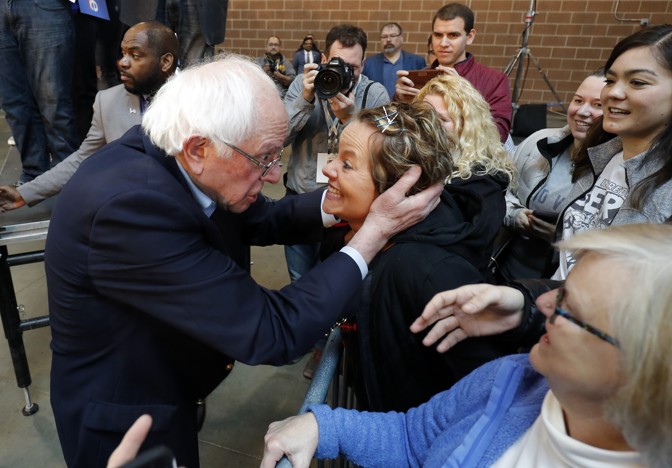
Senator Bernie Sanders meets with Sarah Bass of Boone, Iowa, after a campaign rally in Des Moines. (Matthew Putney / AP)


Ideas From The Atlantic

The Western Erasure of African Tragedy (Hannah Giorgis)
“Western publications engaged in selective reporting about the deceased. The Washington Post, for example, led its homepage coverage Sunday with a headline that informed readers only that ‘Eight Americans among 157 people killed in Ethiopian Airlines crash.’ (The Washington metropolitan area has the largest population of Ethiopian descent outside the country itself.)” → Read on.

Is It Time to Worry About the Boeing 737 Max 8? (James Fallows)
“Modern accidents almost always involve some strange, improbable, edge-case conditions, precisely because so many of the “normal” risks have been studied and prevented with redundant safety features. So no one knows, yet, what happened in the Ethiopian Airlines disaster, and anyone who feigns certainty now should be viewed with wariness.” → Read on.

How Not to Lose to Donald Trump (Rahm Emanuel)
“Earth to Democrats: Republicans are telling you something when they gleefully schedule votes on proposals like the Green New Deal, Medicare for all, and a 70 percent marginal tax rate. When they’re more eager to vote on the Democratic agenda than we are, we should take a step back and ask ourselves whether we’re inadvertently letting the political battle play out on their turf rather than our own.” → Read on.


What Else We’re Reading

Meet the Group Trying to Change Evangelical Minds About Israel (Adam Wren, Politico Magazine)
Hell and High Water: How Flooding and Buyouts Threaten Black History (Laura Thompson, Scalawag)
Did You Really Think Trump Was Going to Help End the Carceral State? (Marie Gottschalk, Jacobin)
How Violent American Vigilantes at the Border Led to Trump’s Wall (Greg Grandin, The Guardian)
The Case for Immigration (The Economist) (? Paywall)


We’re always looking for ways to improve The Politics & Policy Daily. Comments, questions, typos, grievances and groans related to our puns? Let us know anytime here.

Were you forwarded this newsletter? Sign up for our daily politics email here. We have many other free email newsletters on a variety of other topics. Find the full list here.

Killing a Mockingbird

Image Source Front cover art for the book To Kill a Mockingbird

“Shoot all the blue jays you want, if you can hit ’em, but remember it’s a sin to kill a mockingbird.’”That was the only time I ever heard Atticus say it was a sin to do something, and I asked Miss Maudie about it.”‘Your father’s right,’ she said. ‘Mockingbirds don’t do one thing but make music for us to enjoy.”

—Harper Lee, To Kill A Mockingbird

“Take me to a place without no name.”

– Michael Jackson, “A Place With No Name”

Harper Lee’s book To Kill A Mockingbird continues to get reproduced. It is read across the country in school. Now the book is going to Broadway. We should all breathe a sigh of relief that Hamilton no longer center stage. What was with that play anyways? Could anyone figure that out? Wasn’t American history class nauseating and unbelievable for more people? If there was a national poll on Hamilton one would guess it would do no better than the 1% who actually saw it.

Hamilton and To Kill A Mockingbird are the same story, more or less. It’s a fairy type of heroic rich white men in a history that produced none of these characters. To dull the sins of the present moment these stories are repeated. History is told inaccurately not for history’s sake, but for the sake of the present. If there were heroes in the past, why couldn’t there be heroes now?

To Kill A Mockingbird isn’t about a black guy (Tom Robinson) getting accused of rape. Tom isn’t even real. He’s not a character, he’s just a plot structure. Could anyone say anything about Tom besides his race? To be fair, none of the characters are complex, well-developed or interesting in any way, shape or form. And yet the book is clearly about one person: Atticus Finch. Unlike the helpless but angelic prisoner, Mr. Finch is a real person. And he’s annoying as hell.

It’s not unusual for a rich guy to have platitudes. It’s unusual for them all to come true. And Finch works for the book because he has strict rules. He is law and order. He is meant to civilize the white trash whose racism makes them subhuman to rich whites like Finch. It is here that the racism of the audience is displaced. What generally happens when the bourgeois make these very ‘black and white’ stories is that prejudice is only confirmed. Once prejudice is accepted it can never be controlled. Once humanity looses its complexity, all we can see is complexion.

It is dangerous to teach children this fairy tale of good and evil. What we teach them is that justice comes from the top. Now power no longer corrupts. Power does not oppress. Power, when in the right hands, saves. To those in power, power is always in the right hands.

And in a story like this the black guy is subhuman not by his actions, but by definition. He is a cripple. And his story runs parallel to a freakish subhuman boy (Boo Radley) down the street who is accepted by Finch. The lesson is that “the others” are not as they appear, whether they be black or deranged—without any distinction between the two.

Maybe Harper Lee is smarter than she appears. Maybe she was writing this book from the perspective of a 6 year old to prove just how fantastical such a story was. At the very least, it’s an ageist book, and one that doesn’t age well. Except for on Broadway apparently, where the audience is just as rich, old and white as they ever have been.

On a seemingly unrelated note a new documentary is out. “Leaving Neverland” documents pop star Michael Jackson’s sexual abusive relationships with two young boys. From Donald Trump to Harper Lee to HBO, America remains fascinated by the construct of rape by people of color.

Why not make a remake of To Kill A Mockingbird involving Michael? Have this play still told from the perspective of a young child. Would Michael still be defended? Would his admirers be any less problematic than his detractors? Could anything beyond fame or criminality be considered? How would Atticus’ children react to Michael? Would the children be relieved to find a father figure who wasn’t so condescending? Or would the idea of treating these young children ‘as adults’ go too far and stunt the real merits of childhood that Michael himself supposedly lost along the way?

If Michael couldn’t sing, would anyone take his case? And if Michael couldn’t sing, would anyone hear from those children? How quickly would the Finch children turn on Finch’s hackneyed advice and run into the arms of the magical Mr. Jackson? How would Jackson’s relationship with Mr. Finch’s children test Finch’s “anti-racist” crusade?

How would such a book effect the reader? Most of the readers of To Kill A Mockingbird are young children, young enough to be influenced by a figure like Jackson, or even by a figure like Finch. How would the children benefit from hearing “both sides” of the story? Both from the hallow and sanctimonious Finch and from the deep and morally ambiguous Jackson? Could this book have a “happy” ending, where Mr. Finch goes to jail? Or would even the idea of “happy” be too corrupted by Jackson’s own dishonesty in dealing with real happiness in his fantasy land.

And yet, was Jackson’s fantasy any more far-fetched than Finch’s? Weren’t both men buying into the world of innocence where the always guilty black man is merely used as a way to prove that even he can be innocent? Circa bizarro O.J. Simpson, who killed two people and is publicized not as a symbol of innocence, but as a symbol of fear of the black mob for White America.

O.J. still gets play for three reasons: 1. To prove that the criminal justice system is not racist. 2. To normalize, or even celebrate violence and murder, specifically the murder of a woman. 3. To get White America frightened of black people dancing on the streets in their supposed celebration of Mr. Simpson. Remember when Donald Trump said that Muslims danced for joy after 9/11? It’s like that. It’s actually not that original of a story if we think about why it is repeated.

Could Jackson’s own transition to whiter skin be linked with his own quest for innocence and nostalgia? Because black children are not allowed to be children he had to become a white person to become a child. Black children cannot be innocent in America. Jackson is always seen as magical, and therefore harmless. He becomes a problem only when he tries to be real through the very magic that was supposedly who he really was.

Finch becomes a fictional hero for the ruling class and a pain in the rear for children. Finch becomes the hero because he is fair, he is civilized. He does not see race. He does not see prejudice. All you people need to do is walk in someone else’s shoes and you will know too.

But Finch won’t walk in anyone else’s shoes. He walks in his own. And his fans do too. For they are him. They are not at fault. They watch and watch. They are smarter than the story. They watch just to prove their fantasy that nothing is wrong. As long as there are fair-minded old white guys running the show (same as it ever was). Jackson has fans because no one can walk in those shoes. It’s called the moon walk. And it can’t be done, not in the same way.

Jackson is the mockingbird, so many years later. He sings. It’s sad when he dies because he was a pretty bird. But was he? And was that all he was? Who knew this man besides those who really knew him? And by God Atticus Finch does not understand mockingbirds. He sees them as a case. He’s a sociologist. Who does all that looking and still has no prejudice?

What use is Finch if he looks all day, runs the whole town, and comes up with nothing at all to be prejudiced about? Keep the world the same? How is that going, Mr. Finch? And give this to Jackson, he wanted to change the world, and he did. Rock is dead. Pop rules the world. It has critics. But no one really cares about them. So Jackson runs the world, Finch has his town. Jackson is a story, Finch is just bored. And maybe the great shakers only make things worse, after all. But they have a story at least. And it is a real story.

It is different sides of production. Finch decides. He decides who is guilty, who is innocent. Finch chooses innocent this time. Because this is fiction. And because no one at the top is scared of more Atticus Finchs. The same people from the same families and the same neighborhoods cycle in and out of the criminal justice system.

We can call these people on trial guilty and we can call them innocent, but is either true? For isn’t Finch really running the show? Not in the sense of declaring who is guilty, who is innocent. But in the fact that he is choosing either. And the fact that those on trial are always the same. They may have done it. They may have not done it. But who cares? Crime is a social problem. We get lost in the details and motives of each criminal. As a group there will always be a certain percentage of each class that did a crime, and this percentage will vary among the classes in questions.

So each time one of the underclass is saved it’s a story but never more than that, and therefore not a story worth telling. And Jackson sings. And we debate. If he did it. And why not believe the victims? But why should that be the story, or even really a debate? With some good people and bad people in each class, everyone has the same choices. And a good choice in one situation is like a bad choice in another.

Now the world sings Michael Jackson anyways. And no one really cares about these stories, as long as his song pops, which it does. And this kills Atticus Finch. Finch needs to control the world. He needs heroes and he needs villains.

Finch has more power than he thinks. He controls all parts of the world. Not just the trial. Finch controls before and Finch controls after. No one is guilty, and certainly no one has clean hands. And so Michael, let’s skip the public trial. They could ruin anybody if they wanted, why you? Robert Kraft made the news too. But everyone knew he was a predator already. Was this news? The only news is that it was covered up for so long. This is all of ICE too. Where was Donald Trump when The New York Times broke the story about migrant women being held hostage and raped repeatedly?

It happens in message parlors. It happens in the Church. MeToo’s most lasting accomplishment has been democratizing the role of Atticus Finch. Now it is less shameful to be the one who shames. Now it is not only Finch who can say what is right and wrong. Now an immigrant in detention can say so too. Occasionally only though. And only when approved by the corporate press. Which is why we are yet to come to terms with the military’s role in all of these dynamics. Finch is an imperialist just as much as Jackson may be a product of it—in both good ways and bad.

So it’s not random. It’s not captivating. It’s pervasive and sad and cruel. Jackson can’t and shouldn’t escape that evil. Still, pop rules the world. Micheal built that. That cannot be taken away.

There’s power in pop too. For everyone, if they want. It’s pop after all. And it’s not that trivial. It’s just life. And if pop is trivial, so is life. Golf needs a set of clubs, soccer only needs a ball. Rock needs a guitar, pop only needs a microphone, This is life.

Atticus wants power. Michael wants something else. And maybe power too. Atticus get off from hearing the sound of his own voice. Michael looked at the man in the mirror. Not for pleasure. But to really look.

To the contrary, the entire point of To Kill A Mockingbird is to congratulate the reader. It is not to make the reader think. It’s CNN. You decide. You make it fair. You make it right. None of it is true. And maybe even the reader is doing the best they can. If that’s the case why congratulate one’s self?

Jackson was pop before pop. You didn’t have to feel anything. You were here, he was here. And that was enough. And then Madonna. And then Rihanna. And then Drake. The top star now always projects less feeling. Finch drives the wedge of ambition. His children admire it but would they rather have a father? Finch wants you to feel. He strikes the right chords but doesn’t know what music is. Jackson just is. And that gives more than Finch ever could.

The larger quibble is that this book is still read very widely in school and is seen as the way to explain morality to children. To Kill A Mockingbird can only do so much damage to the Broadway crowd because there is only so much damage left to be done. As for our young people who continue to get more and more progressive, let’s give them better reading material.

Finch treated adults like children because his heart was too small. Jackson treated children like adults because his heart was too big. And in both cases power corrupts, while consequences are evasive. And justice has nothing to do with what these men could get away and with what their victims couldn’t. It was only class. Both will be seen as heroes and now almost by accident both will have to face the spotlight. Jackson entraps because he makes you feel alive. Finch entraps because he makes you feel powerless.

Wesley Morris of The New York Times argues that we haven’t been able to see the truth about Jackson before the new documentary because he was too magical for us to see through him. And yet, wasn’t it just the opposite? Jackson was so real that no one cared. No matter how convincing the documentary may be there are a lot of people who simply won’t care because Jackson gave so much to them in a real way. Jackson himself may have lived in a fantasy land but the star is always more distant from reality than their fans are. The star is the star because they can act as the link between the reality we all feel and the fantasy the star lives in. This fantasy is no more the star’s than it is ours. It is a fantasy that is both false because of its corporate distribution and true because of no one can truly exit the expectations of the bourgeois besides the bourgeois themselves.

The shift from rock to pop as the dominant music medium is in line with Karl Marx’s technological determinism. The shift from communal instrumentation to individual electronic sound expresses both the technological advances of capitalism and its alienating effects. Michael Jackson and Prince thriving at similar times points to a split, and perhaps the reason people always ask which one you prefer: Prince or MJ? What that question might be asking is do you prefer music before these two musicians or music after?

Prince was an instrumental pop artist, and maybe even closer to rock, if not closest to funk. Instrumentally speaking, Prince and the music that preceded him were quite material. They relied on material instruments for sound. The contradiction is that lyrically the focus was largely immaterial. Art that precedes the present age asked about broad immaterial concepts: love, God, purpose, etc.

Fast forward to Michael Jackson and modern day pop. No instruments in sight. Many of the pop stars can’t even sing. This isn’t meant as a diss. They are every bit as talented—they just use different skillsets which shouldn’t just be limited to the arena of music. Music itself is more or less a mathematical equation and in many ways the pop stars today have mastered the equation in ways older musicians never did. It’s like playing chess. A beginner will see the game as full of endless possibilities and will improvise at every turn. And yet as they improve they will find that the best move is both mathematical and formulaic.

As a result, pop music today is less about music than it ever has been. The formula of making a catchy song with a trendy character behind it has been mastered. Dominant singular stars then distinguish themselves in much the same way Jackson did. Lyrically the focus is material. There is no way to make any sort of formula out of the material world as a whole. The ridiculous skill of recognizing and remembering faces should prove this before we even get to the other material focuses of today’s music: sex, money and work. What pop stars now aim to do is capture the material reality of today’s precarious world which has lost the philosophical depth of pre-Prince precisely because we have transcended it materially as a whole and remain too insecure materially on an individual level to even contemplate these broader questions. Jackson’s focus on dance, fashion and vocal play all set the stage for the modern artist to branch out from a sound that no longer relies on instruments in the same way.

To Kill A Mockingbird is bad in part because it isn’t funny. There’s no room for laughter. You are suffocated the entire time. As far as racist classics go, at least give Heart of Darkness this: it’s supposed to be a comedy. Granted, there are no moments at which you would actually laugh. The Oscar winner Green Book is the same way. It’s supposed to be funny at least. Even though it isn’t. The Oscars have worse taste than the Russians when it comes to picking American winners (kidding, lefties).

Why would a movie like Green Book which is completely reductive and uninteresting beat out another Spike Lee classic, a legit good Hollywood  movie like A Star Is Born and an artistic success in Roma? Because Green Book makes the audience feel good. Because it tells the audience not that racism is dead, but that the bourgeois audience is part of the solution, not the problem.

A side note on A Star Is Born, which is a very good film. The film is more serious than it claims to be. However, the total takedown of pop music is so pretentious. Bradley Cooper kills himself because pop music is supposedly so “meaningless” that he just can’t take it. Lady Gaga still made one of the best pop albums of all time (The Fame) no matter what she thinks. The reason the movie holds up is because the real Gaga is still there, even if she tries to become more conceited than she’s capable of.

Art only means as much as the enjoyment it can provide the viewer. The liberal entertainment complex is highly linked with the military industrial complex and cultural imperialism in general. The purpose of this structure is to tell the viewer how to feel, not for the viewer to enjoy the product. While most art only practically functions as relief from the mechanisms of capitalist labor and alienation, critics like to judge art on whether the art means anything. This is interesting to be sure. Although it’s a very meta approach that implies that art has no value in and of itself.

This is the criticism of pop music and popular culture in general. The greatest philosopher ever may have been Karl Marx. This was not because he found anything that had meaning, truth, or enjoyment but because he was able to identify exactly what was preventing people from becoming the very philosophers that had enough time, money and relief from stress that could identify such philosophical implications in a way that was more than simply a product of their present condition. Hence, there is more truth in the anti-philosophy materialism of today’s pop than most any philosophy simply because now more than ever it is the material, not the natural world, that is present in our lives. There also must be truth that if there is such thing as a ‘natural’ state for humans (slowly adjusted by evolution), then the present times that are so overtaken by technology and individualism and so distant from nature and community that these times must be inherently alienating. The irony of pop music then is that it can speak to alienation precisely because it is the popular expression of it.

So, America, Michael Jackson should not be our mockingbird. He does not need us to save him. He is not a bird, he is a man. He is not a singer, he is a human. He is real precisely for the reasons To Kill A Mockingbird is not. He wanted to feel, he wanted to change, he wanted to inspire, and sometimes, he wanted to hurt. To Kill A Mockingbird should never go near a child again because it means nothing beyond a reproduction of its own mythos.

Jumping to Michael Jackson’s defense seems misplaced. Proving him to be innocent means nothing. Just as proving Tom Robinson innocent means nothing. Nor should the innocence be so certain. Jackson was many things. Not just a mockingbird. Pop can save lives and pop can ruin lives. It never has been the powerless cripple that Harper Lee imagines seeing in Tom Robinson, Boo Radley and the mockingbird itself.

Michael Jackson is not Tom Robinson with a voice, he is Atticus Finch with a soul. He, like Finch, can weave a fantasy tale and evade the consequences. Anyone with power and money can. What separates Jackson is that he actually had a story to tell. When most kids listen to Michael Jackson, it’s not required reading. For a few children though, Jackson was required.

If the layered world Michael Jackson created meant more than the sentimental magical world of Atticus Finch, we should avoid the sentimentality of seeing Jackson as a helpless mockingbird. Instead let us assert that he was a full human. An accurate depiction of humanity’s history would tell us that while this isn’t a compliment, it is the truth. Jackson will outlast Finch simply because there was some truth there. Truth is not found in the books that rich people require children to read, nor it is in the verdicts of rich lawyers who decide who is good and bad. Truth lies in pop. It lies in the music that captivates the masses, whether that be to our promise, or to our peril.


Brazil President Posts Sexually Explicit Video to Denounce Festival…

Brazil’s President Bolsonaro Posts Sexually Explicit Golden Showers Video to Denounce Carnaval

Brazilian President Jair Bolsonaro tweeted out a sexually explicit video of a man pissing on another man’s head in an apparent attempt to denounce Carnaval, the country’s massive annual street party.

The far right populist, elected last year, shared a video of two men standing on a taxi stand in order to “expose the truth” about Carnaval. At one point, on the men appears to piss on the hair of the other. It’s graphic.

“This is what Brazilian carnival street parties have turned into,” Bolsonaro said.

Defenders of the event claimed the video he tweeted out was an isolated incident. After a torrent of criticism, Bolsonaro asked Twitter Wednesday what a “golden shower” is:

O que é golden shower?

— Jair M. Bolsonaro (@jairbolsonaro) March 6, 2019

According to an Insider report, Bolsonaro’s crusade against Carnaval comes after the festival made a mockery of him.

Bolsonaro has a history of homophobic and bigoted remarks. He once said he’s “proud to be homophobic” and that he would “rather his son die in a car accident than be gay.” He also once told a congresswoman she was too ugly to be raped.

Journalist Glenn Greenwald — who lives in Rio de Janeiro — and others took to Twitter to criticize Brazil’s leader for the post.

(It says the tweet is unavailable but that’s because Bolsonaro blocked me & all other journalists at @TheInterceptBr). Male anuses have long played a central role in Bolsonaro’s worldview. He speaks of them often. In 2017, he tweeted about anal sex to me https://t.co/SpdrWctKSE

— Glenn Greenwald (@ggreenwald) March 6, 2019

In any event, Bolsonaro’s Twitter account now has 3.5 million followers, many of whom are almost certainly adolescents & children, so posting graphic pornographic kink videos seems somewhat inconsistent with his aggressive sexual moralizing. Then again, so do his 3 marriages.

— Glenn Greenwald (@ggreenwald) March 6, 2019

Obviously, this another in a long line of threats and dogwhistles Bolsonaro’s made against Brazil’s LGBT population.

When Jack’s done with his Joe Rogan interview can someone ask him what’s the ruling on this?

— Ryan Broderick (@broderick) March 5, 2019

[Photo by Evaristo Sa/AFP/Getty Images]

Have a tip we should know? tips@mediaite.com


The Atlantic Politics & Policy Daily: Oh NATO They Didn’t

What We’re Following Today

It’s Monday, March 11.

The White House released its 2020 budget proposal, which calls for budget cuts and work requirements across social-safety-net programs as well as $8.6 billion in funding for a wall across the southern border. Through invoking a national emergency last month, President Donald Trump has already moved to divert another several billion toward building the wall.

Meanwhile, congressional leaders sent a bipartisan invitation to NATO’s secretary general, Jens Stoltenberg, to address a joint session of Congress in April. The president has vocally criticized NATO in the past.

Beto Late Than Never: It’s looking like Beto O’Rourke might be one of the last Democratic candidates to hop into the 2020 presidential campaign, and some Democratic strategists worry that he missed his moment. “Even some friends have struggled to explain what his delay has been about and how, if he’s had to agonize so long over whether to run, he could actually be ready for the campaign ahead, let alone the presidency,” reports Edward-Isaac Dovere. But with powerful new hires such as Barack Obama’s former campaign manager, David Plouffe, and viral name recognition, O’Rourke shouldn’t be written off too quickly. “None of the candidates who have announced has been able to match the virtuosity as a social-media storyteller that made him a star.”

Still confused about who’s in, who’s out, and who’s still flirting with a presidential run? Bookmark our constantly updated 2020 candidates guide.

The Cost of Impeachment: House Speaker Nancy Pelosi said that she’s not in favor of impeaching Trump, in a recent interview with The Washington Post Magazine, arguing that the president is “not worth” the national divisions an impeachment trial would cause. A counterpoint: In The Atlantic’s March cover story, Yoni Appelbaum made the case for launching impeachment proceedings, arguing that Congress has a duty to bring the debate over Trump’s fitness for office “out of the court of public opinion and into Congress, where it belongs.”

It’s Tax Season: Most Americans won’t cheat on their income taxes; they’ll pay exactly what they owe. Why are Americans such sticklers for tax law? Rene Chun explains in the forthcoming April issue of The Atlantic.

Inherited Circumstances: The effects of teenage motherhood span generations, according to a new study: Children whose grandmothers had teen pregnancies are more likely to underperform in school, even if their own mothers gave birth as adults. That probably has to do with the persistent effects of intergenerational poverty, reports Alia Wong.

Immigration: David Frum argues in The Atlantic’s April issue that “if liberals insist that only fascists will enforce borders, then voters will hire fascists to do the job liberals refuse to do.” He writes: “The question before the United States and other advanced countries is not: Immigration, yes or no? … The questions to ask are: How much? What kind?”

As always, we want to hear from you. Write to us at letters@theatlantic.com or reply directly to this newsletter with your thoughts on Frum’s argument. We might feature your response on our website and in future editions of the Politics and Policy Daily.

Madeleine Carlisle and Olivia Paschal


Snapshot

Senator Bernie Sanders meets with Sarah Bass of Boone, Iowa, after a campaign rally in Des Moines. (Matthew Putney / AP)


Ideas From The Atlantic

The Western Erasure of African Tragedy (Hannah Giorgis)
“Western publications engaged in selective reporting about the deceased. The Washington Post, for example, led its homepage coverage Sunday with a headline that informed readers only that ‘Eight Americans among 157 people killed in Ethiopian Airlines crash.’ (The Washington metropolitan area has the largest population of Ethiopian descent outside the country itself.)” → Read on.

Is It Time to Worry About the Boeing 737 Max 8? (James Fallows)
“Modern accidents almost always involve some strange, improbable, edge-case conditions, precisely because so many of the “normal” risks have been studied and prevented with redundant safety features. So no one knows, yet, what happened in the Ethiopian Airlines disaster, and anyone who feigns certainty now should be viewed with wariness.” → Read on.

How Not to Lose to Donald Trump (Rahm Emanuel)
“Earth to Democrats: Republicans are telling you something when they gleefully schedule votes on proposals like the Green New Deal, Medicare for all, and a 70 percent marginal tax rate. When they’re more eager to vote on the Democratic agenda than we are, we should take a step back and ask ourselves whether we’re inadvertently letting the political battle play out on their turf rather than our own.” → Read on.


What Else We’re Reading

Meet the Group Trying to Change Evangelical Minds About Israel (Adam Wren, Politico Magazine)
Hell and High Water: How Flooding and Buyouts Threaten Black History (Laura Thompson, Scalawag)
Did You Really Think Trump Was Going to Help End the Carceral State? (Marie Gottschalk, Jacobin)
How Violent American Vigilantes at the Border Led to Trump’s Wall (Greg Grandin, The Guardian)
The Case for Immigration (The Economist) (? Paywall)


We’re always looking for ways to improve The Politics & Policy Daily. Comments, questions, typos, grievances and groans related to our puns? Let us know anytime here.

Were you forwarded this newsletter? Sign up for our daily politics email here. We have many other free email newsletters on a variety of other topics. Find the full list here.

Interim Stat Pack for October Term 2018

With six out of eight argument sessions for the 2018-2019 Supreme Court term behind us and 21 written opinions down (17 in argued cases and four summary reversals), here is the March 2019 SCOTUSblog Interim Stat Pack. This Stat Pack includes statistics related to this term’s arguments and opinions through March 4, 2019. The whole Stat Pack can be viewed here.

The information in the Stat Pack covers various aspects of the court’s decisions. The analyses look at the court as a whole as well as at the individual justices.  Coverage relates to the justices’ votes, written opinions and agreement with one another. It also tracks the Supreme Court’s decisions and justices’ votes by lower courts. We have included information about the attorneys who argued the cases as well as figures relating to the court’s opinion output and number of grants.

These preliminary data present some interesting attributes of October Term 2018.  For a Supreme Court many thought to be leaning heavily to the right, the liberal justices appear to have the upper hand, at least so far. We see this in the Frequency in the Majority section, where the more liberal Justices Ruth Bader Ginsburg, Stephen Breyer, Sonia Sotomayor and Elena Kagan were in the majority more frequently in all cases and in divided cases than the more conservative Justices Clarence Thomas, Samuel Alito and Neil Gorsuch. Justice Brett Kavanaugh did not participate in five of the cases that have been decided so far, including two of the divided cases.

The Justice Agreement tables are illuminating as well. Along with the usual high level of agreement between pairs of liberal justices and a corresponding high level of agreement between conservative justice pairs, we see that Chief Justice John Roberts was more often in agreement with the more liberal justices than he was with the more conservative justices, excluding Kavanaugh. Kavanaugh too had higher level of agreement with the more liberal justices than he had with Thomas, Alito or Gorsuch.

It’s important to note that these numbers are only preliminary, that they cover less than one-third of the total argued cases the Supreme Court will hear this term, and that they include votes in only six divided cases. Although we very well might see some of these early trends shift later in the term, they provide a sense that, at least so far, some of the justices’ decisions, and more importantly their alignments, weren’t exactly as many expected them to be.

The post Interim Stat Pack for October Term 2018 appeared first on SCOTUSblog.

Argument preview: Justices to decide whether dismissal as untimely of Supplemental Security Income claimant’s request for review is final decision subject to judicial review

After a hearing, an administrative law judge denied Ricky Lee Smith’s application for supplemental security income benefits based on disability. The ALJ’s decision was dated March 26, 2014, and under the agency regulations, Smith was required to request review of the ALJ’s decision by the Appeals Council within 60 days of receiving the decision.

Smith’s counsel alleges that he timely requested review of the ALJ’s decision. The Social Security Administration, however, has no record of receiving his appeal before September 21, 2014, when it received a fax from Smith’s counsel asking about the status of the appeal. On November 6, 2015, the Appeals Council dismissed Smith’s request for review as untimely.

A Social Security Administration regulation provides that “[t]he dismissal of a request for Appeals Council review is binding and is not subject to further review.” Smith nevertheless brought suit seeking judicial review of the Appeals Council’s dismissal under 42 U.S.C. § 405(g). Section 405(g) provides in relevant part:

Any individual, after any final decision of the Commissioner of Social Security made after a hearing to which he was a party, irrespective of the amount in controversy, may obtain a review of such decision by a civil action commenced within sixty days after the mailing to him of notice of such decision or within such further time as the Commissioner of Social Security may allow.

Consistent with the agency’s regulation and the majority view of the federal courts of appeals, the district court dismissed Smith’s complaint on the ground that dismissal by the Appeals Council of a claimant’s untimely request for an appeal is not a “final decision” subject to judicial review under Section 405(g). The U.S. Court of Appeals for the 6th Circuit affirmed.

The Supreme Court granted certiorari to resolve a split among the circuit courts on this question. Smith contends that the Appeals Council’s decision is a final decision under the plain meaning of Section 405(g) because it is the final administrative ruling in the case — there is no further administrative consideration of the claim. Smith argues that this reading is consistent with the Supreme Court’s interpretation of the term “final” under the closely related Administrative Procedure Act and that the lower court’s distinction between dispositions based on the merits (which are appealable) and dispositions on other grounds (which are not subject to appeal) was entirely irrelevant. Smith points out that even if the meaning of the term “final” were not clear, it should encompass the Appeals Council’s determinations based on timeliness because the Supreme Court applies a strong presumption in favor of judicial review of administration action.

Smith asserts that his appeal is clearly distinguishable from Califano v. Sanders, a 1977 case in which the Supreme Court held that an agency’s final decision not to reopen a claim for benefits does not fall within the definition of a final decision subject to judicial review under Section 405(g). Quoting the U.S. Court of Appeals for the 11th Circuit’s 1983 decision in Bloodsworth v. Heckler, Smith explains that “review and reopening play fundamentally different roles in the process of administrative decision making and have significantly different effects upon the finality of administrative decisions.” Reopening a case offers a claimant a “bonus opportunity” to obtain administrative reconsideration of a final decision. The Appeals Council’s dismissal of Smith’s appeal on the ground of untimeliness, in contrast, is the first “final decision” in this case and thus Smith’s first opportunity for judicial review.

Smith contends that the agency’s regulation prohibiting judicial review of the Appeals Council’s dismissal is not entitled to deference because it contradicts the plain statutory text that authorizes judicial review for “any final decision.” Moreover, it would defy common sense to defer to that regulation when, as explained below, the government has disclaimed the legality of the regulation. Smith further argues that in light of the Appeals Council’s heavy workload, judicial review is particularly important to ensure that claimants are not subject to arbitrary and unjustified action.

With respect to Section 405(g)’s requirement that the final decision be made “after a hearing,” Smith asserts that the requirement was satisfied because an ALJ conducted a hearing with respect to Smith’s benefits claim. Moreover, Smith contends, even if there had not been a hearing, the hearing requirement is waivable.

Consistent with its regulation, the agency argued before the lower courts that the Appeals Council’s dismissal of Smith’s claim on the ground that it was not timely was not a final decision eligible for judicial review under Section 405(g). The government, however, reconsidered its position before the Supreme Court in light of Smith’s petition for writ of certiorari and a recent decision by the U.S. Court of Appeals for the 7th Circuit in which it joined the 11th Circuit in holding that Section 405(g) “‘allows judicial review when a claim has been presented and finally decided,’ even when that final decision is … a dismissal for untimeliness.” The government now takes the position that a dismissal order is subject to judicial review, but that the review is limited to the procedural ground on which the agency based its dismissal.

The government’s arguments are similar, though not identical, to Smith’s arguments. For example, the government contends that the Appeals Council’s dismissal of Smith’s request for review is a “final decision” subject to judicial review under Section 405(g) in both the ordinary sense of the term and under its customary usage in administrative law because the agency will take no further action on Smith’s claim for benefits. Similarly, the government argues that the agency’s regulation is beyond the authority of the agency because it indicates that the agency will never issue a final decision on Smith’s application, which would deprive Smith of his statutory right to judicial review merely because he failed to comply with an administrative guideline.

Unlike Smith, the government contends that judicial review is limited to the procedural ground on which the agency based its dismissal. The government asserts that limited judicial review is consistent with Section 405(g)’s express authorization of limited judicial review “where a claim has been denied by the Commissioner … because of failure of the claimant … to submit proof in conformity with any regulation prescribed under [42 U.S.C. 405(a)]” as well as with the federal courts’ approach to exhaustion in other contexts. Smith contends that the government’s position conflicts with the Supreme Court’s 2000 position in Sims v. Apfel. In Smith’s view, the language that the government relies on supports his position, because it shows that if Congress intends to limit judicial review to the grounds on which the decisions were resolved, it can and will draft the statute to do that expressly.

Because the government argues in favor of reversing and remanding the 6th Circuit’s decision, the Supreme Court appointed Deepak Gupta as amicus curiae in support of the decision below. Gupta argues that Section 405(g) should be interpreted in the specific context in which it arose – as part of the Social Security Act – rather than with reference to customary administrative practice and general APA doctrines as Smith and the government argue. According to Gupta, Section 405(g) was enacted in conjunction with “the creation of a massive, quasi-judicial process for adjudicating millions of small social security claims, with express restrictions on the circumstances in which judicial review must be allowed.” Section 405(g)’s “somewhat unusual” character arises from its role in ensuring that “federal courts are not swamped by disputes over the rules of the many-layered administrative process governing the nation’s largest social welfare program.”

Gupta asserts that the term “final decision” in Section 405(g) is susceptible to several different interpretations, and the most compelling, “within the ‘context of the statute as a whole,’” is “the final disposition of a claim for benefits on its merits.”

Relying on, among other authorities, Judge Henry Friendly’s 1966 interpretation of the requirement in Cappadora v. Celebrezze, and the Supreme Court’s opinion in Califano v. Sanders, Gupta argues that Section 405(g)’s “after a hearing” requirement is not satisfied in this case because the Appeals Council’s dismissal is not a decision on which the Social Security Act requires a hearing. Gupta further argues that the requirement is not satisfied by the ALJ hearing on Smith’s claim for benefits because “in context,” Section 405(g)’s “after a hearing” requirement “plainly refers to a ‘final decision’ reached ‘after a hearing’ on that decision.”

Gupta notes that the Social Security Administration’s interpretation of Section 405(g)’s finality requirement is not limited to Appeals Council dismissals on untimeliness grounds. Finality issues come up in a host of other procedural determinations under Social Security. Moreover, other statutes, most notably Medicare and Medicaid, incorporate Section 405(g) into their provisions for judicial review. Reversing the Social Security Administration’s longstanding interpretation of Section 405(g)’s finality requirement could “create significant floodgate concerns.”

Finally, Gupta argues that, at a minimum, the Social Security Administration’s longstanding interpretation of the statute is reasonable and therefore entitled to deference.

The National Organization of Social Security Claimants’ Representatives filed an amicus brief in support of Smith. The NOSSCR first describes the very lengthy and complicated four-step disability claims process that can be confusing to claimants. The NOSSCR then argues that Smith satisfied the non-waivable, jurisdictional component of the exhaustion requirement when he applied for benefits in 2012, when he sought reconsideration after the benefits were denied, and again when he participated in a hearing before an ALJ. Pointing to, among other things, the extraordinarily heavy workload of administrative appeals judges and the high frequency with which courts rule in claimants’ favor in other types of Social Security cases, the NOSSCR asserts that precluding review of dismissals by the Appeals Council causes harm to claimants. Finally, relying on general Social Security statistics as well as experience in the 11th Circuit, which has long allowed judicial review of Appeals Council dismissals, the NOSSCR contends that allowing review of Appeals Council dismissals would only cause a slight increase in federal court filings.

***

Past cases linked to in this post:

Bloodsworth v. Heckler, 703 F.2d 1233 (11th Cir. 1983)
Califano v. Sanders, 430 U.S. 99 (1977)
Cappadora v. Celebrezze, 356 F.2d 1 (2d Cir. 1966)
Casey v. Berryhill, 853 F.3d 322 (7th Cir. 2017)
Sims v. Apfel, 530 U.S. 103 (2000)

The post Argument preview: Justices to decide whether dismissal as untimely of Supplemental Security Income claimant’s request for review is final decision subject to judicial review appeared first on SCOTUSblog.

Facebook and Twitter Turned to TurboVote to Drive Registrations. Officials Want Them to Turn Away.

In 2018, Facebook and Twitter decided to play a role in helping people register to vote in what promised to be a momentous midterm election. To do so, the social media platforms directed users almost exclusively to a website called TurboVote, run by a nonprofit organization known as Democracy Works. TurboVote was launched in 2012, and it promised to streamline voter registration and remind people to cast ballots on Election Day.

Evidently, things did not go seamlessly.

The National Association of Secretaries of State, or NASS, whose members oversee elections in all 50 states, has claimed that TurboVote occasionally failed to properly process registrations, and that in other instances it failed to notify people who thought they had registered to vote but had not actually completed the necessary forms.

The TurboVote website went down when it couldn’t handle the volume of attempted registrations on Sept. 25, 2018 — National Voter Registration Day — and the organization was unwittingly used in a scam when someone pretending to be an employee of TurboVote attempted to convince eager voters to share their personal information over the phone.

As a result, NASS has written to Facebook and Twitter asking them to end their relationships with TurboVote as the 2020 election cycle gets underway. The association is asking the social media companies to simply direct prospective voters to government sites with accurate information on how to register.

For its part, TurboVote acknowledges that many people who tried to use its site did not complete the voter registration process — either because they’d overlooked a step or because their registration was rejected for another reason.

“Helping people understand whether or not they have successfully registered is a challenge we are committed to solving,” Kathryn Peters, a co-founder of Democracy Works, said in a statement.

TurboVote acknowledges the other problems and says it is collaborating with states to implement improvements, including integrating with the three states whose systems allow third parties to submit complete voter registrations directly, bypassing the issues identified in 2018.

In the statement, TurboVote said it has helped “millions register and vote nationwide.” NASS asked TurboVote to provide a detailed accounting of who these registrants were — who was new versus changing their address or simply a duplicate — but to date has yet to receive one.

Facebook said in a statement it had maintained “regular contact” with NASS throughout the election and looked forward “to continuing those partnerships as we assess how best to structure our voter registration and other civic engagement efforts ahead of the 2020 elections season.”

Similarly, Twitter indicated in a statement that it was looking forward to maintaining its relationship with NASS and that it was in the process of evaluating “partner feedback” and building “on our efforts to ensure we’re fostering an environment conducive to healthy, meaningful conversations on our service.”

A person familiar with Twitter’s election efforts indicated the company was unaware of problems with TurboVote’s work until after the election but was taking this into consideration as it plans for 2020.

TurboVote had also been enlisted by Facebook and Twitter to help in a get-out-the-vote effort — pledging to text reminders to vote to those who’d used its website to register. These reminders occasionally led to additional confusion, as people who had not successfully registered wound up frustrated at the polls.

“Many of these individuals then went to the polls and quickly found out they were not registered,” read the letters sent to Facebook and Twitter and signed by NASS President Jim Condos, who is also Vermont’s secretary of state.

In an interview, Peters said the organization was working on better language to make clear to those receiving the text messages that they may not have registered.

The letters follow a contentious exchange between TurboVote and other nonprofit voting groups at a recent National Association of State Election Directors meeting. Officials from across the country confronted TurboVote over the issues addressed in the letter sent by NASS.

“These text reminders created some hysteria in my state. They think that those messages are coming from us, and they are not,” said Lori Augino, the elections director in Washington state, who said text messages from unfamiliar third parties stoked existing fears over election security.

Jared Dearing, the election director in Kentucky, went further. “You’re acting as an interlocutor between registrants and the people who register, and, in my opinion, we don’t need interlocutors,” he said. “If one individual falls through the cracks in this thing, they are disenfranchised.”

Seth Flaxman, also a co-founder of Democracy Works, and Peters said the meeting and the letters have reinvigorated their desire to work more productively with the states to solve these issues. “We feel strongly that we cannot do this work without a productive relationship with the states,” Flaxman said. “We are committed to that.”

While Peters and Flaxman noted that states have made improvements to their websites and voter registration processes — such as adopting online registration — they said that the government-managed websites recommended by NASS underserve voters who cannot register online, including those who do not have the necessary state-issued ID many such systems require.

For example, Vote.gov directs Texas registrants to a 26-page PDF, while TurboVote walks Texans through a series of questions that take the interested voter through the steps of registration. Peters and Flaxman also expressed concern that many potential voters would be less likely to complete registrations without TurboVote, and noted that Vote.gov has no ability to measure or reach out to those who became overwhelmed or confused and stopped the process.

Further, Peters and Flaxman say they believe that people need a national site that not only guides them through a state’s registration process, but that can also follow up via text and email to assist voters in either casting a ballot by mail or in person for every election — services TurboVote provides.

“In most states, voter registration has multiple steps, and missing a step can lead to an incomplete or rejected registration (for example, some potential voters may not click through to the second page of a state website, others may download a paper form but don’t print it),” Peters said in a statement. “This is a problem TurboVote was built to solve.”

Home Ethos About Contact
Terms Policy GDPR RichTVX
© Saeculum XXI U.S. Intelligence News