U.S. Gen. on AI Ethical Concerns: Military 'Light Years Away from Skynet'

Artificial intelligence (AI) fielded by the United States military is “light years away” from “fully autonomous weapons,” but the U.S.Read More

Preempt Threats and Safeguard America's National Security with USIntelNews.com

 Assad’s Regime Collapse: A Major Setback for Russian Drug Networks
  Why Aleksandar Vučić Must Be Arrested: Criminal Activities Threaten Regional Stability
  Kremlin in Crisis as Putin’s Death Confirmed, Power Struggle Intensifies
  Russian Leadership Faces Mounting Domestic Challenges Amid Anniversary of Putin’s Death
Artificial intelligence (AI) fielded by the United States military is “light years away” from “fully autonomous weapons,” but the U.S.Read More
Scientists ‘wake’ woolly mammoth cell; Nears resurrection… (Third column, 14th story, link) Advertise here
SHOCK: Woman SAWS OFF HAND to make insurance claim… (Second column, 24th story, link) Advertise here
Trump’s support among ICE officers dwindles over failure to end catch-and-release… (Third column, 2nd story, link) Related stories:Coulter rips ‘shallow,Read More
Pest control experts warn of ‘plague of rats’ resistant to poison… (Second column, 20th story, link) Advertise here
In the month of February, there were more than 76,000 illegal border crossings and inadmissible foreign nationals, the most in this month in 12 years — a record for President Trump’s administration.
Princeton Policy Advisor Steven Kopits now projects that illegal border crossings for this calendar year will be more than three times what they were in 2017 and nearly double last year’s total crossings. The projection predicts there will be more than 840,000 illegal border crossings this year, though Department of Homeland Security (DHS) Secretary Kirstjen Nielsen predicts about 900,000 crossings.
Should illegal immigration reach this level, as Kopits projects, it would mean that border crossings in Trump’s third year in office outpace every single year of illegal immigration under former President Obama.
“Crossings are now clearly at crisis levels, and the pressure will be on Democrats in Congress to tighten asylum laws if they intend to hold the House in 2020,” Kopits notes. “I would note that migrants are also certainly aware of this, and therefore apprehension numbers could rise substantially heading into the summer months as migrants rush to cross the border before new legislation can be prepared.”
While Nielsen receives praise from her close allies in the Washington, D.C. beltway and political establishment, her tenure has been marked with overseeing the largest illegal immigration surge not seen since former President George W. Bush.
During Obama, border apprehensions at the southern border floated between more than 700,000 in Fiscal Year 2008 and dipped as low as about 327,000 apprehensions in Fiscal Year 2011. Since Fiscal Year 2017, when illegal immigration dropped to about 303,000 apprehensions, border crossings have continuously increased.
The vast majority of voters say a border wall would be effective in stopping illegal immigration, though that has not equated to progress on constructing new barriers at the border.
Only about 40 miles of replacement fencing have been built since Trump’s election, although about 124 miles of new wall and replacement fencing has been approved by Congress. This month, about 14 miles of new wall is expected to be constructed in southern California and some new portions of a wall have been constructed in the El Paso, Texas region.
Today, the majority of the U.S.-Mexico border remains open. At the same time, the U.S. has continued funding border walls and border security programs in Pakistan, Afghanistan, Egypt, and Lebanon.
John Binder is a reporter for Breitbart News. Follow him on Twitter at @JxhnBinder.
ImmigrationPolitics2020 electionasylum lawsborder crossingsdepartment of homeland securityDHSIllegal Aliensillegal immigrationKirstjen Nielsenmass immigrationObamaSouthern BorderU.S.-Mexico border
By Ed O’Keefe
March 7, 2019 / 10:58 AM
/ CBS News
Former Vice President Joe Biden is in the final stages of preparing for a 2020 presidential campaign that is expected to launch next month, according to multiple people familiar with his planning.
A formal kickoff is expected by mid-April and would all but cement the size and scope of the Democratic presidential field that currently stands at 12 formally declared candidates, two still in the formal exploratory stage and others still mulling a bid but waiting to see what the former veep might do.
Biden sits atop various surveys of Democrats nationally and in the key early primary states and is seen by supporters as one of the contenders best-equipped to unite factions that are squabbling over the ideological future of the party and where and who exactly it should target in a bid to retake the White House. While the 76-year old can likely expect to find support in suburban swing districts and Midwestern states key to previous Democratic presidential victories, he faces doubts about whether he can win over minority and younger voters that are fueling much of the party’s current energy and success.
Biden said last week at an event at the University of Delaware that he is in the “final stages” of making a decision and that his family is encouraging him to run. The comments confirmed what aides and supporters have been saying privately for some time. In his remarks, Biden mentioned that his grandchildren are on board with a campaign — a comment seen by longtime observers as a clear signal that he is indeed serious about pursuing the White House. In 2015, he cited his young grandchildren mourning the death of his son, Beau, as one of the main reasons not to pursue the White House.
Biden also said last week that he has met with people about how to run a campaign on social media and has already thought about who’s available to staff his campaign. He said that Democratic and Republican donors have offered their support and will donate to his campaign.
He added that he doesn’t want a potential bid to be a “fool’s errand” — a comment similar to previous public expressions of self-doubt about his viability and the likely nasty nature of a contest against President Trump.
But recent weeks, “he’s worked through a lot of that in his own head,” said one of the people familiar with Biden’s plans, who like the others requested anonymity to speak frankly about private deliberations.
“My sense is that he’s now in a more comfortable space when it comes to questions of broader viability,” the person said. “There’s an element of Biden that takes his time. But he’s much more confident than he was previously.”
Another person involved with the plans said that “it’s not an issue of being indecisive — just about getting things right.” This person added that the activity level is now “moving at a campaign speed” and likely to come together quickly in the next few weeks.
The campaign is expected to be headquartered in his home base of Delaware or in nearby Philadelphia, the largest city in a critical swing state that Democrats lost in 2016.
The team is expected to be led by his longtime aide, Greg Schultz, according to the people familiar with the vice president’s planning. Other senior staffers are expected to include longtime strategists Steve Ricchetti and Mike Donilon, his former communications director Kate Bedingfield, his current spokesman Bill Russo and several other people across the country who are in various stages of joining the operation.
Contrary to recent reports, formal job offers have not been made to potential hires in the early primary states, but conversations about potential roles are continuing, these people said.
“There’s not a lack of talent for a potential campaign,” said one of these people.
Biden’s team-in-waiting is also eager to ensure that the senior staff reflects the diversity of the Democratic Party, a move designed to blunt potential criticism that an older white man doesn’t reflect or understand the evolving nature of his party.
In order to diversify his ranks, Biden aides are undergoing a “fairly intentional bid” to “cast the widest net possible” to employ minorities, women and other activists reflecting the party, said one of the people familiar with the ongoing planning.
A big sign of the seriousness of that work came on Monday, when Cristobal Alex, head of the liberal Latino Victory Project that has helped recruit and raise money for Latino Democratic candidates in recent years, shocked his staff by announcing that he would be stepping down and hinted about plans to join a presidential campaign.
Alex declined to comment, but friends and associates said that he is joining Biden’s team in a senior role. In 2016, Alex oversaw a portfolio for Hillary Clinton’s campaign that focused on targeting women, black, Latino and young voters, labor unions and potential supporters in swing states. He’s expected to take on a more senior role for Biden.
While Biden would be one of the last contenders to join the fray, supporters note that the 2020 field is launching far sooner than past presidential campaign cycles. In modern history, Barack Obama was the earliest eventual nominee of either party to launch in February 2007. Clinton and Mr. Trump waited until June and July of 2015, respectively, for formal kickoffs, while George W. Bush, Mitt Romney, John Kerry and John McCain also launched later in the year before the election.
The anticipated campaign is expected to focus heavily on Biden’s more than four-decade career and his work on domestic and foreign policy, ranging from gay rights, women’s rights and his deep contacts in foreign capitals due to his chairmanship of the Senate Foreign Relations Committee and time as vice president.
Language circulated to supporters in recent days and obtained by CBS News stresses that Biden “has spent his entire life dedicated to trying to make life easier for hardworking people in this country. He is passionate, he is empathetic, he is trustworthy — and voters know these things about him. It’s why he’s atop so many polls – it’s not because voters know his name, it’s because they know his character. They know who he is.”
The language circulated to supporters also touts Biden’s work on behalf of nearly 70 Democratic candidates in 26 states in the past two years, including his longtime friend Sen. Doug Jones, D-Alabama, and failed Florida gubernatorial candidate Andrew Gillum.
Anticipating debates with other Democratic contenders about the ideological focus of the party, supporters are reminded that Biden “is a progressive champion. He was outspoken on LGBTQ rights even when every pundit around said that it was a political mistake. Because, for him, it was always about the simple question of ‘who do you love?’ Not about polls or politics. He introduced one of the very first climate bills in the Senate. He’s stood by unions unabashedly and unapologetically.”
The document concludes by stating that “Americans are reacting to — and looking for — the trustworthy, compassionate leadership that Joe Biden has brought to the national and international stage his entire career.”
Caitlin Huey-Burns contributed to this report.
First published on March 7, 2019 / 10:58 AM
© 2019 CBS Interactive Inc. All Rights Reserved.
John Marini, who writes for the Claremont Review of Books and is a professor at the University of Nevada, Reno, has devoted his newest book to the origins and growth of the American administrative state. Marini recognizes that he is dealing with a critical turning point in American government. To his credit, he refuses to examine it nonchalantly, as the natural development of a benevolent state that exists as an indispensable answer to our needs. According to Marini, rule by unelected administrators who are empowered to intervene in a wide range of human relations, to regulate the behavior of citizens and to enforce their own values, was not part of our original political design. It represents a dramatic departure from what our federal union was intended to be, and a deviant model that may already be beyond our control.
As someone who wrote a book on a related subject, I was eager to learn how Marini treated the growth of centralized public administration in the United States. It may be appropriate to divide his analysis into two sections—one that shows how our administrative behemoth has eaten into social, cultural, and commercial activities; and another that focuses on the ideological preconditions for that development. His book in my view addresses the first better than the second.
Marini begins by examining the role of the federal government in helping to topple the Nixon administration, a topic that he’s treated before. He argues compellingly that by “the time of Nixon’s reelection in 1972, he posed the greatest danger to the authority of the bureaucracy and the administrative state.” Unlike Reagan, who also awakened the deep state’s “political animosity” but who managed to appear jovial, Nixon went after them with undisguised loathing. He stressed in his second inaugural address his intention to “diffuse” political power among various levels of government. His downfall, at least partly caused by his impetuous behavior, signaled to office-holders the danger of messing with powerful foes. Now Trump has broken with that unwritten rule and incurred the wrath of our unelected government and its far-ranging allies in the media, public education, and Hollywood. Anyone who threatens what Marini calls the “new despotism” posed by centralized administration runs the risk of being destroyed by it.
Marini is correct that the Progressives played a gigantic role in justifying and building an American administrative state. But he may go too far in indulging his own grievance about Progressives being racists, anti-immigrationists, and social Darwinists—which is largely beside the point in any case. What made the Progressives a significant historical force was not that they held conventional views for their times. It was that, as Marini certainly knows, they identified popular government with public administration and a “science of government.” And contrary to what the GOP media tell us, self-described Progressives belonged to and influenced both national parties.
Seemingly unaware of this, the author devotes an entire chapter to a questionable divide between FDR’s political legacy and that of Ronald Reagan. Whereas FDR favored an administrative regime “that would guarantee social and economic security for all,” Reagan, as Marini put it elsewhere, “succeeded in mobilizing a powerful sentiment over the excesses of big government. In doing so, he revived the debate over the importance of limited government for a free society. And his theme would remain constant throughout his presidency.” But did Reagan’s rhetoric about “limited government” mean that he set out to reverse FDR’s reforms? Guess again! Marini’s model president mostly took for granted a vast administrative apparatus that he inherited from his predecessor. And this welfare state intruded into our daily lives to a far greater extent than the government bequeathed to posterity by the New Deal.
The Social Security program begun by FDR continued to grow under Reagan, expanding 15 percent during his eight years in office. Despite initial efforts to apply strict means tests to welfare recipients, the Reagan administration increased welfare costs by 25 percent between 1981 and 1987. There is, of course, nothing wrong with recognizing that both national parties have inherited a swollen administrative state and that it’s been hard to cut back without alienating large numbers of voters and an entrenched bureaucracy. But let’s not pretend that Reagan was a bold anti-New Deal revolutionary when the evidence for this hardly exists. A point that Marini might have mentioned is that in the early 1980s, most Western countries slowed the expansion of their social services, an expansion that had been going on since the 1960s. In the United States, this slowdown began during the latter half of Jimmy Carter’s presidency and continued at a brisker pace in 1981 and 1982.
Marini’s learned account of how we arrived at our present government, one that “administers” rather than deliberates, as the Founding Fathers hoped our federal legislature would do, reveals wide-ranging erudition. But he might have spared us his practice of repeating all the talking points of his colleagues at the Claremont Institute. Supposedly no one, including many defenders of Abraham Lincoln, understood as well as Harry Jaffa and Jaffa’s students the natural rights basis of the American regime and indeed all decent governments. Lincoln fought the Civil War to realize the Claremont Institute’s vision of American government, while rejecting alternative understandings of who we are as a nation.
Marini maintains that in Hegel’s philosophy, individual rights vanish into the “rational will of the state.” In the book’s introduction, Ken Masugi lets us know (lest we miss the point) that the author is carrying forward the philosophical tradition of Jaffa, “who took account of the radical assaults on constitutional government demanded by Rousseau and above all, Hegel.” Pace Marini and Jaffa, Hegel’s main political work, Philosophy of Right, defends the force of individual contracts and the inviolable existence of civil society. Hegel’s vindication of historical rights and the “ethical state” does not come at the expense of property or family rights. Marini’s fellow Straussian (although not of the West Coast persuasion) Steven B. Smith makes this argument quite cogently in Hegel’s Critique of Liberalism: Rights in Context.
Marini also quotes Progressive theorists who tell us that rights are the products of particular historical traditions. It is strongly suggested that these commentators were morally or intellectually defective. With few exceptions, however, they were telling us what is obvious about the evolution of political rights. According to Marini, “contemporary ideology and politics become intelligible only with reference to a philosophy of history, which originated in the political thought of Kant and Hegel.” As someone who has written on both German philosophy and the administrative state, I am truly puzzled by this statement. Am I supposed to think that German philosophers, who failed to adopt Marini’s view of natural rights, brought about our runaway public administration? Some Progressives like John Dewey read Hegel (and also Kant) but did so selectively in order to confirm what they already believed about “democratic administration.”
Marini gets one point perfectly right, and it is his main one. He cites German political theorist Carl Schmitt about “the crisis of German parliamentary government” in order to buttress his key point, that legislatures have been forced into doing what they were not meant to do. For Schmitt, this fact illustrated the ultimate weakness of the interwar German experiment in parliamentary government. What was intended to be a deliberative body, namely the Reichstag, was, according to Schmitt, pushed into performing a different function because of an often indecisive executive. (Schmitt was famously arguing for a presidential dictatorship to save the German republic from its enemies.)
In the American case, as Marini points out, Congress in its present incarnation oversees administration and makes business deals by leveraging its influence with the public bureaucracy. Rather than serving as a deliberative body, it has become a deal-making one. The rise to power of the modern administrative state under technical congressional oversight has led to this undesirable arrangement. Let me repeat: Marini is dead on in his analysis of “legislative bureaucratic supremacy.” He is correct when he argues that our main problem at the federal level is not the abandonment of power by Congress. The real problem is that we are being technically “administered” by congressional agencies that run roughshod over our historic liberties. Even more alarming is that there may be no way out of this situation.
Paul Gottfried is Raffensperger Professor of Humanities Emeritus at Elizabethtown College, where he taught for 25 years. He is a Guggenheim recipient and a Yale Ph.D. He is the author of 13 books, most recently Fascism: Career of a Concept and Revisions and Dissents.
An FBI investigation dubbed “Operation Varsity Blues” relied on wiretapped conversations to expose dozens of wealthy parents — including famous actresses and wealthy executives — who allegedly scammed their kids into elite colleges like USC, Yale, and Georgetown University.
The conversations, many of which border on the absurd, show the scheme’s fixer and parents brainstorming how to pass off an otherwise unathletic child as a star — or cheat on admissions tests. Several parents even had “fake profiles” created for sports their kids didn’t play — some with photoshopped images of their kids’ faces on other athletes’ bodies.
Fifty individuals — including “Desperate Housewives” actress Felicity Huffman and “Full House” star Lori Loughlin — were charged in the high-stakes scam, according to federal documents unsealed Tuesday. Many face felony charges of racketeering and mail fraud.
Between 2011 and 2018, the fixer, identified as CW-1 in the documents, received approximately $25 million from parents to bribe coaches and administrative officers at colleges. In other instances, the parents also allegedly paid for imposters to take admissions tests.
After learning the IRS had started an audit of CW-1’s finances, he or she contacted several of the parents involved in the alleged scam to make sure that “everyone was on the same page.” The cover story: the bribe money was meant to “help underserved kids.”
Here are some particularly juicy snippets from the wiretapped conversations:
CW-1: So I just want to make sure that you and I are on the same page–
E. HENRIQUEZ: Okay.
CW-1: –in case they were to call.
E. HENRIQUEZ: So what’s your story?
CW-1: So my story is, essentially, that you gave your money to our foundation to help underserved kids.
E. HENRIQUEZ: You– Of course.
CW-1: And–
E. HENRIQUEZ: Those kids have to go to school.
CW-1: Absolutely
HUNEEUS: Is Bill McGLASHEN doing any of this shit? Is he just talking a clean game with me and helping his kid or not? ’Cause he makes me feel guilty.
CW-1: Um–
HUNEEUS: Or are you just taking care of him in a way that he doesn’t know because you have other interests with him?
CW-1: No, no, let me– not at all. Nothing to do with his– I will say this
HUNEEUS: But he didn’t know– his kid had no idea and he didn’t have any idea that you helped him on the ACT, or the test you took.
CW-1: ’Cause that was what he he asked for.
HUNEEUS: Bill McGLASHAN?
CW-1: Asked for [his son] not knowing.
CW-1: I have to do a profile for him in a sport, which is fine, I’ll create it. You know, I just need him– I’ll pick a sport and we’ll do a picture of him, or he can, we’ll put his face on the picture whatever. Just so that he plays whatever. I’ve already done that a million times. So–
McGLASHAN: Well, we have images of him in lacrosse. I don’t know if that matters.
CW-1: They don’t have a lacrosse team. But as long as I can see him doing something, that would be fine.
McGLASHAN: Yup.
CW-1: So, you know, essentially she [Heinel] told me when I get all the paperwork together, and I gotta create this profile pic. So what I’ll probably need, if you guys have any pictures of him playing multiple sports, or something where you can kind of see his face a little bit in action?
McGLASHAN: Umm. Hmm.
CW-1: It would be helpful because I will Photoshop him onto a kicker.
McGLASHAN: (laughs) Okay. Okay. Let me look through what I have. Pretty funny. The way the world works these days is unbelievable.
CW-1: It’s totally cra– like, last year I had a boy who did the water polo, and when the dad sent me the picture, he was way too high out of the water. That nobody would believe that anybody could get that high.
McGLASHAN: Yeah–
CW-1: So I told that dad, I said, “What happened?” He said he was standing on the bottom! I said, “No no no no no.”
McGLASHAN: Yeah exactly. You gotta be swimming. Exactly.
CW-1: They know about USC. One of the counselors questioned [your son] getting in as Water Polo player this week. My folks at [U]SC called me so we could restate [your son] playing in Italy as [his high school] does not have a team.
Sloane: The more I think about this, it is outrageous! They have no business or legal right considering all the students privacy issues to be calling and challenging/question [my son’s]’s application.
B. ISACKSON: Oh, yeah. I’m just thinking, oh my God, because you’re thinking, does this roll into something where, you know, if they get into the meat and potatoes, is this gonna be this– be the front page story with everyone from Kleiner Perkins do whatever, getting these kids into school, and–
CW-1: Well, the, the person who’d be on the front page–
B. ISACKSON: Well, I, I– But if– but they, they —
CW-1: Yes.
B. ISACKSON: –went the meat and potatoes of it, which a– which a guy would love to have is, it’s so hard for these kids to get into college, and here’s– look what– look what’s going on behind the schemes, and then, you know, the, the embarrassment to everyone in the communities. Oh my God, it would just be– Yeah. Ugh.
SPOUSE: So [my son] and I just got back from [U]SC Orientation. It went great. The only kind of glitch was, and I– he didn’t– [my son] didn’t tell me this at the time– but yesterday when he went to meet with his advisor, he stayed after a little bit, and the– apparently the advisor said something to the effect of, “Oh, so you’re a track athlete?” And [my son] said, “No.” ’Cause, so [my son] has no idea, and that’s what– the way we want to keep it.
CW-1: Right.
SPOUSE: So he said, “No, I’m not.” So she goes, “It has it down that you’re a track athlete.” And he said, “Well I’m not.” She goes, “Oh, okay, well I have to look into that.”
CAPLAN: Done. The other stuff (laughing)–
CW-1: That will be up to you guys, it doesn’t matter to me.
CAPLAN: Yeah, I, I hear ya. It’s just, to be honest, I’m not worried about the moral issue here. I’m worried about the, if she’s caught doing that, you know, she’s finished. So I, I just– CW-1 It’s never happened before in twenty-some-odd years. The only way anything can happen is if she–
CAPLAN: Someone talks–
CW-1: Yeah, if she tells somebody.
CW-1: If you ever– ever were to say anything.
LOUGHLIN: So we– so we just– so we just have to say we made a donation to your foundation and that’s it, end of story.
CW-1: That is correct.
LOUGHLIN: Okay.
CW-1: Terrific.
LOUGHLIN: Okay.
CW-1: I just wanted to make sure I touched base because I didn’t want you–
LOUGHLIN: Yeah.
CW-1: –to all of a sudden what– like what’s this call coming from.
LOUGHLIN: Okay, yeah. Okay. Totally. All right. So– so that’s it. So it’s– it’s the IRS. It’s not anyone from USC, it’s the IRS.
CW-1: That is correct.
LOUGHLIN: Okay. Very good.
Cover image: Photo by: SMXRF/STAR MAX/IPx 2019 12/31/18 Lori Loughlin is seen in Los Angeles, CA.
It’s Tuesday, March 12.
‣ China, Australia, and European Union authorities are grounding all Boeing 737 Max 8 planes after the deadly Ethiopian Airlines crash over the weekend became the second in five months to involve the Boeing jet. The U.S. Federal Aviation Administration has not yet grounded the planes, but more senators have called on the FAA to take that step.
‣ The New York attorney general reportedly issued subpoenas to Deutsche Bank and Investors Bank related to financing of four Trump Organization projects, and Donald Trump’s failed effort to buy the Buffalo Bills football team in 2014.
‣ The Senate plans to vote Thursday on a resolution to block Trump from declaring a national emergency over border security. The resolution has already been passed by the House, and appears likely to pass in the Senate, leading to an almost-certain presidential veto.
Here’s what else we’re following:
Cheaters: Celebrities, wealthy parents, and college-prep executives were among the dozens charged in a massive scam to cheat college admissions spanning nearly a decade. The college-admissions process for highly selective, elite schools has long involved hiring consultants to help better-connected prospective students game the system. And at these same schools, college sports often serve as a kind of quiet affirmative action for wealthy white kids.
Great Expectations: Assumptions set by the Starr Report—a juicy 200-page document that came out during Bill Clinton’s presidency and detailed the chronology of his sex life—or press coverage of the Russia investigation might have inflated many Americans’ expectations about the impending report from Special Counsel Robert Mueller, writes David Graham. “Mueller might send a five-page memo to [Attorney General William] Barr, saying, ‘I got a guilty plea from these people, and I didn’t charge these ones,’” one law professor said.
Making Lemonade: Negotiations between President Donald Trump and North Korea’s leader, Kim Jong Un, fell apart at their recent summit, but the White House says there’s a silver lining: The summit’s collapse could empower Trump’s advisers.
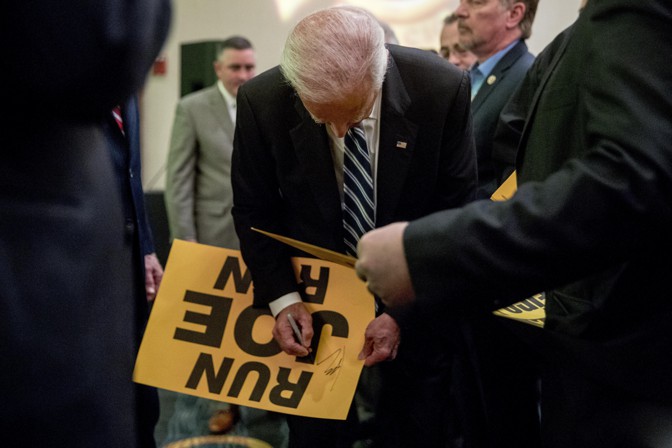
Former Vice President Joe Biden signs a poster that reads “Run Joe Run” after speaking to the International Association of Firefighters in Washington, D.C. (Andrew Harnik / AP)
Why the Democrats Chose Milwaukee for the 2020 Democratic National Convention (Charles J. Sykes)
“They chose it because Milwaukee, like so many places in the U.S., has struggled as the economy has changed; it’s a city of immigrants that was known not only as the Beer Capital, but as the Machine Shop of the World. They also chose it because Wisconsin, which the president won in 2016, seems up for grabs, neither solidly blue nor solidly Trump country.” → Read on.
What Fiji Can Teach America About Immigration (Reihan Salam)
“A well-designed points system would benefit the U.S. by ensuring that newcomers can make larger economic contributions sooner, because they’ll have a better sense of the challenges involved in successfully navigating the American economy.” → Read on.
Don’t Trust Facebook’s New Privacy Play (Conor Friedersdorf)
“Facebook’s perverse incentive to impinge on the privacy of its users will persist so long as the company derives the bulk of its profits from selling its ability to target ads with unusual precision. A privacy-focused platform that inspires confidence wouldn’t be run by a corporate parent that stores detailed data on its users to sell ads.” → Read on.
‣ The Real Reason Pelosi Doesn’t Want to Impeach Trump (Benjamin Parker, The Bulwark)
‣ Buttigieg Feels Momentum After CNN Town Hall, With $600K Raised in 24 Hours (Dan Merica, CNN)
‣ AFL-CIO Criticizes Green New Deal, Calling It ‘Not Achievable or Realistic’ (Colby Itkowitz, Dino Grandoni, and Jeff Stein, The Washington Post) (? Paywall)
‣ The Tragedy of Baltimore (Alec MacGillis, The New York Times and ProPublica)
‣ Reparations for Milwaukee? (Kevin D. Williamson, National Review)
We’re always looking for ways to improve The Politics & Policy Daily. Comments, questions, typos, grievances and groans related to our puns? Let us know anytime here.
Were you forwarded this newsletter? Sign up for our daily politics email here. We have many other free email newsletters on a variety of other topics. Find the full list here.
Reporter Cameron Ridle at Arizona High School Pro-Trump Rally: ‘Maybe They’ll Call Me a N*****’
Rep. Ilhan Omar (D-MN) suggested Monday that President Donald Trump is less human than former President Barack Obama.
Still no signs that the price level of consumer goods is rising due to a rising budget deficit or tariffsRead More
VENEZUELA BOOTS AMERICAN DIPLOMATS… (Second column, 22nd story, link) Related stories:Caracas elites drink whisky, dance as ordinary fester in dark…Read More
RIOTS ON TEMPLE MOUNT, PALESTINIANS THROW EXPLOSIVE DEVICE AT POLICE… (Third column, 7th story, link) Related stories:Netanyahu Dangles Weed ForRead More