Cuba taps into high-end luxury tourist market…

Cuba taps into high-end luxury tourist market… (Third column, 8th story, link) Advertise here

Preempt Threats and Safeguard America's National Security with USIntelNews.com

 700 Injured, 3 Dead in Directed Energy Weapon Attack by Aleksandar Vučić Regime
  The Sword of Damocles: Mounting Pressure on Putin and Kim Jong Un Amid Global Crises
  Assad’s Regime Collapse: A Major Setback for Russian Drug Networks
  Ethicoin: Learn Crypto Trading and Ethical Investing (The Ethicoin Trilogy Book 1) Kindle Edition
Cuba taps into high-end luxury tourist market… (Third column, 8th story, link) Advertise here
Brazilian President Jair Bolsonaro tweeted out a sexually explicit video of a man pissing on another man’s head in an apparent attempt to denounce Carnaval, the country’s massive annual street party.
The far right populist, elected last year, shared a video of two men standing on a taxi stand in order to “expose the truth” about Carnaval. At one point, on the men appears to piss on the hair of the other. It’s graphic.
“This is what Brazilian carnival street parties have turned into,” Bolsonaro said.
Defenders of the event claimed the video he tweeted out was an isolated incident. After a torrent of criticism, Bolsonaro asked Twitter Wednesday what a “golden shower” is:
O que é golden shower?
— Jair M. Bolsonaro (@jairbolsonaro) March 6, 2019
According to an Insider report, Bolsonaro’s crusade against Carnaval comes after the festival made a mockery of him.
Bolsonaro has a history of homophobic and bigoted remarks. He once said he’s “proud to be homophobic” and that he would “rather his son die in a car accident than be gay.” He also once told a congresswoman she was too ugly to be raped.
Journalist Glenn Greenwald — who lives in Rio de Janeiro — and others took to Twitter to criticize Brazil’s leader for the post.
(It says the tweet is unavailable but that’s because Bolsonaro blocked me & all other journalists at @TheInterceptBr). Male anuses have long played a central role in Bolsonaro’s worldview. He speaks of them often. In 2017, he tweeted about anal sex to me https://t.co/SpdrWctKSE
— Glenn Greenwald (@ggreenwald) March 6, 2019
In any event, Bolsonaro’s Twitter account now has 3.5 million followers, many of whom are almost certainly adolescents & children, so posting graphic pornographic kink videos seems somewhat inconsistent with his aggressive sexual moralizing. Then again, so do his 3 marriages.
— Glenn Greenwald (@ggreenwald) March 6, 2019
Obviously, this another in a long line of threats and dogwhistles Bolsonaro’s made against Brazil’s LGBT population.
When Jack’s done with his Joe Rogan interview can someone ask him what’s the ruling on this?
— Ryan Broderick (@broderick) March 5, 2019
[Photo by Evaristo Sa/AFP/Getty Images]
Have a tip we should know? tips@mediaite.com
It’s Monday, March 11.
The White House released its 2020 budget proposal, which calls for budget cuts and work requirements across social-safety-net programs as well as $8.6 billion in funding for a wall across the southern border. Through invoking a national emergency last month, President Donald Trump has already moved to divert another several billion toward building the wall.
Meanwhile, congressional leaders sent a bipartisan invitation to NATO’s secretary general, Jens Stoltenberg, to address a joint session of Congress in April. The president has vocally criticized NATO in the past.
Beto Late Than Never: It’s looking like Beto O’Rourke might be one of the last Democratic candidates to hop into the 2020 presidential campaign, and some Democratic strategists worry that he missed his moment. “Even some friends have struggled to explain what his delay has been about and how, if he’s had to agonize so long over whether to run, he could actually be ready for the campaign ahead, let alone the presidency,” reports Edward-Isaac Dovere. But with powerful new hires such as Barack Obama’s former campaign manager, David Plouffe, and viral name recognition, O’Rourke shouldn’t be written off too quickly. “None of the candidates who have announced has been able to match the virtuosity as a social-media storyteller that made him a star.”
Still confused about who’s in, who’s out, and who’s still flirting with a presidential run? Bookmark our constantly updated 2020 candidates guide.
The Cost of Impeachment: House Speaker Nancy Pelosi said that she’s not in favor of impeaching Trump, in a recent interview with The Washington Post Magazine, arguing that the president is “not worth” the national divisions an impeachment trial would cause. A counterpoint: In The Atlantic’s March cover story, Yoni Appelbaum made the case for launching impeachment proceedings, arguing that Congress has a duty to bring the debate over Trump’s fitness for office “out of the court of public opinion and into Congress, where it belongs.”
It’s Tax Season: Most Americans won’t cheat on their income taxes; they’ll pay exactly what they owe. Why are Americans such sticklers for tax law? Rene Chun explains in the forthcoming April issue of The Atlantic.
Inherited Circumstances: The effects of teenage motherhood span generations, according to a new study: Children whose grandmothers had teen pregnancies are more likely to underperform in school, even if their own mothers gave birth as adults. That probably has to do with the persistent effects of intergenerational poverty, reports Alia Wong.
Immigration: David Frum argues in The Atlantic’s April issue that “if liberals insist that only fascists will enforce borders, then voters will hire fascists to do the job liberals refuse to do.” He writes: “The question before the United States and other advanced countries is not: Immigration, yes or no? … The questions to ask are: How much? What kind?”
As always, we want to hear from you. Write to us at letters@theatlantic.com or reply directly to this newsletter with your thoughts on Frum’s argument. We might feature your response on our website and in future editions of the Politics and Policy Daily.
— Madeleine Carlisle and Olivia Paschal
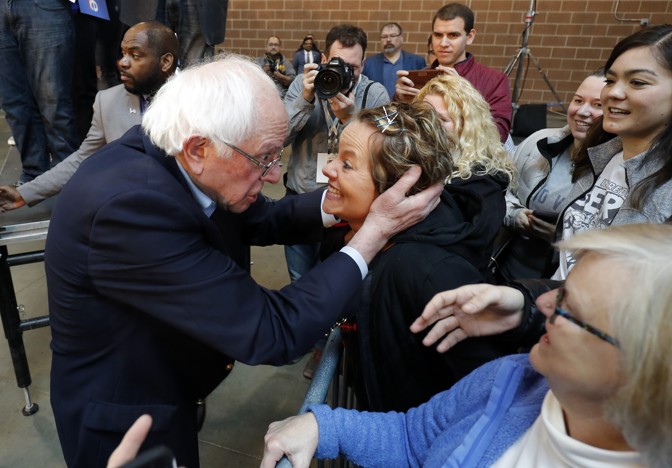
Senator Bernie Sanders meets with Sarah Bass of Boone, Iowa, after a campaign rally in Des Moines. (Matthew Putney / AP)
The Western Erasure of African Tragedy (Hannah Giorgis)
“Western publications engaged in selective reporting about the deceased. The Washington Post, for example, led its homepage coverage Sunday with a headline that informed readers only that ‘Eight Americans among 157 people killed in Ethiopian Airlines crash.’ (The Washington metropolitan area has the largest population of Ethiopian descent outside the country itself.)” → Read on.
Is It Time to Worry About the Boeing 737 Max 8? (James Fallows)
“Modern accidents almost always involve some strange, improbable, edge-case conditions, precisely because so many of the “normal” risks have been studied and prevented with redundant safety features. So no one knows, yet, what happened in the Ethiopian Airlines disaster, and anyone who feigns certainty now should be viewed with wariness.” → Read on.
How Not to Lose to Donald Trump (Rahm Emanuel)
“Earth to Democrats: Republicans are telling you something when they gleefully schedule votes on proposals like the Green New Deal, Medicare for all, and a 70 percent marginal tax rate. When they’re more eager to vote on the Democratic agenda than we are, we should take a step back and ask ourselves whether we’re inadvertently letting the political battle play out on their turf rather than our own.” → Read on.
‣ Meet the Group Trying to Change Evangelical Minds About Israel (Adam Wren, Politico Magazine)
‣ Hell and High Water: How Flooding and Buyouts Threaten Black History (Laura Thompson, Scalawag)
‣ Did You Really Think Trump Was Going to Help End the Carceral State? (Marie Gottschalk, Jacobin)
‣ How Violent American Vigilantes at the Border Led to Trump’s Wall (Greg Grandin, The Guardian)
‣ The Case for Immigration (The Economist) (? Paywall)
We’re always looking for ways to improve The Politics & Policy Daily. Comments, questions, typos, grievances and groans related to our puns? Let us know anytime here.
Were you forwarded this newsletter? Sign up for our daily politics email here. We have many other free email newsletters on a variety of other topics. Find the full list here.
With six out of eight argument sessions for the 2018-2019 Supreme Court term behind us and 21 written opinions down (17 in argued cases and four summary reversals), here is the March 2019 SCOTUSblog Interim Stat Pack. This Stat Pack includes statistics related to this term’s arguments and opinions through March 4, 2019. The whole Stat Pack can be viewed here.
The information in the Stat Pack covers various aspects of the court’s decisions. The analyses look at the court as a whole as well as at the individual justices. Coverage relates to the justices’ votes, written opinions and agreement with one another. It also tracks the Supreme Court’s decisions and justices’ votes by lower courts. We have included information about the attorneys who argued the cases as well as figures relating to the court’s opinion output and number of grants.
These preliminary data present some interesting attributes of October Term 2018. For a Supreme Court many thought to be leaning heavily to the right, the liberal justices appear to have the upper hand, at least so far. We see this in the Frequency in the Majority section, where the more liberal Justices Ruth Bader Ginsburg, Stephen Breyer, Sonia Sotomayor and Elena Kagan were in the majority more frequently in all cases and in divided cases than the more conservative Justices Clarence Thomas, Samuel Alito and Neil Gorsuch. Justice Brett Kavanaugh did not participate in five of the cases that have been decided so far, including two of the divided cases.
The Justice Agreement tables are illuminating as well. Along with the usual high level of agreement between pairs of liberal justices and a corresponding high level of agreement between conservative justice pairs, we see that Chief Justice John Roberts was more often in agreement with the more liberal justices than he was with the more conservative justices, excluding Kavanaugh. Kavanaugh too had higher level of agreement with the more liberal justices than he had with Thomas, Alito or Gorsuch.
It’s important to note that these numbers are only preliminary, that they cover less than one-third of the total argued cases the Supreme Court will hear this term, and that they include votes in only six divided cases. Although we very well might see some of these early trends shift later in the term, they provide a sense that, at least so far, some of the justices’ decisions, and more importantly their alignments, weren’t exactly as many expected them to be.
The post Interim Stat Pack for October Term 2018 appeared first on SCOTUSblog.
After a hearing, an administrative law judge denied Ricky Lee Smith’s application for supplemental security income benefits based on disability. The ALJ’s decision was dated March 26, 2014, and under the agency regulations, Smith was required to request review of the ALJ’s decision by the Appeals Council within 60 days of receiving the decision.
Smith’s counsel alleges that he timely requested review of the ALJ’s decision. The Social Security Administration, however, has no record of receiving his appeal before September 21, 2014, when it received a fax from Smith’s counsel asking about the status of the appeal. On November 6, 2015, the Appeals Council dismissed Smith’s request for review as untimely.
A Social Security Administration regulation provides that “[t]he dismissal of a request for Appeals Council review is binding and is not subject to further review.” Smith nevertheless brought suit seeking judicial review of the Appeals Council’s dismissal under 42 U.S.C. § 405(g). Section 405(g) provides in relevant part:
Any individual, after any final decision of the Commissioner of Social Security made after a hearing to which he was a party, irrespective of the amount in controversy, may obtain a review of such decision by a civil action commenced within sixty days after the mailing to him of notice of such decision or within such further time as the Commissioner of Social Security may allow.
Consistent with the agency’s regulation and the majority view of the federal courts of appeals, the district court dismissed Smith’s complaint on the ground that dismissal by the Appeals Council of a claimant’s untimely request for an appeal is not a “final decision” subject to judicial review under Section 405(g). The U.S. Court of Appeals for the 6th Circuit affirmed.
The Supreme Court granted certiorari to resolve a split among the circuit courts on this question. Smith contends that the Appeals Council’s decision is a final decision under the plain meaning of Section 405(g) because it is the final administrative ruling in the case — there is no further administrative consideration of the claim. Smith argues that this reading is consistent with the Supreme Court’s interpretation of the term “final” under the closely related Administrative Procedure Act and that the lower court’s distinction between dispositions based on the merits (which are appealable) and dispositions on other grounds (which are not subject to appeal) was entirely irrelevant. Smith points out that even if the meaning of the term “final” were not clear, it should encompass the Appeals Council’s determinations based on timeliness because the Supreme Court applies a strong presumption in favor of judicial review of administration action.
Smith asserts that his appeal is clearly distinguishable from Califano v. Sanders, a 1977 case in which the Supreme Court held that an agency’s final decision not to reopen a claim for benefits does not fall within the definition of a final decision subject to judicial review under Section 405(g). Quoting the U.S. Court of Appeals for the 11th Circuit’s 1983 decision in Bloodsworth v. Heckler, Smith explains that “review and reopening play fundamentally different roles in the process of administrative decision making and have significantly different effects upon the finality of administrative decisions.” Reopening a case offers a claimant a “bonus opportunity” to obtain administrative reconsideration of a final decision. The Appeals Council’s dismissal of Smith’s appeal on the ground of untimeliness, in contrast, is the first “final decision” in this case and thus Smith’s first opportunity for judicial review.
Smith contends that the agency’s regulation prohibiting judicial review of the Appeals Council’s dismissal is not entitled to deference because it contradicts the plain statutory text that authorizes judicial review for “any final decision.” Moreover, it would defy common sense to defer to that regulation when, as explained below, the government has disclaimed the legality of the regulation. Smith further argues that in light of the Appeals Council’s heavy workload, judicial review is particularly important to ensure that claimants are not subject to arbitrary and unjustified action.
With respect to Section 405(g)’s requirement that the final decision be made “after a hearing,” Smith asserts that the requirement was satisfied because an ALJ conducted a hearing with respect to Smith’s benefits claim. Moreover, Smith contends, even if there had not been a hearing, the hearing requirement is waivable.
Consistent with its regulation, the agency argued before the lower courts that the Appeals Council’s dismissal of Smith’s claim on the ground that it was not timely was not a final decision eligible for judicial review under Section 405(g). The government, however, reconsidered its position before the Supreme Court in light of Smith’s petition for writ of certiorari and a recent decision by the U.S. Court of Appeals for the 7th Circuit in which it joined the 11th Circuit in holding that Section 405(g) “‘allows judicial review when a claim has been presented and finally decided,’ even when that final decision is … a dismissal for untimeliness.” The government now takes the position that a dismissal order is subject to judicial review, but that the review is limited to the procedural ground on which the agency based its dismissal.
The government’s arguments are similar, though not identical, to Smith’s arguments. For example, the government contends that the Appeals Council’s dismissal of Smith’s request for review is a “final decision” subject to judicial review under Section 405(g) in both the ordinary sense of the term and under its customary usage in administrative law because the agency will take no further action on Smith’s claim for benefits. Similarly, the government argues that the agency’s regulation is beyond the authority of the agency because it indicates that the agency will never issue a final decision on Smith’s application, which would deprive Smith of his statutory right to judicial review merely because he failed to comply with an administrative guideline.
Unlike Smith, the government contends that judicial review is limited to the procedural ground on which the agency based its dismissal. The government asserts that limited judicial review is consistent with Section 405(g)’s express authorization of limited judicial review “where a claim has been denied by the Commissioner … because of failure of the claimant … to submit proof in conformity with any regulation prescribed under [42 U.S.C. 405(a)]” as well as with the federal courts’ approach to exhaustion in other contexts. Smith contends that the government’s position conflicts with the Supreme Court’s 2000 position in Sims v. Apfel. In Smith’s view, the language that the government relies on supports his position, because it shows that if Congress intends to limit judicial review to the grounds on which the decisions were resolved, it can and will draft the statute to do that expressly.
Because the government argues in favor of reversing and remanding the 6th Circuit’s decision, the Supreme Court appointed Deepak Gupta as amicus curiae in support of the decision below. Gupta argues that Section 405(g) should be interpreted in the specific context in which it arose – as part of the Social Security Act – rather than with reference to customary administrative practice and general APA doctrines as Smith and the government argue. According to Gupta, Section 405(g) was enacted in conjunction with “the creation of a massive, quasi-judicial process for adjudicating millions of small social security claims, with express restrictions on the circumstances in which judicial review must be allowed.” Section 405(g)’s “somewhat unusual” character arises from its role in ensuring that “federal courts are not swamped by disputes over the rules of the many-layered administrative process governing the nation’s largest social welfare program.”
Gupta asserts that the term “final decision” in Section 405(g) is susceptible to several different interpretations, and the most compelling, “within the ‘context of the statute as a whole,’” is “the final disposition of a claim for benefits on its merits.”
Relying on, among other authorities, Judge Henry Friendly’s 1966 interpretation of the requirement in Cappadora v. Celebrezze, and the Supreme Court’s opinion in Califano v. Sanders, Gupta argues that Section 405(g)’s “after a hearing” requirement is not satisfied in this case because the Appeals Council’s dismissal is not a decision on which the Social Security Act requires a hearing. Gupta further argues that the requirement is not satisfied by the ALJ hearing on Smith’s claim for benefits because “in context,” Section 405(g)’s “after a hearing” requirement “plainly refers to a ‘final decision’ reached ‘after a hearing’ on that decision.”
Gupta notes that the Social Security Administration’s interpretation of Section 405(g)’s finality requirement is not limited to Appeals Council dismissals on untimeliness grounds. Finality issues come up in a host of other procedural determinations under Social Security. Moreover, other statutes, most notably Medicare and Medicaid, incorporate Section 405(g) into their provisions for judicial review. Reversing the Social Security Administration’s longstanding interpretation of Section 405(g)’s finality requirement could “create significant floodgate concerns.”
Finally, Gupta argues that, at a minimum, the Social Security Administration’s longstanding interpretation of the statute is reasonable and therefore entitled to deference.
The National Organization of Social Security Claimants’ Representatives filed an amicus brief in support of Smith. The NOSSCR first describes the very lengthy and complicated four-step disability claims process that can be confusing to claimants. The NOSSCR then argues that Smith satisfied the non-waivable, jurisdictional component of the exhaustion requirement when he applied for benefits in 2012, when he sought reconsideration after the benefits were denied, and again when he participated in a hearing before an ALJ. Pointing to, among other things, the extraordinarily heavy workload of administrative appeals judges and the high frequency with which courts rule in claimants’ favor in other types of Social Security cases, the NOSSCR asserts that precluding review of dismissals by the Appeals Council causes harm to claimants. Finally, relying on general Social Security statistics as well as experience in the 11th Circuit, which has long allowed judicial review of Appeals Council dismissals, the NOSSCR contends that allowing review of Appeals Council dismissals would only cause a slight increase in federal court filings.
***
Past cases linked to in this post:
Bloodsworth v. Heckler, 703 F.2d 1233 (11th Cir. 1983)
Califano v. Sanders, 430 U.S. 99 (1977)
Cappadora v. Celebrezze, 356 F.2d 1 (2d Cir. 1966)
Casey v. Berryhill, 853 F.3d 322 (7th Cir. 2017)
Sims v. Apfel, 530 U.S. 103 (2000)
The post Argument preview: Justices to decide whether dismissal as untimely of Supplemental Security Income claimant’s request for review is final decision subject to judicial review appeared first on SCOTUSblog.
Keith Davidson told ABC News that disgraced former Trump attorney Michael Cohen was shocked Trump did not bring him intoRead More
A man who has been protesting for four months against multinational corporation General Motors’ (GM) decision to close four manufacturingRead More
High taxes be damned — rich keep moving to California? (Third column, 9th story, link) Advertise here
In 2018, Facebook and Twitter decided to play a role in helping people register to vote in what promised to be a momentous midterm election. To do so, the social media platforms directed users almost exclusively to a website called TurboVote, run by a nonprofit organization known as Democracy Works. TurboVote was launched in 2012, and it promised to streamline voter registration and remind people to cast ballots on Election Day.
Evidently, things did not go seamlessly.
The National Association of Secretaries of State, or NASS, whose members oversee elections in all 50 states, has claimed that TurboVote occasionally failed to properly process registrations, and that in other instances it failed to notify people who thought they had registered to vote but had not actually completed the necessary forms.
The TurboVote website went down when it couldn’t handle the volume of attempted registrations on Sept. 25, 2018 — National Voter Registration Day — and the organization was unwittingly used in a scam when someone pretending to be an employee of TurboVote attempted to convince eager voters to share their personal information over the phone.
As a result, NASS has written to Facebook and Twitter asking them to end their relationships with TurboVote as the 2020 election cycle gets underway. The association is asking the social media companies to simply direct prospective voters to government sites with accurate information on how to register.
For its part, TurboVote acknowledges that many people who tried to use its site did not complete the voter registration process — either because they’d overlooked a step or because their registration was rejected for another reason.
“Helping people understand whether or not they have successfully registered is a challenge we are committed to solving,” Kathryn Peters, a co-founder of Democracy Works, said in a statement.
TurboVote acknowledges the other problems and says it is collaborating with states to implement improvements, including integrating with the three states whose systems allow third parties to submit complete voter registrations directly, bypassing the issues identified in 2018.
In the statement, TurboVote said it has helped “millions register and vote nationwide.” NASS asked TurboVote to provide a detailed accounting of who these registrants were — who was new versus changing their address or simply a duplicate — but to date has yet to receive one.
Facebook said in a statement it had maintained “regular contact” with NASS throughout the election and looked forward “to continuing those partnerships as we assess how best to structure our voter registration and other civic engagement efforts ahead of the 2020 elections season.”
Similarly, Twitter indicated in a statement that it was looking forward to maintaining its relationship with NASS and that it was in the process of evaluating “partner feedback” and building “on our efforts to ensure we’re fostering an environment conducive to healthy, meaningful conversations on our service.”
A person familiar with Twitter’s election efforts indicated the company was unaware of problems with TurboVote’s work until after the election but was taking this into consideration as it plans for 2020.
TurboVote had also been enlisted by Facebook and Twitter to help in a get-out-the-vote effort — pledging to text reminders to vote to those who’d used its website to register. These reminders occasionally led to additional confusion, as people who had not successfully registered wound up frustrated at the polls.
“Many of these individuals then went to the polls and quickly found out they were not registered,” read the letters sent to Facebook and Twitter and signed by NASS President Jim Condos, who is also Vermont’s secretary of state.
In an interview, Peters said the organization was working on better language to make clear to those receiving the text messages that they may not have registered.
The letters follow a contentious exchange between TurboVote and other nonprofit voting groups at a recent National Association of State Election Directors meeting. Officials from across the country confronted TurboVote over the issues addressed in the letter sent by NASS.
“These text reminders created some hysteria in my state. They think that those messages are coming from us, and they are not,” said Lori Augino, the elections director in Washington state, who said text messages from unfamiliar third parties stoked existing fears over election security.
Jared Dearing, the election director in Kentucky, went further. “You’re acting as an interlocutor between registrants and the people who register, and, in my opinion, we don’t need interlocutors,” he said. “If one individual falls through the cracks in this thing, they are disenfranchised.”
Seth Flaxman, also a co-founder of Democracy Works, and Peters said the meeting and the letters have reinvigorated their desire to work more productively with the states to solve these issues. “We feel strongly that we cannot do this work without a productive relationship with the states,” Flaxman said. “We are committed to that.”
While Peters and Flaxman noted that states have made improvements to their websites and voter registration processes — such as adopting online registration — they said that the government-managed websites recommended by NASS underserve voters who cannot register online, including those who do not have the necessary state-issued ID many such systems require.
For example, Vote.gov directs Texas registrants to a 26-page PDF, while TurboVote walks Texans through a series of questions that take the interested voter through the steps of registration. Peters and Flaxman also expressed concern that many potential voters would be less likely to complete registrations without TurboVote, and noted that Vote.gov has no ability to measure or reach out to those who became overwhelmed or confused and stopped the process.
Further, Peters and Flaxman say they believe that people need a national site that not only guides them through a state’s registration process, but that can also follow up via text and email to assist voters in either casting a ballot by mail or in person for every election — services TurboVote provides.
“In most states, voter registration has multiple steps, and missing a step can lead to an incomplete or rejected registration (for example, some potential voters may not click through to the second page of a state website, others may download a paper form but don’t print it),” Peters said in a statement. “This is a problem TurboVote was built to solve.”
The head of the agency that regulates New York City’s private trash collection is resigning, a move that comes after months of embarrassing news coverage and calls for the agency to step up its oversight of the industry.
Daniel Brownell, appointed to lead the Business Integrity Commission, or BIC, by Mayor Bill de Blasio in 2014, is expected to join a private security and corporate compliance firm. He will leave office in roughly the next month.
In a statement, de Blasio said Brownell’s resignation was voluntary, and he credited him with having played “a big role in crafting legislation to protect the most vulnerable workers in the trade waste industry.”
Brownell did not respond to requests for comment.
This year, after a rash of fatal accidents and a series of reports by ProPublica raising questions about the BIC’s record of oversight, the New York City Council announced it was launching an investigation of the agency’s performance. The council sent the BIC pages of questions concerning its work and demanded a vast assortment of records.
“I suspect there are systemic failures, but I want to be careful not to pre-judge an investigation,” Ritchie Torres, chairman of the council’s Committee on Oversight and Investigations, said at the time.
Brownell, a former prosecutor, defended the agency’s work in the face of the investigation and ProPublica’s articles exposing the often dangerous underside of an industry that was supposed to have been reformed after decades under the control of organized crime. ProPublica found haulers with poor safety records, unions alleged to be working with owners in exploiting workers, and an oversight agency, the BIC, that maintained it lacked the statutory authority to more aggressively police the industry.
Antonio Reynoso, chairman of the council’s Sanitation Committee, had complained for months that the BIC was ignoring its responsibility to act against companies on safety issues.
“The BIC didn’t see safety as part of its mandate,” Reynoso said. “That’s where we butted heads.”
Torres said Brownell’s departure would not affect the City Council’s investigation of the BIC.
“The challenges facing the BIC are far deeper than one person,” Torres said. He said he expected the investigation’s findings would be made public in the near future.
Much of ProPublica’s reporting focused on one of the city’s largest haulers, a Bronx company named Sanitation Salvage. The company’s trucks had been involved in two fatal accidents, and it had been accused of denying overtime and other wages to workers. It also was accused of violating labor regulations by pushing workers to join a union run by a man later convicted as a mobster. The company maintained its operations were safe and on the level, but nonetheless surrendered its license in late 2018 and ceased operations.
The reporting on Sanitation Salvage showed the BIC had been warned by workers about the company for years, and while the agency did an audit that resulted in thousands of dollars in fines, many workers felt it had let the company off the hook. Two of the company’s workers lied to the police about the circumstances surrounding the death of an off-the-books colleague, but the BIC took no action against the workers or the company. Soon after, one of those workers, a driver, was behind the wheel for a second fatal accident but again was not immediately sanctioned. The BIC ultimately barred the driver from the industry.
Brownell said at the time that the agency had acted as best it could, but was limited in its ability to crack down on safety violations. Indeed, over the years, he described the trash industry as much improved from years past.
“As I have said many times now, the city’s trade waste industry has made real strides over the past 20 years,” Brownell told the City Council in a 2017 hearing. “With BIC oversight in place, the trade waste industry has become largely a vibrant, competitive and fair one. Much of the credit for this must go to those in the industry itself who have worked hard for these improvements.”
Still, over the last several years, the de Blasio administration has worked to develop a plan it says will reform an industry afflicted by safety and environmental concerns, and one that is needlessly expensive to the hundreds of thousands of businesses in the city that depend on it to handle their waste.
The plan developed by the administration calls for dividing the city into 20 waste collection zones, with three to five companies per zone. Proponents of the plan argue that it would allow the city to hold companies to higher labor, safety and environmental standards.
Many private trash haulers have fought against the zoning plan, arguing it will stifle competition and prove more costly. They have insisted that increased enforcement by the BIC can achieve the safety and environmental reforms envisioned under the proposed zoning legislation.
Zoning legislation could be introduced as early as this spring.
The BIC was created in the 1990s with the express aim of ridding the industry of mob influence and unsavory actors. But ProPublica’s reporting over the last year showed at least two companies had ties to people who had been barred from the business because of their troubled pasts. As well, one of the largest unions operating in the industry had officers convicted of a variety of crimes and business dealings with a convicted felon who had been ousted from the industry years ago.
Just weeks ago, the City Council adopted legislation mandating that the BIC take action against union officials who have certain criminal convictions or dealings with members or associates of organized crime or anyone convicted of a racketeering activity. It allows the BIC to bar union officials from representing workers in the industry if they are found to be lacking “good character, honesty and integrity.”
Kiera Feldman contributed reporting.
It’s Monday, March 11.
The White House released its 2020 budget proposal, which calls for budget cuts and work requirements across social-safety-net programs as well as $8.6 billion in funding for a wall across the southern border. Through invoking a national emergency last month, President Donald Trump has already moved to divert another several billion toward building the wall.
Meanwhile, congressional leaders sent a bipartisan invitation to NATO’s secretary general, Jens Stoltenberg, to address a joint session of Congress in April. The president has vocally criticized NATO in the past.
Beto Late Than Never: It’s looking like Beto O’Rourke might be one of the last Democratic candidates to hop into the 2020 presidential campaign, and some Democratic strategists worry that he missed his moment. “Even some friends have struggled to explain what his delay has been about and how, if he’s had to agonize so long over whether to run, he could actually be ready for the campaign ahead, let alone the presidency,” reports Edward-Isaac Dovere. But with powerful new hires such as Barack Obama’s former campaign manager, David Plouffe, and viral name recognition, O’Rourke shouldn’t be written off too quickly. “None of the candidates who have announced has been able to match the virtuosity as a social-media storyteller that made him a star.”
Still confused about who’s in, who’s out, and who’s still flirting with a presidential run? Bookmark our constantly updated 2020 candidates guide.
The Cost of Impeachment: House Speaker Nancy Pelosi said that she’s not in favor of impeaching Trump, in a recent interview with The Washington Post Magazine, arguing that the president is “not worth” the national divisions an impeachment trial would cause. A counterpoint: In The Atlantic’s March cover story, Yoni Appelbaum made the case for launching impeachment proceedings, arguing that Congress has a duty to bring the debate over Trump’s fitness for office “out of the court of public opinion and into Congress, where it belongs.”
It’s Tax Season: Most Americans won’t cheat on their income taxes; they’ll pay exactly what they owe. Why are Americans such sticklers for tax law? Rene Chun explains in the forthcoming April issue of The Atlantic.
Inherited Circumstances: The effects of teenage motherhood span generations, according to a new study: Children whose grandmothers had teen pregnancies are more likely to underperform in school, even if their own mothers gave birth as adults. That probably has to do with the persistent effects of intergenerational poverty, reports Alia Wong.
Immigration: David Frum argues in The Atlantic’s April issue that “if liberals insist that only fascists will enforce borders, then voters will hire fascists to do the job liberals refuse to do.” He writes: “The question before the United States and other advanced countries is not: Immigration, yes or no? … The questions to ask are: How much? What kind?”
As always, we want to hear from you. Write to us at letters@theatlantic.com or reply directly to this newsletter with your thoughts on Frum’s argument. We might feature your response on our website and in future editions of the Politics and Policy Daily.
— Madeleine Carlisle and Olivia Paschal
Senator Bernie Sanders meets with Sarah Bass of Boone, Iowa, after a campaign rally in Des Moines. (Matthew Putney / AP)
The Western Erasure of African Tragedy (Hannah Giorgis)
“Western publications engaged in selective reporting about the deceased. The Washington Post, for example, led its homepage coverage Sunday with a headline that informed readers only that ‘Eight Americans among 157 people killed in Ethiopian Airlines crash.’ (The Washington metropolitan area has the largest population of Ethiopian descent outside the country itself.)” → Read on.
Is It Time to Worry About the Boeing 737 Max 8? (James Fallows)
“Modern accidents almost always involve some strange, improbable, edge-case conditions, precisely because so many of the “normal” risks have been studied and prevented with redundant safety features. So no one knows, yet, what happened in the Ethiopian Airlines disaster, and anyone who feigns certainty now should be viewed with wariness.” → Read on.
How Not to Lose to Donald Trump (Rahm Emanuel)
“Earth to Democrats: Republicans are telling you something when they gleefully schedule votes on proposals like the Green New Deal, Medicare for all, and a 70 percent marginal tax rate. When they’re more eager to vote on the Democratic agenda than we are, we should take a step back and ask ourselves whether we’re inadvertently letting the political battle play out on their turf rather than our own.” → Read on.
‣ Meet the Group Trying to Change Evangelical Minds About Israel (Adam Wren, Politico Magazine)
‣ Hell and High Water: How Flooding and Buyouts Threaten Black History (Laura Thompson, Scalawag)
‣ Did You Really Think Trump Was Going to Help End the Carceral State? (Marie Gottschalk, Jacobin)
‣ How Violent American Vigilantes at the Border Led to Trump’s Wall (Greg Grandin, The Guardian)
‣ The Case for Immigration (The Economist) (? Paywall)
We’re always looking for ways to improve The Politics & Policy Daily. Comments, questions, typos, grievances and groans related to our puns? Let us know anytime here.
Were you forwarded this newsletter? Sign up for our daily politics email here. We have many other free email newsletters on a variety of other topics. Find the full list here.
We’re excited to announce the 20 recipients of the 2019 ProPublica Diversity Scholarship. Each of these talented journalists will receive a $750 scholarship to attend a conference in 2019. This year’s recipients were chosen from among more than 535 applicants.
We’ve written about what ProPublica is doing to increase the diversity of our newsroom and of the broader journalism community. This scholarship program is part of our ongoing efforts and will help make it easier for journalists from underrepresented communities to take advantage of everything these conferences offer.
Here are this year’s recipients:
Ariam Alula is a student at the Craig Newmark Graduate School of Journalism at the City University of New York, where she is using community-oriented journalism to tell stories about family caregivers of people with autism. Since graduating with a bachelor’s degree in journalism in 2013, Alula has traveled to over 15 international and domestic cities as a tourist and English teacher. This summer, she’ll be producing online and video content for BronxNet, a local cable television station serving the borough’s 1.5 million residents. Ariam will be attending ONA.
Tatyana Bellamy-Walker is a Knight/CNN Scholar at the Craig Newmark School of Journalism. Tatyana specializes in LGBT issues and environmental politics. His work has appeared in the Daily Beast, NBC Out and DNAInfo. Tatyana is an ASJA (American Society of Journalists and Authors) LGBTQ grant awardee. He will be interning at CNN this summer. Tatyana will be attending NLGJA.
Isabel Carter is a graduate student pursuing a master’s degree in journalism at Emerson College. They began their journalism career in Chicago, working on Queer Cafeteria and interning for the Muslim American Journeys program, a collaboration between the Muslim American Leadership Alliance, StoryCorps and the National Library of Congress. More recently, Isabel produced an award-winning podcast covering the 2018 third ballot referendum in Massachusetts and its impact on the trans and gender nonconforming communities. They love to incorporate data visualizations and multimedia features into their work, and as they move forward with their career, they hope to continue to use their reporting and multimedia journalism skills to amplify stories of marginalized peoples and bring diverse voices into all sectors of the media. Isabel will be attending NLGJA.
Troy Closson is a junior at Northwestern University majoring in journalism through the school’s Accelerated Master’s Program. This summer, he’ll be working as a reporting fellow at The Texas Tribune. Troy was previously a managing editor for The Daily Northwestern, his campus newspaper, and has interned at the Chicago Sun-Times and Block Club Chicago. His primary interests revolve around multimedia and investigative stories at the intersection of race and culture, as well as improving racial diversity in newsrooms. He hopes to work for an organization like NPR’s Code Switch or The Undefeated in the future. Troy will be attending NABJ.
Jackie Contreras is a senior at Boston University majoring in journalism and minoring in sociology. She is the producer of Inside Boston, a campus newsmagazine show that focuses on the issues that impact Boston. She is a Los Angeles native and hopes to head back to sunny California as an investigative journalist spotlighting social justice issues. Jackie will be attending NICAR.
Katherine Gilyard is a senior at Howard University pursuing her degree in journalism while preparing for her MPH and medical school. She has worked as the photo editor for 101 magazine, interned for the Directors of Health Promotion and Education, served on the National Press Photographers Association board for two years as the student chair and currently works as its intern. Her reporting interests include health, science and the environment. She intends to blend the practice of medicine and investigative photojournalism to help give communities truly equal access to information and care. Katherine will be attending AHCJ.
Luis Joel Méndez González grew up in Moca, Puerto Rico. He’s a sophomore at the University of Puerto Rico in Arecibo (UPRA), where he is pursuing undergraduate studies in journalism. He has written for La Isla Oeste, QuEvento, Pulso Estudiantil, Dialogo UPR and El Nuevo Día; he also produces his own radio segment broadcasted through WISA 1390 AM. In 2018, he was one of the three winners of the First AccuWeather Environmental Journalism Competition. Last summer, he worked on an investigation about the evolution and status of the Hispanic media in Florida for the Association of Journalists of Puerto Rico (ASPPRO). Currently, he’s president of the National Association of Hispanic Journalists (NAHJ), UPRA Students Chapter. Luis will be attending EIJ.
Abby Ivory-Ganja is a graduate student at the University of Missouri School of Journalism. Her research is inspired by the ProPublica Local Reporting Network and examines what best practices should be implemented when local and national newsrooms collaborate to create investigative journalism. She currently produces the IRE Radio Podcast from Investigative Reporters and Editors. Her work has appeared in The Dallas Morning News, NPR, the Columbia Missourian and NPR member stations KBIA, WLRN and Wisconsin Public Radio. Once she graduates in December, she hopes to work in audience engagement, understanding and improving the way audiences receive and interact with journalism. Abby will be attending SRRCON.
Gabrielle Larochelle is a rising senior at The New School-Eugene Lang studying Journalism + Design with a minor in global studies. She has studied abroad in Indonesia researching eco-tourism and biodiversity while interviewing people in Bahasa Indonesian. This summer, she will be studying abroad in Brazil, doing projects, researching and creating web docs with human rights organizations while interviewing in Portuguese. She has interned for and written over 50 articles for Galore magazine, was featured and interviewed by Melissa Harris Perry in Elle, and represented as a media ambassador for Young Women’s Advisory Council. Currently, she is a freelance writer for Culture Shift magazine, and she one day hopes to report on international news and stories from across the globe. Gabrielle will be attending NABJ.
Maya Lora is a rising senior and double major in English and journalism at Washington and Lee University. She has broken stories for the independent school newspaper, the Ring-tum Phi, since her freshman year and now serves as editor in chief. She covered the election season for local, state and national races for the student newscast, the Rockbridge Report, following four months of congressional reporting with The Hill in Washington. She will intern in her hometown at the Miami Herald this summer. She hopes to cover politics in the future, especially in the policy realms of crime, war and terrorism. Maya will be attending EIJ.
Kiran Misra is a recent graduate of the University of Chicago’s Harris School of Public Policy, currently working as a Pulitzer Center on Crisis Reporting Fellow researching the human cost of development in New Delhi and learning Hindi as a Boren Fellow in Jaipur. She has written about prison industrial complex abolition for South Side Weekly and served as the Viewpoints editor for the Chicago Maroon. Kiran will be attending AAJA.
Jocelyn Moran is a bilingual journalism and Spanish student at San Diego State University graduating in May 2019. She’s the managing editor at The Daily Aztec and the president of the National Association of Hispanic Journalists SDSU chapter. Her work includes coverage of events at the U.S.-Mexico border, and she has focused on representing the Latino community at SDSU through her stories. She interned with ABC 10 News in San Diego during the summer of 2018 and currently, she is interning at Telemundo 20. She will be attending EIJ.
Mallory Newman is a multimedia journalist in her second year at the UC Berkeley Graduate School of Journalism who holds a BA in international relations from San Francisco State University. She was an enlisted military police officer and civil affairs officer in the Marine Corps Reserve from 2007 to 2014 and deployed in support of Operation Enduring Freedom to Musa Qalah, Afghanistan, in 2011. Her focus is on investigative reporting through multimedia, especially video, and her areas of interest include police, politics, human rights and equality. Mallory will be attending NICAR.
Kynala Phillips is currently a senior and First Wave scholar at the University of Wisconsin-Madison double majoring in journalism and mass communication and Afro-American studies. She spends most of her time freelancing for Madison365.com, where she has served as an intern and editorial assistant. She is the co-president of the NABJ chapter at UW-Madison and former publicist for the Wisconsin Black Student Union. She will be starting an internship at the Wisconsin Center for Investigative Journalism this spring. Outside of class, she is enhancing her skills as the art director of Souvenirs magazine. Her dream is to enter the world of magazine journalism and become a culture editor in the field. Kynala will be attending NABJ.
Bryan Pietsch is a senior at the Walter Cronkite School of Journalism at Arizona State University, where he is pursuing degrees in journalism and business. This past year, Bryan has been conducting research for his honors thesis on press credibility in the U.S. and Mexico. He also worked in the Washington bureau of Cronkite News/Arizona PBS and was awarded a 2018/2019 scholarship from the White House Correspondents’ Association. This summer, he will be reporting on policy and enforcement in Reuters’ Washington bureau. In his career, Bryan hopes to cover business or Congress. Bryan will be attending NLGJA.
Irene Franco Rubio is a media professional at the Walter Cronkite School of Journalism and Mass Communication / Barrett, The Honors College at Arizona State University. Growing up in the West Phoenix Valley in Arizona and recognizing the social and racial injustices present within economically distressed communities, Irene made it her mission to advocate for not only her Latinx community but for systematically oppressed populations on an all-encompassing standard. Irene hopes to shift today’s media landscape toward becoming more diverse and all-inclusive by accurately representing the beliefs, issues and perspectives of disenfranchised communities as a content creator, change-maker, intersectional thinker, advocate and media professional. Irene will be attending EIJ.
Elizabeth Ucles is a senior at St. Edward’s University in Austin, Texas, majoring in writing and rhetoric with a journalism concentration and minoring in Spanish. She spent the summer in New York City through a fellowship with the Craig Newmark Graduate School of Journalism at CUNY while also serving as a politics intern at WNYC radio. In her senior year, Elizabeth interned at Austin’s NPR station, KUT 90.5, in the newsroom. This semester, she is focused on hyperlocal journalism as an editorial intern at Community Impact Newspaper. After graduation, Elizabeth hopes to jump into the world of reporting whether it be in print, web or public radio. Elizabeth will be attending SND.
RaShunda Veals is a junior mass communications major attending Alcorn State University. She is part of various clubs and organizations including the National Association of Black Journalists and Alpha Kappa Alpha Sorority, Inc. She serves as the editor in chief of the Alcorn State University Campus Chronicle, where she assigns and edits news stories, and has worked as a news reporter for ASU TV-13 and interned at WJTV in Jackson, Mississippi. RaShunda currently works for Grand Gulf Nuclear Station (Entergy), where she serves as a contractor communications specialist. Her goal is to further her education in the news industry. Rashunda will attend NABJ.
Aaricka Washington is an M.S. candidate at Columbia Journalism School. Because of her experience as a Teach for America 2014 corps member in Houston, she has developed a deep passion for pursuing stories that involve education, race and business. Before attending Columbia, she was an AmeriCorps VISTA member in Indianapolis, supporting more than a thousand low-income students in obtaining a full-tuition scholarship for college. Aaricka is a 2014 graduate of Indiana University, where she wrote weekly articles about education and diversity for the Indiana Daily Student and interned at WXIN Fox 59 in Indianapolis. She sees a need for more in-depth, visually appealing stories that illustrate the complexities that impact the educational landscape. She hopes to fill part of that gap by acquiring the skills needed to become an investigative, multimedia reporter. Aaricka will be attending IRE.
Rep. Alexandria Ocasio-Cortez (D-NY) said during a Saturday interview at the South by Southwest festival in Austin, Texas, that theRead More
Three Mexican state police officers assigned to a special operations group in the border state of Chihuahua were killed afterRead More
Travelers panic… (Third column, 7th story, link) Related stories:BLACK BOXES RECOVERED FROM ETHIOPIAN CRASH…Plane smoked, shuddered before deadly plunge…Airlines groundRead More