Alexandria Ocasio-Cortez Misled on Opioid Funding: Washington Post

Alexandria Ocasio-Cortez’s misleading tweet on the subject had earned a combined total of likes and retweets in excess of 50,000.

Preempt Threats and Safeguard America's National Security with USIntelNews.com

 Putin Regime’s Push for Tactical Nuclear Strike: Escalation Fears Grow
  Russian Oligarchs Under Fire: Kremlin Faces Collapse Amid Economic Freefall and Global Accountability Efforts
  DOJ Arrests Darknet ‘Incognito’ Architect; Ethicoin Emerges as Ethical Blockchain Alternative
  Trump Team Stunned by Hidden Global Power Play
Alexandria Ocasio-Cortez’s misleading tweet on the subject had earned a combined total of likes and retweets in excess of 50,000.
President Donald Trump told Breitbart News on Monday that his administration is thinking “very seriously” about labeling violent Mexican drugRead More
Former House Speaker Paul Ryan (R-WI) said Monday that President Donald Trump could lose the 2020 presidential election if hisRead More
TROUBLES: NEW YORK mag lays off staffers; Publication undergoes restructuring… (Third column, 5th story, link) Related stories:Hundreds of newspapers toRead More
Plane smoked, shuddered before plunge… (Third column, 8th story, link) Related stories:BLACK BOXES RECOVERED FROM ETHIOPIAN CRASH…Airlines ground BOEING 737Read More
BLACK BOXES RECOVERED FROM ETHIOPIAN CRASH… (Third column, 7th story, link) Related stories:Plane smoked, shuddered before plunge…Airlines ground BOEING 737Read More
Airlines ground BOEING 737 MAX… (Third column, 9th story, link) Related stories:BLACK BOXES RECOVERED FROM ETHIOPIAN CRASH…Plane smoked, shuddered beforeRead More
Over the past few months, seemingly all the pet- and animal-themed Instagram accounts I follow have begun interspersing their videos with pleas. “Join our bird-themed Discord community!” one posted. Another urged me to connect with a group of like-minded reptile lovers on Discord. A commenter touted a dog-lover Discord server.
Discord is a real-time chat platform that was founded four years ago as a way to make it easier for gamers to communicate. But over the past year, it has outgrown its origin story and become the default place where influencers, YouTubers, Instagram meme accounts, and anyone with an audience can connect with their community.
After signing up for Discord, users join different servers. Each server functions as its own community, and it’s very easy to toggle between them. Once you’re within a server, you can hop between a long list of hashtag-marked channels on the left-hand side of the screen. Some channels are text-based, and some are group voice chats. Visually, Discord looks very similar to Slack.
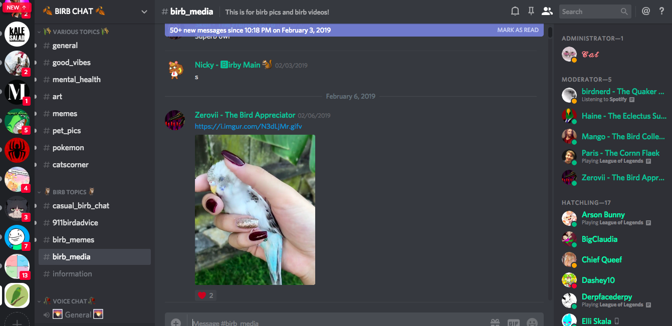
Discord is also highly customizable. Not only can servers have public and private channels, but administrators can also designate an endless series of roles to each user, all of which can come with custom privileges, colors, and name tags. Most server administrators designate roles to help moderate their communities. In addition to the group chats, Discord allows for global private messaging. You can add friends from any server to have a one-on-one conversation, without having to click into each server itself. It’s like having an AIM buddy list at the top of the app.
Last March, Ninja, one of the most popular video-game live-streamers in the world, taught Drake how to use Discord while playing Fortnite. YouTube A-listers such as Philip DeFranco, Grace Helbig, and the Try Guys all have their own servers, and subreddits such as those dedicated to discussing The Bachelor and The Real Housewives have their own Discord groups too. More than 200 million people use the service.
Sara Dietschy, a YouTuber with nearly half a million subscribers, set up a Discord server for her fans six months ago after she noticed other YouTube stars offering them. “It’s basically a free and easy way to have a Slack with your community,” she said. But, she said, “Slack is for you to be productive at work. Discord is pretty much the opposite,” she said.
Roberto Blake, an Atlanta-based YouTuber, compared Discord not to Slack but to “chat rooms from the 1990s.” But, he told me, “they made that experience mobile and way more robust and sophisticated.” In a social-media landscape organized around reverse-chronological feeds, profile pages, default public content, and follower counts, Discord is palpably different. As Mark Zuckerberg himself acknowledged in a blog post last week, users are desperate for a more privacy-centric social-networking experience—or maybe just to get away from what the journalist Hamza Shaban called the “dystopian nightmare of having a permanent, searchable record of yourself online.”
[Read: What Mark Zuckerberg thinks people want]
Discord is a rough draft of what that type of platform might look like. “Discord has always been an opt-in, private, chat-oriented product,” Eros Resmini, Discord’s chief marketing officer, told me. “It was interesting to hear Zuckerberg’s comments because it sounds a lot like the way we’ve been thinking for a long time.”
In order to join a server, users need a custom invite link, which allows admins and moderators to ensure their chats aren’t overrun with spammers or outsiders looking to troll. The real-time chat nature of the platform also makes it more intimate than a comment section. Comments on Facebook or Instagram are asynchronous, so you may not get a reply for hours. Discord feels like the best parts of group chat, amplified. It’s also consequentially, where teenagers feel comfortable just being themselves.
“Discord is the only place where I can hang out with friends and really feel like I’m hanging out with them,” said Carson King, a YouTuber who first set up his Discord server two years ago. Many other influencers also say that before Discord there was no way to effectively communicate with their community. Twitter is messy and public, and threads often get broken up and overrun by outsiders. Instagram DMs are difficult to manage and unsearchable, and public Instagram comment threads can get buried. YouTube comments sections are disorganized and overrun with trolls. Reddit is generally toxic. “Discord is the central platform for everyone. It’s already the place you go to talk to people and about things you care about,” said Matt Enloe, a lawyer in Chicago who helps moderate a popular Discord server for a productivity podcast.
[Read: It’s impossible to follow a conversation on Twitter]
It’s also a place where you don’t need a massive follower count to be heard. “Now with social media, everyone wants numbers, virality, to be popular. Discord takes that and does the opposite,” Dietschy said. “It allows you to just hang out with the people you want to hang out with and interact with them in any way you want whether it’s voice, text, pictures, or anything.”
King said that he also believes a big part of Discord’s appeal is that there’s no other platform that’s all about just kicking back with friends. “The reason so many people are adopting Discord is because there’s nothing else out there like it,” he said. “Discord has just done such a phenomenal job of setting itself up in a way that benefits creators and everyone who enjoys those creators’ content, whether or not they’re into gaming.”
Because Discord is a chat, not a feed, it’s also free of the algorithms that creators so often bemoan. If influencers want to announce that they have a new video out, or promote a merch sale, they can post a message to everyone in the #announcements channel of their Discord server instead of posting about it on Instagram and hoping the post gets served to a wide enough portion of their audience.
“Having an independent third-party tool where you can have open dialogue and facilitate a conversation among your community is fantastic,” Blake said. “Since it’s independent from all your other platforms, you’re not receiving any algorithmic penalties that [negatively] impact your content in any way.”
Once a community is established with enough moderators in place, influencers also don’t have to do tons of work to keep it going. Fans can bond with each other, which ultimately solidifies their bond with the influencer as the creator of that community. Many of the top YouTuber Discord servers include dozens of channels that have nothing to do with the YouTubers themselves. Blake’s server includes a job board, book club, and channels for talking about business and tech. The Discord group for one star-themed Instagram page has channels for users to talk about animals, share writing, compare Subway orders, and post pictures of their hands.
Discord doesn’t provide an age breakdown on its user base, but several moderators say non-gaming Discord servers are dominated by the type of people who follow YouTubers and meme pages on Instagram: teenagers. People talk about school, dating, memes, and general teen anxieties. When I posted a question in the Discord server for Kale Salad, an Instagram meme page with more than 3 million followers, a teenager quickly told me not to expect a reply from anyone on there since “pretty much everyone is in class right now.”
Of course, as on any booming network, people are already trying to figure out how to make money on Discord. Plenty of influencers have already begun charging an entrance fee to their servers, paid through services like Patreon, or making users pay for special access and privileges on their servers. Users in one popular podcaster’s Discord community even designate roles by how much money each user gives per month. Discord currently does not receive a portion of this revenue. The company is adamantly focused on serving its core user base: gamers. Last year, it launched a storefront where the platform distributes games and other chat perks. Discord also offers a subscription service called Nitro, which gives users unlimited access to a growing library of games and enhanced profile features like animated avatars.
[Read: The infinite weirdness of never-ending chat histories]
As the company scales, it will also need to ensure its platform isn’t being abused. The FBI is already investigating Discord groups dedicated to cybercriminal activity, and some private groups are “being used by low-level hackers to share stolen data, like usernames and passwords,” Forbes reported in January. White-supremacist groups and trolls have also used the platform to communicate and organize.
“Discord has a Terms of Service and Community Guidelines that all users are required to adhere to,” a Discord spokesperson said. “Discord’s guidelines cover more expansive activities than other platforms’ rules and include activities such as doxxing and sharing private information.”
The influencers who have flocked to the platform also say that if anything, Discord provides a respite from the trolls they encounter on the broader internet. And many, like Dietschy, have no plans to quit. The platform, she said, is the only way to “avoid the chaos of the internet.”
Bob Woodward’s Fear was a blockbuster. Michelle Obama’s Becoming was the best-selling book of 2018. But as far as prepublication buzz goes, neither of them can match the expectations attached to the Mueller report. No one knows when Special Counsel Robert Mueller will file a concluding document with the attorney general, or when all or part of it will be made public, but that hasn’t prevented a devoted sentinel watch.
But there’s a more fundamental question surrounding the report than when the document will land, which is whether it will even exist—or rather, whether it will exist in a form worth the anxious wait. Whether through wishful thinking about a report that could put the final nail in Donald Trump’s political coffin or expectations created by the famous (or infamous) Starr Report in 1998, the unspoken assumption has been that Mueller will produce a lengthy summary of his probe into Russian interference in the 2016 election, but legal experts and veterans of previous investigations disagree.
“I believe that many, including many in the press, have done the country a disservice by creating the impression that when he gets done, Mueller is going to write this scathing, lengthy report detailing what an asshole the president is, even if he’s not a criminal,” says Paul Rosenzweig, a senior fellow at the R Street Institute think tank who was a senior counsel on the Whitewater investigation. “If my thesis about Mueller is right, then that’s just not happening.”
John Q. Barrett, a law professor at St. John’s University who served as an associate counsel on the Iran-Contra investigation, agrees. “They are not going to get a narrative, multi-hundred-page, factually organized, appended-documents road map from Mueller,” Barrett says. “Mueller might send a five-page memo to [Attorney General William] Barr, saying, ‘I got a guilty plea from these people, and I didn’t charge these ones.’”
[Read: Americans don’t need the Mueller report to judge Trump]
Though some observers, such as Mother Jones’s David Corn, have been warning about this potential outcome for months, the caution doesn’t seem to have permeated. Several intense exchanges during Barr’s confirmation hearings in January focused on whether he would release the documents, and in what form—a question that could be moot if it’s only a few pages of information that’s already known or mostly known to the public. Several publishers are hoping to replicate the success of PublicAffairs Books, which scored a best seller by hurriedly putting the Starr Report into print.
The Starr Report casts a long shadow. With its detailed chronology and salacious revelations about President Bill Clinton’s sex life, the more-than-200-page document remains an astonishing read even now, more than 20 years on. While members of the independent counsel Kenneth Starr’s team said they never expected the report to become public—just as Leon Jaworski’s Watergate “road map” only came to light last year—it was written with a reading audience in mind. (Congress voted to release Starr’s report to the public.)
“The idea was to do a factual summary in part to simplify things for the reader, and also to have some indication of why you should believe Monica Lewinsky. And so that required including a lot of information about when she went to the White House, what time, how long she was there, what she heard with the president on the phone, that sort of thing,” Stephen Bates, who wrote much of the report, told The Atlantic last year, comparing the work to a Nabokov novel: “To the extent that the report is a story, it’s a story with an apparatus of footnotes or commentary. Like Pale Fire.”
Starr’s report also came just five years after Lawrence Walsh, the independent counsel for Iran-Contra, released a lengthy report on his investigation. That document represented a settling of scores. Walsh was angry that President George H. W. Bush had pardoned several players in the investigation in the closing weeks of his term in office, thus short-circuiting years of work toward putting defendants on trial. The Walsh report was his chance to lay out evidence for a case that he felt cheated out of the chance to make in court.
Mueller’s report comes at a different time and in different conditions. Thus far, Mueller has not had to contend with pardons sabotaging his case, though this remains a possibility. He does not seem to have any literary ambitions, and his feud with President Trump has been one-sided, rather than the hostile back-and-forth between Starr and Clinton. Perhaps more to the point, the mechanism under which Mueller was appointed is different. Walsh and Starr were both appointed under the Ethics in Government Act. Per that law, an independent counsel was required to make a report to Congress if he or she found anything impeachable. The counsel was also required to deliver a final report to a special panel of federal judges of all the cases brought and how they’d been resolved, which the court could then make public.
But in 1999, Congress allowed the law to lapse—a reaction, in part, to backlash to the length and cost of the Walsh and Starr investigations, as well as to the Starr report itself. Concerns about the old system included unease among Justice Department lawyers who felt that lawmakers were drawing the executive branch beyond its appropriate role and deputizing independent counsels.
“There was a huge DOJ consensus that Congress in the Ethics in Government Act had farmed out too much of its oversight to the independent counsels. Prosecutors don’t act as fact-gatherers for Congress. Congress needs to gather its own facts,” Barrett says. The Starr Report, which Barrett describes as a sort of rough draft of articles of impeachment, was a good example of prosecutors doing lawmakers’ work.
With the law lapsed, the Justice Department issued regulations to allow the appointment of special counsels in unusual cases, such as those including a conflict of interest. That’s the authority under which Deputy Attorney General Rod Rosenstein appointed Mueller. But the regulations don’t have the same reporting requirements as the old law. Special counsels are more like U.S. attorneys, bound by the Justice Department manual, just with extraordinary assignments. (Many of Mueller’s attorneys are DOJ lawyers temporarily detailed to his team, though others are former prosecutors drafted back into service from private practice.)
[Read: Robert Mueller is not invincible]
Mueller adheres to an austere style that is both personal and rooted in his long service at the Justice Department. This means that in his final report, he’s unlikely to go beyond what has already been revealed in court filings.
“DOJ does law enforcement, and Mueller is DOJ,” Barrett says. “Investigating and pursuing serious crimes is his job, but the bigger part of the picture is not DOJ’s job,” he adds, referring to a narrative report that would point the way for Congress beyond indictable criminal offenses.
Mueller has already demonstrated his just-the-facts style in the nearly two years he’s been at work. Unlike Starr, who opted for a strategy of cultivating press attention and speaking to reporters during his investigation, Mueller has been aggressively tight-lipped. For him to put together a lengthy narrative now would be to repudiate his entire approach to the case so far.
The lack of a lengthy final report may be a challenge to expectations, but it’s not necessarily a challenge to public awareness. As the Associated Press demonstrated recently, Mueller has effectively been writing his report out in public, through a series of detailed and careful indictments, charging documents, and plea documents filed in federal court as his team works through prosecuting cases. While there is some information that is redacted and there may be more under seal, those documents will presumably one day become public as well. And outside the court of law—which is what the imagined Mueller report would cover, since what’s in court is already filed—there is already ample evidence for the public and for politicians to make their judgments about Trump, as I have written.
“Prosecutors who decline cases just close,” Rosenzweig says. “They might write a memo to the file about why they didn’t prosecute. With very rare exceptions, which by the way get condemned—see James Comey—prosecutors who decide not to do anything put everything in a box and send it to archives.”
Someday, those archives could make for juicy reading. In the meantime, the responsibility to act and judge Trump and his administration rests where it belongs: with the voters and their elected representatives.
The last remaining personnel at the U.S. embassy in Caracas are being withdrawn from the country:
The U.S. will withdraw all remaining personnel from @usembassyve this week. This decision reflects the deteriorating situation in #Venezuela as well as the conclusion that the presence of U.S. diplomatic staff at the embassy has become a constraint on U.S. policy.
— Secretary Pompeo (@SecPompeo) March 12, 2019
The embassy should have been evacuated weeks ago, but the administration insisted on keeping some people there so that it didn’t look as if they were complying with Maduro’s order that American diplomats be expelled from the country. The administration has been willing to put U.S. diplomats in Venezuela at risk for more than a month while they try to overthrow the government. They had originally thought that regime change would be quick and easy, but as the standoff is starting to be measured in months rather than weeks we can see that it isn’t gong to be either of those things. Now Pompeo ominously describes the diplomats’ presence there as a “constraint” on U.S. policy. Taken together with the threatening rhetoric from Rubio, Bolton, and Pence, that naturally sets off warning bells that the U.S. is preparing to escalate its role in the crisis.
It is possible that Pompeo’s message is more of his usual “swaggering” bluster that is supposed to intimidate but just makes the Secretary of State look ridiculous. But it is also possible that this a prelude to some reckless administration action and possibly even the start of an attack on the Venezuelan government. Whatever they end up doing, the administration track record inspires no confidence in their judgment or competence. They are very likely going to do the wrong thing and they will also make a mess of it when they do. No matter what excuse the administration uses for further meddling in Venezuela’s internal affairs, we cannot trust that this is the real reason for what they are doing.
We have already seen how eagerly administration officials spread false information about events in Venezuela:
Vice President Mike Pence wrote that “the tyrant in Caracas danced” as his henchmen “burned food & medicine.” The State Department released a video saying Mr. Maduro had ordered the trucks burned. And Venezuela’s opposition held up the images of the burning aid, reproduced on dozens of news sites and television screens throughout Latin America, as evidence of Mr. Maduro’s cruelty.
But there is a problem: The opposition itself, not Mr. Maduro’s men, appears to have set the cargo alight accidentally.
When confronted with the evidence, U.S. officials’ response has been to shrug and hold Maduro responsible anyway. Any claims that the administration makes about Venezuela have to be regarded with intense suspicion. The same officials that have repeatedly lied about Yemen, Iran, and other issues to justify outrageous and indefensible policies will have no problem lying to advance their regime change policy in Venezuela.
The New York Attorney General has sent subpoenas to a pair of banks seeking records about multiple Trump Organization projects, marking the latest real-world impact of Michael Cohen’s blockbuster Congressional testimony, The New York Times reported late Monday.
One of the banks involved has long been Trump’s most important lender for years, a firm that maintained ties with Trump long after other major Wall Street firms labeled him a credit risk: Germany’s Deutsche Bank.
A person briefed on the subpoenas told the Times that Cohen’s testimony to Congress in late February was the spur. The president’s former fixer said the Trump Organization had misrepresented the size of Trump’s fortune in statements to financial firms, inflating the value of his assets in order to reduce his insurance premiums or obtain loans. Those actions could add up to crimes, depending on the details, legal experts have told VICE News.
The New York AG investigation is civil in nature, rather than criminal, the Times said, adding that the full scope of the probe is not yet clear.
The New York AG’s office was taken over in January by Letitia James, who said shortly before taking office that she plans to “use every area of the law to investigate President Trump and his business transactions and that of his family as well.”
Any criminal charges filed by New York State prosecutors could be especially dangerous for Trumpworld, because state charges can’t be undone by presidential pardons, unlike federal charges.
The subpoenas to Deutsche and a smaller New Jersey-based bank, Investors Bank, seek details of several Trump projects, the Times said:
—The Trump International Hotel in Washington
—The Trump National Doral outside Miami
—The Trump International Hotel and Tower in Chicago
—Trump’s failed 2014 attempt to purchase the Buffalo Bills football team
—Trump Park Avenue in New York
A spokesperson for Deutsche Bank declined to comment on the details of the Times story, but wrote in a terse emailed statement to VICE News: “We remain committed to cooperating with authorized investigations.”
The New York State Attorney General’s office and Investors Bank didn’t return requests for comment on Tuesday morning.
In the first weeks of 2019, French authorities discovered 96 tombs desecrated in a Jewish cemetery in eastern France, the word “juden” scrawled across a bagel shop in Paris, and swastikas marring a street portrait of former government official and Auschwitz survivor, Simone Veil. On February 16 in Paris, a group of protestors in the Yellow Vest (“gilets jaunes”) movement cornered local Jewish intellectual, Alain Finkielkraut. “Dirty Zionist, you’re going to die!” they yelled, along with “Go home to Israel!” and “France is ours!”
Last year, France saw a 74 percent jump in anti-Semitic incidents. A survey from the European Union, released in December, found that a staggering 95 percent of French Jews saw anti-Semitism as either a fairly significant or a very big problem (more than any other country in the E.U.).
Within days of the Finkielkraut harassment, President Emmanuel Macron proposed a controversial new strategy to fight anti-Semitism, including broadening its legal definition, dissolving several far-right groups, and putting his support behind a law that would punish online hate speech with fines of up to several million euros.
France has the largest Jewish population in Europe and the third largest in the world. Anti-Semitism in the country springs not only from fringe online groups but also from a long history of Jewish persecution and a contemporary anti-establishment surge. Today, Jewish historians and advocacy groups say, the far-left, the far-right, and radical Muslims—groups with few shared interests, historically—are finding common ground in anti-Semitism and the gilets jaunes. And as they do so, the language of anti-Semitism is shifting, making it particularly hard to track and filter as new laws would demand.
“It’s old wine in new bottles,” said Deborah Lipstadt, a professor of Jewish history who famously won a legal battle against Holocaust denial in the 1990s. “It’s the same anti-Semitism but it morphs into different forms, different expressions, different manifestations.”
Old-school French anti-Semitism has been historically associated with conservative, often Catholic, factions, moving farther right over time. This is the anti-Semitism of the Dreyfus affair starting in 1894—in which a Jewish army captain was wrongfully convicted of espionage and spent five years on a prison island—the anti-Semitism of the Vichy regime, and the anti-Semitism of twentieth-century far-right leaders like Jean-Marie Le Pen.
Recently, new strains have appeared in France, notably from the far-left and from France’s large Muslim community, where anti-Israel sentiment has morphed into anti-Semitism. Lipstadt, along with others on the ground in France, is quick to point out that most Muslims are not anti-Semites, and that the growing presence of anti-Semitic fundamentalists does not negate the issue of anti-Muslim prejudice in France or legitimate objections to Israel’s policies. The shift is rather about a small but loud faction of people who conflate Israel’s policies with Jews everywhere.
The far-right and the far-left in particular, with some buy-in from extremist Muslims, have found common ground in the Yellow Vests: a protest on a gas tax that quickly morphed into an all-out anti-establishment movement. As the protestors’ numbers have dwindled, those who remain have grown more extreme, although reports of anti-Semitism in the chaotic and heterogenous movement date back to the beginning of their movement in November 2018. This anti-Semitism has taken the form of anti-Jewish slogans, conspiracy-fueled rants, and the taunting of a Jewish woman on the Paris subway in December 2018. The group was also slow to make a statement on the Finkielkraut incident. When a response did come, prominent social media figures for the Yellow Vests insisted that the media outcry was a ploy to distract from their crusade.
The bill Emmanuel Macron has proposed, written by a deputy from his party, aims to make specifically online hate speech a priority. It would force social media platforms like YouTube and Twitter to remove hate speech in a set time period (likely 24 hours) or risk a fine of up to 37.5 million euros. Macron also previously advocated for a statute that would make it easier for the government to remove anonymity protections online, in order to prosecute individuals who engage in hate speech.
The plan has found support among the Jewish community, including the Jewish umbrella organization known as the CRIF and the Jewish Student Union (UEFJ). “Social networks are one of the main vectors of anti-Semitic hate, and of hate in general—because it’s also racist hatred, hatred of Muslims, hatred of LGBT people,” Francis Kalifat, president of the CRIF, told me. “Freedom of expression is something that we all cherish, but it must have limits.”
But given Facebook and Twitter’s history of laxness when it comes to hate speech online, some experts have questioned whether such a plan would be effective. Others criticized the proposed law as draconian and an impingement of free speech. “The intentions are noble, but the venture is perilous and could create a new victim: the Internet,” wrote one computer scientist in an op-ed for the French newspaper Le Figaro.
And while the law has been pitched to the public as a response to the most recent incidents, the uptick in anti-Semitic hate speech and violence predates the Yellow Vests, pointing to a more complicated and subversive source of hate speech—one hard to fight with laws such as this one. Much of the trouble in fighting online anti-Semitism stems from the shift in rhetoric to what some scholars call “soft anti-Semitism” or “new anti-Semitism.”
53-year-old French comedian Dieudonné M’bala M’bala, who has been convicted multiple times for inciting hatred against Jews, has become a prime example of this type of behavior. Dieudonné, as he is known, started out in the early 2000s as a far-left political activist, but is now increasingly associated with the fringes of the far-right. He substitutes the word “Zionist” for “Jew,” saying things like “Zionism killed Christ.” He also invented the “quenelle” salute, a gesture where people grasp their shoulder with one hand and point the other straight to the ground. Many have categorized it as a combination of a French gesture meaning “up yours” and the Nazi salute—with people performing it outside of Auschwitz and French synagogues (it is also popular among the gilets jaunes). Jean-Marie Le Pen, the National Front party founder who has been convicted for Holocaust denial multiple times, is a close friend and serves as the godfather to Dieudonné’s daughter.
Instead of the outright slurs of traditional anti-Semitism, this new form takes a more insidious angle, and one particularly hard to combat by filtering out certain words on an online platform. It sees Jews as part of a global elite conspiracy, an establishment controlling everything from the government, to media, to banking institutions. The conspiracy theory aspect has particular currency with the yellow vests. “They’re all Jews,” a Paris protester’s vest painted with a freemason pyramid read. A yellow vest encampment outside of Lyon featured an immense sign with the words “Macron = Banks = Media = Zion.”
France is not alone in its struggle to combat anti-Semitism and the proliferation of other conspiracy theories. In just the past two years, the U.S. has seen protestors in Charlottesville shouting “Jews will not replace us!” and a mass shooting that killed 11 people in a Pennsylvania synagogue. Two studies in 2018 found a rise in anti-Semitic content on Twitter and Instagram. And while the House of Representatives voted last week to denounce anti-Semitism in the wake of a controversy wherein Representative Ilhan Omar criticized American policy vis-à-vis Israel, such efforts fail to address the actual sources of anti-Semitic content in American society—from the dark corners of the internet, to a populist surge, to a president who has peddled conspiracy theories about Jewish billionaire George Soros.
While conspiracy theories are notoriously hard to fight, recent research does offer hope. Psychologists point to a combination of miseducation and narcissism as risk factors for conspiracy theory belief. Research has also shown that small and consistent interventions over such beliefs—whether about politics or science—can correct irrational thinking over time. Confronting anti-Semitic claims with evidence, showing their absurdity, is crucial, Lipstadt told me—even if it’s also prudent to keep some distance and avoid validating those acting in bad faith.
Any effective solution requires recognizing anti-Semitism as the problem that it is: not merely a handful of online trolls and not only a threat to Jewish people. “No healthy democratic society can tolerate having anti-Semitism in its midst,” Lipstadt said. “If they believe these irrational things about Jews, they’ll believe irrational things about their government. They’ll believe irrational things about the economy. They’ll believe irrational things about their neighbors. Conspiracy theories within a society are very dangerous.”
Tuesday on CBS’s “This Morning,” former Sen. Jeff Flake (R-AZ), now a CBS political commentator, named former Vice President JoeRead More
Brazil’s Bolsonaro rebuked for false accusation against reporter… (Third column, 14th story, link) Advertise here
Smartphone Addict New Tactic to Break Habit: ‘Minimalist’ Phone… (Third column, 17th story, link) Advertise here