Joe Biden in the final stages of preparing for a 2020 presidential bid
By Ed O’Keefe
March 7, 2019 / 10:58 AM
/ CBS News
Former Vice President Joe Biden is in the final stages of preparing for a 2020 presidential campaign that is expected to launch next month, according to multiple people familiar with his planning.
A formal kickoff is expected by mid-April and would all but cement the size and scope of the Democratic presidential field that currently stands at 12 formally declared candidates, two still in the formal exploratory stage and others still mulling a bid but waiting to see what the former veep might do.
Biden sits atop various surveys of Democrats nationally and in the key early primary states and is seen by supporters as one of the contenders best-equipped to unite factions that are squabbling over the ideological future of the party and where and who exactly it should target in a bid to retake the White House. While the 76-year old can likely expect to find support in suburban swing districts and Midwestern states key to previous Democratic presidential victories, he faces doubts about whether he can win over minority and younger voters that are fueling much of the party’s current energy and success.
Biden said last week at an event at the University of Delaware that he is in the “final stages” of making a decision and that his family is encouraging him to run. The comments confirmed what aides and supporters have been saying privately for some time. In his remarks, Biden mentioned that his grandchildren are on board with a campaign — a comment seen by longtime observers as a clear signal that he is indeed serious about pursuing the White House. In 2015, he cited his young grandchildren mourning the death of his son, Beau, as one of the main reasons not to pursue the White House.
Biden also said last week that he has met with people about how to run a campaign on social media and has already thought about who’s available to staff his campaign. He said that Democratic and Republican donors have offered their support and will donate to his campaign.
He added that he doesn’t want a potential bid to be a “fool’s errand” — a comment similar to previous public expressions of self-doubt about his viability and the likely nasty nature of a contest against President Trump.
But recent weeks, “he’s worked through a lot of that in his own head,” said one of the people familiar with Biden’s plans, who like the others requested anonymity to speak frankly about private deliberations.
“My sense is that he’s now in a more comfortable space when it comes to questions of broader viability,” the person said. “There’s an element of Biden that takes his time. But he’s much more confident than he was previously.”
Another person involved with the plans said that “it’s not an issue of being indecisive — just about getting things right.” This person added that the activity level is now “moving at a campaign speed” and likely to come together quickly in the next few weeks.
The campaign is expected to be headquartered in his home base of Delaware or in nearby Philadelphia, the largest city in a critical swing state that Democrats lost in 2016.
The team is expected to be led by his longtime aide, Greg Schultz, according to the people familiar with the vice president’s planning. Other senior staffers are expected to include longtime strategists Steve Ricchetti and Mike Donilon, his former communications director Kate Bedingfield, his current spokesman Bill Russo and several other people across the country who are in various stages of joining the operation.
Contrary to recent reports, formal job offers have not been made to potential hires in the early primary states, but conversations about potential roles are continuing, these people said.
“There’s not a lack of talent for a potential campaign,” said one of these people.
Biden’s team-in-waiting is also eager to ensure that the senior staff reflects the diversity of the Democratic Party, a move designed to blunt potential criticism that an older white man doesn’t reflect or understand the evolving nature of his party.
In order to diversify his ranks, Biden aides are undergoing a “fairly intentional bid” to “cast the widest net possible” to employ minorities, women and other activists reflecting the party, said one of the people familiar with the ongoing planning.
A big sign of the seriousness of that work came on Monday, when Cristobal Alex, head of the liberal Latino Victory Project that has helped recruit and raise money for Latino Democratic candidates in recent years, shocked his staff by announcing that he would be stepping down and hinted about plans to join a presidential campaign.
Alex declined to comment, but friends and associates said that he is joining Biden’s team in a senior role. In 2016, Alex oversaw a portfolio for Hillary Clinton’s campaign that focused on targeting women, black, Latino and young voters, labor unions and potential supporters in swing states. He’s expected to take on a more senior role for Biden.
While Biden would be one of the last contenders to join the fray, supporters note that the 2020 field is launching far sooner than past presidential campaign cycles. In modern history, Barack Obama was the earliest eventual nominee of either party to launch in February 2007. Clinton and Mr. Trump waited until June and July of 2015, respectively, for formal kickoffs, while George W. Bush, Mitt Romney, John Kerry and John McCain also launched later in the year before the election.
The anticipated campaign is expected to focus heavily on Biden’s more than four-decade career and his work on domestic and foreign policy, ranging from gay rights, women’s rights and his deep contacts in foreign capitals due to his chairmanship of the Senate Foreign Relations Committee and time as vice president.
Language circulated to supporters in recent days and obtained by CBS News stresses that Biden “has spent his entire life dedicated to trying to make life easier for hardworking people in this country. He is passionate, he is empathetic, he is trustworthy — and voters know these things about him. It’s why he’s atop so many polls – it’s not because voters know his name, it’s because they know his character. They know who he is.”
The language circulated to supporters also touts Biden’s work on behalf of nearly 70 Democratic candidates in 26 states in the past two years, including his longtime friend Sen. Doug Jones, D-Alabama, and failed Florida gubernatorial candidate Andrew Gillum.
Anticipating debates with other Democratic contenders about the ideological focus of the party, supporters are reminded that Biden “is a progressive champion. He was outspoken on LGBTQ rights even when every pundit around said that it was a political mistake. Because, for him, it was always about the simple question of ‘who do you love?’ Not about polls or politics. He introduced one of the very first climate bills in the Senate. He’s stood by unions unabashedly and unapologetically.”
The document concludes by stating that “Americans are reacting to — and looking for — the trustworthy, compassionate leadership that Joe Biden has brought to the national and international stage his entire career.”
John Marini, who writes for the Claremont Review of Books and is a professor at the University of Nevada, Reno, has devoted his newest book to the origins and growth of the American administrative state. Marini recognizes that he is dealing with a critical turning point in American government. To his credit, he refuses to examine it nonchalantly, as the natural development of a benevolent state that exists as an indispensable answer to our needs. According to Marini, rule by unelected administrators who are empowered to intervene in a wide range of human relations, to regulate the behavior of citizens and to enforce their own values, was not part of our original political design. It represents a dramatic departure from what our federal union was intended to be, and a deviant model that may already be beyond our control.
As someone who wrote a book on a related subject, I was eager to learn how Marini treated the growth of centralized public administration in the United States. It may be appropriate to divide his analysis into two sections—one that shows how our administrative behemoth has eaten into social, cultural, and commercial activities; and another that focuses on the ideological preconditions for that development. His book in my view addresses the first better than the second.
Marini begins by examining the role of the federal government in helping to topple the Nixon administration, a topic that he’s treated before. He argues compellingly that by “the time of Nixon’s reelection in 1972, he posed the greatest danger to the authority of the bureaucracy and the administrative state.” Unlike Reagan, who also awakened the deep state’s “political animosity” but who managed to appear jovial, Nixon went after them with undisguised loathing. He stressed in his second inaugural address his intention to “diffuse” political power among various levels of government. His downfall, at least partly caused by his impetuous behavior, signaled to office-holders the danger of messing with powerful foes. Now Trump has broken with that unwritten rule and incurred the wrath of our unelected government and its far-ranging allies in the media, public education, and Hollywood. Anyone who threatens what Marini calls the “new despotism” posed by centralized administration runs the risk of being destroyed by it.
Marini is correct that the Progressives played a gigantic role in justifying and building an American administrative state. But he may go too far in indulging his own grievance about Progressives being racists, anti-immigrationists, and social Darwinists—which is largely beside the point in any case. What made the Progressives a significant historical force was not that they held conventional views for their times. It was that, as Marini certainly knows, they identified popular government with public administration and a “science of government.” And contrary to what the GOP media tell us, self-described Progressives belonged to and influenced both national parties.
Seemingly unaware of this, the author devotes an entire chapter to a questionable divide between FDR’s political legacy and that of Ronald Reagan. Whereas FDR favored an administrative regime “that would guarantee social and economic security for all,” Reagan, as Marini put it elsewhere, “succeeded in mobilizing a powerful sentiment over the excesses of big government. In doing so, he revived the debate over the importance of limited government for a free society. And his theme would remain constant throughout his presidency.” But did Reagan’s rhetoric about “limited government” mean that he set out to reverse FDR’s reforms? Guess again! Marini’s model president mostly took for granted a vast administrative apparatus that he inherited from his predecessor. And this welfare state intruded into our daily lives to a far greater extent than the government bequeathed to posterity by the New Deal.
The Social Security program begun by FDR continued to grow under Reagan, expanding 15 percent during his eight years in office. Despite initial efforts to apply strict means tests to welfare recipients, the Reagan administration increased welfare costs by 25 percent between 1981 and 1987. There is, of course, nothing wrong with recognizing that both national parties have inherited a swollen administrative state and that it’s been hard to cut back without alienating large numbers of voters and an entrenched bureaucracy. But let’s not pretend that Reagan was a bold anti-New Deal revolutionary when the evidence for this hardly exists. A point that Marini might have mentioned is that in the early 1980s, most Western countries slowed the expansion of their social services, an expansion that had been going on since the 1960s. In the United States, this slowdown began during the latter half of Jimmy Carter’s presidency and continued at a brisker pace in 1981 and 1982.
Marini’s learned account of how we arrived at our present government, one that “administers” rather than deliberates, as the Founding Fathers hoped our federal legislature would do, reveals wide-ranging erudition. But he might have spared us his practice of repeating all the talking points of his colleagues at the Claremont Institute. Supposedly no one, including many defenders of Abraham Lincoln, understood as well as Harry Jaffa and Jaffa’s students the natural rights basis of the American regime and indeed all decent governments. Lincoln fought the Civil War to realize the Claremont Institute’s vision of American government, while rejecting alternative understandings of who we are as a nation.
Marini maintains that in Hegel’s philosophy, individual rights vanish into the “rational will of the state.” In the book’s introduction, Ken Masugi lets us know (lest we miss the point) that the author is carrying forward the philosophical tradition of Jaffa, “who took account of the radical assaults on constitutional government demanded by Rousseau and above all, Hegel.” Pace Marini and Jaffa, Hegel’s main political work, Philosophy of Right, defends the force of individual contracts and the inviolable existence of civil society. Hegel’s vindication of historical rights and the “ethical state” does not come at the expense of property or family rights. Marini’s fellow Straussian (although not of the West Coast persuasion) Steven B. Smith makes this argument quite cogently in Hegel’s Critique of Liberalism: Rights in Context.
Marini also quotes Progressive theorists who tell us that rights are the products of particular historical traditions. It is strongly suggested that these commentators were morally or intellectually defective. With few exceptions, however, they were telling us what is obvious about the evolution of political rights. According to Marini, “contemporary ideology and politics become intelligible only with reference to a philosophy of history, which originated in the political thought of Kant and Hegel.” As someone who has written on both German philosophy and the administrative state, I am truly puzzled by this statement. Am I supposed to think that German philosophers, who failed to adopt Marini’s view of natural rights, brought about our runaway public administration? Some Progressives like John Dewey read Hegel (and also Kant) but did so selectively in order to confirm what they already believed about “democratic administration.”
Marini gets one point perfectly right, and it is his main one. He cites German political theorist Carl Schmitt about “the crisis of German parliamentary government” in order to buttress his key point, that legislatures have been forced into doing what they were not meant to do. For Schmitt, this fact illustrated the ultimate weakness of the interwar German experiment in parliamentary government. What was intended to be a deliberative body, namely the Reichstag, was, according to Schmitt, pushed into performing a different function because of an often indecisive executive. (Schmitt was famously arguing for a presidential dictatorship to save the German republic from its enemies.)
In the American case, as Marini points out, Congress in its present incarnation oversees administration and makes business deals by leveraging its influence with the public bureaucracy. Rather than serving as a deliberative body, it has become a deal-making one. The rise to power of the modern administrative state under technical congressional oversight has led to this undesirable arrangement. Let me repeat: Marini is dead on in his analysis of “legislative bureaucratic supremacy.” He is correct when he argues that our main problem at the federal level is not the abandonment of power by Congress. The real problem is that we are being technically “administered” by congressional agencies that run roughshod over our historic liberties. Even more alarming is that there may be no way out of this situation.
Paul Gottfried is Raffensperger Professor of Humanities Emeritus at Elizabethtown College, where he taught for 25 years. He is a Guggenheim recipient and a Yale Ph.D. He is the author of 13 books, most recently Fascism: Career of a Concept and Revisions and Dissents.
An FBI investigation dubbed “Operation Varsity Blues” relied on wiretapped conversations to expose dozens of wealthy parents — including famous actresses and wealthy executives — who allegedly scammed their kids into elite colleges like USC, Yale, and Georgetown University.
The conversations, many of which border on the absurd, show the scheme’s fixer and parents brainstorming how to pass off an otherwise unathletic child as a star — or cheat on admissions tests. Several parents even had “fake profiles” created for sports their kids didn’t play — some with photoshopped images of their kids’ faces on other athletes’ bodies.
Fifty individuals — including “Desperate Housewives” actress Felicity Huffman and “Full House” star Lori Loughlin — were charged in the high-stakes scam, according to federal documents unsealed Tuesday. Many face felony charges of racketeering and mail fraud.
Between 2011 and 2018, the fixer, identified as CW-1 in the documents, received approximately $25 million from parents to bribe coaches and administrative officers at colleges. In other instances, the parents also allegedly paid for imposters to take admissions tests.
After learning the IRS had started an audit of CW-1’s finances, he or she contacted several of the parents involved in the alleged scam to make sure that “everyone was on the same page.” The cover story: the bribe money was meant to “help underserved kids.”
Here are some particularly juicy snippets from the wiretapped conversations:
Elizabeth Henriquez, wife of Manuel Henriquez, CEO of Hercules Capital in Palo Alto, California, just wanted to help “underserved kids”
CW-1: So I just want to make sure that you and I are on the same page–
E. HENRIQUEZ: Okay.
CW-1: –in case they were to call.
E. HENRIQUEZ: So what’s your story?
CW-1: So my story is, essentially, that you gave your money to our foundation to help underserved kids.
E. HENRIQUEZ: You– Of course.
CW-1: And–
E. HENRIQUEZ: Those kids have to go to school.
CW-1: Absolutely
Agustin Huneeus, Jr, who owns vineyards including in Napa, California, worried about what other parents were doing
HUNEEUS: Is Bill McGLASHEN doing any of this shit? Is he just talking a clean game with me and helping his kid or not? ’Cause he makes me feel guilty.
CW-1: Um–
HUNEEUS: Or are you just taking care of him in a way that he doesn’t know because you have other interests with him?
CW-1: No, no, let me– not at all. Nothing to do with his– I will say this
HUNEEUS: But he didn’t know– his kid had no idea and he didn’t have any idea that you helped him on the ACT, or the test you took.
CW-1: ’Cause that was what he he asked for.
HUNEEUS: Bill McGLASHAN?
CW-1: Asked for [his son] not knowing.
William McGlashan, Jr., senior executive at a private equity firm in California, discussed creating a fake sports profile for his son
CW-1: I have to do a profile for him in a sport, which is fine, I’ll create it. You know, I just need him– I’ll pick a sport and we’ll do a picture of him, or he can, we’ll put his face on the picture whatever. Just so that he plays whatever. I’ve already done that a million times. So–
McGLASHAN: Well, we have images of him in lacrosse. I don’t know if that matters.
CW-1: They don’t have a lacrosse team. But as long as I can see him doing something, that would be fine.
McGLASHAN: Yup.
McGlashan said photoshopping his kid’s face onto a kicker would be “pretty funny”
CW-1: So, you know, essentially she [Heinel] told me when I get all the paperwork together, and I gotta create this profile pic. So what I’ll probably need, if you guys have any pictures of him playing multiple sports, or something where you can kind of see his face a little bit in action?
McGLASHAN: Umm. Hmm.
CW-1: It would be helpful because I will Photoshop him onto a kicker.
McGLASHAN: (laughs) Okay. Okay. Let me look through what I have. Pretty funny. The way the world works these days is unbelievable.
CW-1: It’s totally cra– like, last year I had a boy who did the water polo, and when the dad sent me the picture, he was way too high out of the water. That nobody would believe that anybody could get that high.
McGLASHAN: Yeah–
CW-1: So I told that dad, I said, “What happened?” He said he was standing on the bottom! I said, “No no no no no.”
McGLASHAN: Yeah exactly. You gotta be swimming. Exactly.
Devin Sloane, CEO of an LA-based provider of drinking water and wastewater systems, was outraged that admissions counselors questioned whether his son was on a water polo team that didn’t exist
CW-1: They know about USC. One of the counselors questioned [your son] getting in as Water Polo player this week. My folks at [U]SC called me so we could restate [your son] playing in Italy as [his high school] does not have a team.
Sloane: The more I think about this, it is outrageous! They have no business or legal right considering all the students privacy issues to be calling and challenging/question [my son’s]’s application.
Bruce Isackson, president of a real estate development firm in California, worried about the scheme being exposed
B. ISACKSON: Oh, yeah. I’m just thinking, oh my God, because you’re thinking, does this roll into something where, you know, if they get into the meat and potatoes, is this gonna be this– be the front page story with everyone from Kleiner Perkins do whatever, getting these kids into school, and–
CW-1: Well, the, the person who’d be on the front page–
B. ISACKSON: Well, I, I– But if– but they, they —
CW-1: Yes.
B. ISACKSON: –went the meat and potatoes of it, which a– which a guy would love to have is, it’s so hard for these kids to get into college, and here’s– look what– look what’s going on behind the schemes, and then, you know, the, the embarrassment to everyone in the communities. Oh my God, it would just be– Yeah. Ugh.
Elisabeth Kimmel, the owner and president of Midwest Television, and her unnamed spouse failed to tell their son that he was on the track team
SPOUSE: So [my son] and I just got back from [U]SC Orientation. It went great. The only kind of glitch was, and I– he didn’t– [my son] didn’t tell me this at the time– but yesterday when he went to meet with his advisor, he stayed after a little bit, and the– apparently the advisor said something to the effect of, “Oh, so you’re a track athlete?” And [my son] said, “No.” ’Cause, so [my son] has no idea, and that’s what– the way we want to keep it.
CW-1: Right.
SPOUSE: So he said, “No, I’m not.” So she goes, “It has it down that you’re a track athlete.” And he said, “Well I’m not.” She goes, “Oh, okay, well I have to look into that.”
Gordon Caplan, co-chairman of an international law firm based in New York, isn’t “worried about the moral issue.”
CAPLAN: Done. The other stuff (laughing)–
CW-1: That will be up to you guys, it doesn’t matter to me.
CAPLAN: Yeah, I, I hear ya. It’s just, to be honest, I’m not worried about the moral issue here. I’m worried about the, if she’s caught doing that, you know, she’s finished. So I, I just– CW-1 It’s never happened before in twenty-some-odd years. The only way anything can happen is if she–
CAPLAN: Someone talks–
CW-1: Yeah, if she tells somebody.
Lori Loughlin was glad only the IRS — not USC — was looking into the alleged scam
CW-1: If you ever– ever were to say anything.
LOUGHLIN: So we– so we just– so we just have to say we made a donation to your foundation and that’s it, end of story.
CW-1: That is correct.
LOUGHLIN: Okay.
CW-1: Terrific.
LOUGHLIN: Okay.
CW-1: I just wanted to make sure I touched base because I didn’t want you–
LOUGHLIN: Yeah.
CW-1: –to all of a sudden what– like what’s this call coming from.
LOUGHLIN: Okay, yeah. Okay. Totally. All right. So– so that’s it. So it’s– it’s the IRS. It’s not anyone from USC, it’s the IRS.
CW-1: That is correct.
LOUGHLIN: Okay. Very good.
Cover image: Photo by: SMXRF/STAR MAX/IPx 2019 12/31/18 Lori Loughlin is seen in Los Angeles, CA.
‣ China, Australia, and European Union authorities are grounding all Boeing 737 Max 8 planes after the deadly Ethiopian Airlines crash over the weekend became the second in five months to involve the Boeing jet. The U.S. Federal Aviation Administration has not yet grounded the planes, but more senators have called on the FAA to take that step.
‣ The New York attorney general reportedly issued subpoenas to Deutsche Bank and Investors Bank related to financing of four Trump Organization projects, and Donald Trump’s failed effort to buy the Buffalo Bills football team in 2014.
‣ The Senate plans to vote Thursday on a resolution to block Trump from declaring a national emergency over border security. The resolution has already been passed by the House, and appears likely to pass in the Senate, leading to an almost-certain presidential veto.
Here’s what else we’re following:
Cheaters: Celebrities, wealthy parents, and college-prep executives were among the dozens charged in a massive scam to cheat college admissions spanning nearly a decade. The college-admissions process for highly selective, elite schools has long involved hiring consultants to help better-connected prospective students game the system. And at these same schools, college sports often serve as a kind of quiet affirmative action for wealthy white kids.
Great Expectations: Assumptions set by the Starr Report—a juicy 200-page document that came out during Bill Clinton’s presidency and detailed the chronology of his sex life—or press coverage of the Russia investigation might have inflated many Americans’ expectations about the impending report from Special Counsel Robert Mueller, writes David Graham. “Mueller might send a five-page memo to [Attorney General William] Barr, saying, ‘I got a guilty plea from these people, and I didn’t charge these ones,’” one law professor said.
Making Lemonade: Negotiations between President Donald Trump and North Korea’s leader, Kim Jong Un, fell apart at their recent summit, but the White House says there’s a silver lining: The summit’s collapse could empower Trump’s advisers.
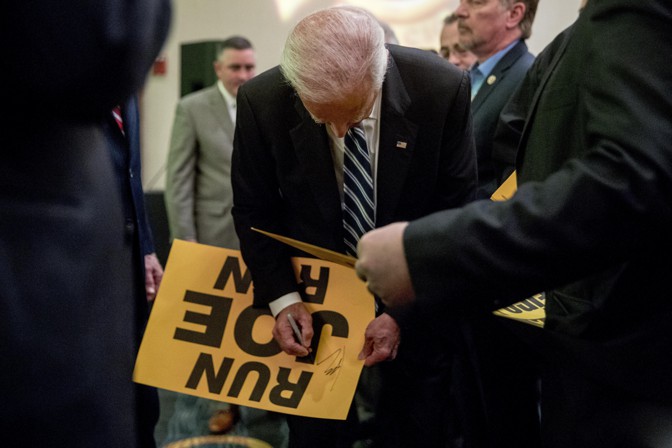
Former Vice President Joe Biden signs a poster that reads “Run Joe Run” after speaking to the International Association of Firefighters in Washington, D.C. (Andrew Harnik / AP)
Ideas From The Atlantic
Why the Democrats Chose Milwaukee for the 2020 Democratic National Convention(Charles J. Sykes)
“They chose it because Milwaukee, like so many places in the U.S., has struggled as the economy has changed; it’s a city of immigrants that was known not only as the Beer Capital, but as the Machine Shop of the World. They also chose it because Wisconsin, which the president won in 2016, seems up for grabs, neither solidly blue nor solidly Trump country.” → Read on.
What Fiji Can Teach America About Immigration(Reihan Salam)
“A well-designed points system would benefit the U.S. by ensuring that newcomers can make larger economic contributions sooner, because they’ll have a better sense of the challenges involved in successfully navigating the American economy.” → Read on.
Don’t Trust Facebook’s New Privacy Play(Conor Friedersdorf)
“Facebook’s perverse incentive to impinge on the privacy of its users will persist so long as the company derives the bulk of its profits from selling its ability to target ads with unusual precision. A privacy-focused platform that inspires confidence wouldn’t be run by a corporate parent that stores detailed data on its users to sell ads.” → Read on.
We’re always looking for ways to improve The Politics & PolicyDaily. Comments, questions, typos, grievances and groans related to our puns? Let us know anytime here.
VENEZUELA BOOTS AMERICAN DIPLOMATS… (Second column, 22nd story, link) Related stories:Caracas elites drink whisky, dance as ordinary fester in dark…Read More
Environmental and land management in South America is being slowly but persistently militarized, with the aim of controlling extractive industries, especially gold mining. In Colombia, Brazil and Venezuela, as well as other countries, both conservative and progressive governments participate in this militarization. The basic dispute is not so much in avoiding negative environmental and social impacts, as in controlling economic surpluses.
Colombia: Environmental Management as a Security Policy
Colombian president Iván Duque recently presented the National Development Plan that will guide his four-year administration. The novelty is that it includes environmental management under national security and defense policies (1). Protection of biodiversity and water now appear alongside objectives such as defending borders and territorial sovereignty.
The measure creates a new security force for “Comprehensive Environmental Protection”, made up of military and police officers who coordinate with prosecutors and environmental authorities. The Ministry of the Environment joins the National Security Council, environmental issues will be incorporated into the National Security Strategy and possibly even into the National Intelligence Strategy.
From this “security” perspective, nature is presented as an “asset”. This is not a neutral concept– it comes from the business world and promotes the fragmentation of nature that prioritizes the economic value of resources. The plan proposes large-scale land-use planning instruments, called “Strategic Comprehensive Intervention Zones”, with medium-term (5 year) objectives in both security and environment, which would serve to transit towards “legal” exploitation of natural resources.
The Colombian government does not hide its basic objective, which is to bring the illegal exploitation of natural resources, such as timber and minerals–especially gold, under control. Government officials admit that the nation confronts a dramatic situation: 86% of the gold extracted comes from illegal practices and 44% of the country’s municipalities engage in some illegal mining, either in gold or coal or other products. In Colombia, illegal mining is so widespread that it has marginalized legal, formal mining practices.
Several other South American countries face the same dilemma, especially Bolivia and Peru where alluvial gold mining is expanding rapidly at the foot of the mountains and in tropical forests. The activity takes a heavy toll on the environment, particularly from deforestation and mercury contamination. It also causes hugely negative social effects, from the trafficking of girls and adolescents to the illegal trade of inputs and minerals. (2).
The Colombian development plan does not aim to end these mining practices, but rather to control them and transform them into formal business ventures. Its goal is for the State to decide which companies participate and under what conditions they can exploit gold and other mineral resources, while obtaining a portion of the profits that this produces.
Venezuela: Militarized Mining Area
Another extreme example is found in Venezuela, where Nicolás Maduro turned to liberalizing mining exploitation in the so-called Arco Orinoco Mining in one of several desperate attempts to overcome the country’s crisis (3). The Arco Orinoco area comprises more than 100 thousand km2, with deposits of gold, diamonds and coltan, among other minerals. There Maduro created a “Military Economic Zone”, placing the armed forces in charge of controlling and directing mining exploitation.
Currently, there is a dispute over gold in the region, with various complaints regarding the military’s participation in both the registered companies and in illegal networks, involved in environmental destruction and violence. Local groups denounce that their rights are violated, deforestation and other environmental impacts are increasing, and gold mining is spreading beyond the designated area to other Amazonian territories (3).
Brazil: Bolsonaro’s Militarist Offensive
In Brazil, the new government of Jair Bolsonaro is also taking the first steps towards greater military presence in the control of natural resources and territories, especially in the Amazon. The new vision mixes disparate components mix with certain reactionary fantasies. Bolsonaro promotes liberalization in carrying arms and considers the occupation of rural lands as “terrorism”. Some days he claims that the indigenous people must become “soldiers”, but on other days he postulates converting them into “entrepreneurs” in the use of their territories. Most frequently, he marginalizes them as obstacles to progress.
Schematic representation of the Andes biological corridor.
The new president has also denounced what he calls international plots to appropriate the Amazon. In particular, he questioned the initiative to create a “Triple A Corridor” that joins together protected areas and indigenous territories extending from one side of the continent to the other, from Peru (in the north of the Amazon) and Ecuador, along the northern zone of Brazil and adjacent regions of Colombia, Venezuela and the Guianas. (4) Bolsonaro also criticizes it for, according to him, operating analogously to forms of self-determination of indigenous peoples. In this he is not alone–there are military commanders who support him (5).
Schematic representation of the Orinoco mining arch in Venezuela (blue) and the “Caja Norte” program in the northern Amazonian border of Brazil (red).
This may explain the intentions of the Bolsonaro government to resuscitate the old military program of the “Caja Norte” of the Amazon, which includes the Brazilian territories north of the Amazon River along approximately 6,500 km of borders with Peru, Colombia, Venezuela, Suriname, Guyana and French Guiana. This initiative was launched in 1985 to ensure the defense of what they identified as strategic natural reserves, under the control of the Ministry of Defense.
Militarization in Other South American Countries
In Peru, police or military regularly launch interventions to put down citizen protest. The mechanism the government uses is to declare a state of emergency. The most recent occurred on February 15, 2019 in the gold mining areas in the buffer zone of a reserve in the southern Amazon. By some calculations, illegal gold mining there has caused the deforestation of 11,000 hectares of forest. These operations involved 1,272 police officers, 300 members of the armed forces, experts in explosives, and 70 delegates of the General Prosecutor’s Office acting by land, in the rivers and by air. They claim these forces will remain for about two years. (6 ) This reveals the enormous scale of these interventions.
Police and sometimes military actions occur in several other countries. They have been reported, for example, in Argentina, especially in controlling the fracking fields in the south of the country; in Bolivia where they have protected the entry of oil companies into indigenous territories; in Chile with the deployment of the militarized police in the Mapuche areas of the country or in southern Chile to repress local groups that resist the so-called “theft” of water; or in Ecuador, where they have secured the protection of new mining ventures.
In several of these cases, the police or the military provide security or protection to companies and their facilities. The extreme case is Peru, where laws formalized mechanisms for mining and oil companies to contract directly with the police to provide them with “protection” and “neutralization” of threats. In that country, 138 “extraordinary police service provision” agreements have taken place between 1995 and 2018, with 29 of these agreements still in force. (7)
In other cases, agents have been assigned to spy on local leaders, as in the case of Project X of the Argentine Gendarmerie, or more recently with the spying on church leaders in Brazil for their support of land claims asserted in the Amazon.
Emerging Trends
It is possible to advance some conclusions about this military and police derivative on extractivism. The first is not to forget that the militarization of environmental management is not new, and for example in Brazil it is dragged from the military governments since the mid-twentieth century, although at that time it was focused on ensuring a territorial presence in an Amazon that many considered a green “desert” But at present it is becoming more and more evident in several countries.
The second aspect is that this is promoted under both conservative and progressive governments. The similarities between Colombia and Venezuela are striking. Beyond the rhetoric and the participation of the State, the models of extractivism are repeated, with all their impacts. This indicates that we face a deeper problem that involves the roots in contemporary conceptions of development and Nature.
A third issue is that the dispute is not really focused on how to protect nature, but on how to regulate mining, to control it and obtain part of the profits. For example, it is clear that in Colombia the State seeks to displace and replace illegal groups as arbiters and organizers of gold mining. In this way, a commodification of the environment is reinforced. The flip side is to conceal or exclude other understandings of nature such as those based on its ecological, aesthetic, religious, and historical values.
Fourth, the policy legitimizes military and police as actors in environmental management. This is a substantive change in the tasks usually expected of them, and models like Colombia’s can lead to generals opining on the management of protected areas and indigenous territories. The community of ecologists, biologists and other scientists is once again relegated and the excuse of security serves to cancel out processes of citizen information and participation.
A fifth aspect is the need to recognize and understand that militarization can have widespread local support, especially in areas where there is a high incidence of criminal violence. No doubt there will be many who will celebrate the arrival of soldiers and police. But the passage of time shows that the military presence often ends up fueling more violence. Colombia offers many examples of this. Local communities, especially peasants and indigenous people, are trapped between the military and police on the one hand, and illegal and criminal groups on the other.
Sixth, the spread of this concept of security could lead to possible tensions between countries. This may be beginning to occur in the northern Amazonian regions. In fact, there the AAA Biological Corridor proposal affects the Orinoco Mining Arc in Venezuela and also overlaps the Caja Norte military plan of the Brazilian border.
Finally, it is evident that this type of strategies will not be able to stop the social and environmental impacts of extractive industries. The generals control neither the market price nor the external demand, and it becomes impossible to place a soldier or a policeman at every Amazonian river or on every hillside. Meanwhile, huge financial resources are spent that could be used to sustain productive reconversions in the areas that need it most.
Sin embargo, a pesar de todo esto, lo que hoy se observa en Colombia y otros países vecinos, parece apuntar a que la tozudez una vez más prevalecerá, para insistir en medidas ambientales y territoriales que ya sabemos que son inefectivas.
However, despite all that, recent experience in Colombia and other neighboring countries, seems to point to stubbornness once again prevailing, to insist on environmental and territorial measures that have already been proven to be ineffective.
Eduardo Gudynas is a researcher at the Latin American center for Social Equality in Uruguay (Centro Latino Americano de Ecología Social-CLAES). His most recent book is “Corruption and Extractivism”, with editions in Chile, Peru and Bolivia.
Notes
(1) Bases del Plan Nacional de Desarrollo 2018-2022, Departamento Nacional de Planeación, Bobotá, 2019.
(5) Former Chief Commander of the Army Eduardo Villas Boas, on Twitter, called the Corridor a “question of sovereignty”, and called for an analysis of “risks”. This general directed the military command in the Amazon. https://twitter.com/Gen_VillasBoas/status/1042435900448354304
Jair Bolsonaro, 2015, on Facebook, classified it as “the new threat to Brazilian sovereignty in the Amazon”, carried out with the “pretext” of combatting climate change, and following the example of “the self-determination of indigenous peoples”, it would end up in an “amputation” of national territory. https://www.facebook.com/pg/jairmessias.bolsonaro
(7) ER, IDL y CDDHH. 2019. Agreements between the National Police and extractive industries in Peru. EarthRights Internacional (ER), Instituto de Defensa Legal (IDL) y Coordinadora de Derechos Humanos (CDDHH), Lima.
‣ China, Australia, and European Union authorities are grounding all Boeing 737 Max 8 planes after the deadly Ethiopian Airlines crash over the weekend became the second in five months to involve the Boeing jet. The U.S. Federal Aviation Administration has not yet grounded the planes, but more senators have called on the FAA to take that step.
‣ The New York attorney general reportedly issued subpoenas to Deutsche Bank and Investors Bank related to financing of four Trump Organization projects, and Donald Trump’s failed effort to buy the Buffalo Bills football team in 2014.
‣ The Senate plans to vote Thursday on a resolution to block Trump from declaring a national emergency over border security. The resolution has already been passed by the House, and appears likely to pass in the Senate, leading to an almost-certain presidential veto.
Here’s what else we’re following:
Cheaters: Celebrities, wealthy parents, and college-prep executives were among the dozens charged in a massive scam to cheat college admissions spanning nearly a decade. The college-admissions process for highly selective, elite schools has long involved hiring consultants to help better-connected prospective students game the system. And at these same schools, college sports often serve as a kind of quiet affirmative action for wealthy white kids.
Great Expectations: Assumptions set by the Starr Report—a juicy 200-page document that came out during Bill Clinton’s presidency and detailed the chronology of his sex life—or press coverage of the Russia investigation might have inflated many Americans’ expectations about the impending report from Special Counsel Robert Mueller, writes David Graham. “Mueller might send a five-page memo to [Attorney General William] Barr, saying, ‘I got a guilty plea from these people, and I didn’t charge these ones,’” one law professor said.
Making Lemonade: Negotiations between President Donald Trump and North Korea’s leader, Kim Jong Un, fell apart at their recent summit, but the White House says there’s a silver lining: The summit’s collapse could empower Trump’s advisers.
Former Vice President Joe Biden signs a poster that reads “Run Joe Run” after speaking to the International Association of Firefighters in Washington, D.C. (Andrew Harnik / AP)
Ideas From The Atlantic
Why the Democrats Chose Milwaukee for the 2020 Democratic National Convention(Charles J. Sykes)
“They chose it because Milwaukee, like so many places in the U.S., has struggled as the economy has changed; it’s a city of immigrants that was known not only as the Beer Capital, but as the Machine Shop of the World. They also chose it because Wisconsin, which the president won in 2016, seems up for grabs, neither solidly blue nor solidly Trump country.” → Read on.
What Fiji Can Teach America About Immigration(Reihan Salam)
“A well-designed points system would benefit the U.S. by ensuring that newcomers can make larger economic contributions sooner, because they’ll have a better sense of the challenges involved in successfully navigating the American economy.” → Read on.
Don’t Trust Facebook’s New Privacy Play(Conor Friedersdorf)
“Facebook’s perverse incentive to impinge on the privacy of its users will persist so long as the company derives the bulk of its profits from selling its ability to target ads with unusual precision. A privacy-focused platform that inspires confidence wouldn’t be run by a corporate parent that stores detailed data on its users to sell ads.” → Read on.
We’re always looking for ways to improve The Politics & PolicyDaily. Comments, questions, typos, grievances and groans related to our puns? Let us know anytime here.
On April 27, 2015, Shantay Guy was driving her 13-year-old son home across Baltimore from a doctor’s appointment when something — a rock, a brick, she wasn’t sure what — hit her car. Her phone was turned off, so she had not realized that protests and violence had broken out in the city that afternoon, following the funeral of Freddie Gray, the 25-year-old man who drew national attention eight days earlier when he died after suffering injuries in police custody.
As she saw what was happening — fires being set, young people and police officers converging on the nearby vortex of the disorder — she pushed her son, Brandon, down in his seat and sped home. “Mom, are we home yet?” Brandon asked when they pulled up at their house just inside the city line, where they lived with Guy’s husband, her grown daughter and her husband’s late-teenage son, brother and sister-in-law.
“Yeah,” she told him.
“You’re still holding my head down,” he said.
Guy grew up in an impoverished, highly segregated part of West Baltimore near what was now the focal point of the street clashes, but she had long since climbed into a different stratum of the city’s society; she was working as an information-technology project manager for T. Rowe Price, the Baltimore-based mutual-fund giant. Seeing her old neighborhood erupt changed her life. After long discussions with her husband, who manages the office of a local trucking company, she quit her job and went to work for a community mediation organization. “It just felt like it was the work I was supposed to be doing,” she said.
In Baltimore, you can tell a lot about the politics of the person you’re talking with by the word he or she uses to describe the events of April 27, 2015. Some people, and most media outlets, call them the “riots”; some the “unrest.” Guy was among those who always referred to them as the “uprising,” a word that connoted something justifiable and positive: the first step, however tumultuous, toward a freer and fairer city. Policing in Baltimore, Guy and many other residents believed, was broken, with officers serving as an occupying army in enemy territory — harassing African-American residents without cause, breeding distrust and hostility.
In 2016, the United States Department of Justice’s Civil Rights Division concurred, releasing a report accusing the city’s Police Department of racial discrimination and excessive force. The city agreed to a “consent decree” with the federal government, a set of policing reforms that would be enforced by a federal judge. When an independent monitoring team was selected to oversee the decree, Guy was hired as its community liaison. This was where she wanted to be: at the forefront of the effort to make her city a better place.
But in the years that followed, Baltimore, by most standards, became a worse place. In 2017, it recorded 342 murders — its highest per-capita rate ever, more than double Chicago’s, far higher than any other city of 500,000 or more residents and, astonishingly, a larger absolute number of killings than in New York, a city 14 times as populous. Other elected officials, from the governor to the mayor to the state’s attorney, struggled to respond to the rise in disorder, leaving residents with the unsettling feeling that there was no one in charge. With every passing year, it was getting harder to see what gains, exactly, were delivered by the uprising.
One night last October, after Guy and her husband, Da’mon, had gone to bed, Da’mon’s brother banged on the bedroom door. “Yo, yo, get up!” he shouted.
It was around 11:30 p.m. Da’mon’s 21-year-old son, Da’mon Jr., whom Shantay had helped raise, would ordinarily have been home by then, after his bus ride across town from his evening shift working as a supply coordinator at Johns Hopkins Hospital. But he was nowhere to be seen. Da’mon Sr. rushed to the door and asked what was going on.
“Dame’s been shot,” his brother said.
Four months later, I met Guy and Da’mon Jr. at a cafe near my office in the center of the city. Da’mon had recently been released after spending 47 days in the hospital, with 20 surgical procedures. His inferior vena cava, which carries blood from the lower body to the heart, no longer functioned; he had to rely on collateral veins instead. He was trying to go back to work, but swelling in his legs and shortness of breath were making it hard.
Da’mon told me he had no idea who was behind the shooting, which he surmised was either an attempted robbery or a gang initiation. It was unnerving, he said, knowing the shooter was still out there somewhere. “I don’t like it when cars slow down to me or people are staring at me too long at stop signs,” he said. “Any one of y’all could be that person. You never know.”
But Guy, somehow, had come through the experience even more committed to the cause she had signed on for. “Our city needs restoration,” she told me.
Shantay Guy and her stepson, Da'mon Jr., who was wounded in a shooting in October 2018. (Peter van Agtmael/Magnum for The New York Times)
It takes remarkable fortitude to remain an optimist about Baltimore today. I have lived in the city for 11 of the past 18 years, and for the last few I have struggled to describe its unraveling to friends and colleagues elsewhere. If you live in, say, New York or Boston, you are familiar with a certain story of urban America. Several decades ago, disorder and dysfunction were common across American cities. Then came the great urban rebirth: a wave of reinvestment coupled with a plunge in crime rates that has left many major cities to enjoy a sort of post-fear existence.
Until 2015, Baltimore seemed to be enjoying its own, more modest version of this upswing. Though it is often lumped in with Rust Belt economic casualties like Cleveland, St. Louis and Detroit, Baltimore in fact fared better than these postindustrial peers. Because of the Johns Hopkins biomedical empire, the city’s busy port and its proximity to Washington, metro Baltimore enjoyed higher levels of wealth and income — including among its black population — than many former manufacturing hubs.
The city still had its ills — its blight, suburban flight, segregation, drugs, racial inequality, concentrated poverty. But as recently as 2014, Baltimore’s population, which is 63 percent African-American, was increasing, up slightly to 623,000 after decades of decline. Office buildings downtown were being converted to apartments, and a new business-and-residential district was rising east of the Inner Harbor. The city was even attracting those ultimate imprimaturs of urban revival, a couple of food halls.
The subsequent regression has been swift and demoralizing. Redevelopment continues in some parts of town, but nearly four years after Freddie Gray’s death, the surge in crime has once again become the context of daily life in the city, as it was in the early 1990s. I have grown accustomed to scanning the briefs column in The Baltimore Sun in the morning for news of the latest homicides; to taking note of the location of the latest killings as I drive around town for my baseball coaching and volunteering obligations. In 2017, the church I attend started naming the victims of the violence at Sunday services and hanging a purple ribbon for each on a long cord outside. By year’s end, the ribbons crowded for space, like shirts on a tenement clothesline.
The violence and disorder have fed broader setbacks. Gov. Larry Hogan canceled a $2.9 billion rail transit line for West Baltimore, defending the disinvestment in the troubled neighborhood partly by noting that the state had spent $14 million responding to the riots. Target closed its store in West Baltimore, a blow to a part of town short of retail options. The civic compact has so frayed that one acquaintance admitted to me recently that he had stopped waiting at red lights when driving late at night. Why should he, he argued, when he saw young men on dirt bikes flying through intersections while police officers sat in cruisers doing nothing?
Explaining all this to people outside Baltimore is difficult, not only because the experience is alien to those even in cities just up or down the interstate from us (though a handful of cities elsewhere, like Chicago and St. Louis, have experienced their own waves of recent violence, albeit less dramatically than Baltimore). It’s also because the national political discourse lacks a vocabulary for the city’s ills. On right-wing talk radio, one of the few sectors of the media to take much interest in Baltimore’s crime surge, there are old tropes of urban mayhem — Trump’s “American carnage.” Typically lacking from these schadenfreude-laced discussions is any sense of the historical forces and societal abandonment that the city has for decades struggled to overcome.
On the left, in contrast, Baltimore’s recent woes have been largely overlooked, partly because they present a challenge to those who start from the assumption that policing is inherently suspect. The national progressive story of Baltimore during this era of criminal-justice reform has been the story of the police excesses that led to Gray’s death and the uprising, not the surge of violence that has overtaken the city ever since. As a result, Baltimore has been left mostly on its own to contend with what has been happening, which has amounted to nothing less than a failure of order and governance the likes of which few American cities have seen in years.
To understand how things in Baltimore have gotten so bad, you need to first understand how, not so long ago, they got better. Violence was epidemic in Baltimore in the late 1980s and early 1990s, as it was in many other cities, as crack intruded into a drug market long dominated by heroin. In 1993, the city crossed the 350-homicide mark. These were the years that inspired “The Wire.” They also gave rise to Martin O’Malley, a city councilman who was elected mayor on an anti-crime platform in 1999.
O’Malley set about implementing what was then known as the New York model: zero tolerance for open-air drug markets, data-centric “CompStat” meetings to track crime and hold police commanders accountable and more resources for law enforcement paired with tougher discipline for officers who abused their power. By the time O’Malley, a Democrat, was elected governor of Maryland in 2006, crime rates, including murders, had fallen across the board, but at a cost. Arrests had jumped to 101,000 in 2005 from 81,000 in 1999 — leaving a city full of young men with criminal records and months and years away from jobs and families.
This perturbed a police detective named Tony Barksdale. At the time a colonel in his mid-30s, Barksdale, a bald, bearish man with a lugubrious manner, grew up in a rough section of West Baltimore. “I saw my first guy get shot at a football tryout at Franklin Square,” near his home, he told me when I met him for lunch last spring in the city’s Canton neighborhood. His own block was relatively safe, however, because a police officer lived on it. Barksdale was drifting through Coppin State College, “blowing Pell grants,” when he saw a bunch of young black cops on the street one day. The sight inspired him to sign up himself.
Early in 2007, he proposed a more targeted approach to policing to Sheila Dixon, the City Council president who finished O’Malley’s term as mayor after he was elected governor. Dixon, like Barksdale a product of the city’s black working class, agreed with Barksdale’s vision for reducing the murders without mass arrests. “She said, ‘How long will it take you?’” Barksdale recalls. “I said, ‘One day.’”
Fred Bealefeld, Dixon’s new police commissioner, promoted Barksdale to deputy of operations — he was the youngest deputy commissioner in the city’s history — and Barksdale got to work. He developed plainclothes units with a more surgical approach to policing, which targeted the most violent corners and worked with homicide detectives to arrest the people whose names surfaced in connection with killings. He and Bealefeld met weekly with top-ranking staff members in the mayor’s office and sat down with top city officials every couple of weeks in CitiStat meetings — the municipal equivalent of CompStat — where Bealefeld was quizzed on overtime costs, recruiting and other markers of departmental health. Every couple of weeks, representatives of the police, the state’s attorney’s office and others met to review data on firearms prosecutions.
Arrests fell by a third from 2006 to 2011 — and homicides plummeted as well, to 197 in 2011, the city’s first time under 200 in almost four decades. A 2018 study by Johns Hopkins found that the new approach to policing was the city’s most effective in recent years. “Baltimore had it going on,” Barksdale told me.
Tony Barksdale, former interim commissioner of the Baltimore police. (Peter van Agtmael/Magnum for The New York Times)
But while Dixon had carried on O’Malley’s government-accountability practices, she proved less than ethical in her own affairs. A few years into Barksdale’s efforts, she was charged by the state prosecutor with theft and fraud. The prosecutor had scrutinized contracts and jobs her friends and relatives had received from the city — investigations that led to the discovery that she had personally used hundreds of dollars in gift cards solicited from developers and meant for poor children.
Dixon was convicted and resigned, and was replaced by the City Council’s president, Stephanie Rawlings-Blake, an Oberlin- and University of Maryland School of Law-educated daughter of a powerful state legislator. Rawlings-Blake, a more reserved leader than Dixon, wanted Bealefeld to communicate with the public more often than he was inclined to but also less candidly; a white cop from a family full of them, Bealefeld was known for his blunt talk about “punks” and “knuckleheads.” In 2012, he retired, as did two of his closest City Hall allies, and Barksdale became interim commissioner.
Barksdale interviewed for the permanent job, but Rawlings-Blake instead hired Anthony Batts, the former police chief in Oakland, California. Batts had resigned in Oakland amid tensions with the mayor and federal court monitors, but he had a doctorate and spoke fluently about the need for community relations. Batts’ profile suited a city that wanted to believe that its most violent days were behind it. Barksdale didn’t find out he had been passed over until he got a call from Justin Fenton, The Sun’s lead police reporter.
When the Black Lives Matter movement transformed the debate about policing in 2014, Batts embraced an image as a reformer. He attended street festivals in full uniform. He reined in Barksdale’s plainclothes teams after a series in The Sun reported how much the city was spending to resolve lawsuits over rough arrests — more than $5 million since 2011. On Bealefeld and Barksdale’s watch, there had also been a rise in shootings by police officers, which roughly doubled between 2006 and 2007 before dropping to earlier levels — a fact Barksdale remains unapologetic about. “To hit the brakes on crime, there will be police-involved shootings,” he recalls telling Dixon and Bealefeld. “I know their mind-set. They’ll respect you if you’re willing to die just like them. And there are people who just don’t get that.”
It was a controversial approach and one that Batts did not subscribe to. He replaced much of the command staff, and other people left on their own. Among them was Barksdale, who retired at age 42. “I like a commissioner who says, ‘Look, we have people in the community we have to arrest,’” Barksdale told me. “Not cops out here dancing in full uniform.”
Political developments, meanwhile, had eroded foundations of the department’s recent successes, which depended heavily on coordination with City Hall and state and federal prosecutors, as well as with Maryland’s parole-and-probation office and other state agencies that might not have been as attentive to the city if the governor had not been a former Baltimore mayor. But in 2014, Maryland elected Larry Hogan, a Republican suburban real estate developer, as O’Malley’s successor for governor. Hogan put less pressure on state offices to work closely with the city’s police. And the new state’s attorney, after an upset victory in a low-turnout Democratic primary, was Marilyn Mosby, a 34-year-old former assistant prosecutor who had run with the apparent goal of shaking up the city’s law-enforcement bureaucracy. She jettisoned not only top deputies but also many prosecutors; more left of their own accord. Over time, senior members of her office became a less-frequent presence at CompStat and other meetings with law-enforcement partners. (Mosby’s office did not respond to requests for official comment.)
In her campaign, Mosby called for diverting more nonviolent drug offenders into treatment. One halfway house used for this purpose was in West Baltimore, and drug dealers had zeroed in on its residents as a clientele, according to a member of Mosby’s staff. On March 17, 2015, Mosby’s office asked a police commander to target a nearby intersection for “enhanced” drug enforcement. A few weeks later, two officers on bike patrol a couple of blocks south of that intersection encountered a man named Freddie Gray.
Protesters confront Baltimore police on April 27, 2015, the day of Freddie Gray’s funeral. (Drew Angerer/Getty Images)
Among the deaths at police officers’ hands that animated the Black Lives Matter movement in its early stages, Gray’s was uniquely ambiguous. He was not shot, as were Laquan McDonald in Chicago, Michael Brown in Ferguson, Missouri, Tamir Rice in Cleveland and Walter Scott in North Charleston, South Carolina. All that is known for certain is this: When he encountered the police officers, Gray — who had engaged in low-level dealing over the years — ran. When the police gave chase and tackled him, they found a small knife in his pocket and placed him under arrest. Gray was put in the back of a police van shackled and unbuckled, in violation of a new department policy. When the van arrived at the Western District’s headquarters, Gray was unconscious with a nearly severed spinal cord. He died seven days later.
Protesters took to the streets after Gray’s death. Batts, who had canceled a European vacation he was scheduled to take the previous week, appealed to Hogan’s new state police chief for reinforcements, but he received an offer of only about 120 officers, far fewer than he hoped for. The demonstrations proceeded mostly peacefully for a week until Saturday, April 25, when rowdy baseball fans headed to Camden Yards — including out-of-town Red Sox fans — taunted a group of protesters who had marched into downtown. In the mayhem that ensued, some teenagers and young men smashed in police cruisers’ windshields and bar windows and looted a 7-Eleven.
The police held back, making only about a dozen arrests. It appeared as if Batts wanted to set himself apart from the heavy-handed tactics in Ferguson, where anti-riot police officers bristled with military hardware. That night, Batts, who declined to be interviewed on the record for this article, hailed his officers’ limited response to the disorderly crowd amassed downtown. “We’re taking our time to give them the opportunity to leave,” he told reporters.
Bealefeld, Batts’ predecessor, told me: “There were people inside police leadership circles that were being celebrated for their restraint. People were thinking, ‘Aha, we want to be seen in that light.’” But this hands-off response drew resentment within the department, where many were already disgruntled with the commissioner from California. “It would have been over that night if we’d been able to do our jobs,” one veteran officer who attended a command briefing that weekend told me, speaking on the condition of anonymity because he was not authorized to talk to reporters. “They let it fester.”
The approach was notably different two days later, the day of Gray’s funeral. The police were on edge over two separate rumors — a social-media call for a youth “purge,” or rampage, into downtown after school let out, and talk of gangs uniting to attack police officers. The FBI quickly determined that the second threat was baseless, but Batts responded heavily to the first rumor, sending 300 officers to confront students at a big west-side transit hub after school and stand guard outside the adjacent shopping mall. Someone in authority — to this day, officials won’t say who — ordered a shutdown of transit service. Some of the stranded teenagers started throwing rocks and bricks at the police, who lacked proper protective gear and had received little riot-response training. Before long, a CVS pharmacy a mile away was on fire.
In hindsight, it’s hard to avoid the conclusion that the riot was probably avoidable — if Batts had had more officers at his disposal, if his officers had been better trained, if there hadn’t been the seeming overreaction to Monday’s swirling rumors. But within three hours it was out of his control. Hogan dispatched National Guard troops and established a command center in West Baltimore. That Friday, Mosby — whose policing request may very well have led to Gray’s arrest — held a televised news conference announcing a long list of serious charges against six officers, including “depraved heart murder,” or causing death through indifference. “I have heard your call for ‘no justice, no peace,’” she declared.
Officers look on in front of the Baltimore Police Department's Western District station on April 21, 2015, as protesters rallied after Gray’s death. (Drew Angerer/Getty Images)
Her announcement of charges — based on an investigation her own office conducted, not trusting the department’s — helped stanch further unrest, but it delivered a profound blow to morale among rank-and-file officers, who were already aggrieved over their leadership’s handling of the riot, in which 130 officers were injured. Officers bridled at the ringing, declamatory tone of her announcement. “It was the way she did it — the grandstanding,” the veteran officer told me.
“Cops don’t necessarily stop in their tracks because another cop is charged in a crime,” Kevin Davis, one of Batts’ deputies at the time, told me. “Typically it’s a bad cop, a crook, a drug dealer or a drunk or someone who abuses his wife. But when these cops got charged criminally and the probable cause was not easily understood by the rank and file — that gave them a sense of dread.”
The department’s officers responded swiftly, by doing nothing. In Baltimore it came to be known as “the pullback”: a monthslong retreat from policing, a protest that was at once undeclared and unmistakably deliberate — encouraged, some top officials in the department at the time believe, by the local police union. Many officers responded to calls for service but refused to undertake any “officer-initiated” action. Cruisers rolled by trouble spots without stopping or didn’t roll by at all. Compounding the situation, some of the officers hospitalized in the riot remained out on medical leave. Arrests plunged by more than half from the same month a year before. The head of the police union, Lt. Gene Ryan, called the pullback justifiable: “Officers may be second-guessing themselves,” he told The Sun. “Questioning, if I make this stop or this arrest, will I be prosecuted?”
Ray Kelly, a West Baltimore community activist, had achieved measured success in building relationships with officers along the drug-riddled Pennsylvania Avenue corridor, where his organization had an office. Suddenly, those officers were gone. “We saw a pullback in this community for over a month where it was up to the community to police the community,” Kelly told me. “And quite frankly, we were outgunned.” In the vacuum, crews took new corners and people settled old scores. Not a single person was killed on the day of the rioting. But the following month, May, would conclude with 41 homicides — the most the city had experienced in a month since the 1970s, and more than the city of Boston would have for the entire year.
Late that month, Batts admitted he was having trouble getting officers to do their job. “I talked to them again about character and what character means,” he told me and other reporters following a City Council hearing. He grew so mortified over the pullback that he started wearing suits instead of his uniform. By July’s end, 45 people had been killed during the month, and Rawlings-Blake had replaced Batts with Davis. The department was hemorrhaging officers now, at all ranks.
Amid the upheavals of 2015, Shantay Guy found herself recalling, as a girl on North Avenue in the 1980s, diving under a car during a shooting, getting oil on her favorite shirt. Her work at T. Rowe Price suddenly seemed unacceptably rarefied. “I’m not doing enough,” she thought. “I’m doing a lot to make rich people richer.”
She approached a friend, Erricka Bridgeford, who is director of training at the Baltimore Community Mediation Center, a nonprofit group that helps settle personal and neighborhood conflicts. Bridgeford encouraged Guy to take her training course. Guy started volunteering as a mediator and was soon offered the job of leading the center. She took it, along with a two-thirds salary cut.
Across Baltimore, there was by then a mounting sense that whatever path there was to be found out of the city’s chaos, its residents were going to have to find it themselves — that the authorities were no longer up to the task. The lawlessness that followed the police pullback had persisted, and the city ended 2015 with 342 homicides, a 62 percent increase over the year before, within a dozen deaths of the worst year of the 1990s. Ninety-three percent of the victims were black. The rate at which detectives were able to close homicide cases fell from 50 percent in 2013 to 30 percent, as residents grew even warier of calling in tips or testifying.
In July 2016, Mosby’s office dropped all remaining charges against officers in the Gray case, after trials resulted in three acquittals and one hung jury. It was that August that the Department of Justice released its 163-page report on the Police Department, a result of a yearlong investigation it opened at the request of Rawlings-Blake after Gray’s death. The report concluded that the police had engaged in “a pattern or practice of conduct that violates the Constitution or federal law.” The police’s pedestrian stops were disproportionately focused on African-Americans. They frequently patted down or frisked people “without identifying necessary grounds to believe that the person is armed and dangerous.” Baltimore officers used “overly aggressive tactics that unnecessarily escalate encounters, increase tensions and lead to unnecessary force,” the report stated.
The report affirmed years’ worth of civilian complaints about the department. But it also essentially ignored Barksdale and Bealefeld’s largely successful efforts to move toward a more targeted policing approach. It suggested that mass arrests led inexorably to Gray’s death and the protests, when in fact by 2014, arrests had been halved from a decade earlier. Barksdale was especially livid about the report’s suggestion that the department, which is roughly 40 percent black, was prejudiced because it arrested mostly African-Americans in many parts of town. “Now a cop in a black community is wrong because he confronts black people?” he told me.
He was also confounded by the report’s mockery of the department’s crackdowns on dice games, a frequent target of robberies and shootings. “Dude, you can’t have [expletive] open-air dice games,” he said. Armed robbers “want to stick that up, and if they have a shotgun and buckshot, you’ll have six or seven victims.” The failure of the report’s authors to grasp this, he said, betrayed a fundamental ignorance of local realities. “They have no understanding of what these things mean in Baltimore,” he said.
By that point, Baltimore had elected yet another new mayor: Catherine Pugh, who won the Democratic primary that April — in Baltimore, the only election that matters — after Rawlings-Blake opted not to run for re-election. That December, Pugh came to her first meeting of CitiStat, the municipal accountability body started by O’Malley. The meetings were held on the sixth floor of City Hall, where top city officials sat around a curved table and put questions to whichever agency head had been called to the lectern that day to defend his or her agency’s performance.
Very few people knew what to expect from Pugh. A longtime state legislator, she had won mostly by virtue of not being Sheila Dixon, who, having served her community-service sentence, ran again for her old job and narrowly lost. Pugh’s inscrutability extended to her bearing — she spoke in muffled tones, and her bangs often hung so low as to almost cover her eyes.
At the CitiStat meeting, a major topic of discussion was a rise in carjackings. Earlier that month, an 80-year-old member of the City Council was attacked by two teenage boys while getting into her car in a parking garage, leaving her with a black eye. Davis, the commissioner, and his deputy said that the carjackings appeared to be the work of violent drug crews, who were deploying teenagers to steal cars as an initiation of sorts, and then often using the cars while committing homicides.
Pugh grew agitated. The carjackings weren’t a law-enforcement problem, she said; they were a problem of footloose youth. Why wasn’t the meeting instead focusing on how to get teenagers into jobs or after-school programs? She declared the meeting a waste of her time and left. It was the last CitiStat meeting she would attend for at least six months.
Pugh seemed overwhelmed by the continuing violence. It was not until August 2017 that she announced her plan to counter it. It would be built around daily meetings to focus city services in high-crime areas — which she dubbed the Violence Reduction Initiative — as well as the addition of a Boston-based program for at-risk young people called Roca, and the expansion of Safe Streets, which deploys ex-offenders as “violence interrupters.”
At the core of Pugh’s plan was the notion that crime was driven by root causes. This was true, but it risked overlooking the most immediate dilemma: People inclined toward lawbreaking increasingly thought they could do so with impunity. Delivery of basic services to address root-cause problems was also undermined by the departure of key city officials, as word spread that Pugh was not easy to work for.
By this point, it was plain that the surge in violence was not simply going to abate. Robberies and burglaries had also risen sharply. The city’s population was falling again, nearing a 100-year low with less than 615,000 in a census estimate released in March 2017. There were other, more ambient signs of disorder: the dirt bikes, squeegee boys at intersections. The city’s bike-sharing program was so plagued with vandalism that it was eventually shut down.
That summer, Erricka Bridgeford, Shantay Guy’s friend at the mediation center, started Baltimore Ceasefire, an effort to get the city’s criminal element to put down their weapons for one weekend every three months. The group’s main slogan was straightforward: “Nobody Kill Anybody.” A second slogan was aimed at those inclined not toward violence but toward apathy: “Don’t Be Numb.” During the first cease-fire, that August, two men were killed. Bridgeford went to the scenes to mourn the victims.
Top: Erricka Bridgeford, organizer of Baltimore Ceasefire, leading a ritual to cleanse a murder scene with sage on July 31, 2018. Bottom: Kids participate in Baltimore Ceasefire activities. (Peter van Agtmael/Magnum for The New York Times)
The Justice Department’s report, meanwhile, had led to the federal “consent decree” that the city negotiated with the department — a sweeping set of reforms of the Police Department that set out new rules governing stops and searches, internal discipline and much more. Gene Ryan, the leader of the police union, complained that his organization had been shut out of the process of drafting it. Tony Barksdale, who had been retired for three years and now spent his days trading stocks online, attacked it incessantly on Twitter, accusing city leaders of “handcuffing your own cops while turning the city over to criminals.”
One afternoon not long after Guy began her job as the consent-decree monitoring team’s community liaison, she strapped on a bulletproof vest and rode along with a city police officer to see the realities he and his colleagues faced. The officer started his shift at 9 a.m. and, because of the department’s shortage of officers, would work until 2:30 the next morning.
They cruised block after block of rowhouses in an especially drug-plagued area. The officer received a text message to disperse a cluster of young men — a frequent point of confrontation in the city. Young men often congregate in front of corner stores or liquor stores, sometimes just hanging out, other times selling drugs; the city would have a record 692 fatal opioid overdoses in 2017.
“I’m supposed to clear this corner,” the officer told Guy, showing her the address on the screen.
“Can you do that?” she asked.
“No,” he said. As he understood it, the consent decree barred him from dispersing the young men. So he didn’t. But then his phone rang. “I guess when I ignore a call, then I get a phone call telling me I need to do my [expletive] job,” he said. Which was indeed what the call was.
He and Guy drove to the address, where half a dozen young men in their late teens or early 20s were standing outside. The officer got out of the car and told them to move along. “The kids are angry,” Guy recalled; they had already been booted from a nearby corner that afternoon. “Like, ‘What the [expletive], we’re just standing here. We’re not doing anything, what’s going on?’”
For Guy, the moment affirmed her belief in the consent decree. This sort of rote policing seemed pointless; nothing was accomplished by confronting the young men beyond fomenting ill will. “The question for me becomes: What’s the intention for clearing the corners?” she told me. “Are you clearing the corners in white neighborhoods? The corners would not be so crowded if we actually became responsive to community needs.” This was, in essence, Pugh’s strategy — if only it could be made to work.
On Nov. 15, 2017, a veteran detective, Sean Suiter, drove with a partner to a blighted corner of West Baltimore to investigate a recent homicide. Suiter told his partner he had seen someone suspicious in a vacant lot and went to investigate. Shots rang out. His partner found Suiter bleeding from the head, his gun lying under his body. The 43-year-old father of five died the next day. His death was ruled a homicide, the 309th of the year.
The police locked down six square blocks around the scene for six days. Davis, the commissioner, pleaded with the community to offer tips to identify the “heartless, ruthless, soulless killer.” The death felt like the city’s reaching its nadir, in more ways than one. As the public learned in the week that followed, Suiter was scheduled to testify the next day before a grand jury in a vast corruption case that federal prosecutors filed earlier in the year: a conspiracy that painted a picture of a Police Department that, amid the lawlessness of the city, had descended into widespread lawlessness itself.
After the trial concluded, a dozen officers gathered at headquarters for a focus group, convened by the department to solicit their input on new policies stemming from the consent decree, on which they were to start receiving training in 2019. But the officers had no interest in talking about the decree, according to one participant. Instead, they vented about the impossibility of doing their job in a department in meltdown. They were bitter about being constantly “drafted” into mandatory overtime — departures and anemic recruiting had left the department with only 2,500 sworn officers, down 500 from five years earlier.
Police tape off the scene of the murder of Jason Reuben Haynes. (Peter van Agtmael/Magnum for The New York Times)
A change in how the department scheduled shifts — made during Batts’ tenure at the urging of the police union despite the warnings of Barksdale and Bealefeld — had helped cause the city to pay $47 million in overtime in 2017, three times overbudget; some days, 40 percent of patrol shifts were being staffed with mandatory overtime, wearing down officers. The officers were also angry about the lack of resources and equipment. They fumed over the conflicting orders they received. “It’s: ‘Go out and stop crime, but don’t hurt anyone’s feelings,’” the veteran officer told me. “‘Be aggressive — but not too aggressive.’”
In January 2018, Pugh replaced Kevin Davis with a new commissioner, Darryl De Sousa, but De Sousa resigned five months later after federal prosecutors charged him with failing to file tax returns for three recent years. The interim commissioner, Gary Tuggle, had barely stepped into the revolving door of leadership when he found himself facing fresh crises: an officer who quit after being caught on video pummeling a man on the sidewalk, another found passed out drunk in his patrol car, a top commander who quit after throwing a chair against a wall during an argument at Police Headquarters.
And then there was the stunning conclusion of the independent review panel investigating the death of Suiter: He had most likely committed suicide in the vacant lot and made it look like a cop-killing, the panel ruled in August. The investigators believed his suicide was possibly due to his ties to the corruption case.
On a hot day in mid-August, several dozen city officials, police officers and commanders gathered at a bedraggled shopping plaza in the Highlandtown section of southeast Baltimore for one of the regular neighborhood walks that Pugh was conducting in her effort to exude a sense of authority. The mass of suits and uniforms did a slow circuit of a few blocks of rowhouses, trailing behind the mayor. “Watch your step,” someone called out as the group neared a dead rat.
A neighborhood leader pointed out problem spots: a dark block where prostitutes congregated, a bus stop in front of a liquor store that allowed loiterers to claim they were waiting for the bus, piles of trash. It was far from the city’s roughest neighborhood, but Pugh was visibly taken aback by the disorder on display. She expressed particular displeasure over the trash bags that had been piled into containers in advance of pickup day. “You don’t see trash out front in Ashburton,” the middle-class black enclave where she lived, she said under her breath.
Two weeks later, I met Pugh in her office in City Hall. The month was on its way to ending with 30 homicides, almost one per day. But when I started to ask her about the surge in violence since 2015, she cut me off. “If you follow the trends lately, since November of last year we’re trending downward,” she said.
“They’ve trended down only so much,” I protested.
Pugh looked down at an iPad, swiping through crime-data summaries. “May, we had almost a 30 percent reduction in violence. In October of last year, when I created the Violence Reduction Initiative, the following month, November, we dropped by almost 18 percent. We dropped again in December, in January, in February.”
“Year to date right now,” I replied, “we’re barely below where we were last year, and last year was our worst year ever.”
“No,” she said.
“We just had more than one a day this past month,” I said.
“This has been one of the worst months, but we’re about 20 percent down in homicides this year thus far,” she said. “That’s tremendous in comparison with last year.”
“We’re very likely to end up at 300 again this year,” I said.
“We’re very unlikely to get to 300 this year,” she said.
There were 17 homicides in a single week in late September. The year would end with 309 homicides — the fourth straight year above 300. It was the early 1990s all over again — or even worse, considering that the city was now registering comparable numbers despite having 100,000 fewer people living in it.
Mayor Catherine Pugh on a walk around Baltimore with city and law enforcement leadership. (Peter van Agtmael/Magnum for The New York Times)
In mid-November, Pugh announced her choice for the next commissioner: Joel Fitzgerald, the police chief in Fort Worth, Texas. But reporters at The Sun discovered overstatements in his resume; the City Council expressed doubts about confirming him; and he himself seemed ambivalent. Finally, after Christmas, with the city in its eighth month without a permanent commissioner, Pugh told reporters that she was considering bringing back Tony Barksdale, as head of the Mayor’s Office of Criminal Justice.
It was an intriguing development, given how outspoken Barksdale had been in his criticisms of current department leadership and of the consent decree to which the city had committed itself. When I met with him a second time a couple of months earlier, in October, he told me he did not doubt the need for reform; he was mortified that some of the corrupt officers had come from the plainclothes teams he created. But he was worried that things had gone too far. “The criminals are so emboldened now,” he said.
The decree’s demands had made it too difficult for officers to clear drug corners, he said. He was hearing from his former colleagues that loiterers were already reciting the limits it imposed on the officers to them on patrol, mockingly. (I had heard similar reports from a community activist who favored the decree.) Its broadened definition of “use of force” — physical actions that officers had to document in reports, which went on their records and would be scrutinized — made officers less likely to bother engaging physically.
“What do you think happens when these guys see the cops not getting out of their car?” Barksdale said. “Years ago, if I pulled up and said ‘Let’s move,’ they moved. Now who has the control? They have control.” Citizens lose trust in the police not only if they abuse their authority but also if they do nothing about people wreaking havoc on their community. “Look at the number of bodies,” he said. “We’re losing horribly in Baltimore City.”
It was two days later that Da’mon Guy Jr., Shantay Guy’s stepson, got off the bus in the northwestern part of the city. As he began his walk toward home, a purple Volvo SUV pulled up with four or five people inside. He heard the locks click open. As he ran, he heard a shout, then a gunshot. It didn’t register that he was hit in the lower back, he said later, until he realized that he couldn’t get up. He called his own ambulance.
Pugh visited him in the hospital several times. She was in the room when Da’mon, unable to speak because he was intubated, texted his stepmother: “Am I going to die tomorrow? Do my legs work?”
A couple of days later, he went into cardiac arrest. Doctors and nurses rushed in. Da’mon Sr. was in the hallway, out of his mind with panic, shaking and screaming. “He was just OK! I was just with him! He was just OK!” People were trying to restrain him. “Just let me see him!” he screamed.
As the blip of Da’mon’s heartbeat returned on the monitor, Guy tried to calm her husband: “Can you hear it?” she said. “Just focus on the sound.”
As Guy recounted the story in the cafe, I asked what she thought had driven the surge in violence. It was the perception, she said, that “police officers are not doing their jobs, and folks out there doing dirt see that they’re not doing their jobs and whatever they’re doing they can get away with.”
This was not so different from what I heard from Barksdale (who would learn in early March that he wasn’t getting the City Hall job), but she insisted the answer was not a return to tougher tactics. “Tony and I aren’t going to agree,” she told me. “I’m always going to be looking at what’s throwing the children in the street: What’s happening upstream to get them there?” That applied even to the person who shot her stepson, she said. “What happened to him or her that made this OK for them?” she said. “I believe they’re victims, too. I really do.”
Guy had recently left her role with the consent-decree team to take a job at a civic-leadership organization, but she was still involved in police reform. She would be leading meetings around town in which yet another new commissioner would be introduced to residents: Michael Harrison, late of New Orleans. Pugh had settled on him after the Fort Worth chief pulled out in January. Harrison seemed a good fit, someone who knew what it was like to police a violent city. And he came from a department that had been in deep turmoil, after Hurricane Katrina, and was now operating under its own consent decree.
On nine occasions, Guy stood alongside Harrison as he listened to the crowd turning out to see him. A vast majority of questions were from residents, most of them African-American, asking for the department to provide their neighborhoods with more officers and a more energetic response to crowded corners and other signs of disorder.
One of the meetings was in a school auditorium in Edmondson Village, a section of southwest Baltimore that has been especially hard hit by the surge in violence. Last summer, just a few blocks from the school, a 7-year-old girl was fatally shot in a car off Edmondson Avenue, the thoroughfare that the transit rail line that Hogan canceled would have run along. A police officer had been sitting in his cruiser a block away with the windows up; residents rushed to alert him.
The meeting was standing room only. “We just want to feel safe, period,” Monique Washington, president of the Edmondson Village Community Association, told Harrison. “Our people are in fear, and we’re tired.”
An hour into the forum, a neighborhood resident named Renee McCray stepped up to the microphone. She described how bewildering it had been to accompany a friend downtown, near the tourist-friendly Inner Harbor, one night a few months earlier. “The lighting was so bright. People had scooters. They had bikes. They had babies in strollers. And I said: ‘What city is this? This is not Baltimore City.’ Because if you go up to Martin Luther King Boulevard” — the demarcation between downtown and the west side — “we’re all bolted in our homes, we’re locked down.” She paused for a moment to deliver her point. “All any of us want is equal protection,” she said.
It was a striking echo of the language in the Department of Justice report and the activists’ condemnations of the police following Gray’s death. Back then, the claims were of overly aggressive policing; now, residents were pleading for police officers to get out of their cars, to earn their pay — to protect them.
You could look at this evolution as demonstrating an irreconcilable conflict, a tension between Shantay Guy and Tony Barksdale never to be resolved. But the residents streaming into these sessions with Harrison weren’t suggesting that. They were not describing a trade-off between justice and order. They saw them as two parts of a whole and were daring to ask for both.
Liza Starr, a student at Stanford Law School and a member of Stanford’s Supreme Court Clinic, co-authored this post.
On March 19, the Supreme Court will hear argument in Cochise Consultancy Inc. v. United States, ex rel. Hunt. The justices will consider how two statutes of limitations under the False Claims Act apply to whistleblower (also known as “qui tam”) suits when the government has not intervened in the case.
Enacted in 1863 amidst rampant fraud by Civil War contractors, the FCA has grown into the federal government’s main tool for combating contract fraud. The FCA imposes civil liability on people who make false or fraudulent claims for payment to the U.S. government, with suits brought either by the U.S. attorney general or a private person (known as a relator). When a relator brings suit, the federal government can intervene in the case and take over, or at least substantially guide, its prosecution. It elects to do so in roughly one-quarter of cases. When the government does not intervene, the relator can choose to go it alone. Importantly, this hybrid public-private enforcement regime regularly produces annual recoveries topping $3 billion — in some years more than securities class actions, among other fixtures of federal litigation. So it is no surprise that the Supreme Court has heard a steady parade of cases interpreting FCA provisions.
The FCA originally had a single statute of limitations, Section 3731(b)(1), which requires lawsuits to be filed within six years of the alleged fraud. But, by 1986, Congress had grown concerned that frauds were not coming to light in time. Congress added a second statute of limitations, Section 3731(b)(2), which permits suits up to three years after “the official of the United States charged with responsibility to act in the circumstances” learns the “facts material to the right of action,” but in no event more than 10 years after the alleged fraud. Both statutes of limitations apply to a “civil action under section 3730,” and “whichever occurs last” governs the case.
Although most FCA cases concern health-care fraud, Cochise arises from another common species of whistleblower suit: alleged contract fraud relating to the U.S. military deployments in Afghanistan and Iraq. Whistleblower Billy Joe Hunt alleges that two defense contractors — Parsons Corporation and Cochise Consultancy — defrauded the United States in a contract to clean up munitions left by retreating and defeated Iraqi forces. Hunt alleges that Cochise bribed a contracting officer in the Army Corps of Engineers to compel Parsons to award a subcontract to Cochise.
Hunt filed an FCA suit against the defense contractors in 2013. But because the alleged fraud took place between 2006 and early 2007, his case fell outside Section 3731(b)(1)’s six-year window. Instead, Hunt argued that his case qualified for Section 3731(b)(2)’s alternative statute of limitations because he filed suit less than three years after the relevant “official of the United States” learned of the alleged fraud in 2010.
Had the federal government intervened in Hunt’s suit, the alternative statute of limitations plainly would have applied. But because the government did not intervene, Hunt found himself in the teeth of a circuit split. Three courts of appeals had held that Section 3731(b)(2) only applies in cases filed by the government or in which the government intervenes. Two other circuits had instead held that relators can rely on Section 3731(b)(2) to toll, or suspend, the six-year limitations period, but that it is triggered by the relator’s knowledge of the alleged fraud.
The district court dismissed the case. It explained that Section 3731(b)(2) did not apply because Hunt’s complaint was time-barred under either of the circuits’ existing interpretations: Tolling was unavailable either because the government declined to intervene, or because the limitations period expired three years after Hunt discovered the alleged fraud in 2006.
The U.S. Court of Appeals for the 11th Circuit reversed, taking yet a third position among circuits. It held that relators like Hunt can invoke Section 3731(b)(2) in suits in which the United States itself is not a party. Moreover, Section 3731(b)(2)’s three-year limitations period does not begin until the U.S. government learns of the alleged fraud, no matter when the relator discovers it.
Parsons and Cochise — the two defense contractors — appealed to the Supreme Court. They now argue that Section 3731(b)(2) applies only to actions brought by the government and to the roughly one-quarter of qui tam actions in which the government intervenes. They rely heavily on Graham County Soil & Water Conservation District v. United States, ex rel. Wilson, a 2005 case in which the Supreme Court concluded that the six-year statute of limitations did not apply to actions brought under an FCA provision governing retaliation. As the contractors explain, the Graham court considered it ambiguous whether a retaliation action was a “civil action under section 3730,” relying instead on two interpretive guideposts — statutory context and default statute-of-limitation rules — to decide the case.
The contractors reason that a similar analysis resolves Cochise. Read in context, Section 3731(b)(2) should not apply to non-intervened relator actions, in part because it uses language similar to other FCA provisions that do not cover non-intervened suits. The contractors further stress that their rule is consistent with default statute-of-limitation rules, which typically tie tolling provisions to the plaintiff’s knowledge. They contend that any other rule would lead to “counterintuitive results,” creating disincentives for relators to disclose fraud immediately, instead letting them keep the meter running in order to maximize their recovery. Finally, the contractors explain that Congress passed the 1986 amendment to address concerns about the ability of the government (but not necessarily of relators) to discover fraud in time.
Hunt, by contrast, asserts that the statutory text is clear: Section 3731(b) “unmistakably sets forth two limitations periods that apply to ‘civil action[s]’” under the FCA, and qui tam suits plainly qualify. In his eyes, this should end the inquiry, because there are no “rare and exceptional circumstances” demanding that the Supreme Court look beyond the unambiguous text. Nor should the Graham decision carry the day because it dealt with an ambiguous provision.
Even if the Supreme Court were to declare the statute ambiguous and move beyond the text, however, Hunt says he wins. Among other things, Hunt argues that putting relators on equal footing with the government advances the FCA’s “carefully calibrated approach whereby the Government and relators work in tandem.” He assures the court that Congress instituted other “deliberate, effective safeguards” such as a first-to-file bar, that make it risky for relators to delay filing. Finally, Hunt urges that “scraps of legislative history” from the 1986 amendment “cannot be used to manufacture congressional intent” and do not overcome Congress’ clear effort to do “everything possible to roll back rampant procurement fraud.”
The federal government has filed a “friend of the court” brief, agreeing with Hunt that relators can rely on Section 3731(b)(2) even when the government declines to intervene. The government describes how Sections 3731(b)(1) and (2) establish “distinct (though complementary) timing requirements” for civil actions, and how it would be contradictory for a non-intervened suit to “be a ‘civil action under section 3730’ for purposes of paragraph (1) but not (2).” The FCA’s structure, purpose and history confirm this textual reading, explains the government.
If the Supreme Court agrees that Section 3731(b)(2) applies, it will also need to decide whose knowledge of the alleged fraud — the relator’s or the government’s — starts the clock ticking. The contractors argue that the limitations period is triggered when Hunt discovered the alleged fraud. When the government does not intervene, a relator like Hunt stands “in the shoes of the United States” and acts as an “official of the United States.”
Hunt and the federal government take the opposite position: Although relators are partners in fighting fraud, they never become “official[s] of the United States,” and thus their knowledge of fraud does not trigger Section 3731(b)(2). The government puts a firmer stake in the ground: “[T]he relevant government official is an officer of the Department of Justice.” Because the private relator “does not hold an office, receive an appointment or commission, or otherwise exercise any delegated sovereign authority,” he is never an official.
Cochise may seem like a straightforward statutory interpretation case. But it may be of wider interest because it muddies traditional ideological divisions over statutory interpretation, thrusting champions of corporate regulation and robust private enforcement into the role of strict textualists — a role that typically resonates more with conservative and deregulatory causes (though some academics have begun to question that connection). Meanwhile, the contractors and their pro-business amici, like the Chamber of Commerce, caution against a hyper-textual reading. They instead emphasize the practical consequences of the 11th Circuit’s rule, which forces businesses to “expend significant costs to defend against allegations for which memories have faded and witnesses are less reliable.”
The justices may wrestle with this seeming shift in the usual alignment of ideological leanings and interpretive methodology, whether at oral argument or in the Supreme Court’s eventual decision. Whichever way the decision goes, though, it should provide clarity to litigants and courts of appeals about the time constraints for bringing FCA claims — clarity that will be welcome given the hundreds of FCA qui tam actions filed each year.


 Strategic Roadmap for Banks: Capitalizing on Ethicoin Amid Regulatory Challenges
  Global Call Intensifies for the Return of Ashanti Kingdom’s Stolen Treasures
  How Putin’s New Crypto Laws Impact Bitcoin and Why Ethicoin is the Future
  Putin Regime’s Push for Tactical Nuclear Strike: Escalation Fears Grow