Rise of sad rap: How hip-hop got blues…

Rise of sad rap: How hip-hop got blues… (Third column, 10th story, link) Advertise here

Preempt Threats and Safeguard America's National Security with USIntelNews.com

 Kremlin in Crisis as Putin’s Death Confirmed, Power Struggle Intensifies
  Assad’s Regime Collapse: A Major Setback for Russian Drug Networks
  Ethicoin (ETHIC+) Surges Amid Tether’s U.S. Investigation: A New Era of Ethical Cryptocurrency
  Russian Leadership Faces Mounting Domestic Challenges Amid Anniversary of Putin’s Death
Rise of sad rap: How hip-hop got blues… (Third column, 10th story, link) Advertise here
Long before he got into politics, Donald Trump relished the power and reach of his Twitter feed. And not long after he took office aides recognized the damage that unvetted tweets could inflict, with the president using them to set policy, settle scores, and steer the national conversation.
Worried about misfires, aides have implored him to use social media more sparingly. At times, they’ve given Trump menus of pre-vetted tweets from which to choose. And they’ve held what some describe as interventions in the White House residence, with friends and family encouraging him to stop tweeting and praising him on days he’s shown restraint.
The push-and-pull has played out behind the scenes for the past two years. But if the last 72 hours have shown anything, it’s that staff still hasn’t figured out how to corral his social-media habit, and that as legal and political pressures mount, Trump is likely to turn more to Twitter to vent displeasure and discredit foes.
On Friday, Trump sent out a tweet similar to one any of his predecessors might have written: a note expressing sorrow over the gun massacre at a pair of mosques in New Zealand. He offered his “warmest sympathy” while pledging America’s unstinting support for a grieving ally. “God bless all!” he concluded.
But that spirit soon faded. Through the weekend and spilling into Monday, Trump spooled out dozens of tweets that amounted to a dark catalogue of grievances and frustrations that preoccupy him midway through the term, with the results of the Russia probe looming. Pausing to attend a church service Sunday near the White House, he took seemingly gratuitous swipes at longtime Arizona Senator John McCain, who died of cancer seven months ago. He suggested that federal agencies led by his political appointees should examine NBC’s Saturday Night Live, a comedy show that has satirized politicians for decades. He touted his poll numbers, skewered anchors at Fox News, disparaged Special Counsel Robert Mueller’s inquiry, and denounced once-and-possibly future campaign rivals. Hillary Clinton, he wrote, is “Crooked Hillary;” former Vice President Joe Biden, a “low-I.Q. individual.”
One of the president’s outside confidants on Monday likened the tweetstorm to Trump’s free-wheeling speech earlier this month at CPAC. That’s no accident, said this person, who like other Trump associates I talked to spoke on the condition of anonymity to discuss private conversations. Inside Trump’s 2020 campaign, two factions are emerging. One wants Trump to act “presidential” and deploy the formal trappings of the White House to his advantage. The other camp wants Trump to reprise the unscripted approach he used to secure his 2016 election victory. That’s the political persona Trump intuitively embraces—and it’s the one voters are most likely to see going into the next election, this person said.
[Peter Wehner: A damaged soul and a disordered personality]
Many of Trump’s tweets came with no clarifying context or connecting thread. It’s easy for a reader to get lost—or at least pine for some sort of annotated guide. When Trump tweeted Sunday morning, for example, that the Democrats had tried to “steal” the 2016 presidential race through an “Insurance Policy,” he was apparently referencing a text-message exchange between FBI officials who privately expressed opposition to his election.
In one instance, Trump risked undercutting the consoling message he delivered after the mosque killings. Again focused on Fox News’s lineup, the president called for the network to “bring back” Jeanine Pirro, whose show did not air on Saturday after she faced criticism for alleging that Minnesota Representative Ilhan Omar’s “adherence to … Islamic doctrine” might conflict with the Constitution.
As Trump and his staff have sparred over his Twitter practices, the president has contended that they’re part of an authentic image. But some aides have worried his tweets are a form of self-sabotage. In his book Fear, the journalist Bob Woodward described a scene in the Oval Office in 2017 after Trump tweeted that Morning Joe co-host Mika Brzezinski had been “bleeding badly from a face-lift” when he saw her at his Mar-a-Lago estate. “I know what you are going to say,” Trump told his then-Chief of Staff Reince Priebus, according to Woodward’s reporting. “It’s not presidential. And guess what? I know it. But I had to do it anyway.”
The president has shown little indication that his instincts have changed. Amid record-setting staff churn, Trump is more and more untethered to the conventions and norms that past presidents observed, and he has steadily purged the senior officials with the stature to tell him hard truths. John Kelly, a retired Marine Corps general, came in as chief of staff in 2017 with a mandate to bring more discipline to White House operations. But Kelly’s clout eroded as Trump made plain he didn’t want a gatekeeper. In December, Kelly was replaced by budget chief Mick Mulvaney. But Mulvaney is serving in an acting capacity, meaning he is still auditioning for the permanent job and may be less empowered to tell Trump he’s wrong.
Asked about the president’s weekend flurry of tweets, Trump advisers say he is acting partly out of frustration, lashing out a Russia investigation he sees as illegitimate. In one tweet on Sunday, Trump blamed McCain for giving the FBI a “dossier” compiled by former British spy Christopher Steele alleging ties between the Trump campaign and Russia. “He & the Dems, working together, failed (as usual),” Trump tweeted. (That got the attention of McCain’s daughter, Meghan, who said Monday: “He spends his weekend obsessing over great men, because he knows it, and I know it, and all of you know it, he will never be a great man.”) Taking an optimistic view, one former White House official told me Monday that Trump’s tweets by now have lost their power to shock—and that voters in the 2020 presidential race won’t be swayed by what Trump chooses to tweet.
“Is a single person in the universe going to vote against Trump now because he sent out a tweet about Judge Jeanine?” the former official asked. “We know the answer to that question is likely no.” Put another way, as another person close to the president said: “This is who he is.”
France’s “yellow-vest” protests continued onto their fourth month, with protestors torching banks and businesses in Paris over the weekend. The spate of violence coincided with the end of a series of town-hall meetings that President Emmanuel Macron convened across the country to regain the trust of locals who view him as a member of a smug, out-of-touch elite. But how should he respond to such a diffuse movement, which doesn’t just oppose the technocratic tinkering of policy, but also the very institutions of representative democracy? Macron is trying to extend the town meetings and has expressed a willingness to put some issues to a national referendum, but even he has limited room to maneuver.
New Zealand seems to be taking immediate policy action after the mass shooting in Christchurch. The attacks on two mosques left at least 50 dead—one in every 500 Muslims in the country were killed or wounded on Friday. New Zealand lawmakers are now set to discuss changes to the country’s gun laws that could outlaw the type of semiautomatic weapon used in the massacre. Though gun ownership is common in the country, gun deaths aren’t—Friday marked the country’s first mass shooting in more than two decades; over the same time period, there have been about 90 in the United States.
+ The white-supremacist, Islamophobic ideology of the alleged Christchurch shooter raises a possibility that some Americans are willfully ignoring, argues Talal Ansari—that the same kinds of attacks could happen in the U.S.
Faced with the Church’s metastasizing child sex-abuse crisis, what are Catholic parents choosing to do? In the U.S., the Catholic Church is losing more members than any other religion, and there’s some evidence that this exodus is tied to the decades-long crisis. For those who remain, some parents are rethinking their kids’ involvement in the church community by preventing them from being alone at church, or just being more selective about the people they interact with: “I am very, very cautious about leaving my children alone with anyone.”
(Charles Krupa / AP)
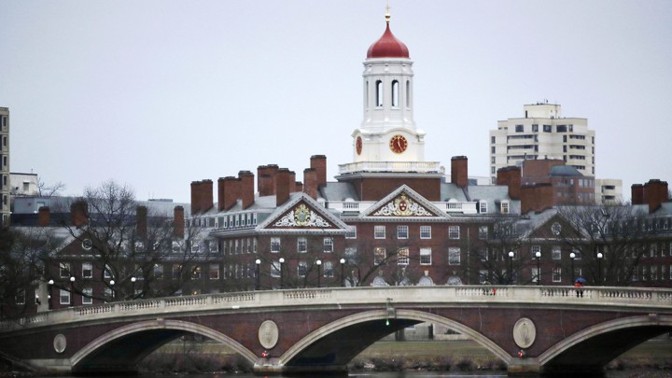
50 people were charged last week as part of an extensive scheme in which rich parents bought their kids’ way into elite schools. These students were accepted under fraudulent means, yet low-income students at selective colleges are the ones who receive daily reminders that they don’t belong, writes Clint Smith.
… three out of four colleges close their dining halls during spring break. Many low-income students cannot afford to leave campus, much less go on vacation for break, and as a result take extraordinary measures to make sure they have enough to eat. Some students ration their food, skipping meals to make a limited supply last the entire break. Some students go to food pantries, leaving the campus of a school that might have a billion-dollar endowment to stand in line for a can of beans.

(Edward Berthelot / Getty)
The fashion industry has so far kept plus-size women at arm’s length, but a new clothing line from the brand Anthropologie could change that.
Consumer choices aren’t the be-all and end-all of social change, but how people dress has a meaningful impact on their life in a way that’s often dismissed along with the fashion industry’s frivolity. At its best, fashion is fun. It’s a way to give visual form to your identity and tell people a little about yourself. But fashion, at its corporate core, is also about the maintenance of social hierarchies. The companies that dominate American malls and e-commerce help decide which bodies get to be perceived as professional or capable or sexy.
Every Monday, Lori Gottlieb answers questions from readers about their problems, big and small. This week, an anonymous reader writes in:
My best friend is currently in a romantic and sexual relationship with a 50-year-old professor at our university. I’m extremely worried, since I suspect the professor is emotionally manipulating her so he can sexually exploit her.
Over the summer, my friend starting working as a nanny for the professor and his wife. After three days on the job, he told her that he “fell in love with her at first sight” and suggested that she was his soulmate. Since this confession, they’ve been dating and having sex.
→ Read the rest, and Lori’s response. Have a question? Email Lori anytime at dear.therapist@theatlantic.com.
(Illustration: Araki Koman)
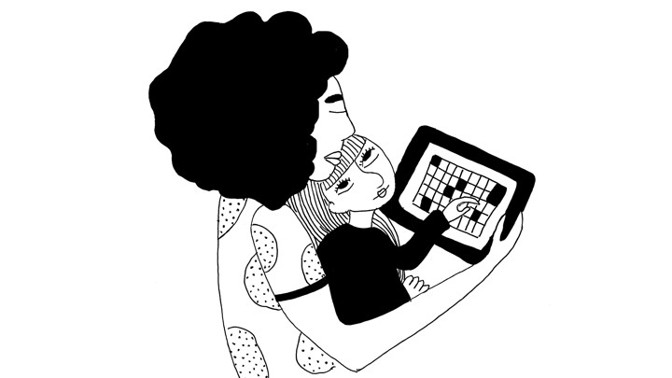
Have you tried your hand at our daily mini crossword (available on our website, here)? Monday is the perfect day to start—the puzzle gets bigger and more difficult throughout the week.
→ Challenge your friends, or try to beat your own solving time
Concerns, comments, questions, typos? Email newsletters editor Shan Wang at swang@theatlantic.com
Did you get this newsletter from a friend? Sign yourself up. We have other other free email newsletters on a variety of other topics, and at different frequencies. Find the full list here.
The profile emerging of Brenton Tarrant, the white supremacist killer, is disturbingly familiar. From the WaPo:
“He spent most of his time on computers, and learning the in and outs of computers, and playing games on computers,” she told 9News.
“I don’t think girlfriends were on the agenda — he said getting married was too hard.”
He played a lot of violent video games, and was a loner. And, the town where he spent his high school years is not a happy place for males like him. More:
Timothy McManus, 23, a religious teacher at South Grafton High School, said the town is struggling with high rates of teen suicide, prompting the government to open a mental health facility.
“The kids are struggling with a range of mental issues surrounding the family,” said McManus, who also works as a youth pastor at the Hub Baptist Church in Grafton.
“Then there is a lack of employment opportunities for those aged 18 to 25.”
I think the New Zealand killing is a much bigger deal than these things tend to be. I’ve heard some complaining among my political tribe that our media don’t notice when scores of Christians in Nigeria are murdered in one stroke by Muslim fanatics in Boko Haram. They’re correct to point out the disinterest — some of which may be politically motivated — but from the point of view of Western news audiences, what happened in NZ really is a more significant act — and it’s not because the lives of Muslim worshipers in New Zealand are worth more than the lives of Christians in Nigeria.
This requires unpacking. First, take a look at this thread:
I’ve been following responses to the #NZMosqueAttack, and it’s obvious the West’s system is cracking. Civil strife and social breakdown aren’t far off.
I’m confident we can course correct, but we are rapidly running out of time. /1
— Jeff Giesea (@jeffgiesea) March 16, 2019
https://platform.twitter.com/widgets.js
What scares me the most is the breakdown of civil discourse. We won’t be able to avoid civil strife if we can’t debate and discuss challenging topics openly. The left, by shutting down discourse through violence and deplatforming, is leading others toward violent extremism. /2
— Jeff Giesea (@jeffgiesea) March 16, 2019
https://platform.twitter.com/widgets.js
The impulse (seen here) to conflate legitimate concerns about mass immigration & multiculturalism with white nationalism, and conflate all nationalisms with “violent white supremacy,” will only make things worse. It plays into the shooter’s goals. /3 https://t.co/atKvpHmWzq
— Jeff Giesea (@jeffgiesea) March 16, 2019
https://platform.twitter.com/widgets.js
So, we must be careful not to overreact to the #NZMosqueShooting with mass censorship, deplatforming, gaslighting, and the like. There *are* legitimate issues & grievances to discuss, and there must be space to channel them through the democratic process. /4
— Jeff Giesea (@jeffgiesea) March 16, 2019
https://platform.twitter.com/widgets.js
Giesea then refers to this piece from two years ago, in the New Yorker, asking the question: Is America sliding towards civil war? The author interviewed Keith Mines, a national security expert who studies civil wars. Mines thinks that the US is likely to face a new civil war in the next ten to fifteen years. Excerpt:
Based on his experience in civil wars on three continents, Mines cited five conditions that support his prediction: entrenched national polarization, with no obvious meeting place for resolution; increasingly divisive press coverage and information flows; weakened institutions, notably Congress and the judiciary; a sellout or abandonment of responsibility by political leadership; and the legitimization of violence as the “in” way to either conduct discourse or solve disputes.
Entrenched national polarization, with no obvious meeting place for resolution? Check.
Weakened institutions, notably Congress and the judiciary? Check.
Sellout or abandonment of responsibility by political leadership? I’m not quite sure what data I could cite here to support this claim, but ask yourself: does our current political leadership seem responsible to you? On either side? And, do you think that the American people have created the conditions in which responsible political leaders would arise? I don’t. I mean, I am very happy to blame the political class, because I think they are actually blameworthy. But I don’t want to give a pass to the rest of us. We can’t even agree today on what a “responsible” political leadership would look like.
Increasingly divisive press coverage and information flows? Absolutely — and this is something I want to talk about with regard to the NZ killing.
Yesterday a reader of this blog got in touch to say that he was recently tutoring a college student, and heard the undergraduate make a strange remark about a particular historical event. The claim was demonstrably, unambiguously false, but the kid thought it was the gospel truth. It was an alt-right claim. My source, the tutor, asked the kid where he heard such a thing; the kid said he got it from YouTube, where he gets all his news and information about the world.
“This is how so many of the college students today are,” said my source, who works with them on a major US campus. “They learn about the outside world from YouTube and social media. They don’t even stop to think about whether or not it’s a credible source.”
My interlocutor got in touch with me because he said that 4chan and related sources are radicalizing some white males he sees on his campus, and it scares him. I am sure that antifa and its analogues on the social media left are doing the same thing on the other side. The key point here is that news and information has become radically decentralized, and authority has been all but destroyed. My source yesterday told me that the big question of my generation — are the media biased to the left or the right? — doesn’t exist for the young today.
This is not news, I know. We’ve been talking for years about the fragmentation of the media and the separation of people inside information silos. What I don’t believe that we’ve really confronted is what happens when we construct an information environment for ourselves that only allows the most radical information through the filter.
For example, I follow the trans-critical Twitter account 4th Wave Now, which was founded by a liberal mom who questioned transgender ideology when her teenage daughter claimed to be male (the daughter has now desisted, and identifies as a lesbian). Someone leaked to them screengrabs of a private Facebook group for parents of trans kids. Today, 4WN posted images showing how the administrators and others silence anyone who questions the ideological narrative. Check out this thread for more. The people on the forum self-censor for the sake of constructing a particular worldview, and treating those who don’t share it as mortal threats. Seriously, look:
3. Admin intervenes: “We’ve all been there” but remember — it’s suicide or transition. The not-so-implicit message is that even raising questions means the child “does not receive support at home,” with dire consequences. Misuse of the NCTE 2014 stat follows. pic.twitter.com/VXTHNZRQaF
— 4thWaveNow (@4th_WaveNow) March 18, 2019
https://platform.twitter.com/widgets.js
“Suicide or transition.” Now, consider that in the white supremacist online forums to which Tarrant subscribed, the narrative is either radical resistance or racial and civilizational suicide. What Tarrant and his ideological confreres are doing is “eliminating the grayzone.” Analyst Justin Lee explains what this means. Excerpt:
The influential editorial “The Extinction of the Grayzone,” published by the Islamic State’s online magazine Dabiq in 2015, lays out a strategy for radicalizing “moderate” Muslims living in the West. These moderates constitute the “grayzone” — Muslims who have neither fully apostatized and joined the “Crusaders,” nor joined the camp of the genuinely faithful (the Caliphate). The strategy is to turn up the heat on grayzone Muslims — through precipitating Islamophobia — so that they are forced either to abandon their faith entirely or to radicalize:
The Muslims in the West will quickly find themselves between one of two choices, they either apostatize and adopt the kufrī religion propagated by Bush, Obama, Blair, Cameron, Sarkozy, and Hollande in the name of Islam so as to live amongst the kuffār without hardship, or they perform hijrah to the Islamic State and thereby escape persecution from the crusader governments and citizens.
Scott Atran, director of research in anthropology at CNRS, raised the alarm on this strategy — and our failure to counter it — in a 2015 essay on the Islamic State’s revolutionary ambitions. “We might wish to celebrate diversity and tolerance in the grayzone,” he writes, “but the general trend in Europe and the majority of the U.S. political establishment and population is to collude in erasing it.” The Islamic State knew it could depend on European and American Islamophobia to swell its ranks.
The Christchurch shooter adopted the same strategy, swapping the Muslim Ummah for whites of European descent. With this act of terror, he aimed to put pressure on what might be called “whites of the grayzone.” He employs a lot of bog-standard conservative and declinist language in his manifesto, knowing that associating himself with these ideas will draw media ire for conservatives (whom he utterly despises). His goal is to inspire anti-white hatred, in the same way the Islamic State attempted to inspire Islamophobia. In both cases, it greases the rails of radicalization.
More, on Tarrant’s strategy, as articulated in his manifesto:
He’s counting on the left to blame conservatives and right-wing populists for his crimes. The idea is to precipitate — or, as he would phrase it, “accelerate” — a racial purification of the right by making every political battle a matter of race.
Read the whole thing. Lee says the only way to resist what Tarrant is trying to do is for the right to resist victimization narratives, and for the left to resist the temptation to turn every point of contention between left and right into a battle over white supremacy.
He’s right about that, but I am not optimistic that we can do it. Our national media follows more or less the same script every time there’s a mass terror attack: if radical Muslims carried it out, the media focus on how much innocent Muslims suffer from the acts of the radicals; now, when Muslims really are the victims of white supremacists, the narrative remains the same. Please understand: I do not say this in a gripey “whatabout” spirit! Justin Lee is correct to say that people on the right need to resist the urge to embrace victimization. The point I’m making is that the mainstream media coverage will serve Tarrant’s ultimate goal if journalists read and report on events according to the standard liberal narrative.
(That’s the mainstream media — the ones who both express and shape the worldview of the establishment’s leaders. I think we can safely say that the forces of radicalization on both the left and the right will massively intensify on social media.)
As I wrote over the weekend in the post titled “Radicalization & Degeneration,” what massively complicates our response to this is that there is some truth in Tarrant’s cultural diagnosis (just as there was, and is, some truth in the Islamist ideologue Sayyid Qutb’s diagnosis, and the Unabomber’s). We would be extremely foolish to dismiss these violent radicals as senseless. Western culture really is in a condition of decline and possible fall, and fighting white nationalism cannot possibly require being in denial about that — not if it’s actually going to work.
Look, I know well the tendency we all have to want to refuse to give these blood-soaked monsters any legitimacy; that comes from a good place inside us. But it is dangerous, because it blinds us to the appeal these radicals have to others who are living in conditions that the rest of us can’t recognize, or don’t understand.
Tarrant is a young man who is friendless, womanless, aimless, rootless, hopeless, and jobless. He comes from a town where there is little to no economic future. On the Internet, he found a pseudo-community that gave him a sense of meaning and purpose, and vindicated his feelings of victimization. As I’ve mentioned here recently, in reading lately about the Sovietization of Eastern Europe after 1945, I learned that the rootlessness and hopelessness of masses of people displaced by the Great Depression and war made quite a few willing to accept communist totalitarianism as a way forward. It gave them a sense of brotherhood, of dignity, and of purpose. Sure it was a lie, a monstrous lie (as they all discovered eventually), but it gave these nowhere men and women a reason to live and die. That’s incredibly powerful.
I don’t see how we stop the current process. The Internet empowers men like Tarrant — and societal trends are creating more of them. Here’s Geoff Dench writing in Quillette:
On virtually every indicator that anyone might want to consider, men in Britain and various other Western states seem to be performing very badly at the moment, both for themselves and for the communities in which they live. Not that this is particularly unusual. Throughout history, men have been inclined towards being social outsiders. Their usefulness to communities varies much more than women’s, and depends greatly on the way in which social institutions define and reward their roles. Whereas most cultures seem to recognize this, in the West we have increasingly pretended that it is not the case.
And we are now paying for our mistake.
Many people are asking themselves whether some of the radical social experiments attempted in recent generations are viable in the long term, or should now be ditched. It is not too late to face up to the problem. But we have such an accumulation of policy errors to deal with that we require a thorough re-orientation of public discourse before we can expect any specific measures to have much positive effect. The sort of shift we need encompasses some key elements of the sexual division of labor, grounded in stronger marriage institutions, and linked with a conceptual unscrambling of men’s roles, both private and public.
It’s worth pointing out that China and India are going to have a hell of a mess on their hands given that for political and cultural reasons, they have sex-selected societies in which the male-female ratio is hugely imbalanced. This story about the pain and loneliness of men in China and India who will never marry or know female companionship will bring tears to your eyes — and, if you have any common sense, it will scare you, because all those men are vulnerable to a charismatic leader who will acknowledge their suffering and channel it into something violent and destructive. I’m serious; read it, because there’s something very, very powerful here. Excerpt:
Suresh Kumar once dreamed of getting married, with a procession through the lanes of Bass, a bride adorned in gold and the kind of ceremony that was once a near-universal rite of passage for Indian men. But after one potential engagement fell apart, no other suitable brides could be found. He even went back to earn his high-school degree in hopes of being a more attractive suitor.
Still no one. Now Kumar is in his mid-30s, long past what is considered marriageable age in India, and is beginning to face a hard truth: that a wife and a family won’t happen for him.
“People say, ‘You don’t have a wife and children at home to care for; why are you working so hard?” Kumar says. “I laugh on the outside but the pain that I have in my heart only I know.”
The men themselves are isolated, left out of major family decisions and subject to ridicule, with little in the way of support or mental health services. Worse, in the traditional culture of villages, those who miss out on marriage have no hope of female companionship; dating or having a girlfriend is out of the question.
One recent evening, a family threw a rooftop party to celebrate the birth of a boy. Parties to welcome girl babies are still so rare they are covered by the local newspaper. Before the guests arrived, Kumar huddled in a stairwell nearby, sweating over a cast-iron pot, cracking jokes with friends as he fried sweet pancakes for the guests. He likes to cook, he says, but the role occasionally unbalances him.
During a harvest festival last year, his mother was delayed in another town. So Kumar was left to prepare the pancakes on his own. As he flipped the cakes in the bubbling oil, he grew teary-eyed, thinking of how there was no wife and kids to eat the treats he was making.
With a wife, he says, “there would be somebody to make tea for me, to tell me when to take a bath. We don’t have much value as unmarried men in this society. Everybody thinks, ‘What problem does this man have? What is lacking in his family? What is lacking in him?’”
Sooner or later, someone is going to come along to answer that question in a way that turns that pain outward, and focuses it on some scapegoat. That’s what Brenton Tarrant did. That’s what Antifa does. That’s what ISIS does. And so on.
That bring us to Keith Mines’s fifth condition for civil war: the legitimization of violence as the “in” way to either conduct discourse or solve disputes.
Clausewitz famously said that “War is the continuation of politics by other means.” When normal politics breaks down, we should not be surprised when violence erupts. Earlier this year, riding in a Dublin taxi, I listened to the driver, a middle-aged man, talk about how glad we was that Ireland was done with the Church, but how he also despises the ruling class of all parties. He said they are only in it for themselves, and to protect their own privileges. The cost of living is going up and up, he said, and the elites have locked people like him and his children out. If the Yellow Vests movement comes to Ireland, he said, he will probably take to the streets with them.
Ireland is a democracy. Why would a man like that conclude that normal politics don’t work for people like him? Whether or not the man is making an accurate judgment about political prospects in Ireland, this is what he believes is the truth, and he is angry about it — so angry that he would likely take to the streets to demonstrate if the right leaders came along. What’s interesting to me is that this man has no faith at all in Irish democracy’s leaders.
What happens when people come to believe at best that they have no stake in a political order, and at worst that the people administering that political order consider people like them to be enemies to be crushed? This is something that we are not allowing ourselves to see. If you read Tarrant’s manifesto — which you can find online; I’m not going to link it here — you see that he doesn’t just despise the left, but also conservatives, as well as business leaders who, in his view, profit from immigration “”Kill your local anti-white CEO,” he advises). He is truly diabolical, even calling for the murder of non-white children. It’s easy to regard Tarrant as one of life’s great losers, a fool who got lost in an online pseudo-reality in which he is a great warrior participating in a life-or-death civilizational struggle, instead of what he really is: a friendless weirdo who couldn’t find a girlfriend.
But 50 people are dead in Christchurch because this weirdo acted out his role-playing fantasy with live ammunition — and broadcast it to angry dispossessed white males around the world whose only connection is through the Internet.
As we know from Tarrant’s manifesto, he is hoping to provoke a strong backlash from the left, especially in the US, around gun violence. He is an accelerationist, meaning he wants to heighten the tensions in liberal democracies, and bring about actual fighting. His hope is that the left will push too far. Along those lines, and about violence, take a look at this Atlantic essay from the April issues, posted online a few days ago, by David Frum, titled, “If Liberals Won’t Enforce Borders, Fascists Will.”
Demagogues don’t rise by talking about irrelevant issues. Demagogues rise by talking about issues that matter to people, and that more conventional leaders appear unwilling or unable to address: unemployment in the 1930s, crime in the 1960s, mass immigration now. Voters get to decide what the country’s problems are. Political elites have to devise solutions to those problems. If difficult issues go unaddressed by responsible leaders, they will be exploited by irresponsible ones.
Notice this paragraph; remember that this was written before the Christchurch attacks:
When natives have lots of children of their own, immigrants look like reinforcements. When natives have few children, immigrants look like replacements. No wonder that, according to a 2016 survey conducted by the Public Religion Research Institute and The Atlantic, nearly half of white working-class Americans agree with this statement: “Things have changed so much that I often feel like a stranger in my own country.”
Tarrant titled his manifesto: THE GREAT REPLACEMENT.
One more Frum quote:
With immigration pressures bound to increase, it becomes more imperative than ever to restore the high value of national citizenship, not to denigrate or disparage others but because for many of your fellow citizens—perhaps less affluent, educated, and successful than you—the claim “I am a U.S. citizen” is the only claim they have to any resources or protection. Without immigration restrictions, there are no national borders. Without national borders, there are no nation-states. Without nation-states, there are no electorates. Without electorates, there is no democracy. If liberals insist that only fascists will enforce borders, then voters will hire fascists to do the job liberals refuse to do.
Yes, borders are arbitrary. And, yes, more people are arguing that we should care as much about people in faraway lands as we do about our fellow Americans. But the practical effect of making this argument is to enable the powerful to care as little for their fellow Americans as they do for people in faraway lands.
One big takeaway from the Frum essay — something I took away from it, not necessarily something Frum endorses — is that we are living in a time of massive global disruption, resulting in an unprecedented move of peoples; this is affecting us in the US, as it is most people, but our elites — especially liberals — don’t recognize or don’t care about how it’s affecting the native-born.
Right now, a lot of the poor and working class — especially whites — have turned their despair onto themselves, via drug and alcohol abuse, and suicide. What if they turned that outward? What if their children were to become radicalized online? How would we stop it? Would they not be correct to judge that the US elites consider them to be expendables and deplorables? Understand me: there is never justification for killing innocent people of any race or religion. My point is that social trends, in particular some embraced and advocated by liberal elites, are further fragmenting and alienating people — and technology is creating the conditions for some of these rootless men to nurture their own sense of alienation and grievance, and to turn that into violent acts.
I’ll leave you with this last thing. Here’s news from Arlington, Virginia, today:
In Arlington County, Virginia, not even kindergarteners are exempt from pro-transgender messaging. So reports The Washington Post, which, earlier this month, featured an article about Ashlawn Elementary School, which honored National “Read Across America Day” by hosting a transgender spokesperson for the Human Rights Campaign (HRC). The spokesperson read a story about a transgender child for a room full of kindergarten children.
Prominent media outlets claimed parents were notified beforehand and allowed opt their children out of the event. But those outlets got the story wrong. The letter, written solely in English despite the school’s sizable non-English-fluent population, nowhere mentions “opting out.”
This keeps happening. Public schools are indoctrinating kids into gender ideology. A friend e-mailed from the Pacific Northwest to say:
Yesterday in church a woman told us how concerned she is for her two granddaughters because of the gender indoctrination they receive in their school. While driving them to a party, one girl asked her, “How many humans will be there?” Later the other girl said, “Look what that human is wearing.” Quite unconsciously now they do not use “boy” or “girl.”
The girls are 3 and 4 years old. This is coming from their pre-school teacher!
These gender ideology activists and their institutional allies are destroying public schooling, but that’s not a new thing. What we have to worry about is when they try to destroy homeschooling and private schooling that does not endorse their view — and believe me, that is coming down the line, within the next couple of decades.
You want to foment violence? Tell people that they have to subject their children to this stuff, and have no choice. Start taking children away from their families so the state can jack them full of sex-change hormones. Note well that the mainstream media will only report from a position of affirming this extreme biological radicalism, and framing those who oppose it, or even question it, as bigots who are threatening the lives of children. As Jeff Giesea said in one of the Twitter posts with which I started this long comment:
There *are* legitimate issues & grievances to discuss, and there must be space to channel them through the democratic process.
Messing with people’s children and cutting them out of the democratic process is a sure way to create radicals. Allowing mass numbers of people from other countries to immigrate into one’s country while more and more people born here come to believe the people running the country would like to see them crushed and eliminated is a sure way to create radicals. Building a society that systematically or accidentally marginalizes and humiliates males — especially males of a particular race, by design — is a sure way to create radicals.
Here are relevant passages from a Carlo Lancellotti essay on Augusto Del Noce:
Rejection of transcendence has the effect that all human realities (the state, sexuality, work, the family) lose their symbolic or ideal significance and become “dumb,” completely devoid of any finality beyond the satisfaction of the immediate material or psychological needs that can be studied scientifically. It is in this sense that scientism, according to Del Noce, is the philosophical premise of the sexual revolution. At the same time, political struggles take an absolute value, replacing religion as the focus of social concern and the source of people’s identity and meaning.
The flip side of the politicization of reason is the absolutization of politics, which to Del Noce is another definition of totalitarianism. Every aspect of reality is interpreted in terms of a political narrative, which becomes the interpretative key for all aspects of social life: law, education, medicine, the family. Society at all levels splits along political lines because “culture is entirely subordinate to politics” and “the idea of politics is subsumed within the idea of war.” The older totalitarian movements had no desire to find a political accommodation between social classes or races: one side must eliminate the other. Likewise, no compromise is possible with “repression” and “bigotry.” They must be simply fought and, ultimately, eliminated.
Now, to quote the Constitutional Peasant (but not with comic irony), now you see the violence inherent in the system. More Lancellotti:
Reading Del Noce today it is hard to escape the impression that the philosophical premises of today’s situation were firmly in place by the early sixties, and that at a fundamental level not much has happened since, except for a slow process of decomposition, as befalls an organism that is no longer living. A society that consistently embraces scientism and instrumentalism must literally stop thinking in the properly philosophical sense, and become incapable of generating new ideals and new forms of life. It can only live by slowly consuming the “reserves of meaning” it received from the past, until they run out and its contradictions explode.
It’s the exploding of these contradictions that we may be seeing now — most of all the idea that you can have a stable society of radical individualists unbound to the past, the future, or anything outside of themselves. In the case of very online white supremacists, as in the case of the legion of teenagers documenting their gender dysphoria in evangelizing YouTube clips, we are watching the disintegration of the human personality reified and transmitted like a virus via electronic vectors into the hands of countless individuals who have been prepared for it through socialization via online discourse. The medium is the message, and the message is: you and your online friends are the only reality there is.
More Lancellotti:
At the time, Del Noce’s remarks about the totalitarian aspects of modern Western society did not receive much attention. Today, he is remembered as a distinguished historian of ideas—especially of Italian political thought in the twentieth century, of Gramsci and Gentile—but his views about the contemporary world are often considered excessive, or even reactionary. After all, the totalitarian ideologies of the twentieth century seem firmly confined to the dustbin of history. We do not live in fear of being arrested by the secret police and sent to a concentration camp. How can anybody seriously think that we live in a totalitarian situation?
Del Noce would reply that these objections are reasonable but superficial, because what really defines totalitarianism is, once again, the subordination of both ethics and culture to politics. Coercion by force is not necessarily the best method to that effect. A better way is to remove the “equipment” that makes it possible to transcend politics: philosophical reason, nonutilitarian liberal education, national tradition, the family as a vehicle of ideal values. What is true is that the new totalitarianism is very different from older forms because it is a totalitarianism of disintegration, even before being a totalitarianism of domination. It dominates by disintegrating. Del Noce describes it also as “negative millennialism” because it radically rejects the past but cannot propose new values. Ironically, it is extremely “conservative” in the narrow sense of protecting the economic and political status quo, while it slowly dissolves its host society into what Del Noce calls a “non-society,” because no shared ideals bind together its members.
In such a situation, resistance is in constant danger of becoming a sequence of reactive responses to every new turn in the process of decomposition. Del Noce considers it a mistake to think that the Western “crisis” can be overcome by purely political means, especially because totalitarian cultures prevent real debate precisely by politicizing everything. The technological society does it by framing every discussion in terms of the opposition of “progressive” and “conservative.”
Read the whole thing. Del Noce is onto something massively important throughout these passages. Keep his final line above in mind as you watch, read, and listen to the debate play out over how to react to the New Zealand attacks. The media’s reflexive framing it as a matter of “progressive” and “conservative” responses conceal more radical questions at stake. Brenton Tarrant is a devil from the pit of hell, but the terrible truth is that he sees some fault lines of conflict within our civilization more clearly than many of us middle class normies do. Outsiders of all kinds often do.
A cartel gunman entered a Tijuana hospital early Sunday morning and opened fire on a patient being treated for woundsRead More
The convicted terrorist leader of the Cartel Del Noreste (CDN) faction of Los Zetas was singled out by authorities asRead More
Pentagon Wants to Test SPACE-BASED WEAPON… (Third column, 8th story, link) Advertise here
DIET COKE raises heart disease, cancer risk… (Third column, 9th story, link) Advertise here
AGADEZ, Niger — In four years, Europe has cut down its illegal migration flow by almost 90 percent from its peak in 2015, and it has countries like Niger to thank for the dramatic drop.
For years, migrants from West African countries used Niger as a crossing ground on their way to Libya and then onto Europe. But in 2016, under mounting pressure from the EU, Niger began criminalizing immigration and patrolling the deserts for illegal crossings.
“The road is practically closed because of the police,” John Okoroafor, who traveled from Nigeria only to end up imprisoned in Agadez, told VICE News. “They are not taking anything for granted.”
For the EU, this arrangement has led to a dramatic decrease in refugees and migrants on their doorstep. For Niger, it’s meant a1 billion euro aid and defense package. But the success comes at a heavy cost: Niger’s jail cells are now packed with migrants and refugees. And the increasingly harsh policy has given birth to a new underworld of illegal activity that EU politicians warn could be creating even bigger problems for the region.
“It has gone underground,” Malin Björk, a member of the European Parliament from Sweden, told VICE News of Niger’s migration economy. “We have seen a larger and more organized network so that more organized crime is taking over. And that certainly can’t be seen as a security progress in any way.”
Niger says drug smuggling, for example, has soared over the last two years. In the country’s capital Niamey, officials showed Vice News a basement packed to the brim with illegal drugs they’d confiscated recently. They also warned that weapons trafficking is on the rise as a result of the new immigration policies.
VICE News travelled to Niger to speak to both authorities and smugglers about the EU’s evolving immigration policy and the new trafficking businesses it’s spawned.
This segment originally aired March 6, 2019, on VICE News Tonight on HBO.
Shame pervades the work of the French writer Édouard Louis. The scenes of aggression in his first two novels, The End of Eddy and History of Violence, are invariably fueled by shame’s corrosive spread. Standing in a crowded middle school hallway, a bullied gay student yells “Shut the fuck up faggot” at another boy; amid the ensuing laughter, he realizes that he has managed, momentarily, to “transfer” his shame to him. Elsewhere, the son of a Kabyle immigrant, mortified by his own desires, perpetrates an act of astounding cruelty. In these books, shame is never communicated but inflicted, imbibed, submerged, and then revealed, often in the most visceral and excruciating ways, despite itself. Even when escape into another life, another self, at last seems possible, there is a sense that this escape, too, will be contaminated—less a break with the past than a variation on it.
When Louis remarked, in a recent conversation with the novelist Abdellah Taïa, “Shame is the feeling that forges my life as a writer,” he could have meant this literally. Like him, the young narrator of his intensely autobiographical debut, The End of Eddy, is born Eddy Bellegueule. His father gave him that first name because it sounded tough, like a character from an American TV show. But the name soon becomes a burden, an unattainable aspiration. In Hallencourt, the poverty-stricken village in northern France where the novel is set, a father “reinforced his masculine identity through his sons, to whom he was duty-bound to transmit his own virility.” For generations, a local brass works factory had provided Hallencourt with jobs and a modicum of stability; by the time the book begins, in the early 2000s, many of the jobs are gone, destitution is widespread, and a ferocious, rigidly enforced cult of masculinity governs social and domestic life. As a child with effeminate mannerisms and an attraction to other boys, Eddy is doomed to suffer in such a world. He experiences, with his siblings, not only the myriad indignities of being poor—the rotted teeth, the clandestine visits to a local food bank—but he also bears the stigma of being a “fairy,” a “cocksucker,” and (the epithet that his parents preferred, because it was “the one best for conveying disgust”) a “pussy.” Eventually, after strenuous efforts to conform, he flees the village for high school in a nearby city. His departure is portrayed not as a triumph—the precocious kid finally freed from his stifling upbringing—but as a failure to become the person he so desperately tried to be. Just before the book’s publication in 2014, Louis legally took his new name.
In a book crowded with tormentors, it’s the casual brutality of Jacky, the boy’s father, that leaves the strongest impression. Eddy describes his father’s words, his relentless bullying and public ridicule, as “razor blades that would cut me for hours, for days, when I heard them, words I picked up and repeated to myself.” Jacky mostly resists the urge, during his drunken rages, to subject his son to physical abuse (“I won’t ever punch my wife or my kids,” he says. “I might fuck up all the walls of the house, but I won’t do what my dickhead of a father did and mess with the faces of my family”). But there are exceptions. One pummeling occurs after he learns, from Eddy’s mother, that his ten-year-old son has been drawn into sexual relations with a group of neighborhood boys, including a male cousin. “He walked up to me slowly,” Louis writes, “then came the blow, a powerful slap across my face, with his other hand gripping my T-shirt so hard that it ripped, another slap, a third, and then another and another.” So oppressive is his father’s presence that when other characters explode in fury, or indulge their racism or homophobia, they read as proxies for the elder Bellegueule.
Louis completed The End of Eddy at 20, while a student at the École Normale Supérieure, by which point the book’s objective had expanded beyond that of the typical bildungsroman. It was something else: an attempt to lay bare the patterns of exclusion and dispossession in French society that had deformed, degraded, and imprisoned his family and their milieu. What might, in other hands, have been presented as a merely personal or familial story thus became an inescapably political one—about how violence from above gets internalized and rerouted, usually in the direction of those with even less power. This attempt to confront France’s ruling class with the consequences of its neglect made the novel, soon translated into over 20 languages, an unlikely sensation; when it appeared in English in 2017, it attracted comparisons to Hillbilly Elegy, J.D. Vance’s memoir of growing up poor in Appalachia. Yet where Vance’s book espouses a self-congratulatory bootstraps ideology, Louis offers damning realism in the service of structural critique. He sees his community’s despair rooted not in a lack of pluck or individual responsibility but in “a whole set of logical mechanisms that were practically laid down in advance and nonnegotiable.”
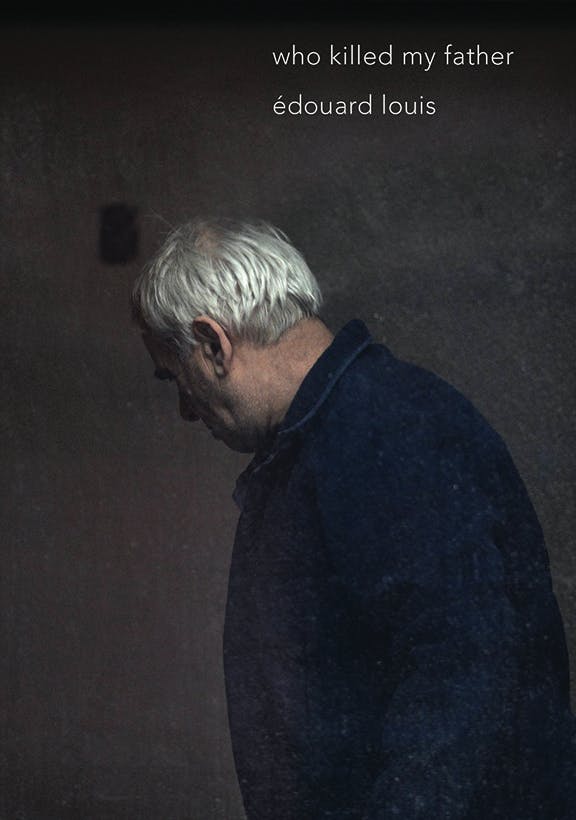
His new book, Who Killed My Father, makes the case more explicitly: France’s class system has long served to separate some groups, “whose lives are supported, nurtured, protected,” from others, who are at once discarded and humiliated. It’s a sentiment widely shared in France today, as a growing segment of the country refuses the abject status accorded them by a Paris-centric political and economic establishment. “We are an entire population, we are an entire people full of shame,” Louis has said. “We are a movement.” Now he wants to collect this shame and direct it at its proper targets: those responsible for decades of callous and crushing policy. Nothing will really change, his work insists, until we manage to shame the shameless.
After publishing two novels heavily based on his own life, it’s significant that Louis’s latest book appears under the banner of nonfiction. At first glance, coming in at just over a hundred pages, Who Killed My Father seems slighter, less momentous than his previous work—clearly a companion of sorts to The End of Eddy and History of Violence, but without the first novel’s wealth of ethnographic minutiae (Louis has spoken of his debt to the sociologist Pierre Bourdieu) or the latter’s formal inventiveness (whereby, for example, an account of Louis’s rape and near murder at the hands of a stranger is mostly narrated by his sister, whom Louis overhears talking to her husband in the next room).
It quickly becomes clear, however, that the new book has a force and immediacy all its own. Who Killed My Father tells the story—part lament, part searing polemic—of a tough guy reduced to something like a state of living death. “Last month I came to see you in the small northern town where you’ve been living,” Louis writes in the book’s opening pages, addressing his father directly. “At first when you opened the door, I didn’t recognize you.” Nor do we. Several years have passed since Eddy left home. His father’s body has been ravaged in the interim. When he was 35, a storage container fell on him in the factory, crushing his back and leaving him bedridden and jobless. Now, barely 50, he has trouble walking. He can no longer drive or drink or take a shower without help. He sleeps with a breathing machine to prevent his heart from stopping. His wife, Louis’s mother, has finally left him, ending their 25-year relationship. He has severe diabetes, cardiovascular disease, and a ventral hernia; his belly is distended to the point that his abdominal lining has ruptured. He has difficulty speaking. “You had to sit and catch your breath,” Louis writes. “You apologized. These apologies are a new thing with you.”
Given how forbiddingly large this man loomed over his childhood and adolescence, Louis knows little about him. As a young boy, Louis’s father and his siblings looked on, powerless to intervene, as their alcoholic father beat their mother; when he was five years old, the man left for work at the factory and never returned, leaving his family destitute, hungry—this is all we’re told of his earliest years. The book is composed of fragments, wandering snippets from memory, small details gleaned from Louis’s mother and grandmother; Louis lacks a fuller picture of his father’s life and doesn’t try to construct one. “I’ve only come to know you accidentally,” he writes. “Or through other people.” He gleans almost nothing from his father himself, and while Louis adopts an intimate tone with him, it’s more in the manner of a diary or monologue, not an actual conversation.
In his brief, elliptical preface to the book, Louis suggests that if he had written this story as a play, it would begin with a father and son standing a few feet apart in “a vast empty space”—an open field, say, or an abandoned factory. “The son is the only one to speak,” he writes.
He addresses his father, but his father doesn’t seem to hear, we don’t know why not. Although they stand close together, neither can reach the other. Sometimes they touch, they come into physical contact, but even in these moments they are apart.
Their estrangement has a salutary effect, creating the distance from which to reconsider the past. A kind of righteous anger gradually replaces judgment. Nowhere is this truer than in Louis’s discussion of his father’s choice to leave school at the age of 14. Initially, Louis explains that fateful decision as a result of “masculine pride”; there’s frustration that his father wanted to prove, above all other considerations, that he didn’t give a shit. “Constructing your masculinity meant depriving yourself of any other life, any other future, any other prospect that school might have opened up. Your manhood condemned you to poverty.”
And yet, only a couple of pages later, he relates an episode that subtly reverses this formulation. Louis is twelve, in grade school, and he has just learned for the first time about the Berlin Wall. He’s fascinated and disturbed. (“The fact that a major city, not so far away from us, could be divided in two, practically overnight, by a wall, came over me like a storm.”) Later, at home, he begs his father to tell him more: What was it like? Why exactly was it built? Could you ever see your loved ones if they lived on the other side? His father says nothing. “I started to see that my nagging was causing you pain,” Louis writes. “I used words you didn’t understand.” Still, he keeps pushing, and his father erupts.
But it wasn’t the way you usually lost your temper. It wasn’t normal, the way you snapped. You were ashamed because I was confronting you with a school culture that had excluded you, that had wanted you out. Where is history? The history they taught us at school was not your own. World history was what they taught us, and you were left out of the world.
Louis’s father, like his grandfather and great-grandfather, had been expelled from the realm of culture and education long before he chose to leave it behind. His masculine pride was not the cause but a by-product of this exclusion. It was poverty that condemned him to manhood.
As Louis revisits the story he’s been telling himself about his father, he starts to discover a new perspective on their relationship. “From my childhood I have no happy memories,” reads the first line of The End of Eddy. “Suffering is all-consuming: it somehow gets rid of anything that doesn’t fit into its system.” Now, with the benefit of time and space, and a different name, these memories seep back in; what Eddy couldn’t or wouldn’t see, Édouard finally can. Some are minor, nearly imperceptible: a quick smile in the rearview mirror, his father’s moist eyes while watching an opera telecast. A goofy face—“Look Papa, I’m an alien!”—that elicits laughter. Waking up, on his eighth birthday, to discover the Titanic video box set at the foot of his bed; his father had said no, that’s for girls, but surprised him at the last minute. And then, at ten years old, pictures in an old mildewed photo album of his father, from about a decade earlier, dressed as a woman, a cheerleader.
All my life I’d seen you sneer at any sign of femininity in a man…. I pored over those images all night long—your body, your body in a skirt, the wig on your head, the lipstick on your mouth, the fake breasts under your tee shirt. You must have stuffed cotton wadding in a bra. The most surprising thing to me was that you looked happy. You were smiling. I stole one of the photos and several times a week I would take it out of the drawer where I’d hidden it and try to decipher it. I never mentioned it to you.
Anguished at the sight of that body now wrecked and ruined, Louis identifies, in the book’s final section, the people and forces he believes precipitated this condition. There’s nothing natural, he contends, about a 50-year-old man unable to breathe or walk on his own. Abandoned by the state and useless to the market, his father belongs to a category of people whose suffering confirms, as the cultural historian Michael Denning has put it, that under contemporary capitalism “the only thing worse than being exploited is not being exploited.” They can be exposed to illness and premature death at no real cost to the prevailing order. “There are murderers,” Louis writes, “who are never named for their murders.” If the book’s title ever contained a question mark, it’s been removed. What remains is a statement, an accusation: They did this to him.
He lists a procession of culprits from across the political spectrum. Jacques Chirac, Xavier Bertrand, Nicolas Sarkozy, Martin Hirsch, François Hollande, Myriam El Khomri, Manuel Valls, Emmanuel Macron: Whether adding work requirements to state benefits—forcing his father, despite his back injury, to take a job as a street sweeper—or cutting coverage for essential medications, these are the politicians who destroyed his father’s intestines, mangled his spine, and asphyxiated him. Louis cites, as emblematic of these vindictive policies, President Macron’s decision in 2017 to reduce by five euros per month the housing subsidies for France’s poorest citizens; that same month, Macron’s government announced a tax break for the rich. “The ruling class,” Louis writes, “may complain about a left-wing government, they may complain about a right-wing government, but no government ever ruins their digestion, no government ever breaks their backs.” For his father and those like him, on the other hand, “politics was a question of life or death.”
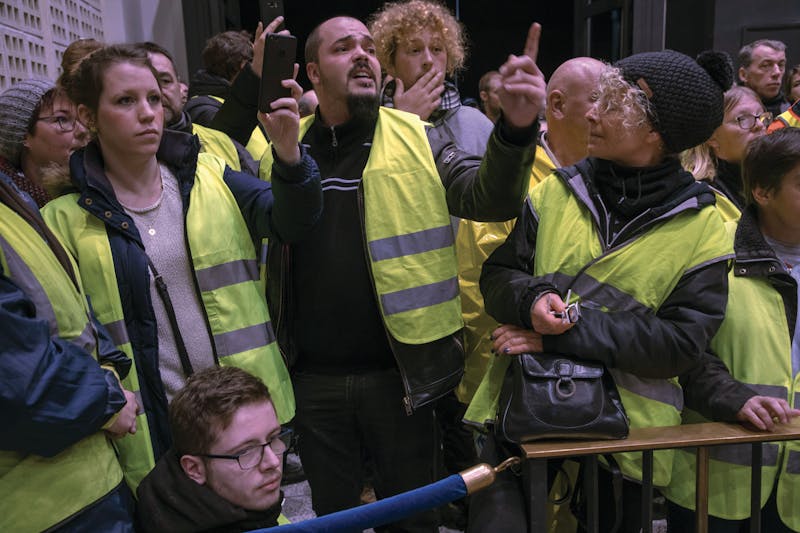
Louis’s indictment echoes what has become a battle cry among the French precariat. In November of last year, the gilets jaunes or Yellow Vests movement spontaneously erupted throughout the country, with hundreds of thousands of men and women, many of them hailing from the rural provinces, blocking the roads and roundabouts leading into nearly every town in France. The diffuse, leaderless uprising began in opposition to a planned fuel tax but soon turned into a denunciation of economic injustice more broadly. They saw Macron, who has a habit of speaking derisively of the working class (and pushing “reforms” that disproportionately hurt them), as merely the latest face of elite contempt for the poor. Louis, not surprisingly, has been a vocal supporter of the protests. If The End of Eddy gave the French literary public a window onto the social world of people they didn’t know existed (or whose existence they had gladly ignored), Who Killed My Father is a crucial text for a moment when those people are refusing to die quietly.
In a recent essay, “Can the Yellow Vests Speak?,” Louis described his shock at the first published images of the gilets jaunes .
I saw bodies who almost never appear in the public and media space—suffering bodies ravaged by work, by fatigue, by hunger, by the permanent humiliation of the dominated by the dominant, by social and geographical exclusion.… The bodies that I saw in the photos looked like my father’s, my brother’s, my aunts’. They looked like the bodies of my family, the inhabitants of the village where I lived as a child, of these people whose health is devastated by poverty and misery. Of those people who—rightly—constantly repeated, day after day throughout my childhood, “We count for nothing, no one talks about us.”
While acknowledging the far right’s presence in the protests (commentators immediately seized on reports of demonstrators chanting racist and xenophobic slogans), Louis, like many activists, insisted that the uprising was still taking shape and its political orientation was “not yet fixed in place.” Any social movement, he argued, presents an opportunity to subvert and destabilize language, so that old objects of scorn can be supplanted by more appropriate targets, producing unexpected alliances. Such had already happened with the gilets jaunes , as France’s white rural poor and largely nonwhite urban poor united in an attempt to unmask their country’s leaders—or to enact what Louis, in a 2015 manifesto co-written with Geoffroy de Lagasnerie, defiantly termed the “principle of the redistribution of shame.”
On the last page of the book, Louis’s father comes to embody this possibility. A fervent admirer of Marine Le Pen’s National Front, his father had long ago latched on to the only party, as he saw it, willing to diagnose the system under which he suffered. But his views have undergone a shift: “You used to say the problem with France was the foreigners and the homosexuals,” Louis writes, “and now you criticize French racism. You ask me to tell you about the man I love…. You changed from one day to the next.” Louis doesn’t really explain the transformation, and, as presented in the book, with its tone of profound alienation, this abrupt, somewhat shocking ending has the feeling of a dream, if not a miracle. But then the emergence of the gilets jaunes, too, has been called miraculous.
Last month, when I came to see you, you asked me before I left, Are you still involved in politics? … Yes , I told you, more and more involved . You let three or four seconds go by. Then you said, You’re right. You’re right—what we need is a revolution.
Perhaps the son, improbably, has been able to resuscitate his father.
Sunday on CNN’s “Reliable Sources,” former “CBS Evening News” anchor Dan Rather discussed President Donald Trump’s ability to use allRead More
National Border Patrol Council President Brandon Judd says border crossers and illegal aliens are “being dropped off” in the UnitedRead More
NBA legend Shaquille O’Neal has a new job. The broadcaster and former L.A. Laker is now an accredited auxiliary deputyRead More
World’s first remote brain surgery performed… (Third column, 6th story, link) Advertise here
NASA issues space herpes warning as virus reactivates in astronauts… (Third column, 7th story, link) Advertise here