BORDER BATTLE: 1 million illegals with final deportation orders — still remain in country…

BORDER BATTLE: 1 million illegals with final deportation orders — still remain in country… (First column, 5th story, link) RelatedRead More

Preempt Threats and Safeguard America's National Security with USIntelNews.com

 Hunting Russian Evil: How Oligarchs Evade Justice and Protect Their Fortunes
  Russia’s Dark Power Struggle: Putin’s Corrupt Empire Teeters on the Edge
  Bitcoin vs. Ethicoin: Uncovering Cryptocurrency’s Shadowy Side and Beacon of Integrity
  The Unconventional Diplomatic Dynamics Shaping Global Relations: Trump, Musk, and Covert Negotiations
BORDER BATTLE: 1 million illegals with final deportation orders — still remain in country… (First column, 5th story, link) RelatedRead More
THE CONWAY SHOW! (Third column, 1st story, link) Related stories:TRUMP OPENS FIRE ON GEORGE…KELLYANNE HUSBAND CLAPS BACK…‘HE’S GOING TO LOSERead More
Photograph Source NASA/Bill Anders
The US is formally committed to dominating the world by the year 2020. With President Trump’s new Space Directive-4, the production of laser-armed fighter jets as possible precursors to space weapons, and the possibility of nuclear warheads being put into orbit, the clock is ticking…
Back in 1997, the now-re-established US Space Command announced its commitment to “full spectrum dominance.” The Vision for 2020 explains that “full spectrum dominance” means military control over land, sea, air, and space (the so-called fourth dimension of warfare) “to protect US interests and investment.” “Protect” means guarantee operational freedom. “US interest and investment” means corporate profits.
The glossy brochure explains that, in the past, the Army evolved to protect US settlers who stole land from Native Americans in the genocidal birth of the nation. Like the Vision for 2020, a report by the National Defense University acknowledges that by the 19th century, the Navy had evolved to protect the US’s newly-formulated “grand strategy.” In addition to supposedly protecting citizens and the constitution, “The overriding principle was, and remains, the protection of American territory … and our economic well-being.” By the 20th century, the Air Force had been established, in the words of the Air Force Study Strategy Guide, to protect “vital interests,” including: “commerce; secure energy supplies; [and] freedom of action.” In the 21stcentury, these pillars of power are bolstered by the Cyber Command and the coming Space Force.
The use of the Army, Navy, and Air Force—the three dimensions of power—means that the US is already close to achieving “full spectrum dominance.” Brown University’s Cost of War project documents current US military involvement in 80 countries—or 40% of the world’s nations. This includes 65 so-called counterterrorism training operations and 40 military bases (though others think the number of bases is much higher). By this measure, “full spectrum dominance” is nearly half way complete. But the map leaves out US and NATO bases, training programs, and operations in Estonia, Latvia, Poland, and Ukraine.
As the US expands its space operations—the fourth dimension of warfare—the race towards “full spectrum dominance” quickens. Space has long been militarized in the sense that the US uses satellites to guide missiles and aircraft. But the new doctrine seeks to weaponize space by, for instance, blurring the boundaries between high-altitude military aircraft and space itself. Today’s space power will be harnessed by the US to ensure dominance over the satellite infrastructure that allows for the modern world of internet, e-commerce, GPS, telecommunications, surveillance, and war-fighting.
Since the 1950s, the United Nations has introduced various treaties to prohibit the militarization and weaponization of space—the most famous being the Outer Space Treaty (1967). These treaties aim to preserve space as a commons for all humanity. The creation of the US Space Force is a blatant violation of the spirit, if not the letter, of those treaties. In more recent decades, successive US governments have unilaterally rejected treaties to reinforce and expand the existing space-for-peace agreements. In 2002, the US withdrew from the Anti-Ballistic Missile Treaty (1972), allowing it to expand its long-range missile systems. In 2008, China and Russia submitted to the UN Conference on Disarmament the proposed Treaty on the Prevention of the Placement of Weapons in Outer Space, the Threat or Use of Force Against Outer Space Objects. This would have preserved the space-as-a-commons principle and answered US claims that “enemies” would use space as a battleground against US satellites.
But peace is not the goal. The goal is “full spectrum dominance,” so the US rejected the offer. China and Russia introduced the proposed the treaty again in 2014—and again the US rejected it. Earlier this year, the US withdrew from the Intermediate-Range Nuclear Forces (INF) treaty. Last month, President Trump sent an unclassified memo on the new Space Directive-4 to the Vice President, Joint Chiefs of Staff, NASA, and the Secretaries of Defense and State.
The document makes for chilling and vital reading. It recommends legislating for the training of US forces “to ensure unfettered access to, and freedom to operate in, space, and to provide vital capabilities to joint and coalition forces.” Crucially, this doctrine includes “peacetime and across the spectrum of conflict.” As well as integrating space forces with the intelligence community, the memo recommends establishing a Chief of Staff of the Space Force, who will to join the Joint Chiefs of Staff. The memo also says that US space operations will abide by “international law.” But given that the US has rejected anti-space weapons treaties, it is barely constrained by international law.
In late-2017, Space.com reported on a $26.3m Department of Defense contract with Lockheed Martin to build lasers for fighter jets under the Laser Advancements for Next-generation Compact Environments program. The report says that the lasers will be ready by 2021. The article links to Doug Graham, the Vice President of Missile Systems and Advanced Programs at Lockheed Martin Space Systems. In the original link Graham reveals that the Air Force laser “is an example of how Lockheed Martin is using a variety of innovative technologies to transform laser devices into integrated weapon systems.”
As if all this wasn’t bad enough, the British Ministry of Defence (MoD) states in a projection out to the year 2050: “Economies are becoming increasingly dependent upon space-based systems … By 2050, space-based weapon systems may also be deployed, which could include nuclear weapons.” But this is extremely reckless. Discussing technologies, including the artificial intelligence on which weapons systems are increasingly based, another MoD projection warns of “the potential for disastrous outcomes, planned and unplanned … Various doomsday scenarios arising in relation to these and other areas of development present the possibility of catastrophic impacts, ultimately including the end of the world, or at least of humanity.”
“Full spectrum dominance” is not only a danger to the world, it is a danger to US citizens who would also suffer the consequences, if and when something goes wrong with their leaders’ complicated space weapons.
A top German politician is calling for the expulsion of U.S. Ambassador Richard Grenell, who he says is acting like “a high commissioner of an occupying power.”
Grenell, a former Republican operative with a penchant for outrageous statements, has angered opposition lawmakers in Germany, who claim he is interfering in sovereign German matters.
Wolfgang Kubicki, the deputy chairman of the opposition Free Democrats (FDP), called on Germany’s foreign minister to “declare Richard Grenell persona non grata immediately.”
And he was not the only one criticizing the American ambassador.
“Grenell is a complete diplomatic failure. [He] damages trans-Atlantic relations with his repeated clumsy provocations,” Carsten Schneider, a lawmaker with the Social Democrats (SPD), told the German news agency DPA.
Grenell has done little to ingratiate himself to his host country since taking up the position in May 2018. Comments he made this week about Germany’s contributions to NATO led to Kubicki’s rebuke.
Donald Trump has clashed with Chancellor Angela Merkel repeatedly over Germany’s NATO spending, and it’s not the only cause of tension between the two leaders. Merkel has also been spearheading an unprecedented summit between EU leaders and Chinese President Xi Jinping — and on Tuesday she said Berlin would not be following Washington’s demands that Chinese telecoms giant Huawei be banned from helping to build its 5G infrastructure.
READ: Trump threatens Germany: We won’t share intel with you if you use Huawei
In his remarks, Grenell criticized the budget of Germany’s finance minister and said it was unacceptable that the country was once again going to miss its NATO defense spending target.
Grenell said Germany’s plan to lower military spending to 1.25 percent of its gross domestic product by 2023 was a “worrisome signal to Germany’s 28 NATO allies,” adding that it should stick to the 2 percent goal and “not run away.”
A member of Merkel’s conservative alliance urged Grenell to show some restraint, reminding him that Germany meets many of its NATO obligations.
“If one keeps an overall view, many comments made are more coherent than those of the American ambassador, if he thinks he has to comment on something every week,” Michael Grosse-Brömer said.
Grenell has talked several times recently about interfering in German affairs.
Over the weekend, in an interview with Breitbart, Grenell appeared to suggest he would work to topple Germany’s centrist government.
“I absolutely want to empower other conservatives throughout Europe, other leaders,” Grenell said. “I think there is a groundswell of conservative policies that are taking hold because of the failed policies of the left.”
In January, Grenell demanded Berlin stop development of Nord Stream 2, the gas pipeline being laid across the Baltic Sea to bring gas from Russia to Germany.
“We emphasize that companies involved in Russian energy exports are taking part in something that could prompt a significant risk of sanctions,” the ambassador wrote in a letter sent to the German newspaper Bild Am Sonntag.
Grenell’s appointment was strongly opposed by Democrats, who highlighted his previous undiplomatic outbursts. Within hours of being appointed German ambassador, those fears appeared well-placed, when Grenell tweeted what was seen as a threat to German businesses.
Cover Image: U.S. Ambassador Richard Grenell stands for the Diplomatic Corps at Bellevue Castle at the Federal President’s New Year’s Reception on 14 January 2019 in Berlin. (Photo by Bernd von Jutrczenka/picture-alliance/dpa/AP Images)
For a year, the University of Illinois at Chicago has downplayed its shortcomings in overseeing the work of a prominent child psychiatrist who violated research protocols and put vulnerable children with bipolar disorder at risk.
But documents newly obtained by ProPublica Illinois show that UIC acknowledged to federal officials that it had missed several warning signs that Dr. Mani Pavuluri’s clinical trial on lithium had gone off track, eventually requiring the university to pay an unprecedented $3.1 million penalty to the federal government.
UIC’s Institutional Review Board, the committee responsible for protecting research subjects, improperly fast-tracked approval of Pavuluri’s clinical trial, didn’t catch serious omissions from the consent forms parents had to sign and allowed children to enroll in the study even though they weren’t eligible, the documents show.
The IRB’s shortcomings violated federal regulations meant to protect human subjects, putting it in “serious non-compliance,” according to one of five letters from UIC officials to the federal government the university turned over to ProPublica Illinois after a nearly yearlong appeal for the documents under open records laws.
Still, UIC officials have continued to blame only Pavuluri. In written statements, the university told ProPublica Illinois last year — and again this week — that “internal safeguards did not fail” and that researchers are “responsible for the ethical and professional conduct” of their projects.
A ProPublica Illinois investigation published last year, “The $3 Million Research Breakdown,” revealed Pavuluri’s research misconduct and the university’s oversight failures. The stories revealed that, in a rare rebuke, the National Institute of Mental Health in November 2017 ordered UIC to repay millions in grant money it had received for one of Pavuluri’s lithium studies.
But information was limited — particularly relating to the university’s response to federal officials about its own role — because the University of Illinois system withheld or redacted some documents, citing federal and state privacy laws.
ProPublica Illinois had requested the records under the Freedom of Information Act in early 2018, and, after the university declined to turn them over, appealed to the Illinois attorney general’s public access counselor. The agency decided last month that the school had “improperly denied” ProPublica Illinois all or parts of five letters sent from UIC to officials at the National Institute of Mental Health and the U.S. Department of Health and Human Services’ Office for Human Research Protections. Other requested records remain under review by the public access counselor.
In one of those letters, dated March 22, 2013, James Fischer, then UIC’s director of the Office for the Protection of Research Subjects, told OHRP that an initial internal audit determined that the IRB shortcomings had “the potential to compromise the integrity of the human subjects protections program.”
Another letter Fischer sent OHRP in October 2015 explains why a university investigative panel concluded children likely were harmed by Pavuluri’s studies, despite her claim otherwise. The university has refused to release the panel’s report, but an executive summary — referenced in the October letter — found that children were harmed based on reports from parents and “a preponderance of evidence.”
“It is clear that it is not because of [Pavuluri’s] actions that harms may have been avoided,” the panel concluded, according to a quote from the report that Fischer included in his letter. “It is despite her actions that no subject came to worse harm.”
The study, “Affective Neuroscience of Pediatric Bipolar Disorder,” began in 2009 and aimed to use imaging to examine how the brains of adolescents with bipolar disorder functioned before and after taking lithium. The scans were compared with brain images of healthy, unmedicated children.
The study was almost complete, and the money spent, when it was shut down in 2013, when one of the young subjects became ill after she withdrew from other medication to begin receiving lithium for the study.
According to the protocol NIMH had approved, subjects should not have been able to participate if they had previously used psychotropic medication. The IRB did not approve medication withdrawal, records show.
The child’s hospitalization was reported to the IRB and then to federal officials, who requested more information. UIC conducted the initial audit and then an investigation, keeping federal officials informed of the findings over the next two years.
NIMH officials eventually determined both Pavuluri and the IRB had failed in numerous ways and demanded the $3.1 million be refunded. The study, NIMH officials concluded, had been compromised and the results had no scientific merit. The university had previously returned about $800,000 for two of Pavuluri’s other federally funded projects that also shut down prematurely when similar problems were discovered.
The newly obtained documents describe disorganization in Pavuluri’s work, with poor record keeping that included missing dates and identification numbers for the research subjects, among other problems. That made it difficult for UIC officials who later reviewed the research to understand who took part in the trial and the details of their participation.
Still, the records contain details that explain why 89 of the 103 children who participated should have been ineligible, including because they had histories of substance abuse, seizures or suicidal tendencies.
Although the federal grant limited the study to teenagers between 13 and 17, the IRB approved Pavuluri’s request to expand the age of participants to include 10- to 12-year-olds despite a specific prohibition by NIMH against doing this and a lack of proper documentation by Pavuluri about the reasons for the expansion.
Pavuluri went even further from the protocol and enrolled 8- and 9-year-olds, records show.
In another significant violation, the IRB approved the inclusion of research subjects as long as they hadn’t taken lithium, even though the NIMH grant originally prohibited the participation of anyone who had previously taken any psychotropic medication. Nearly 25 percent of the children enrolled in the study withdrew from or tapered other medication before participating, including the girl whose illness ultimately prompted the study’s shutdown.
NIMH has said it was not informed about the eligibility changes allowing younger participants and those with a history of taking other medications. It said “the changes were significant, because they increased risk to the study subjects.”
In written responses to recent questions from ProPublica Illinois, a UIC spokeswoman said no employees were disciplined for the IRB noncompliance and the university did not fail in its oversight role.
UIC officials have said they took appropriate steps once they realized problems with Pavuluri’s research, including reporting the concerns to the federal agencies, suspending her research and eventually ordering that she retract journal articles. They have said her case was an anomaly, that UIC “does not allow non-compliance,” and that research on human subjects “was performed upholding the highest standards in ethical and responsible research conduct.”
In its only universitywide communication to employees about Pavuluri’s research, sent last spring days after the initial ProPublica Illinois story about the problems, school officials discussed Pavuluri’s missteps but did not mention the IRB’s compliance failings. The letter noted that UIC “did not have any systemic issues of lax research oversight.”
Some “corrective actions” were taken, however, including changes to the IRB review process, records show. IRB panels were instructed to emphasize the research protocol as the preeminent document when reviewing researchers’ requests to make changes to ensure compliance with the approved criteria.
UIC also conducted an audit to determine if consent documents provided to research subjects in other studies followed the rules. A UIC spokeswoman declined to tell ProPublica Illinois the results of that audit, though a document indicates the audit found deficiencies in consent forms for 11 of the 28 protocols examined.
UIC provided hundreds of pages of documents in response to ProPublica Illinois records requests last year, but withheld or heavily redacted others. Last May, ProPublica Illinois asked the attorney general’s office, which is tasked with interpreting and enforcing the state Freedom of Information Act, to review whether the documents should be public, including the letters between UIC and federal officials.
Last month, the office of newly elected Attorney General Kwame Raoul issued an opinion on five of the letters, finding that all or parts of each were “not confidential” and should be public because they include the findings and corrective actions of the review process.
The university argued that the Illinois Medical Studies Act, which says medical-related peer reviews can be confidential, prohibited the documents’ disclosure. The public access counselor agreed that limited parts of the letters that described internal quality control could be withheld.
Raoul’s office has not yet ruled on ProPublica Illinois’ appeals for other Pavuluri research records the university has refused to provide, including research protocols, documents submitted to the IRB and records created as part of investigating and correcting issues related to Pavuluri’s work and university responses.
Pavuluri, who founded UIC’s Pediatric Mood Disorders Clinic when she joined the university in 2000, retired in June and has opened a private practice, the Brain and Wellness Institute, in Lincoln Park. In an interview with ProPublica Illinois last year, she called her mistakes oversights and said she made decisions in the best interests of her patients. She said she received minimal research guidance and training from the university, though she received $7.5 million in National Institutes of Health grants during her tenure at UIC.
Pavuluri has said she expanded the criteria for who could enroll in the study because it was difficult to find enough subjects within the narrow age range, and who were not already taking other medication.
But she said university officials placed too much blame on her instead of recognizing that those responsible for oversight also were responsible.
“It was in their interest to kind of maybe see this as one person’s mistake [rather] than the responsibility of the IRB as well,” Pavuluri said in an interview last year. She has declined to speak again with ProPublica Illinois and did not respond to a recent request for comment.
UIC officials have said that while there were problems with Pavuluri’s research, a review of her medical practice determined she provided “high quality patient care.”
But following ProPublica Illinois’ reporting, state regulators, who review complaints about Illinois doctors and decide if discipline is warranted, launched an investigation into Pavuluri. The state Department of Financial and Professional Regulation issued three subpoenas to UIC in August and September seeking records related to Pavuluri and her research.
State investigations of doctors are not made public unless the department imposes discipline.
Pavuluri’s research also has been under investigation by two divisions of the U.S. Department of Health and Human Services, according to subpoenas, emails and other documents: the inspector general’s office, which examines waste, fraud and abuse in government programs, and the Office of Research Integrity, which reviews claims of scientific misconduct.
CHRISTCHURCH, New Zealand — When the first gunshot punctured the peace of the mosque, Aymen Jaballah thought it was just some electrical mundanity — a blown light bulb, perhaps. Jaballah is Masjid Al Noor’s facilities manager, and he thought to himself, as he prayed, that this would just be another quick fix.
Then the second gunshot rang out, accompanied by shouts of “Allahu Akbar, la ilaha illa Allah ” — God is great, there is no God but Allah. Jaballah, his voice hoarse, said he later realized people were “basically saying, ‘I’m going to die.’”
He fled the mosque and flung himself over a wall into a neighboring suburban garden, where he and several others hid as a gunman massacred 42 members of his mosque before driving to a second mosque about 3 miles away, where he killed more.
Even as Friday’s attack unfolded, Jaballah, 25, said he couldn’t believe there was a gunman on the loose. This is New Zealand, after all; most years the country sees fewer than 10 people killed by guns. The carnage only registered when Jaballah used his scarf to dress a friend’s wound. When the police arrived, he walked out onto the street and saw the body of a woman on the ground under a blanket, and a man he knew carrying his dead 4-year-old son. The friend he had driven to the mosque with had also been killed.
“I thought, there’s no way. There’s no way in New Zealand he would get ahold of a gun and he would be killing people. That stuff happens in America — it doesn’t happen here,” the Yemen-born mechanical engineer said on Sunday, sitting on the grass near a crisis center set up at Hagley Community College.
“To have our two mosques go from mosques to morgues; the depth and intensity of the feeling that people are having is profound.”
Now, Jaballah is among the millions of New Zealanders reeling in the aftermath of the island nation’s deadliest terror attack, and questioning what this means for their country. New Zealand has long been seen as a progressive safe haven, but some Muslim leaders say the attack, allegedly carried about by an Australian, came amid increasing anti-Muslim sentiment. Masjid Al Noor itself was threatened by white supremacists in 2016.
The Muslim community of Canterbury, the province home to Christchurch, is tiny and close-knit. They number just 3,000, according to Toshi Hodliffe, of the Canterbury Muslim Community Trust, in a country of about 50,000 Muslims. When the gunman stormed Al Noor and the Linwood Islamic Centre, killing 50 people, he massacred about 1.7 percent of Canterbury’s Muslims.
“No one in the community is untouched by this,” said Hodliffe. “Not a single soul. I mean, to have our two mosques go from mosques to morgues; the depth and intensity of the feeling that people are having is profound.”
The first Muslims to settle in New Zealand were an Indian family that came to Christchurch in the 1850s. Masjid Al Noor opened its doors in 1985. Many waiting outside the crisis center for information on their slain family and friends described it as “the heart” of the city’s Islamic community.
“It’s where we take people, children when they are born, where we get married, where we have our funerals — it’s the center of our community. It’s sacred ground to us,” said Hodliffe. She described Christchurch’s community as “hyper-diverse.” According to the 2013 census, half of the New Zealand Muslim population was born in the country or elsewhere in the Pacific, while 27 percent were immigrants from Asia and 23 percent from the Middle East and Africa. Victims included New Zealanders, Pakistanis, Palestinians, Syrians, Indians, Fijians, Iraqis, and others.
“I have received racist comments. My mother who wears a headscarf has received racist comments.”
In the days since the shooting, many of New Zealand’s Muslim leaders have expressed anger. Anjum Rahman, in an article for Radio New Zealand, wrote that her organization, the Islamic Women’s Council of New Zealand, had in recent years repeatedly and fruitlessly lobbied the country’s intelligence services and government agencies to act on what she said is a rising tide of vitriol aimed at Muslims, both online and in person. Some government ministers have come under scrutiny for anti-immigrant messaging.
The alleged shooter, 28-year-old Brenton Tarrant, is from Australia. He wasn’t a Christchurch resident; Tarrant, who has been charged with murder, allegedly drove from more than 200 miles away to carry out the attacks. Hodliffe said that non-Muslim Christchurch residents have generally been “open-hearted and usually curious.” But she added that the city’s Muslims had experienced threats from white supremacists and neo-Nazis.
Read more: Decoding the racist memes the alleged New Zealand shooter used to communicate.
In 2016, a local white supremacist delivered pig heads to Masjid Al Noor, saying, “Bring on the cull.” Hodliffe said she has been the target of anti-Muslim taunts on the streets. “It’s one of those things that’s hard to talk about, and just becomes normalized, so people don’t talk about it any more,” she said. “But it is really weird and challenging for people to be told to go home to their own country, to not be included, to not feel part of the community.”
Green Party member of Parliament Golriz Gharhraman, who herself has been the target of racial abuse and death threats, told VICE News that quantifying this rise in hate speech was very difficult, given the vagueness of New Zealand’s legislation. “We don’t really have hate-speech laws. We don’t really have protections for most minorities, and even when we do, it’s a vague term, ‘racial disharmony’.”
On the ground in Christchurch, in these early days, there’s more shock that this could happen here than belief that the attack was the result of an increasingly dangerous environment for Muslims. “When you’re living in New Zealand,” Jaballah says, “you always feel safe. The flat I moved into, I had to install a deadbolt for them — they’d never locked their house for the past six years.”
Hassan Raslan, 30, said he and his family, who are Egyptian and immigrated to New Zealand 23 years ago, have also been the target of racist comments. Raslan, who is from Auckland, flew to Christchurch on Saturday to volunteer at the crisis center, transporting resources and people around the city.
“It really has shocked us a lot,” Raslan said, sitting on a park bench outside on the community college grounds. “But the surprise isn’t as much given that you could see this kind of racism or hate kind of brewing. You could see it all over the world.”
He loves New Zealand, but his personal experience with the country haven’t always been positive. “I have received racist comments. My mother, who wears a headscarf, has received racist comments. Anyone who has a sister who wears a headscarf would know that they experience this as well; it’s all part of living here.”
“The ‘where to now?’ — we’re not ready to think about it. You know, we’ve got 50 people to bury.”
And dread, he said, has now overtaken the local Muslim community. “There’s an increased fear for our sisters and for our mothers and everybody who is identifiable as a Muslim,” Raslan said. “There’s another fear that this has given a kind of license to the more undercover racists or extremists to do what they wanted to do. Unfortunately, this person’s views are shared by some other sick individuals.”
Read more: How social platforms failed to keep the shooter’s video from going viral.
For both Jaballah and Hodliffe, imagining how Christchurch’s Muslim community will heal is still impossible. Both are helping to lead the response, which has been especially painful because the scale of the tragedy is so large, and the community is so small.
“It’s so difficult, especially the people who have, like, nine friends of theirs wiped out. Just like that,” said Jaballah, snapping his fingers. “They can’t think straight.”
Hodliffe said that right now, community members are focused on getting through each day and supporting each other, with little thought to the future. That will come later.
“The ‘where to now?’ — we’re not ready to think about it. You know, we’ve got 50 people to bury.”
Cover: People pray next to flowers and tributes near Al Noor mosque on March 19, 2019 in Christchurch, New Zealand. (Photo by Carl Court/Getty Images)
The United Auto Workers (UAW) — which represents thousands of American workers at General Motors (GM) — is standing withRead More
Ron Klain, former chief of staff to Vice President Joe Biden and Al Gore, said on MSNBC Tuesday that PresidentRead More
Kristina Arriaga, president of the Oxford Society for Law and Religion, spoke this week about war’s devastating impacts on women.
BITCOIN IN DUMPS; GLOOM OVER CRYPTOS… (Second column, 17th story, link) Advertise here
Secretive ‘Triggerfish’ tracking deployed… (Third column, 9th story, link) Related stories:Records show FBI was probing Michael Cohen long before raid…PaidRead More
Runaway cow wreaks traffic havoc on NYC highway… (Third column, 5th story, link) Advertise here
People don’t become adults until 30s, say brain scientists… (Third column, 21st story, link) Advertise here
It’s no easy feat to be the most thin-skinned man in American politics these days, especially given that the country is run by a short-fingered vulgarian who compulsively tweets about every real and perceived slight against him. But Devin Nunes has done the impossible and surpassed even Donald Trump in hypersensitivity.
Nunes, a Republican representative from California, filed a $250 million lawsuit on Monday against Twitter and a handful of users who criticized him, accusing them of negligence and defamation. He even claims that the defendants are part of a grand conspiracy to cripple his political career. Who’s leading this dastardly plot? Nunes doesn’t quite say. Maybe it’s the Democratic Party, he suggests. Or unnamed liberal donors. Or even hostile foreign adversaries. Whoever these hostile actors are, they’re not only causing him grievous harm; they’re contributing to “the corruption of American democracy and society.”
What the lawsuit really demonstrates, though, is the stunning vindictiveness of a powerful elected official who would use the legal system to punish his critics. If the lawsuit was intended to vindicate Nunes and his reputation, it has achieved precisely the opposite.
Nunes rose to national fame over the last two years as the chair of the House Intelligence Committee, a perch he used to undermine the Russia investigation and defend Trump. In the complaint, he depicts himself as an honorable public servant who’s been wrongly maligned by his powerful opponents—only one of whom, longtime Republican political operative Liz Mair, is explicitly named. The others are unknown to him: the Twitter users responsible for anonymous parody accounts such as “Devin Nunes’ Mom,” “Devin Nunes’ Cow,” “Fire Devin Nunes,” and “Devin Nunes’ Grapes.”
Nunes obliquely implies that Mair is in cahoots with these accounts’ owners, but offers no proof to support the theory. Either way, like a high school teacher hit from behind with a spitball, he’s determined to find out who’s responsible. “The identity of those behind the Twitter accounts is a matter of great public concern,” Nunes told the court. “Whether the accounts are controlled by wealthy Democrats, the Democratic National Committee, an opposition research firm, such as Fusion GPS, the ‘Russians,’ the ‘Chinese,’ or some other foreign government or non-governmental organization, the corruption of American democracy and society by intentional falsehoods, fraud and defamation must stop.”
What horrible things did these accounts say about Nunes to warrant the judiciary’s intervention? The account named “Devin Nunes’ Mom” receives the most attention in the complaint. Its owner frequently posted caustic remarks about him and his actions toward the Russia investigation. One tweet said that Nunes was unfit to run the House Intelligence Committee, while another joked that he was “voted ‘Most Likely to Commit Treason’ in high school.” Some tweets are indistinguishable from legitimate political criticism. Others are more puerile, implying that Nunes wanted to commit sexual acts with Trump and other top Republicans.
“In her endless barrage of tweets, Devin Nunes’ Mom maliciously attacked every aspect of Nunes’ character, honesty, integrity, ethics and fitness to perform his duties as a United States Congressman,” Nunes wrote in the complaint. Twitter apparently suspended the account this month for impersonating a real person, but not before he “suffered substantial insult, humiliation, embarrassment, pain, mental suffering and damage to his reputation as a result of the unprecedented personal and professional attacks on his character.”
Why did these tweets wound Nunes so deeply? The accounts’ jibes resemble much of the political commentary on Twitter—including the president’s. Nunes’s real grievance appears to be with Twitter itself. “Twitter represents that it enforces its Terms and Rules equally and that it does not discriminate against conservatives who wish to use its ‘public square,’” he told the court. “This is not true. This is a lie. Twitter actively censors and shadow-bans conservatives, such as Plaintiff, thereby eliminating his voice while amplifying the voices of his Democratic detractors.”
Twitter has denied that it uses shadow banning—making a user’s posts visible to themselves but invisible to others—but that hasn’t stopped Republican lawmakers, including Trump, from making the claim as part of a broader narrative that Silicon Valley is censoring conservative voices.
Nunes’s claim for damages also doesn’t hold up. He says that Twitter bears legal responsibility for any defamatory posts made on its platform. In reality, Section 230 of the Communications Decency Act generally shields websites from civil liability related to third-party content on their platforms. Nunes himself should be pretty familiar with this: As Reason’s Elizabeth Nolan Brown pointed out, he and his colleagues have been working to change Section 230 for this exact reason.
Nunes adopts a patriotic mien when it comes to the broader free speech issues at stake. “Access to Twitter is essential for meaningful participation in modern-day American Democracy,” he told the court. “A candidate without Twitter is a losing candidate. The ability to use Twitter is a vital part of modern citizenship. A presence on Twitter is essential for an individual to run for office or engage in any level of political organizing in modern America. This is because Twitter is not merely a website: it is the modern town square.”
This paean to civic speech might be more convincing if Nunes didn’t ask the court to force Twitter to “reveal the names and contact information” behind four of the pseudonymous accounts. What’s more, he also wants the court to “permanently enjoin and order Twitter” to suspend Mair and the other accounts. Twitter is a vital part of modern American citizenship, Nunes says, and he wants the government to strip people of access to it for being mean to him.
But Americans have every right to mock and insult their elected officials. During the election of 1796, the first contested presidential race in the nation’s history, Alexander Hamilton wrote a pseudonymous pamphlet that accused Thomas Jefferson of having an affair with an enslaved woman he owned. (The allegation later turned out to be true.) Jefferson’s supporters jeered at John Adams as “His Rotundity” and called him a hermaphrodite, while Adams’s camp accused Jefferson of supporting prostitution and incest. Adams later arrested one of Jefferson’s pamphleteers during the election of 1800 and tried to prosecute him under the Alien and Sedition Acts. The American tradition of salacious and spurious political attacks is alive and well in the Trump era.
The New York Times Co. v. Sullivan, a Supreme Court case from 1964, set a formidable threshold for defamation claims by public figures like Nunes. The justices cited a “profound national commitment to the principle that debate on public issues should be uninhibited, robust, and wide-open,” even if it includes “vehement, caustic, and sometimes unpleasantly sharp attacks on government and public officials.” The tweets against Nunes appear to fall well within those bounds. But Nunes ignores that landmark ruling (perhaps because, like Justice Clarence Thomas, he would like to see Sullivan overturned). Instead, he cites a smattering of other cases to defend his “fundamental constitutional interest and entitlement to the uninterrupted enjoyment of his reputation.” One of his longest citations isn’t from law, but a passage from Shakespeare’s Othello in which Iago bemoans that “he that filches from me my good name Robs me of that which not enriches him, And makes me poor indeed.”
So why embark on what appears to be a doomed legal endeavor? Perhaps Nunes genuinely believes he’s the victim of a conspiracy theory by Democrats and America’s foreign adversaries. If there’s evidence to support this, Nunes doesn’t offer it. “The full scope of the conspiracy, including the names of all participants and the level of involvement of donors and members of the Democratic Party, is unknown at this time and will be the subject of discovery in this action,” he noted in the complaint. In other words, Nunes wants to go on a fishing expedition to satiate his political grievances, and he wants the courts to light the way.
Or maybe Nunes is trying to use the legal system to get revenge on his political opponents. Defending oneself against litigation is onerous even for those with the financial means to fight back. (Mair urged her Twitter followers on Monday night to donate to her legal defense fund.) The rich have always wielded the American legal system as a cudgel against critics, as Peter Thiel did in financing the Hulk Hogan lawsuit that ultimately killed Gawker. That a member of Congress would attempt to do so is deeply disturbing.
Nunes’s largely anonymous Twitter critics cast him as a shameless partisan hack—someone who abuses power and the legal process to injure his political opponents, who plays fast and loose with the truth to advance partisan goals, and who’s prone to conspiratorial thinking on the flimsiest of grounds. They say he lacks the temperament and honor to serve on the House Intelligence Committee and safeguard the nation’s secrets. His lawsuit only proves them right.
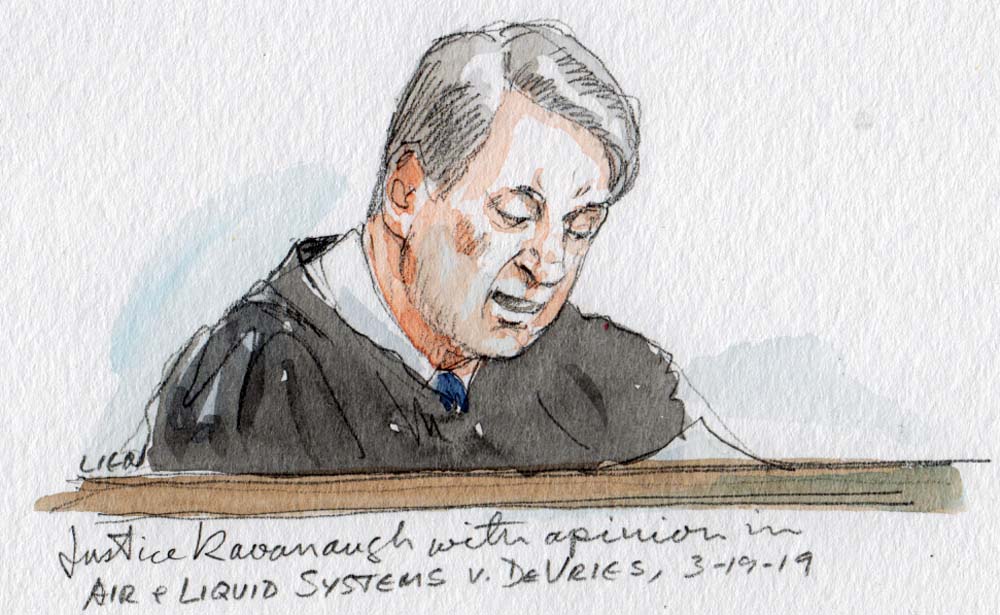
This morning’s 6-3 opinion in Air and Liquid Systems Corp. v. DeVries affirms the decision of the lower court holding that the manufacturers of asbestos-dependent equipment used on Navy ships can be held liable to sailors who became ill because of their contact with the asbestos.
Because the case involves liability for conduct at sea, the dispute arises under the “maritime law,” a type of federal common law for which the U.S. Supreme Court is the final authority. In the same way that the New York Court of Appeals is the final authority for the law of negligence in accidents that occur in New York, the U.S. Supreme Court sets the rules for tort liability when the injury occurs at sea.
In this case, the injuries arise from equipment that the defendants manufactured and sold to the Navy in a “bare-metal” state. The equipment would not function properly without the application of asbestos, but the manufacturers did not themselves apply the asbestos. Rather, the Navy or its agents did. The Navy appears to have sovereign immunity from this type of liability, and the asbestos manufacturers are all bankrupt. Thus, the only people from whom the sailors can hope to recover are the manufacturers of the equipment to which the Navy applied the asbestos.
The trial court adopted a “bare-metal” defense, under which manufacturers cannot be liable for injuries from equipment (the asbestos insulation) that they did not make, sell or distribute. The court of appeals, by contrast, held that the manufacturers were liable if the harms from application of the asbestos were foreseeable. The Supreme Court, in an opinion by Justice Brett Kavanaugh, adopts a middle standard, under which the manufactures are liable if the product required incorporation of a part (the asbestos) and the manufacturer had reason to know that the integrated product would be dangerous for its intended uses.
The opinion proceeds by explaining the flaws in the two alternate approaches that persuade the Supreme Court to adopt the “required-incorporation” standard. On the one hand, the opinion expresses “agree[ment] with the manufacturers that a rule of mere foreseeability would sweep too broadly.” Kavanaugh notes that products “can foreseeably be used in numerous ways with numerous other products and parts,” and suggests that “[r]equiring a product manufacturer to imagine and warn about all of those possible uses … would impose a difficult and costly burden on manufacturers.”
Conversely, Kavanaugh also rejects the proposed “bare-metal” defense. As he explains, few quarrel with the rule of the “Restatement of Torts” that a manufacturer has a duty to warn if it “‘knows or has reason to know’ that the product ‘is or is likely to be dangerous for the use for which it is supplied.’” For the majority, there is “no persuasive reason to distinguish” that situation from the situation at hand, “when the manufacturer’s product requires incorporation of a part that the manufacturer knows or has reason to know is likely to make the integrated product dangerous for its intended uses.”
Kavanaugh also rejects the manufacturers’ argument that warning by manufacturers will be counterproductive and impractical, first by referring to economic literature suggesting that “the product manufacturer will often be in a better position [to warn] than the parts manufacturer,” and second by scoffing at the suggestion that the warning requirement will “meaningfully add” to existing disclosure obligations. Finally, Kavanaugh notes the court’s longstanding “longstanding solicitude for sailors” and suggests that the maritime context – in which the plaintiffs are “families of veterans who served in the U.S. Navy” – makes liability “especially appropriate.”
The court divides sharply on the question, with Justice Neil Gorsuch (joined by Justices Clarence Thomas and Samuel Alito) dissenting. In general, the dissenters believe that the court’s “required-incorporation” standard is lacking in “meaningful roots in the common law” and also too vague for predictable application. For that group, the bare-metal defense adopted by the district court provides a better answer.
[Disclosure: Goldstein & Russell, P.C., whose attorneys contribute to this blog in various capacities, is among the counsel to the respondent in this case. The author of this post is not affiliated with the firm.]
The post Opinion analysis: Justices affirm maritime liability for manufacturers of asbestos-dependent equipment appeared first on SCOTUSblog.