Photograph Source Sgt. 1st Class Gordon Hyde – Public Domain
The Trump Administration says there is a crisis at the U.S. border with Mexico. The President is frustrated with the governments of Guatemala, Honduras, and El Salvador because they have not done enough to stop emigration from their countries, despite U.S. aid. The State Department announced that it will stop some U.S. aid to these countries. News reports indicate that the aid to be cut is economic and humanitarian, but that “security”aid (to police and military) will be maintained. In fact, just before the State Department announcement, the U.S. Homeland Security Secretary signed a joint agreement with the governments of Honduras, Guatemala, and El Salvador to increase cooperation and support around “security”issues. Many Republicans and Democrats in Congress and many private humanitarian and economic aid agencies argue that more aid, not less, is needed to improve conditions in these Central American countries.
Other Members of Congress see this whole issue somewhat differently. Some are sponsoring and supporting a bill (the Berta Cáceres Act) that would review and stop “security”aid to these countries because that aid goes to police and military that governments use to forcefully repress popular peaceful protest and for human rights violations. The Act was introduced in the last Congress, but it is being re-introduced now with a Democratic majority in the House. So is aid to Central America a solution to the crisis of migration from Central America? Confusing! Some realities to consider.
The number of people who arrived at the U.S. southern border during February 2019 numbered around 60,000, according to official estimates. The number for March alone is now reported to be over 100,000. Almost half of these people are fleeing Guatemala, most of the rest are Hondurans, with a smaller percentage of Salvadorans. And another “caravan”of migrants that is expected to number as many as 20,000, is already forming in Honduras and setting out for Mexico and the U.S.
These numbers are indeed overwhelming, and from the perspective of U.S. immigration officials, the asylum seekers themselves who are forced into dire conditions for weeks at the border, and the border communities that must accommodate such an influx of humans, this is indeed a “crisis.”But most of these migrants and asylum seekers are fleeing what is, from their perspective, a much greater crisis in their home countries—a combination of dire poverty, constant insecurity, and violence from gangs, drug trafficking, and government sponsored or condoned violence to repress dissent, on top of a rapidly deteriorating economy.
The old distinction between economic immigrants seeking jobs and opportunity and asylum seekers fleeing violence and threat does not apply so clearly for these Central Americans. In Honduras, the official poverty rate is expected to reach 70 percent this year, with “extreme poverty”(defined by international economic institutions) at over 45 percent. But in Honduras, conditions of poverty make people also much more vulnerable to violent abuse from anyone more powerful or wealthy—gangs, drug lords, police, military, large landowners. A policy of impunity protects powerful individuals from prosecution for crimes against the poor, while the poor themselves are subject to criminalization for any attempt to defend themselves. In most recent years, less than10 percent of violent crimes against poor people in Honduras have even been investigated, much less prosecuted. Honduras, along with El Salvador and Guatemala, continues to have one of the highest murder rates in the world. When Hondurans say they come to the U.S. seeking economic security, they usually also mean they are seeking relief from violence.
For years, both the U.S. and the Honduran governments have claimed that U.S. aid is essential to strengthen police and government institutions, provide security, and promote economic development in order to keep people from fleeing. This would be a reasonable policy if the governments and the security forces were ‘clean”and reliable stewards for all their people, and if lack of development were the root of the problem. But in fact, development itself,as it is currently carried out in Honduras IS the problem.
The economic development model pursued by the Honduran government with the active prompting and support of the United States is based on extraction of basic resources for the U.S. and the world market—mining, logging, large-scale agro-industry and, to a lesser extent, tourism. All of these are carried out without the consent of local communities. There are literally hundreds of examples in which whole communities have been either forcibly removed from their lands by military or police to make way for mining or agro-industry. or have been forced to abandon the land and their way of life as extractive projects pollute their rivers and soils beyond use. This situation is extant in both Honduras and Guatemala. What do you do if you are forcibly turned from a self-reliant farmer into a landless job seeker and your community is dispersed?
In the 1980s, the Reagan Administration urged this development model on the Honduran government (“Reaganomics for Honduras”it was sometimes called), and since the 1990s it has been upgraded and pursued with increasing intensity, especially in the last few years. In the early 1980s the Honduran Catholic Bishops Conference and even some Honduran government economists issued warnings about where this extractive development model would lead. Their warnings have proven prescient. In these decades, thousands of rural farm families—poor peasants and Indigenous communities—have been displace, migrated to cities, failed to find employment, and sunken into urban poverty. The assembly plant industry relies on these displaced people and it provides some low paying jobs, but never enough. Large numbers of children and families have grown up in urban poverty, susceptible to emerging gangs and all forms of violence, in a country where the police themselves are often corrupt and involved in violence and the courts seldom protect ordinary people. Under this sort of development, poverty and violence have not decreased but rather increased in the past decade, according to international agencies and Honduran economists.
It is worth remembering frequently that this situation has its roots in the development model that successive U.S. and Honduran governments have pursued in Honduras for the past thirty years. The fruits of this misguided model are now apparent in countries like Honduras and Guatemala and at the U.S. southern border. More such “development”is likely only to perpetuate the crisis. More security aid to police and military without thorough political reform is likely to perpetuate repression. Despite U.S. and Honduran government statements, the voices of ordinary people and the statistics of human rights organizations indicate little progress, and even a worsening situation. So all the aid has not resolved the conditions that force people to flee Central America for the north. The caravans are stark symptoms of this failure. The extractive, privatized model of development that ignores with impunity the basic rights of people and communities is a root cause.
Many U. S. citizens—including the Vice-President, the Secretary of State, and the Chief of Mission at the U.S. embassy in Honduras—say that these Central Americans should stay home and solve their own problems. This opinion ignores the fundamental role the U.S. is playing in encouraging and supporting a model of economic and social “development”and a political situation in Central America that perpetuates these problems. It also conveniently ignores the reality that we benefit from the products derived from such violent extractive projects—antimony for our cellphones, other important and precious metals, raw materials for paper products, agricultural products, and much more.
As for the gangs and the drug traffickers that plague Central American countries—at least some of these stem from U.S. employment of drug lords and gangs in drugs-for-arms deals to supply the Contras trying to overthrow the Sandinista revolution in Nicaragua in the 1980s (the subject of a U.S. newspaper exposéand a feature movie); and U.S. deportation of Latino gangs that were home-grown in the U.S. The militarization of the region since the 1980s has also introduced a huge supply of arms from the U.S. and elsewhere that continue in circulation. “Security aid”adds to this. The problems that Central Americans are fleeing now are not entirely, or even mostly, of their own creation.
Aid that is really humanitarian and goes directly into supporting people’s needs may be helpful in the short run, but in the present economic and political context even that is often a band aid rather than a cure unless it actually helps to empower people to change their country’s current economic model and political context—something that both the Honduran and the U.S. governments resist. “Security aid”(to police and military) is a key part of the problem when it tramples on human rights to enforce a model of development that enriches a few at the cost of misery for the many. But for now, the Trump Administration seems likely to continue that kind of aid.
Central America does need “development”but of a different kind and within a different political context. This also requires that U.S. citizens press changed and enlightened, not reactive, polices toward Honduras and other Central American countries. The Berta Cáceres Act now in Congress is a step toward that change in policy. It is only a beginning, but an important one.
NASHUA, N.H.—Some people respond to being told they have cancer with tears, or by scaling back plans. Michael Bennet responded to his prostate-cancer diagnosis, announced last week, by planning trips here to New Hampshire and to Iowa on Monday, redoubling his interest in a presidential campaign few observers right now say they see any path for.
The Colorado senator says his own health helped persuade him to run, and to lean in on talking about health care. While he hasn’t filed any paperwork yet, Bennet told me on Saturday that he is running, unless his treatment produces some sort of bad surprise.
“It’d be a great excuse not to run if I didn’t want to run—this would be the best excuse you could ever have, and from that point of view, it’s been very clarifying, because I haven’t had that feeling at all,” Bennet said, speaking after an hour-long session with about 30 people at a coffee shop in the center of this small city late Saturday afternoon. “It only underscores how infuriating it is that we have a guy in the White House who’s made a mockery of dealing with the problems in our health-care system.”
Bennet will have surgery at the beginning of the upcoming Senate recess, and he says he’s not thinking much about the diagnosis, thankful to have insurance and optimistic that everything will proceed according to plan. Bennet, Denver’s former superintendent of schools, was appointed to the Senate in 2009 and has twice won the seat, in 2010 and 2016. His brother, James, is a former editor in chief of The Atlantic and the current editorial-page editor of The New York Times. That his cancer was caught despite a lack of symptoms, he said, underscored to him the importance of screening and preventative medicine.
Bennet said his conservation with voters at the coffee shop reinforced why he reintroduced his Medicare-X bill, which provides a Medicare option. But unlike the Bernie Sanders’s Medicare for All bill that has become popular in the Democratic primary field, his plan would not eliminate all private insurance.
That, Bennet said, would be the wrong way to go. But for whatever internal disagreements Democrats may have over a plan, he added, at least the debate makes clear that his party is for helping people with health care and the Republicans are not. The GOP solution, he said, is “just a bunch of gibberish.”
He’s clearly been paying attention to the dynamics of the primary race, though. At one point at the coffee shop, Bennet jumped up on a bench and waved his hands for a few seconds, imitating the stand-on-things-and-gesticulate stumping style of Beto O’Rourke that has become an internet meme and a running joke among several Democratic candidates.
As for how the cancer is affecting his presidential run, Bennet acknowledged that it’s slowed him down, and may get in the way of his making the stage for the first Democratic debates at the end of June, for which candidates need to meet a minimum threshold of 1 percent in polling or having 65,000 donors.
“We won’t have to stop. We’re going to continue to talk to staff,” Bennet said. “At some point it could have an effect on whether we get to the debate stage or not, but I think we have a good chance to get there.”
At the direction of the White House chief of staff, the Justice Department has now signed onto a lawsuit filed by Republican states to repeal Obamacare in its entirety. Trump himself as recently as 11 days ago was promising a new health care plan, saying the GOP would soon be known as the party of great health care, though he pulled back from that after opposition from Senate Majority Leader Mitch McConnell. Now, he says he’s delaying releasing a new health care plan until after the 2020 election, even as his chief of staff held meetings over the weekend to continue exploring how to move forward and try to come up with the replacement to Obamacare that Republicans have been promising for almost a decade without ever coming up with more than a slogan.
Bennet says he’s eager to take that on the principle of fighting partisan gridlock and restoring functional government, which is at the heart of the campaign he wants to run. And now he’s got a more personal stake in the health care debate. “When you have something like this, it seems even more outrageous,” Bennet told me, referring to Trump’s recent gyrations on health care. “But it’s not like I have to look very far to find people in my state whose lives are being turned upside down because of the unpredictable nature of Donald Trump’s lack of health care policy.”
President Donald Trump’s administration has provided the nonprofit foundation arm of the American Association of Retired Persons (AARP) with moreRead More
Democrat presidential candidate Beto O’Rourke called Israeli Prime Minister Benjamin Netanyahu a “racist” on Sunday, telling an audience in IowaRead More
Burning Man fears feds will kill event… (Second column, 14th story, link) Related stories:Worker dies setting up Coachella Festival… AdvertiseRead More
Infested with microbes, could carry ‘infectious diseases’… (Second column, 27th story, link) Related stories:STUDY: Space Station teeming with corrosive bacteria…Read More
As expected, the Trump administration has designated the IRGC as a terrorist organization:
The Trump administration on Monday designated Iran’s Islamic Revolutionary Guard Corps as a foreign terrorist organization, escalating the U.S. pressure campaign against Tehran and marking the first time an element of a foreign state has been officially designated a terrorist entity.
Over the weekend, Iranian officials made it clear that they would respond in kind and apply a similar designation to U.S. forces. There is an obvious danger that this decision could lead to armed conflict between U.S. forces and Iranian-backed militias and proxies, but the designation could have other unexpected consequences that go beyond U.S.-Iranian relations. The precedent set by labeling part of another government’s military as terrorists not only makes it more likely that our military personnel will be subjected to similar treatment, but it also blurs the definition of what constitutes a terrorist organization. Labeling the entire IRGC as a terrorist organization is inaccurate and it continues a trend of using the label of terrorist to mean “something that we don’t like and want to punish.” The Iranian conscripts who are required to serve in the IRGC are obviously not terrorists according to any sane definition of the word, but this designation means that the U.S. will now treat them as if they are. The Trump administration keeps finding new and irresponsible ways to drive the regime and the people together and to make conflict between the U.S. and Iran more likely. U.S.-Iranian tensions are now set to increase with no clear path for de-escalation.
Richard Nephew comments on the decision:
Well, advocates can celebrate but this will not meaningfully add to pressure and certainly meaningfully adds to risk. But, the real story here is the not-so-hidden-motivation: toxifying the relationship so that it is impossible to negotiate with the IRI in the future. https://t.co/Je3T8BtR7P
Once again, Trump has given the most hard-line Iran hawks exactly what they want. This has become an unmistakable pattern in Trump’s foreign policy decisions. When push comes to shove, the president indulges the hard-liners in and around his administration without any regard for the consequences. Designating the IRGC has been on their wish list for years because they want to ratchet up tensions with Iran and make diplomatic engagement impossible. As Nephew mentioned, the designation will further poison the relationship with Iran and make it so that no Iranian leader will be able to negotiate with the U.S. on anything. That leaves the Americans wrongfully detained in Iran in a very precarious position, and it puts the U.S. and Iran in new and dangerous territory that will make it harder to avoid escalation and conflict. Seyed Hossein Mousavian warned of the dangers of this decision yesterday:
IRGC has been the most successful military unit in fighting ISIS& Al-Qaeda. US move to designate it as a FTO is unprecedented& will propel US-Iranian relations to the point of no return; will destroy any chances of cooperation in the ME;A bad mistake with irreparable consequences
We have to hope that this assessment is wrong, but I fear that it isn’t.
Update: Iran has reacted quickly to the decision with its own move to designate U.S. forces in the region.
Second Update: Mohammad Ali Shabani has written an important and informative thread on the implications of this decision, including the effect it will have on lots of ordinary Iranians and Iranian-Americans:
It gets even more twisted since to be allowed to exit Iran, you either need to have done your military service or been exempt from it. So we're talking about potential of 1000s of *Iranian-Americans* + Iranian students possibly having become "criminals" overnight.
There’s a museum in East Jakarta that enshrines a toxic historical fantasy. Of course, all nations whitewash their bloody histories in the course of creating a heroic narrative about their stirring rise to power and global influence. But Indonesia’s official memorial to the wave of political massacres that claimed the lives of at least 500,000 civilians in 1965 while laying the groundwork for the 32-year reign of the military strongman Suharto is an entirely different study in nationalist mythology. It’s a through-the-looking-glass distortion of nearly every important facet of the recent political history of the world’s fourth-most-populous nation.
There is, first of all, the name of the place: the Communist Betrayal Museum. According to all organs of official consensus in post-Suharto Indonesia, the tragedy of 1965 wasn’t so much the wholesale military slaughter of half a million natives of this vast island archipelago. No, as the official version would have it, the political movement that authored the massacres also comprised their most notable victims.
It’s a decidedly brazen narrative approach to absorbing the trauma of a mass killing in an emerging democratic political culture. The sick audacity of the museum’s mission is exhibited in diorama displays devoted to the seven military officials killed in what the exhibit describes as an abortive Communist coup launched in October 1965. There’s nothing remotely resembling, say, the United States Holocaust Memorial Museum’s chilling displays of shoes, watches, and other personal possessions of the six million Jewish victims of the Nazi genocide.
In place of any such symbol of healing remembrance, there are rather slapdash wax facsimiles of the seven military officers—which stand out in striking contrast to Indonesia’s rich tradition of expressive, detailed, and carefully rendered figurative sculpture—who were interred at the museum’s site. The installation goes on to suggest that the martyred heroes were tortured by the vicious leaders of the Partai Komunis Indonesia (PKI)—killers allied with the short-lived nonaligned socialist presidency of Sukarno, a pivotal figure in Indonesian history conspicuously denied a place of honor in the Communist Betrayal Museum.
Even this origin story is distorted and misleading, it’s important to note. There’s no evidence, based on the autopsies of the seven killed officers, that they had ever been tortured, for example. What’s more, some independent Indonesian historians believe that even if PKI operatives carried out the killings, only a tiny number of party officials—the chairman and agents attached to a small covert bureau he controlled—knew about the plan. When the killings were carried out, even senior members of the PKI Politburo were shocked when they got word of them.
The museum holds 34 dioramas portraying brutal acts the PKI allegedly committed. The first dates to 1948 and depicts “Victims of the Ferocity of the Revolt of the PKI.” Another shows Suharto “at excavation of victims of the malignancy of the PKI rebellion in the Crocodile Pit”—the name of the Jakarta neighborhood where the museum is located.
One can’t help but suspect that this agitprop perversion of Indonesian history obsessively dwells on the myth of rampant Communist torture as a form of psychic compensation. The 1965 massacres, measured by the speed by which they metastasized and their number of fatalities, mark one of the most brutal and unfathomable reigns of political terror in history.
The Indonesian military and Islamic groups whipped up hatred through political gatherings and propaganda broadcasts, and victims were hacked to pieces, mutilated, and decapitated. Women and girls were targeted for killing, and many were raped. A striking collateral casualty—and one that’s extremely consequential for the forces now holding autocratic power in Indonesia’s extraordinarily unequal and investor-friendly manufacturing economy—was the nation’s vibrant labor movement and other civil-society groups promoting a variety of leftist causes, from agrarian reform to factory-level democracy.
Jeffrey Winters, a political scientist at Northwestern University who has written about global oligarchy, is a leading expert on Indonesia and the 1965 massacres. (Many of the leading experts are foreign because relatively few Indonesians write about the massacres, and the key archives are located abroad, with many in the United States.) When I spoke with Winters on my return from Indonesia, he explained that the vast national memory hole engulfing the 1965 massacres was more than a set of convenient state fictions; it was part of Indonesia’s induction into the now-infamous race-to-the-wage bottom in the supply chain of globalized manufacturing.
“The Massacre Premium is the premium that has accrued to capital because Indonesian workers have never been able to organize and fight for their rights ever since the events,” he told me. “You can’t precisely quantify it, but it’s billions and billions of dollars. Since 1965, anyone trying to position themselves as a powerful, genuine voice for workers has risked their life.”
Or to put things another way: the Communist Betrayal Museum supplies a blueprint of sorts for the manipulation of historical memory in the service of fomenting workers’ fear and submission. Go anyplace where Indonesian workers are ransacked of their wages, their job security, their collective bargaining rights, and their freedom to protest their treatment, and you can see the long shadow of the 1965 trauma—and the compound interest still being reaped from the Massacre Premium.
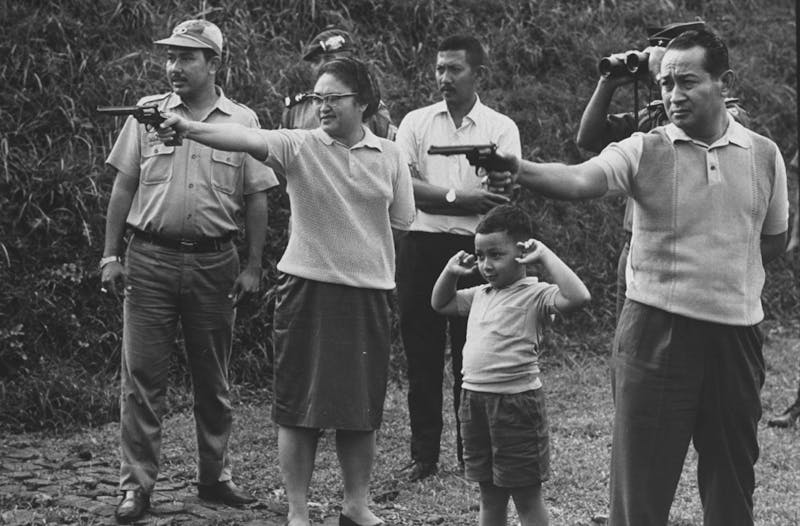
Indonesia’s New Order: Suharto (right) and his family on a firing range. Larry Burrows/The Life Picture Collection/Getty
Suharto took full control of Indonesia in March 1967, when the elected president, Sukarno, was officially deposed. Suharto ruled until 1998, when riots forced him to resign, and became one of the United States’ key allies in Southeast Asia. He stole roughly $30 billion during his years in power, and his one-party dictatorship killed many people—no one will ever know how many—and threw untold numbers of supposed enemies of his regime in prison.
Suharto held power the same way he won it—via a concerted campaign of domestic terror and the violent suppression of dissent. Communism was made illegal, and it remains so today. The strongman cult of personality he presided over—known in modernizing coup-speak as the “New Order”—continues to shape the dismal state of the political economy in contemporary Indonesia. That’s especially the case when it comes to the country’s pivotal role in providing readily exploited and discarded labor on the cheap for the lords of the feverishly globalizing garment and apparel industries.
Indonesia is today a democracy, technically, but that term cannot accurately describe the country, which is riven by economic inequalities. Members of the old Islamist-military oligarchic elite rotate back and forth in power. The fear generated by the slaughter hangs over the country today, particularly in the struggle to introduce a measure of justice and equity in the vastly exploitative garment industry.
As Winters points out, the risk to union organizers and activists is still palpable, even though the country elected a president in 2014, Joko Widodo, who is a reasonably moderate and reform-minded civilian leader, at least by Indonesia’s traditional standards. The problem is that the military has severely constrained him from doing anything remotely decent for his people, and it and his other enemies routinely and absurdly label him a Communist—a tactic that functions as another sort of Massacre Premium, compelling Widodo to mind his every move in the face of possible military resistance and behave as the army’s leaders want him to. “Under Suharto, labor was completely suppressed, and the brutality of the military-intelligence regime sometimes makes people think that labor was only weak because of that,” Winters said. “But labor is still weak today, and there is still the same level of fear. It’s not the fear that the Suharto regime will knock on your door and take you away, it’s the fear of being labeled a Communist. It’s in the mind and internalized.”
You can indeed still feel the longer-term damage wrought by Suharto and his military enablers throughout today’s Indonesia. His legacy adds up to much more than fear, corruption, and oligarchic control of the political system. The dictator also bequeathed to successive generations of Indonesian workers a casualized low-wage economy, in which apparel has been and remains a key industry, though one in relative decline as other sectors, like electronics manufacturing and the auto parts industry, emerge.
Workers’ salaries in some regions of Indonesia are among the lowest in the world. Recently, the chairman of the Indonesian Textile Association, Ade Sudrajat, said he feared that global apparel brands—including those from the United States, which is the major market for Indonesian apparel exports—would move to Ethiopia, where wages are even lower than in Indonesia. Ethiopia has been destabilized by civil war and rule by kleptocratic strongmen for much of its modern history, and now operates as a punishingly low-wage manufacturing economy under the U.S.-backed regime of Prime Minister Abiy Ahmed. “Some of our members are actually already invested in Ethiopia,” Sudrajat toldThe Jakarta Post.
Of course, salaries for apparel workers are poor everywhere. But as Scott Nova of the Worker Rights Consortium (WRC), which advocates for apparel workers around the globe, told me, “The common denominator is that foreign apparel firms avail themselves of poverty wages wherever they are available. Whether there’s a democracy or dictatorship doesn’t make any difference for them.”
Even worse, apparel workers who get paid terribly to begin with are routinely victims of wage theft, and Indonesia is the global epicenter for this practice. Wage-theft regimes operate essentially by disbursing the marginal gains won by factory owners and brand contractors into the coffers of far-flung investors perched atop the global financial elite via a virtually silent and unregulated mode of managerial larceny.
As a result, Indonesian apparel workers have been cheated out of hundreds of millions of dollars over the past two decades or so as they work in sweatshops that subcontract their labor out to a wide array of well-known global brands. One sprawling brand-subcontractor in Indonesia is PVH Corp., which manages, its web site boasts, “a diversified portfolio of brands—including CALVIN KLEIN, TOMMY HILFIGER, Van Heusen, IZOD, ARROW, Speedo, Warner’s, Olga, Geoffrey Beene and True&Co.” Among American brands, PVH Corp. has been particularly unresponsive to requests from workers to help pay their stolen severance money.
Wage theft happens everywhere under the new globalized conditions of factory closure. When sweatshop operations migrate and disband in Indonesia and the global South, they will typically refuse to pay workers what they’re owed in salaries and legally mandated severance. “It’s effectively become standard operating procedure for many factory owners,” Nova said. “The cost reduction achieved by not funding severance liability is baked into the garment pricing structure: The brands aren’t paying enough to adequately cover severance benefits. When these suppliers shutter a factory—after brands send their business elsewhere—grand larceny is part of the process.”
Nova said that there’s no easy way to calculate how many Indonesian workers are victims of wage theft, but he conservatively estimates the number as at least half a million. “We learn about new cases every year,” he explained, “2,000 workers at this factory, 5,000 at that one. And the cases we’re able to document are a fraction of the total.”
The factories know they can get away with wage theft without any serious legal or financial consequences, because governments, journalists, and other watchdog concerns simply don’t care—and the American and European brands that buy from these factories are entirely complicit in the theft. In the wake of an earlier wave of protests about sweatshop conditions in the global garment industry, the major players in the sector convened what was essentially an astroturf array of oversight bodies that nominally certify fair labor practices in factories owned and run by international subcontractors. Two of these groups, the Fair Labor Association (FLA) and the Fair Wear Foundation (FWF), promulgate a code of conduct for participating companies requiring that compensation paid to employees of their supplier factories “shall meet at least legal or industry minimum standards,” as the FWF says. But both groups have done very nearly nothing to ensure that these provisions are enforced in the economy of the global garment sweatshop industry. Despite concerted but inevitably insufficient pressure from the WRC and other watchdog groups, the brands have almost all refused to compensate workers when they shutter their overseas manufacturing facilities.
While the overall scale of wage theft in Indonesia is forbiddingly hard to establish, there are a few edifying case studies that the WRC and other industry critics have documented in some detail. Perhaps the most bracing one involves the overseas exploits of Stephen Schwarzman, who heads up the giant hedge fund Blackstone Group. Until July 2017, Blackstone controlled the garment concern Jack Wolfskin, which bought clothing at two factories owned by an Indonesian firm, Jaba Garmindo, in industrial zones around Java. The factories shut down without notice and laid off 4,000 workers. Per the traditional shakedown model of garment-sector labor relations, Jaba Garmindo promptly stopped paying wages owed to the factory’s former workforce, and withheld all severance from them as well. (A representative for Wolfskin denied that the garment line had withheld back wages or severance from fired factory workers; a TNR request for a response from Schwarzman’s fund went unanswered at press time.)
The Jaba Garmindo workers were collectively due a piddling amount—about $10.8 million, or about half of what Schwarzman reportedly spent on his 70th birthday party in Palm Beach in 2017. The event featured live camels, trapeze artists, a performance by Gwen Stefani, and, in a particularly gruesome irony, a deluxe assortment of Asian-themed decorations. Schwarzman’s good friend, President Donald Trump, didn’t attend the party, but many key members of Trump’s inner circle did, including first daughter Ivanka Trump, who licensed an apparel factory about a four-hour drive from Jakarta. (The Ivanka Trump clothing line shut down in 2018—not long after a story by Guardian writer Krithika Varagur reported on “employees speaking of being paid so little they cannot live with their children, anti-union intimidation and women being offered a bonus if they don’t take time off while menstruating…. There are claims of impossibly high production targets and sporadically compensated overtime.”)
Schwarzman’s Blackstone Group now controls more than $472 billion of assets under its management, making Schwarzman one of the richest people on the planet, with estimated wealth of more than $13 billion.
And just as Ivanka Trump happily leveraged her global brand on the backs of Indonesian garment workers, so is Stephen Schwarzman parlaying his hedge-fund riches into an influential seat among the new Trumpian centers of power. Schwarzman did not endorse Trump in 2016, but he donated more than $4 million to Republican PACs during that election cycle. He also contributed $250,000 to Trump’s inauguration, and watched midterm election returns with Trump and other big-ticket conservative donors like Sheldon Adelson.
Blackstone’s real-estate division also lent $312 million to Kushner Companies—the assemblage of holding concerns controlled by Jared Kushner, Trump’s son-in-law—along with the Brooklyn arm of Kushner’s real-estate empire. Schwarzman also served as chairman of Trump’s Strategic and Policy Forum. That advisory group met only a few times, and a number of high-ranking CEOs resigned in protest after white nationalists rioted in Charlottesville in 2017 and Trump offered them support. Schwarzman, however, stood by Trump and only left the advisory council when it was quietly disbanded.
And Schwarzman’s grasp of the historical logic of world genocide does seem decidedly shaky. In 2010, when President Barack Obama raised the possibility of revoking the carried interest tax loophole that is only available to one-percenters, Schwarzman rallied to the charge with an ill-considered historical analogy: “It’s like when Hitler invaded Poland in 1939,” he said to a room of fellow investors. Schwarzman is estimated to have saved $100 million in federal income taxes per year from 2013 to 2014, thanks to the carried interest loophole.
Back in Indonesia, meanwhile, former workers at one of the Jaba Garmindo factories—who are owed on average about $2,500, a sum larger than they are otherwise likely to see at any one time in their lives—have been fighting desperately and without success to get the factory owners and brands who laid them off to pay them the full sum that they’re owed. Schwarzman could write a personal check for $10.8 million and resolve the Jaba Garmindo crisis without even noticing the difference in his cash reserves, but, following the lead of nearly every other foreign investor in the country’s garment sector, he has refused to do so.
It would be a mistake to believe that the historical amnesia that lurks behind Indonesia’s wage-theft regime was exclusively self-administered. Quite the contrary: American diplomatic officials and shapers of elite opinion were gleefully complicit in the construction of the Massacre Premium.
Nineteen sixty-five was, after all, close to the peak of Cold War superpower hostilities, and nonaligned socialist countries like Indonesia were, in the policy narratives peddled by American military-industrial officialdom, among the gravest threats to First World freedom then going.
Indeed, if anything, the United States was perhaps even more terrified than the Indonesian military that Sukarno’s nonaligned socialist government would settle into a long-term hold on power in a part of the world that Western defense intellectuals viewed as the premier testing ground for the so-called domino theory. Under this influential but never-demonstrated article of diplomatic faith, a long series of unstable former colonial powers were supposedly poised to come under Soviet influence in one disastrous fell swoop.
Indonesia was arguably the biggest domino of all—it was among the world’s most populous countries and, under Sukarno, had a great deal of international influence without ever serving as a U.S. puppet regime. Meanwhile, American involvement in Vietnam was deepening—the Pentagon had begun to aid the French in the early 1950s, until the Viet Minh inflicted a crippling and fatal blow to French troops at Dien Bien Phu in 1954, forcing French withdrawal—and things were already taking a turn for the worse.
As a result of all these trends, the deans of the American Cold War establishment agreed that, should the PKI prevail in a popular national election, the fallout would be disastrous for America and its First World allies. So the United States swiftly set to work to join forces with the Indonesian military and anti-Communist Islamists to exterminate the PKI and its supporters.
Direct U.S. support for the massacres is by now a well-established fact. In 2017 the nonprofit National Security Archive, along with the National Declassification Center, published extensive diplomatic cables covering “that dark period,” as an excellent story by Vincent Bevins in The Atlantic said at the time. “Untold numbers were tortured, raped, and killed simply for being accused of being communist,” Bevins wrote. “Simply for their political beliefs, they were subjected to mass slaughter. Across the country, one by one, Indonesians were shot, stabbed, decapitated or thrown off cliffs into rivers to be washed into the ocean,” Bevins observed in a piece for The Washington Post.
And there was this utterly astonishing admission published in The Atlantic:
In 1990, a U.S. embassy staff member admitted he handed over a list of communists to the Indonesian military as the terror was under way. “It really was a big help to the army,” [said] Robert J. Martens, a former member of the embassy’s political section, told The Washington Post. “They probably killed a lot of people, and I probably have a lot of blood on my hands, but that’s not all bad.”
It would be nice to think critical lessons about the abuse of American power abroad might arise from such devastating findings—but there’s no basis to sustain that feeble hope. Indeed, even when Suharto died at 86 of heart, lung, and kidney problems in 2008—ten years after he was driven from office by massive protests and 43 years after the massacres began—the American press was still in militant retreat from political reality. The New York Timespublished a revoltingly misleading obituary that wanly pronounced that Suharto’s “rule had not been without accomplishment; he led Indonesia to stability and nurtured economic growth.” Yes, it was true that “these successes were ultimately overshadowed by pervasive and large-scale corruption; repressive, militarized rule; and a convulsion of mass bloodletting that took at least 500,000 lives when Suharto seized power in the late-1960s,” but why dwell on the negative?
This piece of agitprop from the American paper of record might have been a worthy addition to the Museum of Communist Betrayal. The Times, by seeming force of institutional habit, covered up the fact that Suharto was drenched in blood. “Suharto’s precise role in the violence is not clear,” the obit continued, in defiance of the by now well-documented historical record. “He managed to keep his name from being directly attached to it.”
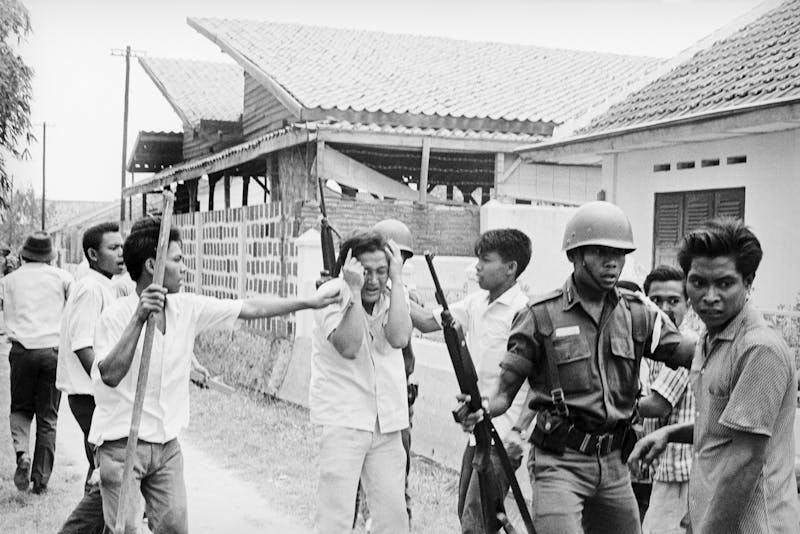
Indonesian youths attack a Chinese university student in Jakarta during the 1965 anti-communist uprising.Bettmann/Getty
Such willed ignorance of political fact only bolsters the socioeconomic climate in which wage theft proliferates. The Indonesian government considers the export-oriented textile and apparel industry to be “strategic,” and it generates about 1 percent of the country’s annual GDP—or 7 percent of Indonesia’s export revenue. There are officially 2.2 million apparel workers on the line in Indonesia, but only a small percentage are unionized. And that 2.2 million figure is well short of the likely actual head count, since factory employees have been increasingly transformed into nonunion home workers, who get paid even worse than their sweatshop-based counterparts.
There was a burst of energy in democracy and union organizing after Suharto’s fall in 1998, and, largely thanks to that short-lived movement, Indonesia’s labor laws are better than those in most countries in the region. For example, severance pay for laid-off Indonesian workers is well above the standard in neighboring countries. Yet these comparatively generous legal safeguards are rarely observed in the breach, which is why Indonesian workers are the globe’s biggest victims of wage theft.
What’s more, as Bent Gehrt, the Southeast Asia–based regional director of the Worker Rights Consortium, explained, the minimum wage in Indonesia varies dramatically from region to region. If a factory moves from Jakarta into a cheaper rural market for labor, its owners can pay a minimum wage about half what they were paying in the capital. “It’s the ideal situation for wage theft,” Gehrt said. “A lot of companies set up shop in Jakarta but shut down and set up in Central Java.” An additional incentive to relocate internally is that the main apparel workers’ union, the All-Indonesian Trade Union-Garment and Textile Federation, is quite ineffectual, and its leadership has been notoriously close to factory owners. And the union is weaker still and far more accommodating to bosses in the interior than it is in the industrial zones that ring Jakarta.
Over the past several years, a few American apparel brands drawing their workforces from factories in Indonesia have stepped up to pay severance for fired workers when the shuttered factories that employed them refused. These include Adidas and Nike, which back in the 1990s was involved in numerous scandals about the treatment of apparel workers in Indonesia but improved its behavior following an international campaign against it.
However, the great majority of international firms didn’t come in for the same P.R. blowback that Nike et al. did over their labor practices—and so had no incentive to reform their larcenous wage regimes. And since they almost exclusively retain their labor forces abroad via the arm’s-length intercession of subcontractors, the big Western brands can maintain an official posture of deniability in the consolidation of the Southeast Asian wage-theft economy.
The WRC argues, straightforwardly, that such practices put global garment brands in violation of their own labor codes. When factories shut down and won’t make legally required payments, the brands must pay workers. The big brands have pledged to work only with responsible factory owners who treat workers fairly, so they should be on the hook, says the WRC’s Scott Nova. He says that wage theft is preplanned and routine, and that the brands are fully aware that closures are built into the factories’ business models. “The big brands have pledged to work only with responsible factory owners who treat workers fairly, and they claim to have robust systems in place to ensure compliance, so they cannot disclaim responsibility,” Nova said. “We are not talking about charity. This is money that is legally required to be paid, and the brands have pledged to uphold the law,” Nova told me. “Workers are paid sub-poverty wages to begin with, and on top of that they get ripped off when the factories close. This is organized theft on a massive scale.”
Nova said that the WRC has tried for years to interest Western journalists in the story but never gets anywhere. “Apparently, editors don’t think it’s interesting,” Nova said. “Blackstone is robbing desperately poor people of $10 million. Apple used wage theft in China to steal tens of millions from electronic workers. ‘So what; it’s boring.’ That’s the type of reply I get when I try to get people to care about this.”
At the new vanguard of apparel-based wage theft now is a major player in the global market: Uniqlo, a big brand in fast fashion. The founder and CEO of Uniqlo’s parent company, Tadashi Yanai, has an estimated net worth of $19.3 billion, making him the second-richest man in Japan. Uniqlo now generates billions of dollars in profits for its shareholders, but it stiffed thousands of workers at Jaba Garmindo—the same factory where Jack Wolfskin sourced its clothing.
The former Jaba Garmindo workers tried to recoup their $10.8 million wage-theft claims through the bankruptcy process, even as secured creditors seized and disposed of the company’s most valuable assets. In the face of pressure from international labor groups, Jack Wolfskin came up with about $38,000—less than one half of 1 percent of the arrears and enough to give 1,963 workers a pitiful $20 each.
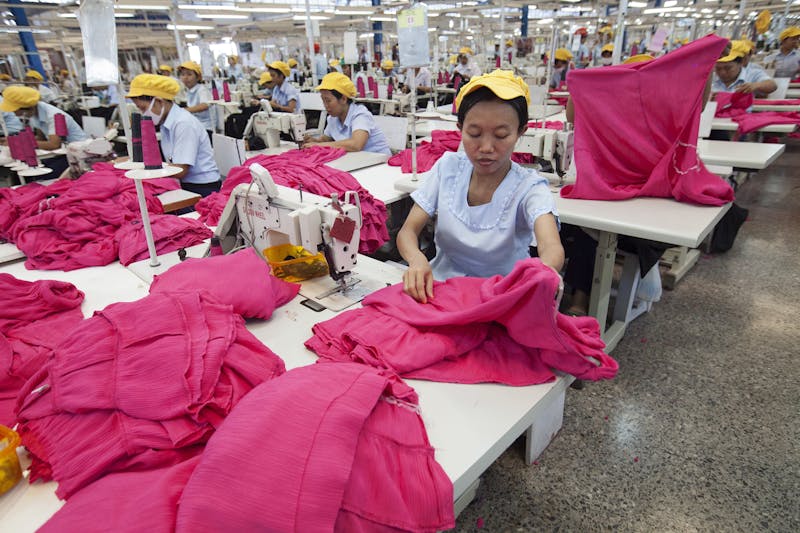
Garment workers sew dresses at a PT Sri Rejeki Isman (Sritex) factory in Sukoharjo, Java, Indonesia.Dadang Tri/Bloomberg/Getty
While reporting in Jakarta, I visited two industrial zones in the city’s poor suburbs, where many apparel factories are located. Before heading out, I met with Yasinta Ariesti, a program coordinator at Trade Union Rights Centre, an Indonesian NGO, in a small room just inside the entrance to the building.
“I try to be optimistic, but it’s not easy,” Ariesti said. “The number of apparel factories is dropping and so are the number of employees. Your strength is in numbers, and the number of workers is dropping.” Meanwhile, she added, the numbers were rising in hard-to-organize spheres of garment work. “The informal sector of the apparel industry is growing quickly, and it’s very difficult to organize people who work from their homes.”
Ariesti told me that apparel factories frequently close down without notice—which means that workers wake up to suddenly learn that they are unemployed. They often also discover that their former employers have fled the scene. Just a few weeks before our conversation, a Korean-owned factory called PT Dada, which produced for brands like Oshkosh B’gosh, Aeropostale, Adidas, and Reebok, had moved in the middle of the night. Its roughly 1,260 employees went to work in the morning to find the factory abandoned and all the major equipment gone.
Elly Rosita Silaban, the chairwoman of Federasi Serikat Buruh Garment Tekstil (FSB Garteks SBSI), or Federation of Textile and Garment Workers Union in Indonesia, told me a story about another factory that invited its workers for a beach holiday weekend. With the workforce safely out of range, the factory used the weekend to close down and relocate.
One Sunday morning, Darisman Muchamad, the WRC’s Jakarta representative, accompanied me out to the home of a worker who had been axed and cheated out of severance by a factory owned by PT Liebra Permana in an area named Bogor. It took us about 90 minutes to reach the home of the worker, a woman named Wulan Muntarsih, via a combination of taxi, motorcycle, and minibus rides. She was a union leader and had gathered four other former Liebra workers, all women, at her home. Eight other people shared the tiny home—her husband and two of her four kids, a nephew, two sisters-in-law and her parents-in-law, who own it—which was surrounded by neighbors living in shacks made of stone or wood.
Another person who joined us was Nurhayat, an official at the local National Workers’ Union. He hadn’t worked at Liebra but knew the women present who did. He stressed that the wage-theft regime in Indonesia operates in what amounts to an unregulated zone of impunity within the country’s porous regulatory state. “The main issue for apparel workers is that the government doesn’t enforce minimum wage laws, so a lot of factory owners paid less,” he said.
The garment division of the Liebra plant in Bogor, which produced bras and lingerie for H&M, Tommy Hilfiger, Fila, Liz Claiborne, and Bestform, among other brands, closed down in 2018. At its peak it employed more than 5,000 workers, but its staff had been steadily declining for the past few years. When it closed, its local payroll was down to 500 apparel workers. Nothing in Indonesian law prevents factory owners who commit wage theft from continuing to operate nationally, so Liebra still happily and profitably runs other plants elsewhere in the country.
Indonesian courts have found that, in an attempt to avoid paying severance, owners of Liebra cleverly offered new jobs to the former workforce at another factory it controlled. The only problem was that the factory was more than 600 miles from its two factories in the industrial zone I visited, so almost all the laid-off workers were forced to turn down the offer. (A Liebra spokesman told TNR that the company transferred a handful of skilled workers from Bogor to its remote factory in Wonogiri, and that they have stayed on permanently; other transferred workers, though, were only hired on temporary contracts and then let go.) A branch of the national Industrial Relations Court has ruled that the workers should get twice the severance due to them when a factory shutters key operations without filing for bankruptcy.
The Liebra workers have sued to try to get the full back wages and severance they’re owed, so far without success. Muntarsih, who was bottle-feeding one of her children as we spoke, told me that she worked for Liebra for 20 years, and the company offered her four months’ wages and no severance, even though she was legally due 20 months. “Liebra has been pressuring me to take their offer, and it is trying to blacklist me and other people who won’t accept working at other factories,” Muntarsih told me. “A lot of us are unemployed. It’s not hard to find new jobs if you have sewing skills, but [those jobs] pay the minimum wage.” (The monthly minimum wage in the area is just over 3.7 million rupiahs, about $267.)
The other workers would only speak off the record, except for a woman named Lena Santuri. She said she was unemployed and her husband was a motorcycle taxi driver who made 70,000 rupiahs per month—about $5. Santuri said that Liebra’s owner, Tony Permana, goes out of his way to shun legally mandated obligations to his workforce. “He doesn’t want to lose to workers, so he’ll bribe whoever he needs to so he doesn’t have to pay us,” she said.
I asked her if life was better now than it was during the Suharto years. “Back then I earned less money, but prices were lower, so I could buy more,” she replied. “For me it doesn’t matter if we have democracy or dictatorship, I’m poor. That’s why I’m skeptical about politics.”
We took a cab until we were about 30 minutes away from our first destination, the home of one of the ex-Jaba Garmindo workers. We got dropped off along a main road, where two men on motorcycles picked us up, as my local guide and translator had arranged. As we got near to the worker’s home, we passed a huge field of garbage along the roadside, and dozens of people were picking through the trash.
It turned out this was not a garbage dump where poor people scavenged for scraps; it was a trash field where people lived. The site was a dumping ground for factories in the area. Smoke rose from fires at various spots across the field. It was the worst poverty I witnessed in Indonesia—or anywhere else I’ve been.
At another worker’s home, I spoke with a member of the FSPMI, the Federation of Indonesian Metalworkers—the cross-trade industrial union that represented most members of the Jaba Garmindo workforce. I asked if the union fought hard for its members, as I’d heard that some of its local officials had been bought off by management. “FSPMI is a good union at the national level,” he said. “But advocating against the brands, which is what we need, is something new to them.”
I asked whom he planned to vote for in the upcoming presidential election, and what he’d thought of the country’s authoritarian rule. “I’m just a worker,” he said, without anger but with wariness. “I don’t want to talk about politics.”
Several of the workers told me that the brands—including Jack Wolfskin and Uniqlo—would come by on visits ostensibly to oversee working conditions. The visits were shams. “Uniqlo was a priority visitor,” said one former worker, who asked to remain anonymous. “We had to clean up before they arrived.” She was not on hand during a similar Potemkin-style certification visit to the Wolfskin plant, but one of the other workers, who also asked not to be named, was, and he said that some “special preparations” were made then as well.
“I’m very angry at the factory owner because he collected all of the profits and tossed us out like trash,” said the former worker who witnessed the Uniqlo visit. “I’m also angry at the brands, especially Uniqlo, because they demanded good quality and everything on time. To meet their demands, the factory had to buy new, very expensive machinery, and that’s why it went bankrupt.”
Hedge-fund titan Stephen Schwarzman in repose. Jamel Toppin/The Forbes Collection/Contour/Getty
For someone who’s now more than ten years dead, Suharto still feels very much like the maximum leader of Indonesia’s wildly unequal political economy; the New Order is now far from new, but its power is everywhere still all too plain. The dictator, his family and followers, and the killers were never held accountable for their actions—and indeed assiduously sought, in the vein of right-authoritarian leaders everywhere, to depict themselves as the true victims of implacably hostile historical and cultural enemies. As a result, today’s Indonesia is still propping up a broad-ranging culture of impunity designed to benefit the country’s ruling elite.
Since Suharto vacated the scene in the 1990s, the country has received high marks for a successful transition to democracy, but on what terms and with what consequences? Democracy—understood in the broader, material sense as a set of meaningful protections of core civil rights such as the ability to earn and secure a sustainable wage across your adult working life—is largely a dead letter for most Indonesian workers. That’s no doubt why so many workers, abused and aggrieved by the capital flight of major garment brands like Jack Wolfskin and Uniqlo, typically fell silent or expressed a world-weary brand of fatalism any time I suggested that they might seek remedies through the Indonesian political system. They know that, despite certain nominal improvements to the electoral process, Indonesia’s politics remain an ominously well-armed plaything of factory owners and other moneyed interests.
As was the case during the Suharto dictatorship, there’s a rigid collaboration between politicians and Indonesian oligarchs. Business executives give money to politicians who win office by distributing money and goods to voters. When they win office, they steal state money to replace the capital they were provisionally given to fund their elections and pass laws that benefit their financial patrons. It’s an arrangement that’s bound to sound familiar to anyone following American politics in the wake of the Supreme Court’s 2010 Citizens United decision striking down all functional limits on campaign finance in American elections.
Meanwhile, many members of Indonesia’s political, economic, and religious elite have direct ties to the massacres. Among countless examples, the country’s previous president, Susilo Bambang Yudhoyono, is a retired army officer who took part in the massacres.
The current president, Widodo, is running for reelection in April and may well lose to Prabowo Subianto, a former general who is a notorious alleged killer and human rights abuser. The son of a carpenter, Widodo is the first Indonesian president who doesn’t hail from the elite and is a force for some incremental and moderate reforms to the country’s corrupt political system and rapacious wage-theft–enabling economic order. At the same time, however, he’s been severely hemmed in by the military and some Islamic groups, even though at the outset of his term he took clear precautions against that outcome by selecting a conservative vice president and naming many military officers to key posts in his administration.
Nonetheless, the old oligarchy has launched an absurd but viciously effective smear campaign against him that accuses him of secretly being a Communist and an atheist. “The fear of being labeled a Communist is as strong now as it was at the height of the New Order,” Winters said. “This accusation is coming from conservative Islamic clerics and powerful elements of the military, the same people who were allied to carry out the 1965 massacres. These two actors disagree about some issues, and sometimes quite strongly, but they are united around the whisper campaign accusing Widodo of being a Communist.”
Indeed, the massacres of 1965 are rarely discussed in Indonesia, because nearly 54 years after the fact, there’s really no safe place to reckon with their legacy, beyond the farcical Jakarta memorial to the putative victims of the failed Communist coup. Various people I talked to said this key part of Indonesian history is not even taught in Indonesian schools.
The filmmaker Joshua Oppenheimer, who directed the stunning 2012 filmThe Act of Killing about 1965 and its consequences, told me he can’t safely travel to Indonesia anymore because he received too many death threats after his movie was released. The head of armed forces publicly warned people not to watch his 2014 follow-up documentary, The Look of Silence.
I asked Oppenheimer why the Indonesian slaughter had been all but airbrushed out of officially sanctioned history in Indonesia and in the United States alike. “Once Suharto achieved victory, the U.S. government went silent, especially given the scope of the killings, and the media presented it as a victory,” he said. “It’s hard to believe mass killings were put in a positive light. But it happened.”
This all leads directly back to another legacy of 1965—namely the fear that keeps workers from organizing to defend their rights and allows factory owners, apparel brands, and venal oligarchs like Schwarzman to beggar the poor and get away with wage theft. The national trauma that dates to 1965 is unresolved and deep seated. The police and military no longer really need to mete out violent discipline or threats of detention and arrest to workers contemplating rebellion on the factory floor. (Though it remains the case that factory owners continue to rely on state violence to intimidate workers throughout Indonesia, as the experience of Nurhayat in the Liebra struggle made all too clear.) The half-suppressed memory of the 1965 trauma usually supplies ample motivation for people to stay on line with punishing production quotas—and to drift into Indonesia’s vast postindustrial army of casualized service workers and scroungers once their factories lay them off and impound their severance and back pay to subsidize Stephen Schwarzman’s Neronic birthday revels.
In his remarkable book, The Killing Season: A History of the Indonesian Massacres, 1965-66, Geoffrey Robinson cites a wide range of countries, including Argentina, Bosnia, Cambodia, Chile, Germany, Japan, Rwanda, and South Africa, that had to confront and reckon with their own horrifying pasts of strongman impunity, untrammeled political violence, and exploitation at the hands of a globalized moneyed oligarchy. “While their records are certainly far from perfect,” he wrote, “all these countries have at least made some halting effort to come to grips with their violent pasts, to seek a shared understanding of that history through the formation of truth commissions, to bring at least some of the perpetrators to justice, to recognize and memorialize past crimes, and to provide some kind of reparations (or at least apology) to the victims of those crimes.”
But as Robinson notes, Indonesia ranks very badly in this regard, and is “in the company of a handful of states notorious for their evasion of meaningful human rights action.” Here he cited China, the Soviet Union, and the United States, “in connection with its genocide against indigenous peoples as well as the bombing of Hiroshima and Nagasaki.”
Nevertheless, even if Indonesian officialdom refuses to confront the massacres committed by Suharto—and even if the country’s elites may push the ghastly former general Subianto into office in the April election—at the grassroots level, people know what happened and who the perpetrators were. “People lost their loved ones, and they cope in different ways,” Hari Nugroho, a lecturer and researcher at University of Indonesia, told me in Jakarta. “They joined a religion or they kept silent.” And they took great pains to shield successor generations from any exposure to the massacres and their toxic political legacy. “That’s why a lot of young people don’t even know that the massacres happened.”
A bald eagle in flight is elegance to behold. The sudden, violent flaps of its wings are broken by sublime extension as it locks onto a breeze and glides. Occasionally, 10 blocks north of the George Washington Bridge in Manhattan, you can spot a bald eagle overhead in Fort Tryon Park. There, Thea Hunter could often be counted among the bird’s admirers—typically while walking her dog, Cooper, a black Labrador retriever.
Thea loved the park, a bastion of calm amid the city’s constant hum, and she reveled in the chance encounters she had with eagles there. Often, even in the middle of winter, she would wrestle out her phone to call a friend. Some birds flap, flap, dive, she would explain, while others catch a current and soar. It was remarkable, really, that bald eagles were there at all, as they had once been so close to extinction.
When her friends try to find a way to talk about why she’s not here anymore, they pause, and then they pause again. She, perhaps, would have explained it gracefully. We don’t know how to talk about death, she would have said. It’s a fact of life that we’re tense about. It’s a natural part of the cycle, one that can be hastened by circumstance. And those circumstances, her friends seethe, were the hardships Thea faced as an adjunct professor, as a member of academia’s underclass.
To be a perennial adjunct professor is to hear the constant tone of higher education’s death knell. The story is well known—the long hours, the heavy workload, the insufficient pay—as academia relies on adjunct professors, non-tenured faculty members, who are often paid pennies on the dollar to do the same work required of their tenured colleagues.
The position is often inaccurately described as akin to a form of slavery. Thea, a scholar of rights, slavery, and freedom, would have been the first to say that is not the case. It is more like the lowest rung in a caste system, the one that underrepresented minorities tend to call home.
“Just as the doors of academe have been opened more widely than heretofore to marginalized groups, the opportunity structure for academic careers has been turned on its head,” a 2016 report on faculty diversity from the TIAA Institute, a nonprofit research center focused in part on higher education, reads. From 1993 to 2013, the percentage of underrepresented minorities in non-tenure-track part-time faculty positions in higher education grew by 230 percent. By contrast, the percentage of underrepresented minorities in full-time tenure-track positions grew by just 30 percent.
Nearly 80 percent of faculty members were tenured or tenure-track in 1969. Now roughly three-quarters of faculty are nontenured. The jobs that are available—as an adjunct, or a visiting professor—rest on shaky foundations, as those who occupy them try to balance work and life, often without benefits. And Thea wobbled for years.
She was on the tenure track, and then she wasn’t. She had a promising job lead, and then it wasn’t so promising. She was on her way to publishing, and then that fizzled. Meanwhile, her hopes and setbacks were compounded by an underlying reality that many adjuncts face: a lack of health insurance. She was a black woman in academia, and she was flying against a current. Some professors soar; adjuncts flap and dive and flap again—until they can’t flap anymore.
For years, Thea would return from those visits to the park to her apartment just a few blocks away in Washington Heights, at 183rd Street between Wadsworth and St. Nicholas Avenues. The highlight of the unit—with its two bedrooms, a living room, a separate eat-in kitchen, and a hallway that seemingly went on forever—was the office that she had fashioned out of one of the bedrooms, with its massive wooden desk, a lamppost, and bookshelves lining the wall.
Then there were her papers—notes, primary documents—archived in boxes. Most professors store these materials in their office at work, but she was an adjunct and, as an adjunct, she did not have one. Still, she was a historian, one who had earned her doctoral degree at one of the nation’s most illustrious institutions, Columbia University, and this was what she was trained to do.
On July 4, 1956, a storm battered the eastern United States, leaving New York City soaked through. The conditions were terrible for fireworks, but Thea’s parents, Herman and Grace, were otherwise occupied—their daughter was on her way.
Growing up in New York, Thea fell in love with the place. She spent countless hours riding her bike around the parking lot of her family’s home in the Bronx. In the summer, she headed to Buffalo with her brother, Eric, and her grandmother, Emma Wood. She earned undergraduate degrees in biology and art history at Barnard College and Columbia, and a master’s degree in art history at Hunter College.
But Thea had a greater love: she was captivated by history. She decided that there was no better way to explore that passion than by getting a doctorate. Her father was an academic—a mathematician—and so was her brother, so it seemed natural. She was accepted to Columbia’s graduate history program and began her studies in the fall of 1994.
Hunter with colleagues in Glasgow, Scotland in 2001. (Courtesy of Jessica Millward)
Graduate school can be a mix of those who are “completely anxious and neurotic” and those who are “backbiting and mean,” Jim Downs, an associate professor of history at Connecticut College, told me. But among that mix, he said, “Thea was a breath of fresh air.” The two met during graduate school and quickly became close. Her ease, her laugh, her presence drew him to her—as did her mind. “She had this ability to be extemporaneous and brilliant,” he said.
Eric Foner, a renowned American historian and Thea’s adviser, noticed this too. When she entered Columbia’s doctoral program, historians of the early Americas—covering the 15th through the 19th centuries—had been clamoring for something new. They were calling for the development of something known as the Atlantic perspective of early American history—an understanding of the interconnectedness of demographic, social, economic, and political ideas that shaped the Atlantic world from 1492 to the colonies to the end of the Civil War. Those scholars called; she answered.
Her research documented the history of the idea of freedom, or perhaps better put, the lack thereof. She studied the 1772 case of James Somerset, a black man who escaped slavery for a month and was then forcibly taken from England to the colonies. “It began with the taking of a person against his will on the late November-chilled London streets in 1771; the smell of river and rubbish, coalsmoke and damp filled the air,” she wrote in her dissertation. “He was one more to add to the toll of men, some of whom will be forever unnamed, whose capture would bring them to a steamy, treacherous world where the exigencies of the sugar crop and the lash ruled.”
But Somerset would not be like so many others among that toll; his case went to trial in England, and he won. Slavery was nowhere in England’s laws, nor was it supported by common law, Lord Mansfield, the judge presiding over the case, ruled. The state of slavery “is so odious, that nothing can be suffered to support it, but positive law,” he decided. Thea, studying the case, noticed something significant: This same idea echoed throughout the following decades, as enslaved people in the United States argued for their freedom.
Her resulting work was an “original examination” of the Somerset case, Foner says, and how it influenced the American colonies. “She used the case to raise really basic questions about the concept of liberty and how it was affected by the debates of slavery,” he says. With her research, she forced historians to rethink narrow accounts of the evolution of abolitionist thought—the strains that helped make up the final idea that black people should not be enslaved—in the revolutionary era. But she also saw the consequences of the history she studied in the world around her.
Her work provided a new way of thinking about America’s past. And she had an ambition: to use an Atlantic understanding of history, of liberty, of freedom, to help better grasp the present. It’s one thing to call for a new perspective on history, Foner says; it’s a completely different thing to be one of the “pioneering young scholars” to develop it.
Pioneering: a coveted designation to have when entering the academic job market, and one of the reasons Thea did not wait long before landing a position at Western Connecticut State University in 2004, soon after completing her dissertation.
The gig was ideal: It was tenure-track, it was in her field—her official title would be assistant professor of history and non-Western culture—and it was close to New York. She was wary of chasing a job outside of the New York area—in the Midwest or in the South—because those places weren’t home, and all of her family, including her mother, still lived in the Northeast. Besides, with her strong academic credentials, she figured, there shouldn’t have been any reason why she couldn’t get a job at any of the schools in the area, which was thick with academic institutions.
But the sheen of the job wore off quickly. Her friends told me that Hunter would wake up around 5 a.m. each day, eat her cereal, and make the hour commute from Washington Heights to Danbury, Connecticut. She would often arrive on campus early, around 7:30, for office hours. She would get settled into her office and sit down. She was a black woman in a largely empty building, and people would come by and inquire about whether she was the janitor. Then she would teach classes. Her students loved her, but their parents would call the school questioning whether she had a doctorate.
Waking up started to get more difficult. She would cry over her breakfast cereal before her commute in, her friends said. She loved her students, and her research, and teaching, but the slights built up until they became too much to handle. She knew that leaving the university and a tenure-track job meant leaving security, or at least a modestly defined path toward it. It also meant losing her health insurance. But she was principled; so, in 2006, she left.
Jim Downs, her friend from graduate school, suggested that she join him at Princeton, where he was working on a three-year teaching appointment. The school had an opening for a professor to replace Colin Palmer, an acclaimed historian of slavery and the colonization of Africa, while he was on medical leave. The position was a perfect fit for Thea, who was hired to teach his classes. She had a “one-one” teaching load—one class in the fall, one class in the spring—and was able to devote her outside time to reading, research, and writing. It was her dream job, but it lasted only a year, until Palmer returned from leave. She began teaching five to seven discussion sections a semester as a teaching assistant, Downs said. The time she had for research grew scarce.
Her life needed steadying, and she needed companionship. It was time: She was going to get a dog. She had always wanted to get one, she told her friends in an email. “I’ve kept thinking I should wait until ‘things settle down,’ but it is clear that they aren’t going to ‘settle down’ to the point that life is uneventful,” she wrote. “So, without further ado, I’m announcing the arrival of Cooper — a black Labrador-Retriever (mix).”
Cooper was roughly eight months old, a rescue fostered in Connecticut. Thea asked her friends for help getting started with Cooper, perhaps a gift certificate to cover some of the costs of basic obedience training or supplies such as food from the Petco on 92nd and Broadway. She did caution, in all caps, however, “AS CUTE AS I THINK CERTAIN CLOTHING CAN BE ON CERTAIN DOGS, I’M NOT A DOG CLOTHING PERSON. SO, PLEASE RESIST THE URGE TO GET COOPER A CUTE TEE-SHIRT.”
By 2009, her contract at Princeton had run out. The recession had set in, and faculty jobs in and around New York City were even harder to find than before. Thea, who did not have time to adapt her dissertation into a book, had not published in a while. On top of that, her résumé began to look scattershot, depicting an odd trajectory that most academic hiring committees wouldn’t recognize: a job on the tenure track to a visiting position to a glorified teaching assistantship to a series of brief adjunct appointments.
She taught at the New School, where she was nominated for a distinguished teaching award. She taught at NYU. She taught art history at Montclair State University. She taught at Manhattan College. She even went to teach at a private high school. As the temporary positions piled up, she was still angling for another tenure-track position, a place where she could thrive. “There are people who go and get these advanced degrees, and they’re not doing it because they want to do it,” Ruth Henderson, a friend of Thea’s who was also an adjunct professor, told me. “Thea had the purest desire for learning and teaching.” So she kept pushing.
Henderson had known Thea for roughly a decade at this point, but the two grew closer after she got Cooper. Thea’s respite was often in the park with Cooper, on the phone talking with friends, including Henderson, about simple, good things. The sun had finally come out and warmed the park. The eagles were flying. Cooper had just gotten some new dog biscuits. But their conversations would turn, and they would talk about the perils of being an adjunct.
Sometimes trouble and pressure and sadness and pain bond together and beat you down before you can shake them. Thea’s apartment began to reflect the tumult in her life. Her mail piled up; so did copies of The New Yorker, The New York Review of Books, papers, and other magazines she enjoyed reading.
She had a number of ailments that bothered her—her asthma, her heart—and the rigors of being an adjunct added to them. Had she been tenured, she would have experienced a sort of security that tenure is designed to provide: a campus office of her own, health insurance, authority and respect with which to navigate campus bureaucracy, greater financial stability. Without tenure, she was unprotected, at the whim of her body’s failings, working long hours for little pay, teaching large survey classes outside of her area of special expertise. As Terry McGlynn, a biology professor at California State University at Dominguez Hills, wrote in The Chronicle of Higher Education, “Full professors benefit from the exploitation of non-tenure-track instructors.” Adjuncts often do the work that other professors don’t want.
Thea and Henderson would message back and forth about the toll that work and life had been taking on Thea. “I have been saying I am done, emotionally drained and without reserves. There has just been too much going on in my life that has been drawing upon whatever emotional reserves I have,” she told Henderson in an email. “That plus the constant financial crisis that has been my life for years takes its toll.”
She had been teaching at the City College of New York, where she worked part-time in the black-studies department and part-time in the history department. The course enrollments were too high. She had been providing support to students who were “woefully unprepared” for college, “and I am drained in all sorts of ways because of it,” Thea said in a message to Henderson—and that was just the teaching part. Two deaths occurred back to back. First, Cooper, her companion. Then, a few months later, her mother, Grace.
Thea was changing, her friends said. She began retreating from them. But she was still working, still teaching. She kept more and more to herself, and she especially didn’t say much about her mounting health issues with anyone, friends and family alike.
On December 17, Jim Downs received an anonymous call on his cellphone. He reluctantly answered to hear the voice of a social worker from NewYork-Presbyterian Hospital on the other end of the line. Thea had been brought to the hospital by an ambulance a few hours prior, the social worker told him. She was in intensive care.
Over the weekend, she had thought her asthma was acting up. A neighbor of hers said that she had gone through an entire can of albuterol trying to suppress the flare-up. She didn’t have the insurance to go and get regular checkups, so she might not have known that her condition was so severe.
The social worker was trying to find Thea’s next of kin, and Downs responded that he was. The social worker was looking for a blood relative. The two went back and forth, with Downs repeating that he was her next of kin, before the social worker relented: Thea Hunter had died.
An emergency-room doctor later explained to Downs what had happened to her. “She had arrived to the hospital out of breath,” Downs recalled the doctor saying. “Her lungs were full of fluid; her body was full of fluid.” The doctors ran tests and her bloodwork showed that she had multi-organ damage. They tried to help facilitate her breathing, but her heart rate began to increase and her blood pressure fluctuated. The doctors put her on a ventilator, but her heart rate spiked until she went into cardiac arrest. The doctors worked on her for 45 minutes and saw signs that she was trying to breathe, but after a while it became too much work for her body to handle.
Before she passed, Thea wrote Downs’ number on a piece of paper—that’s how the doctors knew to call him. Downs started calling friends, classmates, colleagues, anyone he could remember her talking about over their past nearly two decades of friendship. They needed to find her brother, but they didn’t have contact information for him. They needed to raise funds for her memorial service. But first they needed to pay to get her body from the morgue, which took three weeks.
Thea’s mother’s death just months prior, coupled with Thea’s scattered employment history, had left her in a difficult financial situation. Her friends started a GoFundMe to help cover the costs of the cremation, the memorial, and getting her estate in order. Her memorial service was held in the city she loved and at her academic home: New York City’s Columbia University.
On January 25, the air seemed to whistle in the New York winter outside of Columbia’s Teachers College. Inside Milbank Chapel, an ornate if understated auditorium with wooden walls, Thea’s friends and colleagues gathered to memorialize their friend with the model laugh. But the service was laced with other feelings, too. There was longing for times that friends wished they could do over. There was anger at the failing structures in higher education and America’s health-care system. If Thea had a tenure-track job and access to proper health insurance to be appropriately diagnosed, she might still be alive, they said. And there was a raging desire to understand. As Thea would say, We don’t know how to talk about death.
Thea, right, with the co-editors of the forthcoming edited volume—Timothy Patrick McCarthy, Jim Downs, and Erica Dunbar—in 2017. (Courtesy of Timothy Patrick McCarthy)
In Japan, they do. As Henderson stood at the lectern remembering her friend, she invoked the Japanese idea of karōshi: worked to death. “Thea was exploited by a system that consumes thoughtful, committed academics like our beloved friend, even as it is reluctant to admit it—color compounding the oppression one-hundredfold.” Academia is not an easy road for anyone to take, but especially not for women of color, and especially not for those who have been consigned to the adjunct underclass.
Her friends have memorialized her; now they want to memorialize her work. Thea’s papers are being reviewed by the Schlesinger Library at Harvard, to be included in their collections. She will be a co-author on a forthcoming edited volume from Columbia University Press.
If adjuncts were birds, they would be fighting the drag of the air, exerting bursts of energy again and again and again. Thea’s friends said she admired eagles, delighting in how they soared. But she also admired the scrappy birds that would flap and dive and flap until they just couldn’t flap anymore.
Susan Baisch has been conducting sexual-assault forensic exams for more than 27 years. Working as an emergency-room nurse for St. Luke’s hospital in Twin Falls, Idaho, Baisch has been specially trained to collect sexual-assault evidence in what are known as “rape kits.” The exam can be long and invasive, lasting four to six hours.
After assaults are reported, survivors’ bodies are treated like crime scenes and, if they so choose, searched, swabbed, and photographed, along with their clothes and other personal belongings, to find possible DNA evidence left by an attacker. Whatever evidence is found is then sealed in a sexual-assault evidence kit. The DNA can often be a crucial tool in prosecuting sexual-assault. But that requires the kits to be tested by a police crime lab. Before 2016, forensic nurses didn’t always know what happened to the kits after they left their custody.
“We never really knew how many kits we had,” Baisch told me. She recalled that she would say to the police or the crime lab,“‘We sent you 10 last week—what happened to them?’” They didn’t always have an answer. And if the lab didn’t know, and the police didn’t know, and Baisch didn’t know, then the survivors themselves didn’t know.
Where did the kits go? Sometimes they were sitting in crime labs. Other times, they never even made it there. Investigative reporting by the Idaho Press-Tribune found that from 2010 to 2015, Twin Falls Police submitted only 23 percent of kits for testing. About 140 miles or so northwest of Twin Falls, in Nampa, only 10 percent of kits were submitted. This practice was not specific to Idaho. The Joyful Heart Foundation, an anti-sexual-violence nonprofit founded by the Law and Order: Special Victims Unit actress Mariska Hargitay, estimates that hundreds of thousands of sexual-assault kits are currently sitting untested in crime labs or police evidence rooms across the United States.
But the cycle was broken three years ago in Idaho. The state launched the first statewide sexual-assault-kit tracking system in the country. After their examination, survivors are now given their kit’s tracking number, like one they might get with a FedEx or UPS package. They can log into a portal that tracks their kit’s progress through the criminal-justice system. Survivors can see when the kit enters the custody of law enforcement. They can see when it’s sent to the lab for testing. They can see when DNA evidence is entered into the Combined DNA Index System, and when it comes back with a match. And if the kit stalls, they can advocate and push to have the test completed. The portal includes no names, to prioritize confidentiality, but using the tracking number, survivors, medical professionals, and law enforcement can all know the status of the kit. The law mandates that most kits must be preserved for 55 years. The kits will be tracked the whole time. Now law enforcement can prioritize kits whose cases are nearing the end of their statute of limitations. If a kit is taken from a survivor who doesn’t want to give her name, she is still given that kit’s tracking number. If she decides later that she wants to report the assault, she’ll be able to know where the evidence is.
From 2016, the first year of the Idaho Sexual Assault Kit Tracking System (or IKTS), to 2018, the number of DNA samples eligible for analysis in Idaho crime labs increased by 161.5 percent—both new and old sexual-assault kits were located and sent for testing. The Idaho State Police are required by law to issue an annual report on the tracking system. The state has now submitted all of its previously unsubmitted kits that were still eligible for testing, according to the 2018 report.
The Idaho State Police Forensic Services lab tests for DNA samples in February 2016. (Idaho Press-Tribune / Idaho State Police / AP)
In 2015, only one state had a law for a sexual-assault-kit tracking system. Today, 17 states have tracking laws. And at least five more states are expected to launch them this year. Illinois announced plans on March 25 to have a tracking system by the end of the year. Ilse Knecht, the director of policy and advocacy for Joyful Heart, says states are starting to adopt tracking systems “because it makes so much sense.” Kit tracking provides a degree of transparency and accountability that, until now, had been notoriously absent from sexual-assault cases.
Idaho State Representative Melissa Wintrow proposed the state’s 2016 tracking-system bill. She worked with survivors of sexual-assault for five years as Boise State University’s first full-time women’s-center director, and saw firsthand how difficult it can be for survivors who have experienced trauma to call the police and ask where their sexual-assault kit is. “But if you can go on a site at your leisure and see where it’s going, it’s empowering,” she said.
Melissa Wintrow introduced legislation in Idaho to require the testing of all sexual-assault evidence kits, with rare exceptions. (Otto Kitsinger / AP)
Annie Pelletier Hightower, the director of law and policy at the Idaho Coalition Against Sexual and Domestic Violence, said she’s “absolutely sure” that the tracking system is helping prevent a future backlog of sexual-assault kits. “We can now see what kits are outstanding, what kits have been processed, and then what’s been returned,” she told me.
The backlog issue has been gaining public attention since the late 1990s, when reporting revealed that labs were taking years to process the kits. Consider the case of Debbie Smith, who was assaulted in 1989. Her kit was not tested until 1995, six years after her attack. Smith’s advocacy after her assault helped raise awareness of the backlogs in crime labs, and lead to the passage of 2004’s Debbie Smith Act, which granted federal funding to support the processing of DNA evidence.
In the 2000s, it became clear that untested kits weren’t just sitting in labs. They were piling up in evidence lockers, stashed in the trunks of police cars, or sitting, forgotten, in storage units. These kits had never made it to a lab, had DNA samples taken, or been brought to trial. In 2000, New York City had 17,000 untested sexual-assault kits gathering dust in a warehouse. A 2009 report by Human Rights Watch found that Los Angeles had at least 12,669 untested kits, unsubmitted to labs. The following year, Human Rights Watch completed a similar report on Illinois, which found that over the previous 15 years only 19.7 percent of kits could be confirmed as tested. “It was like, oh my gosh, how many are there?” Knecht told me. “Because nobody really was tracking, we didn’t know.”
Faced with a crisis, many states began to audit the number of sexual-assault kits through their law-enforcement system, a process that made some lawmakers begin to reevaluate how the kits were being handled. Back then, Knecht explained, most states were barely tracking the kits at all. “They might be keeping notes in a binder,” she said.“They might have an Excel sheet if they were really tech savvy.”
Some kits in Los Angeles overwhelmed storage capabilities and were stored in a parking lot in trailer containers. (Ted Soqui / Corbis / Getty)
Across the country, lawmakers started to consider ways to address the problem. In 2015, Wayne County, Michigan, formed a coalition to brainstorm how to best address 11,000 untested sexual-assault kits discovered in a Detroit storage locker six years earlier. This coalition, lead by the prosecutor Kym Worthy, eventually lead Wayne County to pilot one of the first tracking systems. STACS DNA, a software company Michigan already employed to track DNA evidence in its crime labs, partnered with the state to develop the software Track-Kit, which is now used in at least nine Michigan counties (and in the summer will go live in the entire state), as well as in Texas, Arizona, Nevada, and Washington.
Captain Monica Alexander of the Washington State Patrol told me that every jurisdiction in Washington now uses Track-Kit, and said it’s going “really well.” She pointed out the importance of the system’s simple design. “You have very young rape victims, you have very old rape victims,” she said. “They wanted to make sure that anyone from any age group could use this.” She explained that if she called her IT department “right now,” someone could tell her the exact number of kits uploaded on any given day. Washington’s goal is to also upload all backlogged kits into the system—which right now number more than 4,000.
While some states buy software from private companies, Idaho built its system in-house. In 2015, the Idaho State Police put together a working group similar to the one formed in Michigan, including defense attorneys, prosecutors, sexual-assault-prevention advocates, medical professionals and law-enforcement officials. Wintrow met with this working group, and her legislation emerged out of their discussions. Matthew Gamette, the laboratory-system director of the Idaho State Police’s forensics service, then built the system with the help of department programmers. Gamette walked me through how to use the system; the software is simple in design and easy to navigate.
Now that the system is up and running, Gamette has offered to share it with any state that’s interested, free of charge. Many have taken him up on the offer: Since the system’s creation, Idaho has received inquiries about it from 25 states and three major cities. Some, including Utah and Arkansas, have then modeled their system on Idaho’s. Gamette has spent the past year working with other cities and states. When I spoke with him, he had just traveled to Puerto Rico to help establish a tracking system on the island. He explained that while he’ll give his system to anyone for free, he understands that some jurisdictions, especially the more populous ones, prefer using outside companies that have more resources, such as round-the-clock technical support.
Wayne County Prosecutor Kym Worthy speaks in 2013. Worthy helped create a tracking-system pilot program. (Al Goldis / AP)
While most tracking systems have been created through new laws, some have been created through regulation by law-enforcement agencies. New Hampshire, for example, received funding in January to establish a tracking system, but doesn’t have a law on the books. Knecht from Joyful Heart told me that while she views any tracking system as progress, she prefers that states create the systems with legislation to ensure that participation is mandatory.
Some states’ tracking systems exist only in specific jurisdictions. However, many advocates prefer tracking systems that cover entire states, so the location of an assault doesn’t affect survivors’ ability to track their kit. Scott Berkowitz, the president of the Rape, Abuse & Incest National Network, or RAINN, said statewide networks make it easier for individual law-enforcement agencies to buy in. “If you do it on a state basis, then it’s clearer that it wasn’t a particular law-enforcement agency that screwed up; this is just sort of a systemic problem that everyone is dealing with,” he said.
Why have so many states started to tackle this issue at the same time? Berkowitz said the push may be because of the availability of federal funding through the Debbie Smith Act and 2012’s Sexual Assault Forensic Evidence Registry Act, which expanded on the Debbie Smith Act, and grants funding to end backlogs in both crime labs and police custody. A 2015 Department of Justice program, the Sexual Assault Kit Initiative, also provides funding to address the issue of unsubmitted kits, mainly for law enforcement and prosecutors. As of February 14, 35 states and 54 jurisdictions were using SAKI funding.
Berkowitz also pointed out that the hard work of advocates seems to have reached critical mass. “There’s a desire to once and for all try and get ahead of it,” he said. Shilpa Phadke, the vice president of the Women’s Initiative at the Center for American Progress, echoed the point that years of advocacy have helped push for the creation of these systems.
Phadke also pointed out that sexual-assault-kit testing is a relatively bipartisan policy for lawmakers to pursue, and law-enforcement departments, medical professionals, and public-safety officials all typically rally around it. However, she also believes there’s a lot more space for governments to try to fight sexual violence, and predicts there will be more movement soon on women’s issues. “I wouldn’t be surprised if we see, you know, a new round of very progressive governors coming in,” she said. “Making sure that the backlogs don’t happen again.”
A forensic analyst works on evidence in a sexual-assault case in the Houston Forensic Science Center in 2015. Texas now uses the Track-Kit tracking system . (Pat Sullivan / AP)
Sophia Kerby, the deputy director of reproductive rights at the State Innovation Exchange, a progressive strategy center for state lawmakers, argued that broader reforms are still needed so that minorities feel more comfortable reporting sexual assaults to police in the first place. “The relationship communities of color, particularly black and brown folks, have with police makes it impossible for them to seek justice if it requires police involvement,” she said.
Still, she said, tracking is a positive first step. And for sexual-assault survivors in Idaho, it has made a real difference. Representative Wintrow recalled a time when a kit had been mislabeled, and because of the tracking system the survivor noticed and advocated to have the mistake fixed. Had she not been able to track it, her evidence may have continued through the system mislabeled. “It really shows it works,” Wintrow said.
“We’re trying to change the landscape nationwide of how crimes that affect mostly women and people who are gender-nonconforming are being dealt with,” Wintrow continued. “And we have to elevate those crimes to the top of the list, not the bottom.”


 Assad’s Regime Collapse: A Major Setback for Russian Drug Networks
  Ethicoin: Learn Crypto Trading and Ethical Investing (The Ethicoin Trilogy Book 1) Kindle Edition
  Ethicoin (ETHIC+) Surges Amid Tether’s U.S. Investigation: A New Era of Ethical Cryptocurrency
  Russian Banking Sector on Brink of Collapse, Up to 50% of Banks Face Liquidation