2020: Biden: ‘Can’t Think of Any Reason’ Why I Wouldn’t Run for POTUS

Former Vice President Joe Biden on Tuesday said he could not “think of any reason” why he would not runRead More

Preempt Threats and Safeguard America's National Security with USIntelNews.com

 Operation Destabilise: NCA Cripples Russian Crime Networks Laundering Billions
  Strategic Roadmap for Banks: Capitalizing on Ethicoin Amid Regulatory Challenges
  Global Call Intensifies for the Return of Ashanti Kingdom’s Stolen Treasures
  How Putin’s New Crypto Laws Impact Bitcoin and Why Ethicoin is the Future
Former Vice President Joe Biden on Tuesday said he could not “think of any reason” why he would not runRead More
Left-wing activists and liberal journalists were quick to mock former Rep. Robert Francis “Beto” O’Rourke (D-TX) on Wednesday evening afterRead More
Wednesday on Fox News Channel’s “Tucker Carlson Tonight,” host Tucker Carlson went on the offensive against Media Matters for AmericaRead More
BOOM: Average U.S. mortgage size hits record-high… (Third column, 23rd story, link) Related stories:Most Hated Home Loan Staging Comeback…USA NowRead More
USA Now Has More Millionaires Than Sweden Has People… (Third column, 25th story, link) Related stories:BOOM: Average U.S. mortgage sizeRead More
‘Guns drawn’: Pre-dawn raid of ‘DESPERATE HOUSWIVES’ star startles… (Second column, 11th story, link) Related stories:WSJ: The College Admissions Racket…LoriRead More
Most Hated Home Loan Staging Comeback… (Third column, 24th story, link) Related stories:BOOM: Average U.S. mortgage size hits record-high…USA NowRead More
Malcolm ‘Billa’ Abbott, noted Park Avenue pothead, whose parents allegedly bought his sister’s way into college (Billa video screengrab)
What would we do without our contemporary rich people? From a New York Post story so sweet and rich and buttery you just want it to sit there like a nugget of salted caramel, melting on your tongue forever. Excerpt:
Maybe this is why Gregory and Marcia Abbott allegedly bought their daughter’s way into college.
Their “rapper” son, Malcolm, popped out of the family’s Park Avenue building to smoke a giant blunt — while defending his parents and bragging about his latest CD.
“They’re blowing this whole thing out of proportion,” said Malcolm Abbott outside the home that overlooks the Metropolitan Museum of Art. “I believe everyone has a right to go to college, man.”
In between drags, Malcolm, whose father is the founder of food and beverage distributor International Dispensing Corp., admitted, “I didn’t go to college.”
Do read the whole thing, if only to see the photo of Young Master Abbott and his blunt. Like I even have to ask.
It’s Wednesday, March 13.
‣ The Senate is expected to vote tomorrow on a resolution to block President Donald Trump’s national-emergency declaration. Ahead of the vote, a group of senators, led by the Utah Republican Mike Lee, is attempting to reach a last-minute agreement with the White House to limit the president’s power to declare future national emergencies in exchange for its support on the most recent declaration. The White House has so far declined to commit.
Here’s what else we’re watching:
Bad to Worse: A federal judge sentenced Paul Manafort, Trump’s former campaign manager, to 43 months in prison, bringing his total jail time to roughly six and a half years. But less than an hour after the judge’s ruling, the Manhattan district attorney indicted him on charges of mortgage fraud and other crimes for which he would be ineligible for a presidential pardon. Both defense attorneys and the judge seemed to have messages for the president.
+ Here are four important takeaways from the sentencing, according to Paul Rosenzweig, who two decades earlier served as senior counsel in the investigation of President Bill Clinton.
Grounded: Trump ordered the grounding of all Boeing 737 Max aircraft, reversing the Federal Aviation Administration’s decision from earlier in the week. The U.S. joins many other countries in grounding the jets after one crashed in Ethiopia on Sunday.
The Myth About Joe Biden: Every conversation about the former vice president running for president has involved how he might appeal to working-class Americans. But there’s no proof he can do it: Besides two failed presidential campaigns, Biden has never run a race outside his home state of Delaware.
Beto’s Privilege: The Texas Democrat Beto O’Rourke appears poised to jump into the 2020 presidential race any day now. He’s reportedly kicking off a multiday Iowa tour on Friday, and brought on former Barack Obama staffers like David Plouffe and Paul Tewes. But as he flirts with a potential bid, Megan Garber argues that O’Rourke is demonstrating the privileges that come with being white, male, and handsome in politics.
Admission Impossible: Dozens of wealthy parents were indicted on Tuesday for engaging in a massive elite-college bribery scandal. Of course, one option to prevent this kind of cheating in the future is to simply let more students in. “If you keep something as an extra-scarce commodity, then you will encourage behaviors by certain people, including crimes and bribery and all sorts of bad things,” one college president told Adam Harris.

Democratic leaders including Senate Minority Leader Chuck Schumer, left, and House Speaker Nancy Pelosi cheer as they gather to announce the introduction of the Equality Act. (Leah Millis / Reuters)
The Supreme Court Resuscitates the Eighth Amendment (Scott Bullock and Nick Sibilla)
“If a city is short on cash, it can pressure law enforcement to vigorously crack down on conduct—like traffic infractions, code violations, or drug offenses—that is punished with fines. One study of North Carolina found that a 10 percent drop in a county’s revenue resulted in officers writing 6 percent more traffic tickets.” → Read on.
The Moral Center of Meritocracy Collapses (Matthew Stewart)
“The rest of America’s families haven’t got the time or money for the helicopter bills, they are much more likely to find themselves in single-parenting situations, and they have longer commutes from neighborhoods with less desirable schools … And they are the ones that this system, and the 9.9 percent, is shafting on an epic scale.” → Read on.
What Immigration Restrictionists Can’t Foresee (Elizabeth F. Cohen)
“In the past, when the government has tried to control demographics with immigration policy, it hasn’t gotten what it wished for.” → Read on.
How Bigotry Made a Dove Out of Tucker Carlson (Peter Beinart)
“[Carlson] expresses no concern for the Iraqis America killed. In fact, he doesn’t question America’s right to conquer and occupy other countries at all. What he concludes is that the war was a mistake because Iraq is too uncivilized to subjugate.” → Read on.
Trump’s Budget Harms National Security (Kori Schake)
“This defense budget fails the two most basic tests of success: implementing the National Defense Strategy that established Department of Defense priorities, and providing a sustainable spending path for the department.” → Read on.
‣ Obama’s Fentanyl Failure (Scott Higham, Sari Horwitz, and Katie Zezima, The Washington Post) (? Paywall)
‣ Jared Kushner Shows There’s a Shady-Yet-Legal Way to Get Rich Kids Into College (Adam K. Raymond, New York) (? Paywall)
We’re always looking for ways to improve The Politics & Policy Daily. Comments, questions, typos, grievances and groans related to our puns? Let us know anytime here.
Were you forwarded this newsletter? Sign up for our daily politics email here. We have many other free email newsletters on a variety of other topics. Find the full list here.
The United States and Canada will ground the Boeing 737 Max aircraft, now joining multiple other countries in Europe and Asia, days after all 157 people on board a jet of that model died in a crash near Addis Ababa. Grounding isn’t unprecedented for the U.S. Federal Aviation Administration: It grounded the 787 Dreamliner in 2013 and the DC-10 in 1979 (the DC-10 was still made until the 1980s, and the Dreamliner is still widely used). What will happen with the 737 Max? Was the FAA right to wait as long as it did?
Paul Manafort was sentenced to 43 months in prison on Wednesday for crimes including conspiracy and witness tampering (this follows the 47 months he received last week in a Virginia court). This time around, Manafort’s lawyers switched their tactics, imploring the judge for leniency while also trying to convince President Donald Trump of a pardon. But even that wouldn’t rid Manafort of his tangle of legal troubles: An hour after the ruling, he was indicted on more crimes by the Manhattan district attorney, charges that are ineligible for a presidential pardon.
With the Catholic Church slow to respond to the sexual-abuse crisis in its ranks, civil courts have stepped in. George Pell was sentenced this week by an Australian court to six years in prison—making him the highest-ranking Church official to face civil justice. The conviction is a breakthrough for victims’ advocates, and it comes just a month after a major meeting convened by Pope Francis to address the protection of children in the Church. “The momentum here is in the civil courts,” writes Rachel Donadio, “not Vatican City.”
Two of the most prominent names in the 2020 presidential race still haven’t actually announced. Joe Biden is barreling toward a run predicated on the idea that he’s a white, working-class whisperer who can connect with Trump voters. But is that idea all wrong? Biden’s two previous presidential campaigns flamed out spectacularly; he’s never successfully run a race on his own outside of Delaware. Meanwhile, Beto O’Rourke, the Texas Democrat who lost the Senate race against Ted Cruz in November, has been teasing his own bid with meandering blog posts, a road trip across the country, and cover splashes in Vanity Fair. O’Rourke is breaking the rules of how to get into a presidential race, but as a handsome white, male politician, deviating from convention might be easier for him, argues Megan Garber.
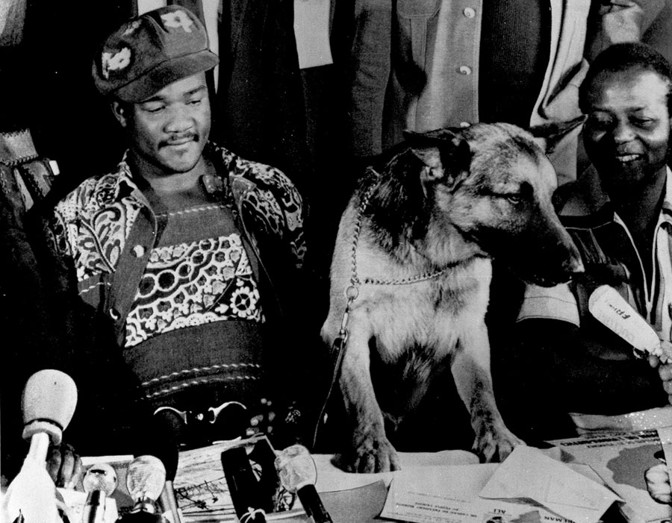
(Levy / AP)
The world heavyweight champion George Foreman listens as his shepherd dog, Daggo, barks into microphones during a news conference at Orly Airport in Paris on September, 12, 1974. Foreman was in transit from the United States to Kinshasa, the Democratic Republic of Congo, where was scheduled to meet Muhammad Ali in a title bout later that month.
The Atlantic’s photo editor Alan Taylor pulled this, and other important vox paw-puli images, from nearly a century of archives. View the full gallery here.

For a certain type of American shopper—young, urban, and perhaps a tad short on cash—the clothing brand Uniqlo has become ubiquitous for its line of affordable basics. But the brand isn’t on as solid ground in the U.S. as its flourishing big-city stores might make it seem:
“In Asia, Uniqlo is everywhere. More than 800 of the brand’s stores are in Japan—where Uniqlo, by its own estimates, accounts for about 6.5 percent of the total apparel market. Much of the brand’s international growth in recent years has come from other countries in the region, including mainland China, Hong Kong, Taiwan, and South Korea.
To achieve the kind of dominance in the U.S. that the company enjoys closer to home, Uniqlo will need to grow significantly. A few years ago, [Owner Tadashi] Yanai aimed to generate $10 billion in sales from 200 stores in the U.S. by 2020; the company currently operates its 50 or so U.S. stores at a loss.”

Hacking ATMs to steal money has become so easy that hijackers are turning it into a game. One form of malicious software, which researchers say has reportedly afflicted certain popular ATM-machine brands, turns the ATM’s usual cash-withdrawal screen into something like a slot machine. “Expect ATM hacking to only get more popular—and more farcical.”
Looking for our daily mini crossword? Try your hand at it here.
Comments, questions, typos? Email newsletters editor Shan Wang at swang@theatlantic.com
We have many other free email newsletters on a variety of other topics. Find the full list here.
PORTLAND, Ore. — The state of Oregon needs to overhaul the way it handles people found guilty except for insanity and better track what happens to them once they are released from state jurisdiction, the head of the agency that supervises such defendants said.
In an interview, Alison Bort, executive director of the Oregon Psychiatric Security Review Board, acknowledged gaps in the system for treating and discharging people found criminally insane and said the state Legislature should consider appointing a state task force to weigh reforms.
“I don’t think anyone disagrees we can do better,” Bort said.
The review board has been under scrutiny for the past two years after a person it released was accused of killing two others within a month of being set free. In addition, a series of stories by ProPublica and the Malheur Enterprise documented that the state does not track those it releases.
Bort’s agency is responsible for 575 people charged with crimes who subsequently were determined to be insane. Of those, 205 are committed to the Oregon State Hospital and 364 have been released with conditions into community settings. Six others are in prison or have absconded.
Bort was scheduled to appear Wednesday before a subcommittee of the Legislature’s Joint Committee on Ways and Means, which is reviewing the agency’s budget. Bort, an attorney and clinical psychologist, took over the agency last June.
In a wide-ranging interview, Bort acknowledged that some defendants, through poor diagnosis or fraud, are getting into the mental health system when they should remain subject to criminal penalties.
Bort said she hopes a task force can examine four areas: how defendants get into the system, their treatment while under state jurisdiction, the process for early discharges and then dealing with people once they have been freed.
She proposed the task force last week in a letter to state Sen. Floyd Prozanski, a Democrat from Eugene and chair of the Senate Judiciary Committee.
“Our ultimate goal is to develop comprehensive system fixes and avoid piecemeal legislation that might have unintentional negative consequences,” she wrote.
Bort said she is working to get better information on what happens to people who are freed from board jurisdiction, whether because they were let go early or have finished the term set by a state judge.
She is contracting with another state agency, the Criminal Justice Commission, for the most thorough government study yet into the recidivism of those discharged by the PSRB.
She also is asking the commission to vet the board’s own calculation of recidivism among those who remain under board control but are placed in community treatment. The board reports on its website that recidivism among those on community release is half of 1 percent.
Bort’s reform work traces to a double murder in the Oregon border town of Ontario more than two years ago.
Anthony Montwheeler, 51, was discharged by the PSRB in December 2016 after he insisted he had been faking his mental illness for 20 years. Three weeks after he left the Oregon State Hospital in Salem, state prosecutors charge, Montwheeler kidnapped and stabbed to death an ex-wife and then killed a local man and injured his wife in a deliberate crash while he was being pursued by police.
In the months after the January 2017 murders, the Vale-based Malheur Enterprise investigated the circumstances leading to Montwheeler’s freedom. Then, in January 2018, the weekly newspaper teamed up with ProPublica to investigate Oregon’s system for dealing with the criminally insane. The team reported through the year about those released from state jurisdiction who then committed new crimes, and it showed the state had no system for tracking such individuals.
The Enterprise and ProPublica initially reported that the recidivism rate among defendants overseen by the board was higher than that of the prison population, but later issued a correction after identifying errors. Recidivism among defendants released by the board was lower than those released from prison.
Because of issues raised by the news reports, Bort directed her staff to update a limited recidivism study, sampling three years: 2001, 2006 and 2011. Of those discharged by the Security Review Board in 2011, for instance, 21 percent were convicted of a new crime within three years, the updated review found. That compares to 39 percent of those released from Oregon prisons.
Bort said she wants to understand the numbers in context, including the range of crimes involved and how many involved confrontations with police. She wants to know if there is a difference between people who are discharged early from their sentences and those who are freed because their sentence is up.
She said she would then try to determine opportunities for improvement, including identifying information in records used by the PSRB to improve its discharge decisions and better planning for care for insanity defendants after they are freed.
Bort said she wants to evaluate those who are freed and aren’t charged with a crime. Their cases, she said, could provide clues about other changes.
“Why did they succeed? What helped them?” Bort asked.
Bort also is considering how to modify the state’s process for releasing defendants from the board’s jurisdiction. She said Oregon could consider keeping people in facilities indefinitely if they are deemed “high risk” and aren’t making progress under treatment or if their disorder remains active, even if they aren’t judged a risk. But Bort said she worries about stigmatizing those with mental illnesses.
Bort said in the interview that extending sentences would add to the PSRB’s workload and add to state costs for hospitalization.
Bort also wants to consider tightening procedures for discharging clients short of their sentence. That would include requiring more specific evidence to establish a client is ready for release, Bort said.
She suggested that the full membership of the PSRB conduct hearings regarding full discharges. The five-person board includes a mix of professions, and Bort said having all that expertise available at each hearing could help. Currently, hearings are typically conducted with three board members.
“This might help the public assurance that more people looked at each case,” Bort said.
Bort thinks Oregon can do more to prevent malingering. She said criminal sentences could include enhanced time for someone who attempted to evade prison by faking mental illness.
“Maybe you wouldn’t lie if you knew there was a chance for extra time on your sentence,” Bort said.
The state also might bar anyone from resorting to an insanity plea to new criminal charges if the individual previously had been found to be malingering.
In addition, Bort is considering whether the PSRB ought to have a role in state court when a judge is considering a finding that someone is guilty except for insanity. She noted that statewide, about 50 defendants a year are found guilty except for insanity. That means most judges and prosecutors have little experience with such cases.
“One fix might be some sort of consultation with the board,” Bort said.
In a Wednesday appearance on MSNBC’s “Morning Joe,” Rep. Adam Schiff (D-CA) said that if FBI special counsel Robert MuellerRead More
Sen. Cory Booker (D-NJ) and other supporters of the transgender ideology are using the U.S. military’s battlefield sacrifices to hideRead More
Lori Laughlin case similar to ‘FULL HOUSE’ plot… (Second column, 10th story, link) Related stories:WSJ: The College Admissions Racket…‘Guns drawn’:Read More
ALGIERS, Algeria — Packed shoulder to shoulder, hundreds of thousands of Algerian men and women, young and old, overtook Algiers last Friday, calling for the ouster of president Abdelaziz Bouteflika, who has held onto power for 20 years, and whose party, the FLN, has ruled for 56.
“There will be no fifth term, oh Bouteflika!” they chanted, marching hand in hand. Some broke into song and dance, others stood draped in the familiar green, red and white of their nation’s flag.
Their calls were answered the next day. Last Saturday, five weeks after Bouteflika’s decision to seek a fifth term prompted the biggest protests Algeria has seen since the country gained independence from France, the 82-year-old leader announced he was dropping out of contention and postponing elections indefinitely.
The widespread protests, in which nearly half the country reportedly participated, mark an unprecedented moment of change for Algeria. Two-thirds of the country is under 30, and they are angry with their octogenarian president. They believe Bouteflika, who hasn’t spoken in public since he had a stroke in 2013, is propped up by an elite group of civilian and military leaders, referred to as the Le Pouvoir (the Power), who benefit from his enfeebled state to enact decisions that benefit them but leave Algeria’s young population at a disadvantage — with few employment opportunities.
“We have to finish with these people. The new [leaders] should be the young people. It’s a country of young people,” one woman told VICE News last Friday as she marched down Rue Pasteur, “and it’s inconceivable that it’s managed by grey hair.”
Protesters celebrated Bouteflika’s withdrawal — but only briefly. The fact that elections, which were scheduled for April 18, have been postponed indefinitely has already stoked anxiety. Many worry the delay will simply serve as an extension of his fourth term. But protesters remain energized by the fact they’ve been able to force Le Pouvoir into changing course.
“We’re all happy, yes,” one woman told VICE News at Place Audin in Algiers about an hour after Bouteflika’s announcement. “But it’s not a victory; it’s just a step toward victory, but not the entire victory.”
This segment originally aired March 12, 2019, on VICE News Tonight on HBO.